Structural dynamics
1)
Static Analysis:As the name suggests,static analysis deals with the objects which are static in nature.Static objects are those which are at rest.
Dynamic Analysis:As the name sugests,dynamic analysis deals with the objects which are dynamic in nature.Dynamic objects are the objects which are not rest,which means either they are in a movement or some sort of forces are acting on them.
The differences between the static analysis and the dynamic analysis are:
- Variations of load with time
- Motion can not be disregarded
- Two additional forces must be accounted
The above are the things which are present in the dynamic analysis and are absent in the static analysis.
Variations of the load with time
- In the static analysis of structures,the load acting on the structure is zero or very negligible load acts on the structure.Thus,there is no increment or decrement of the load acts on the structure considerably with respect to the time.
- Whereas in the dynamic analysis,the rate of load acting is higher or considerable such that there is some increment or decrement of the load acting on the structure.
Motion present
- In the static analysis of the structures,as there in no load acting on the structure or negiligible load acting on the structure,causes no movement or causes negiligible movement.Hence,here the motion can be disregarded.
- In the dynamic analysis of the structures,due to presence of loads acting on the structure,it causes some considerable movement on the structure.Hence,here the motion can not be disregarded.
Additional forces
- As there are no forces acting or no considerable forces acting on a structure in the static analysis,no new forces as a resultant to a external force appear in the structure.
- But in the dynamic analysis,due to the external considerable loading,some resultant forces to the external applied force appear in the building such as the inertial forces and damping forces.And some times even the elastic forces to act under the resultant forces.
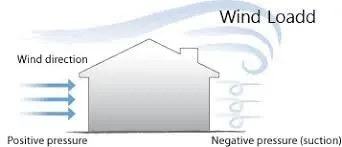
From the above image,the external load is the wind,so when the wind acts on the building,it comes under the dynamic analysis to anlyze the loads acting on the building.And at the time,when wind is absent on the building,it comes under the static analysis to analyze the loads acting on the buildings.
2)
- Elastic Behaviour:It can simply be explained as the regain of original shape of a object or a structure after the application and removal of the loads.
- Inelastic Behaviour:It can simply be explained as the loss of the elastic nature of a object or a structure when the load applied is beyond its elastic limit.So here the permanent deformation occurs in the object or the structure.But in the inelastic situation,though the object is inelastic it could even take the load from the external sources.
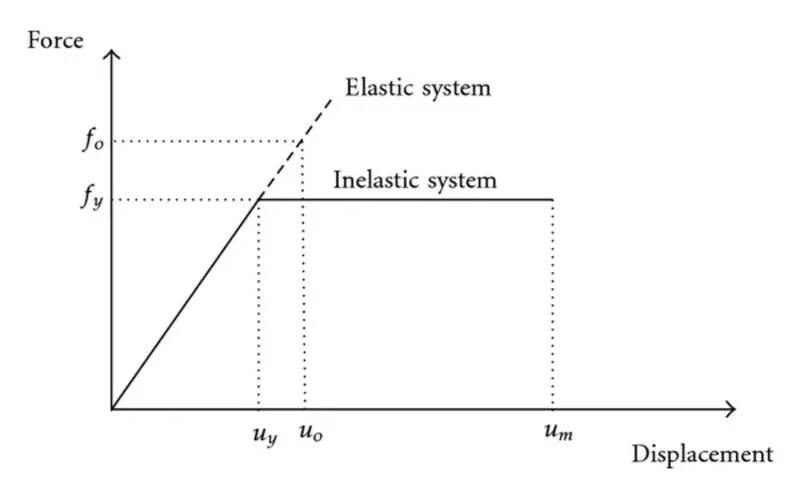
From the above graph,we can see the difference between the elastic and inelastic objects behaviour.
- Plastic Behaviour:It is also similar to the previous one,where when the load applied on a object or a structure is beyond the elastic limit of the object or structure,the object or structure doesn't get its original shape even after the removal of the load.But this stage appears in a object or a structure when the load applied very much beyond its elastic limit such that this happens after the inelastic stage where the structure can't bear the load and breaks.
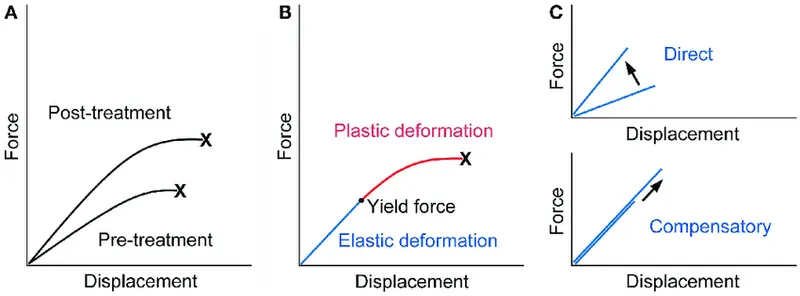
For the plastic behaviour of an object,the behaviour seems to be the same as the inelastic object,but in case of the plastic object,the object breaks at a certain point but in case of the inelastic objects,the object deforms and won't regain its shape.
- Non Linear Inelastic Behaviour:These are materials which provide the non linear stress strain graph.
3)
The single degree of freedom system can be viewed as a combination of 3 pure independent systems.
- Mass Component:As the name suggests,it comprises mass only.So,in this system only the mass is present and the remaining such as the stiffness component and the damping component are absent.In this system the external force acting on the mass component is related to the acceleration such as fi=ma.
- Stiffness Component:As the name suggests,it comprises only the stiffness.So,in this system only the stiffness is present and the remaining such as the mass and the damping component are absent.In this system,the external force acting on the stiffness component is related to the displacement such as fs=ku.
- Damping Component:As the name suggests,it comprises the damping only.So,in this system only the damping component is present and the remaining such as the mass components such as the mass component and the stiffness components are not present.In this system the external force acting on the damping component is related to the velocity such as fd=cv.
4)
Natural period of vibration or Time period:It is the time required for any undamped system to complete one cycle of free vibration.In reality,even when we don't apply any damping forces too,some friction acts as a damping force and makes a freely vibrating body to come to rest.So,for a body when freely vibrates,the time required for it to come to rest is called the Time Period.
The best and the famous example is that,the when a metal ball tied to a roof with a string and pulled to one end and left freely,it oscillates until it comes to rest,therefore the the time required for the ball to come rest from the time of leaving is called its time period.
Its unit in generally is the seconds,it has even other units such as the radians per second.

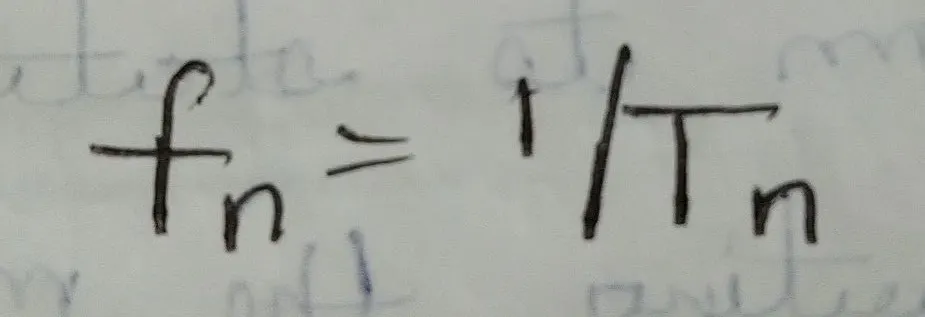
Frequency or Natural cyclic frequency of vibration:It is the number of cycles executed by a oscillating body in a certain time period.But in general it is shown for one second i.e., number of cycles done in one second.
So,it is the inversal of the time period.It's unit is Hertz.
- The stiffer of 2 single degree of freedom systems having the same mass will have the shorter natural period and higher natural frequency.
- The heavier of the 2 single degree of freedom systems having the same stiffness will have the longer natural period and the lower natural frequency.
5)
Response Spectrum is a plot of maximum linear single degree of freedom oscillator for a given component of earthquake ground motion.So,on X-axis,we have the natural period and on the Y-axis,we have the repsone quantity.So,this response quantity can be anything like maximum displacement,maximum velocity and maximum accelration.Thus,we can plot the displcement,velocity and the acceleration.
If for 3 objects having the same natural time periods such that all the 3 are having different masses and having different stiffnesses respectively,the maximum response of linear single degree of freedom system to any given component of earthquake motion depends only on the natural frequency and damping.
The structures are mostly affected by the earthquake only when the frequency of the earthquake matchs the natural frequency of the building.
It is a central concept in earthquake engineering.
It provides a convienent means to summerize the peak response of all possible linear single degree of freedom systems to a particular component of ground motion.
It also provides a practical approach to apply the knowledge pf structural dynamics of the design of structures and development of the lateral force requirements in building codes.
After calculating the maximum response for a range of values,the spectrum chart shows a maximum response of all the single degree of freedom systems to that component of earthquake. 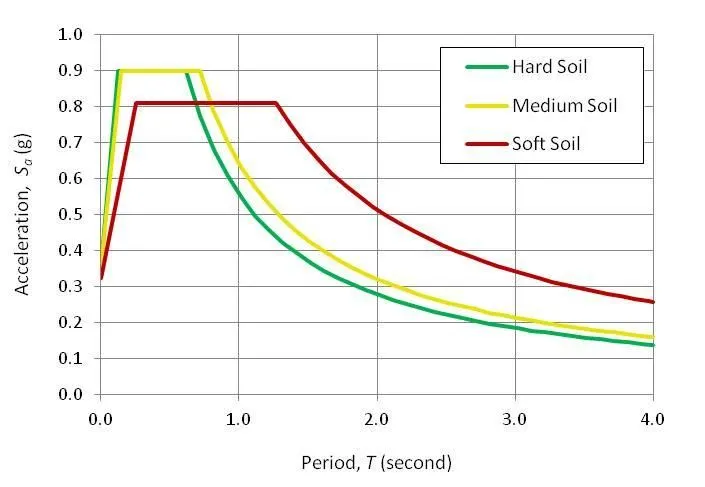
This response spectrum test is even performed to know the maximum response in the different soils.From the aboveimages,we can find the response spectrum of the acceleration in different soils.