Identification of Cracks
1)
a)
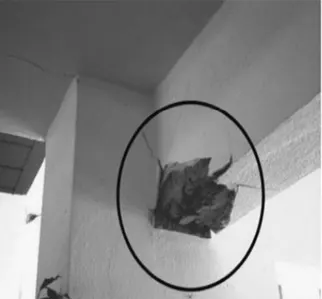
Observation:
From the above image,we can find few points.
- We can find the concrete has been crushed upto some part and even the reinforcement has been exposed to the environment.Even we can find some part of the concrete above the reinforcement is also been damaged.
- And the damage which is done to the beam is just done in the bottom alone and the top portion of the beam looks safe,due to the flange advantage of the slab.
- As the concrete has been damaged even above the reinforcement,we can find it as a sign of rupture.
- And we can even find the crack has started from the bottom portion to top portion which could mean steel rebars had undergone yielding at the bottom.
Answer:
- We can consider the above damage as due to the reversal of the forces during an earthquake.In general during the construction,the beams undergo compression at the top and the tension at the bottom.We know that the steel is good at tension but as it's designed even for the compression at the top portion in a beam,it doesn't undergo any damage in general.
- But due to earthquake and due to the reversal of forces,tension occurs at the top as steel is good in the tension,the top portion of the beam could resist stress.And moreover it has an advantage of the slab.
- Where the bottom part undergoes compression on the reversal of the forces due to earthquake,where the bottom part is actually designed for the tension,so it can take the load and even more as the steel is not good at compression,it ultimately fails causing the cracks.
- Since,the reinforcement got yielded,it can't be repaired.
b)
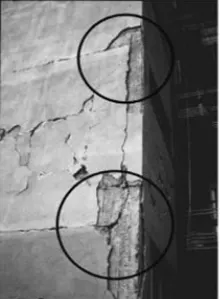
Observation:
From the above image,we can find few points.
- We can find a vertical crack along the structure.And we can even notice that the concrete has not crushed but just a separation as per the image.
- We can think,as it's a beam column junction,we can think like the beam and the column have been separated.
- As cracks seems to be bigger and wider,we can expect that the entire structure has gone through this crack.
Answer:
- Basing on the damage from the image,we can assume it as a slippage of the beam from the beam-column junction.
- It happens only when the proper anchorage of the beam to the column is absent.
- The reinforcement provided at the junction must be of the L shaped bars projecting in to the column from beam or projecting in to beam from the column.
- This damage has occured most probabaly due to the improper reinforcement alone.
- And due to the earthquake,where the lateral forces acting on the building,had made the beam to slip out.
- As providing the anchorage now is difficult as both are existing structures,it is irreparable.
- When any one of the structure yet to be constructed,we can change the reinforcement a bit.
c)
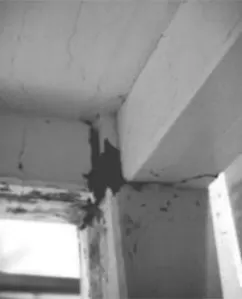
Observation:
From the above image,we can find few points.
- We can find the cracks only at the junction of a beam and column.
- And the beams had undergone cracking along its width.
- And we can even find the cracks along the beam direction in the slab.
Answer:
- In the beam,we can find the cracks on its entire width,so we can find the damage of the section of the beam,so it can be considered as the plastic hinge failure.
- So the damage could have done due to stress reversal during an earthquake and cyclic lateral loading.
- As we can find the cracks along the beam direction in the slab,we can notice that the slab too had undergone the loads and tried its best to handle the tension,as we can find the cracks on the bottom of the slab,where in general the tension at that part.But it was unable to control resulting in the development of cracks.
- The joint can be strengthened as any damage has not done to the reinforcement.
2)
a)
Observation:
From the above image,we can find few points.
- We can notice that the damage has occured only at the top of the column.
- And we can even find that no damage has occured to the beam.
- And the damage has done on all the sides.
- And we can even find the column at the edge of the building and as no other walls have been attached to the column,it couls probablt be a cellar.
Answer:
- It can be known clearly,that it's a soft storey failure due to the strong beam and weak column.
- The failure has not occured only to this cloumn but probabaly to all the columns present in the cellar.
- In this case the damage occurs only at the bottom floor and the remaining building remains safe even without cracks too sometimes.
- As due to the absence of the walls,it got a gap for the damage to occur and could not resist the lateral force.
- In this case,the only damage occurs at the top of all the coulmns.
- And based on the development of the crush of concrete,it can either be repairable or non repairable.
b)
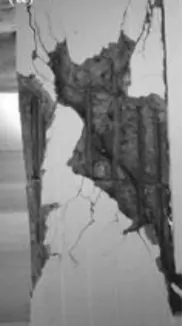
Observation:
From the above image,we can find few points.
- The concrete has broken but the reinforcement seems to be better only as we can find and bents or thinning of the bars.
- And the cracking has been is a shape similar to the X or diagonal.
Answer:
- As only the concrete has damaged,it can be considered as the shear failure,as the concrete couldn't take the shear load,thus the concrete had failed.
- The presence of the crack in the column in X shape or due to diagnol crack,it is a clear indication of the shear failure.
- And we can find the less no. of stirrups,so due to the absence of more shear reinforcement,the failure could occur.
c)
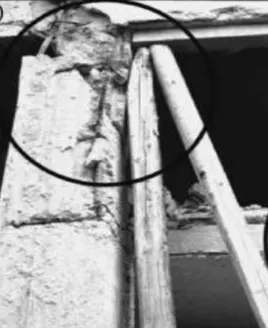
Observation:
From the above image,we can find few points.
- We can find the complete detach of the column from the upper regions.
- And failure of the column is visible at the top of the column.
- And we can even find 2 slabs,where the upper one could be the primary slab and the bottom one could be a sun shade or for a cupboard purpose,etc.
- And we can even notice the wooden poles have been arranged so as to provide an external support from the structure been collapsed entirely indicating that the failure is somewhat a big.
Answer:
- As due to the presence of the 2 slabs,it can be indicated as a short column failure.
- It occurs mainly due to the designing of the column only for the one slab but an another slab is maintained which increases the load on the column especially the shear load acts on the column.
- And one more indication for the short column failure alone is that,the failure has happened just below the upper slab which means that the upper slab gives an ectra loading on the column.And we can't find any failure below the lower slab.
- It just happens due to the connection of the extra slab.And occurs when thw extra connection is not considered while designing.
- This failures are not repairable.