Rule-based energy management strategy: Load following
Firstly, it's important to understand why a load following strategy is part of several energy management rule-based strategies.
A load following strategy works by keeping in consideration the most efficient points of the respective energy storage system (whether its FC, battery, or UC), and developing an algorithm that uses the propulsion power of all sources as efficiently as possible.
Taking an FCEV as reference, the FC will be the primary source of propulsion, while the battery or UC will the secondary ESS. The load following strategy will hence be centered around the efficient operation of the FC.
Below are two figures which depict two crucial points: system efficiency of the FC and its polarization curve.
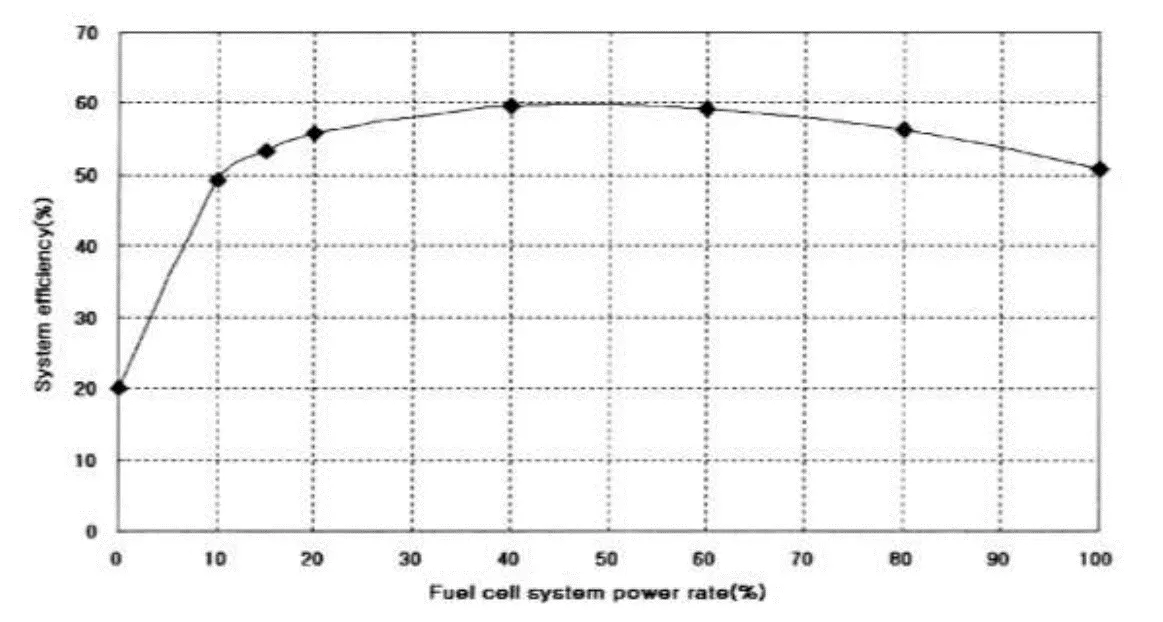
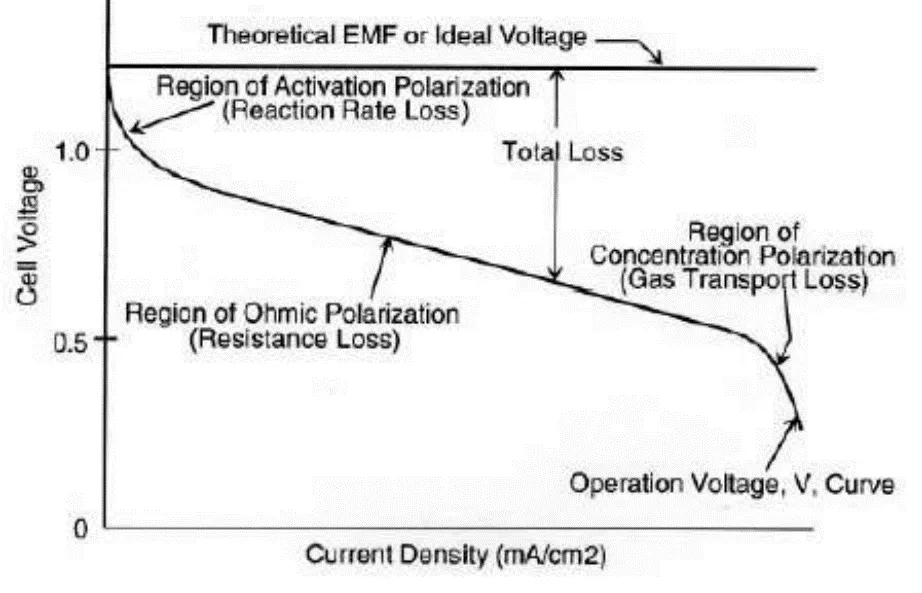
Figure 1: FC's system efficiency is the highest when it operates in the mid-power demand region (from about 30% to 70%). So, if demand ranges from 0kW - 100kW, the operating region of the FC should be from 30kW - 70kW, while the other regions should be covered by the ESS.
Why is the FC's system efficiency the highest in the mid-power demand region?
Figure 2: There are activation losses, ohmic losses, and concentration losses in a FC.
Activation losses - occurs essentially at the beginning of the FC operations at lower temperature. The current density in this region is low, making the reaction sluggish. A sluggish reaction doesn't allow to cover up for the activation losses, hence more energy is needed to overcome the membrane barrier. This makes it a low efficiency region.
Concentration losses - occurs when excess current is demanded. This causes a drastic drop in voltage and pressure, as oxygen supply is unable to keep up with the sudden surge of hydrogen supply.
Ohmic losses (mid-power demand region) - the most natural losses present in every electrical system, linearly increases with current density. Most optimal balance between FC efficiency and power output, and hence this should be the operating point.
SIMULINK/STATEFLOW MODEL:
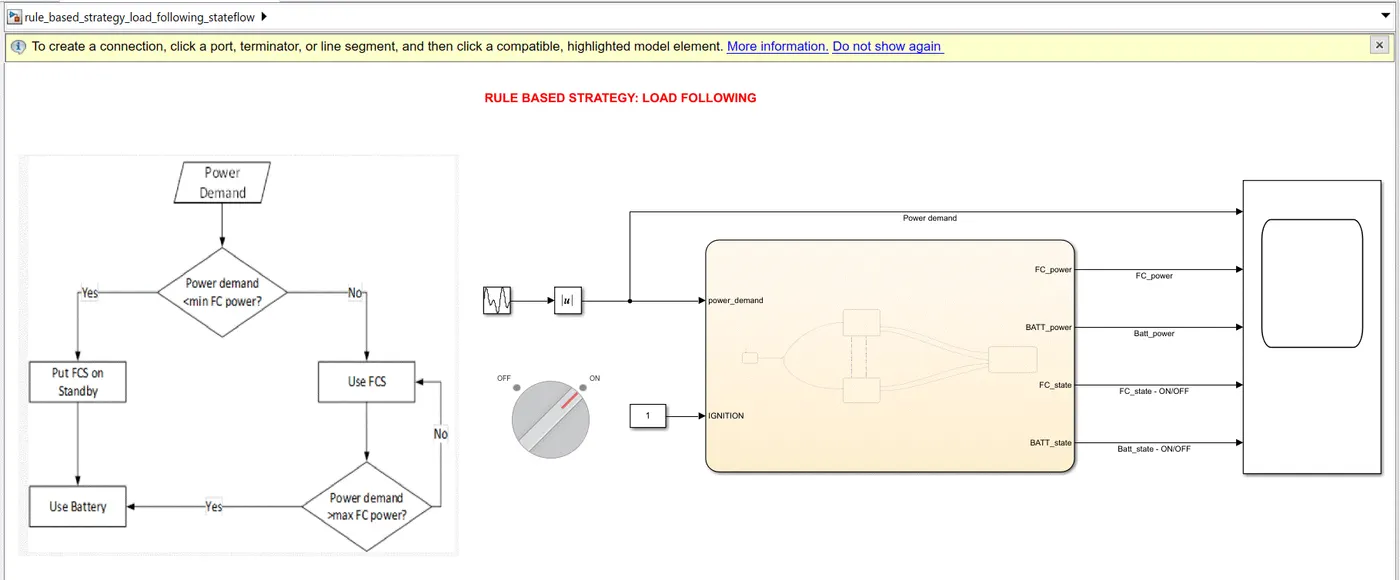
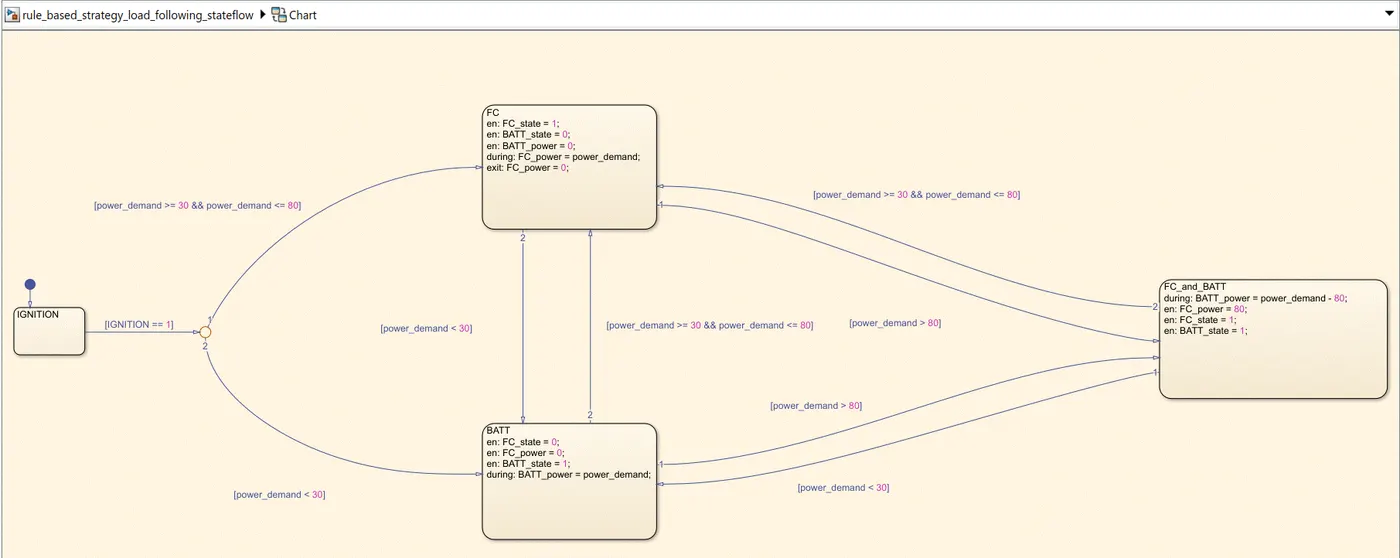
- Power demand < 30 - Use battery, FC is on standby
- 30 < Power demand < 80 - Use FC, battery is on standby
- Power demand > 80 - Use both (FC max at 80, remaining to be provided by battery)
RESULTS:
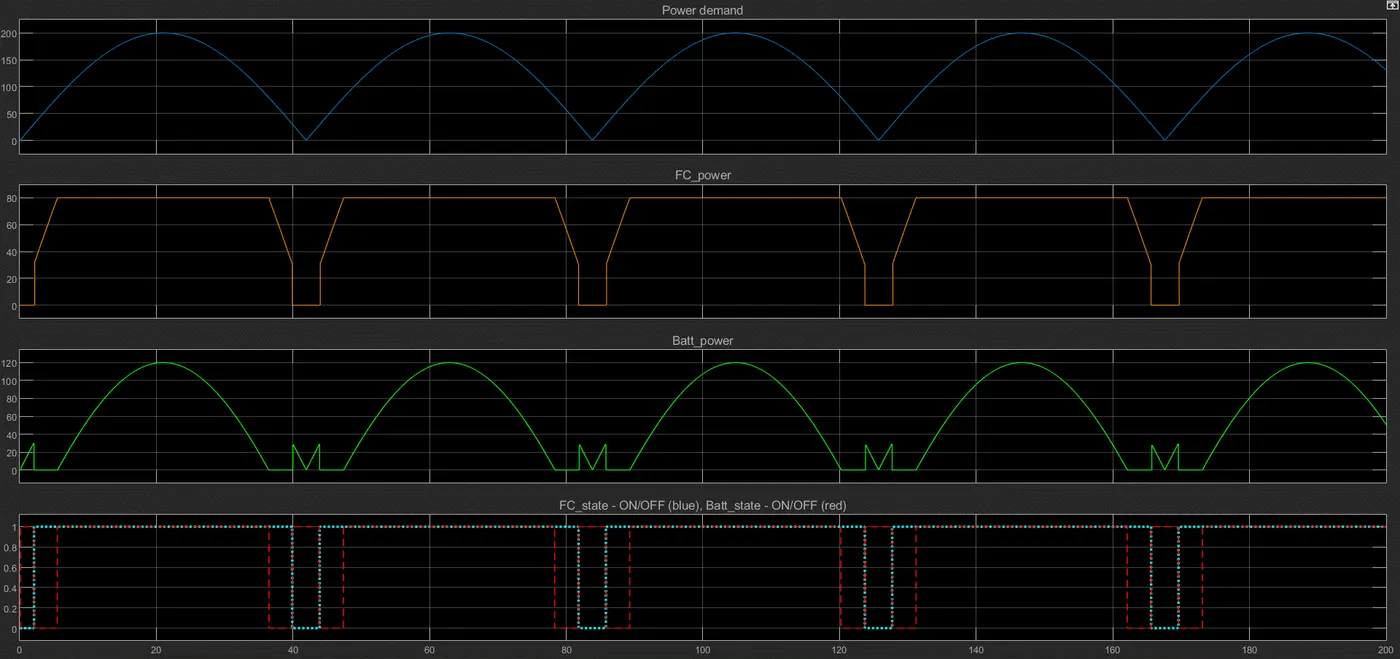
- As is evident, up until 30kW, the FC is off and the battery provides the power
- From 30kW to 80kW, the battery is off, FC provides all the power
- 80kW onwards, FC provides 80kW while the remaining is provided by battery
Further scope:
This model could be developed further if a UC is incorporated. The UC could handle the peak power requirements (beyond 80kW for instance), while the FC continues to operate in its 30kW - 80kW range, and battery operates in the 0- 30kW range. This way, all ESS' will be operating in its most efficient and optimal power range, making the load management strategy more effective.