Thermal Management of Battery
OBJECTIVES:
- Explore the effect of increasing battery temperature on SOC
- Learn about thermal management techniques for an electric car battery pack
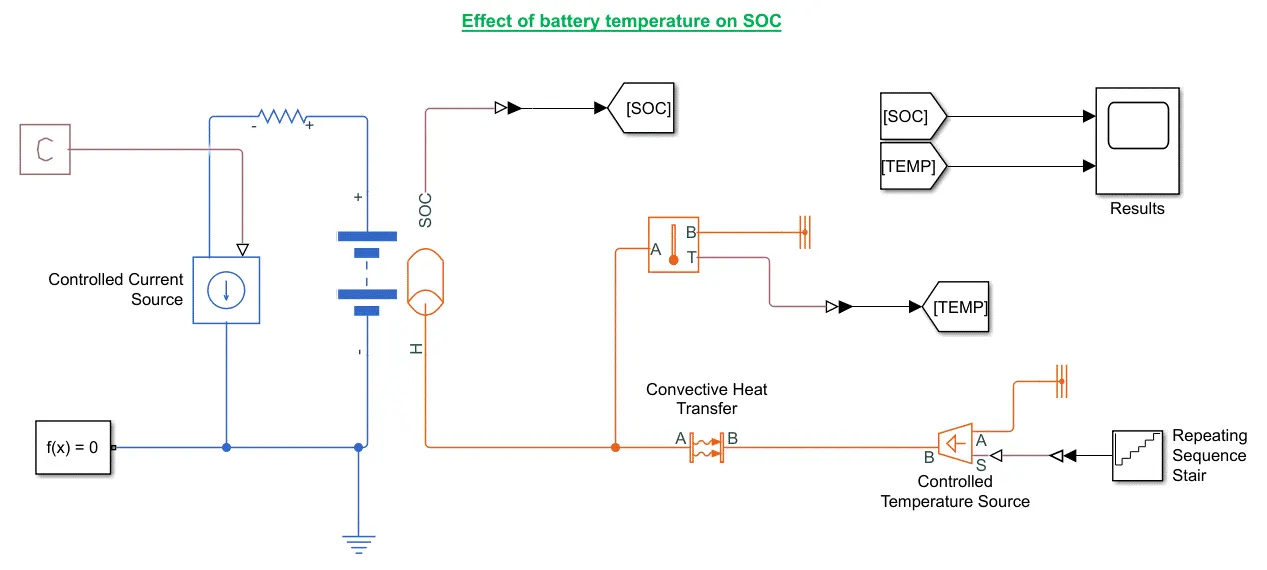
1) Create a simple simscape model with a battery and show the temperature dependance in the performance. Also connect a resistor load of 10 Ohm and compare the resultants graph for different area of contact of heat.
HOW DOES INCREASING TEMPERATURE AFFECT BATTERY PERFORMANCE?
When temperatures increases, this affects the chemical reactions that occur inside a battery. As the temperature of the battery increases, the chemical reactions inside the battery also quicken. At higher temperatures, one of the effects on lithium-ion batteries’ is greater performance and increased storage capacity of the battery. However, there is a side effect to this increased performance - the lifecycle of the battery is decreased over time.
So, while heat exposure does temporarily increase battery capacity, the damage that it does to the lifecycle can cause long term problems and prolonged heat exposure should be avoided.
SIMULINK MODEL: STUDY 1
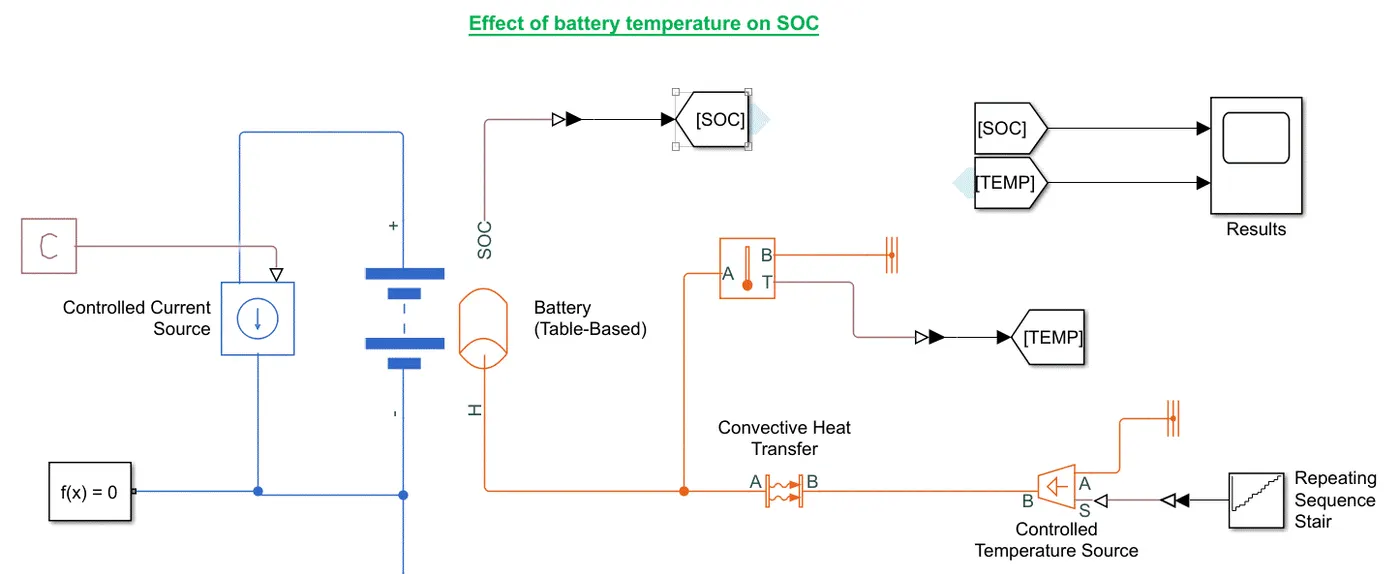
- A battery is discharging a fixed amount of current whilst being heated by a temperature source
- Max battery capacity is 4.2Ah and 2.1A (0.5C rate) of current is being discharged for 1 hour
- The discharge current remains the same whilst there is a 10 degree increment in temperature every 10 minutes
- The battery is at 298K while the heater starts with 318K going all the way up to 368K
- The surface area of the battery in contact with the heating fluid is 1`m^2`
RESULTS:
ANALYSIS:
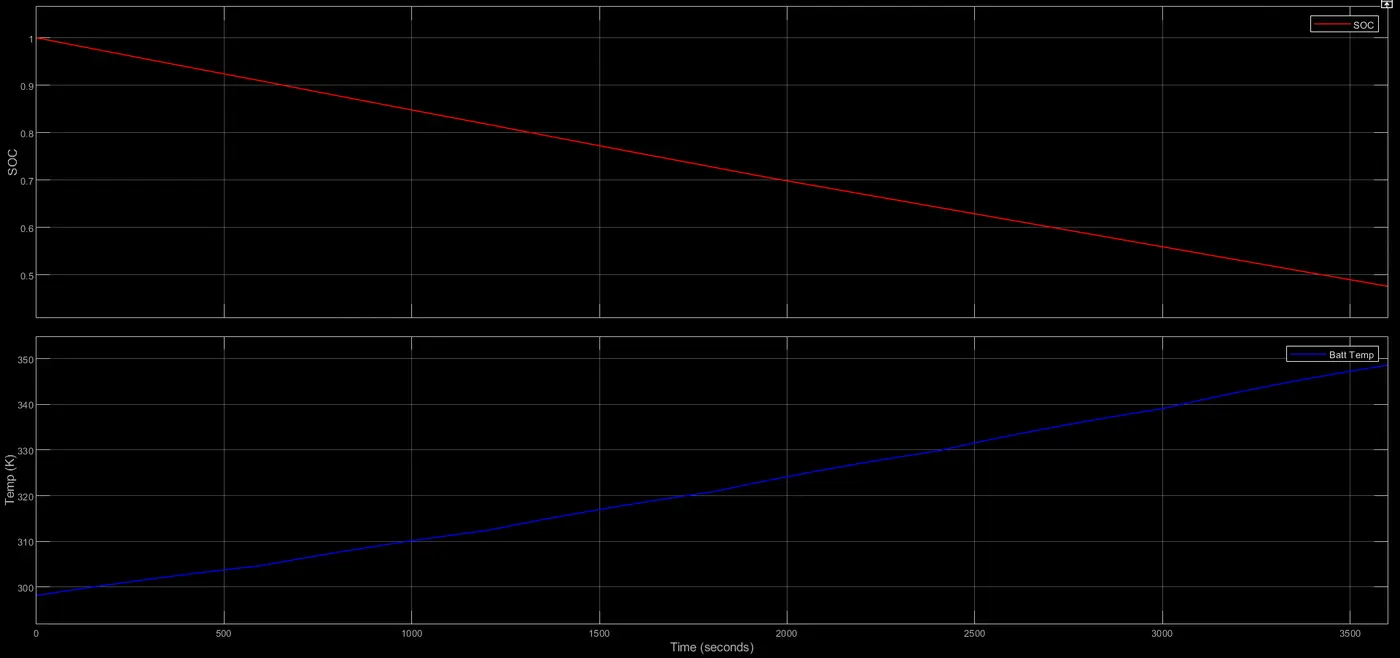
| Time (seconds) | Battery temperature (degree) | Reduction in SOC |
| 0-600 | 25-32 | 9.12% |
| 600-1200 | 32-39 | 9.09% |
| 1200-1800 | 39-48 | 9.01% |
| 1800-2400 | 48-57 | 8.5% |
| 2400-3000 | 57-66 | 8.33% |
| 3000-3600 | 66-76 | 8.33% |
- From Arrhenius' Law: `k=Ae^(-E_a/(RT))` (where k = rate of reaction, T = temperature), we can deduce that the rate of reaction increases exponentially with an increase in temperature. As a rule of thumb in most biological and chemical reactions, the reaction rate doubles when the temperature increases every 10 degrees. From the table above, it is evident that as the temperature increases, there is lower reduction in SOC in the same amount of time. Higher temperature enables higher mobility of the electrons and the chemicals reacting, allowing more power to be extracted and thus increasing the capacity that the cell can provide.
- Beyond a certain point however, an increase in temperature can lead to certain irreversible reactions such as disintegration of the electrolyte and even thermal runaway if there is excess heat inside the cell.
- This is a very basic battery model of a general cell and is not fit to analyze the temperature sensitivity of a lithium-ion cell, beyond what temperature would the cell be unsafe to operate, etc.
SIMULINK MODEL: STUDY 2 - ADDING RESISTANCE
RESULTS:
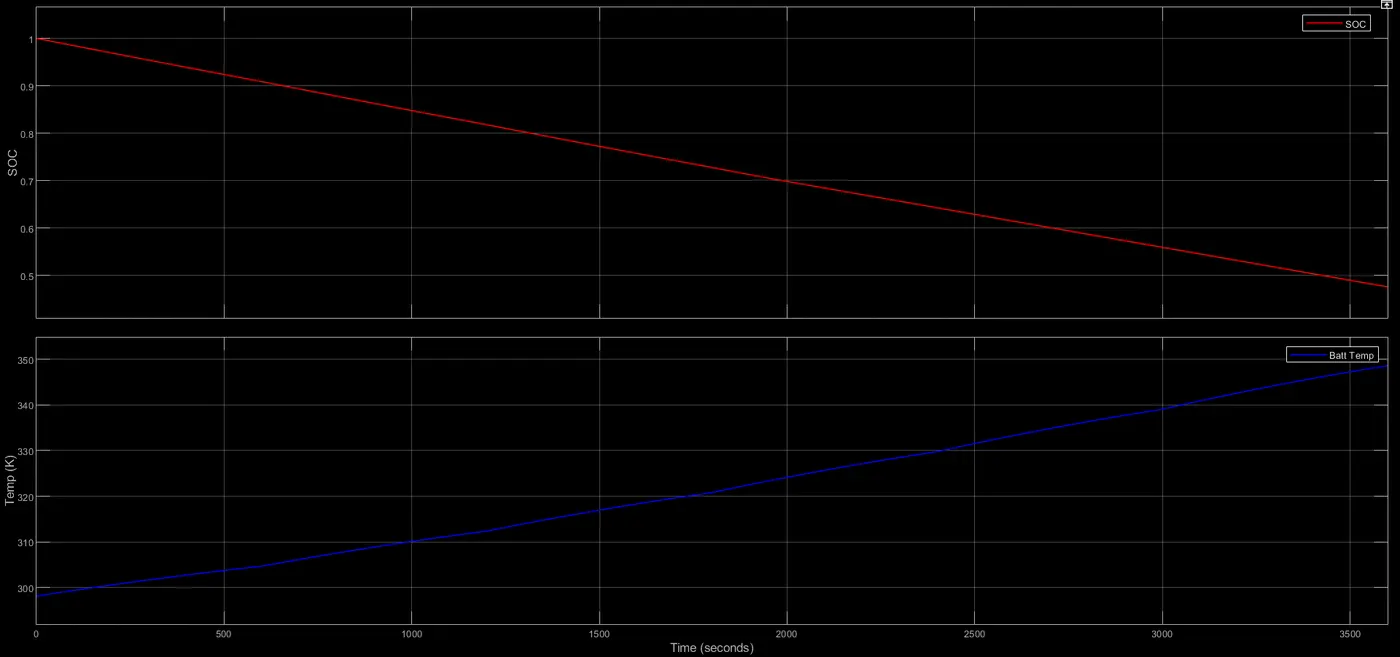
- Identical results as Study 1 - no change in battery temperature or SOC with the attachment of a 10ohm resistor
- This is probably because 10ohm is too low of a resistance to extract enough power from the circuit to affect battery parameters or performance
- For a 10ohm resistor to make an impact, the battery would have to be made less powerful - lower capacity and lower voltage
SIMULINK MODEL: STUDY 3 - CHANGING SURFACE AREA OF CONTACT
- Surface area of the battery in contact with the heating fluid was previously 1`m^2`. Varied it to 0.1`m^2` and 10`m^2`
RESULTS:
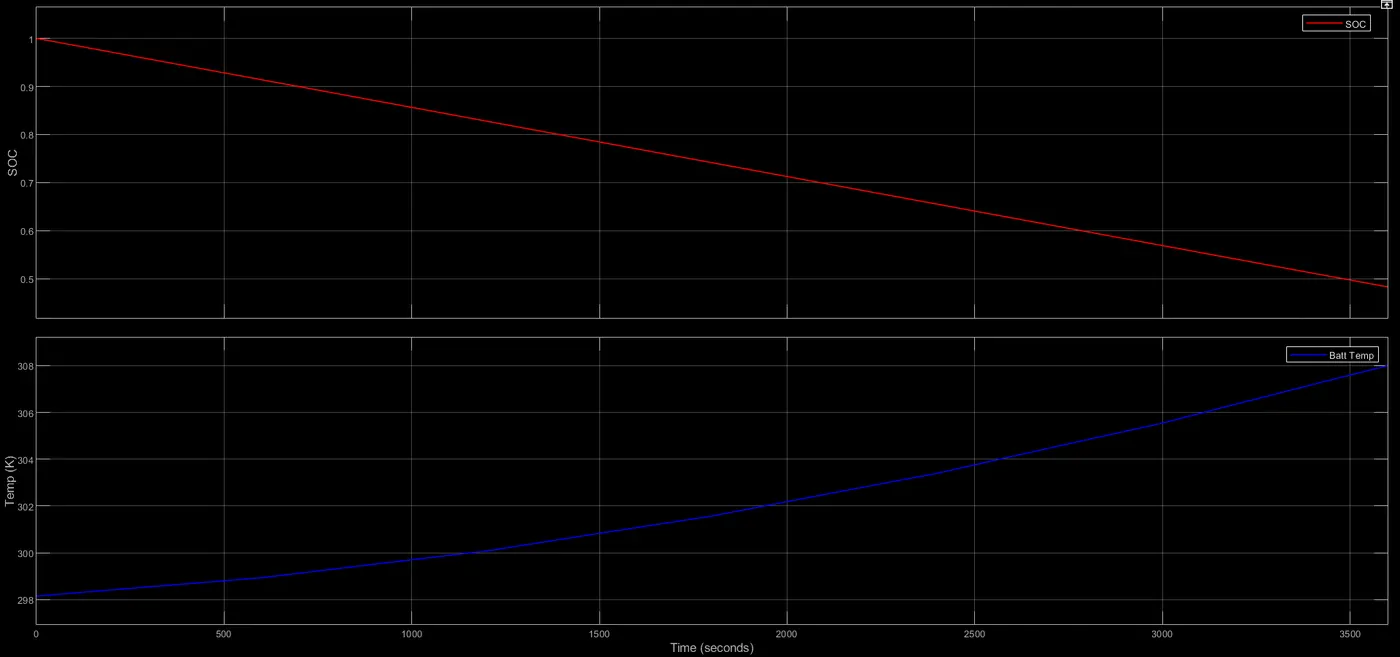
- Since the contact is only 0.1`m^2`, which is very low, the temperature rise of the battery is affected significantly, with a max temperature of 308K as opposed to 349K when the area was 1`m^2`
- The SOC is also draining slower relatively, as expected. For instance, in Study 1, by 2000sec, the SOC is at 70%, but here it is at 72%
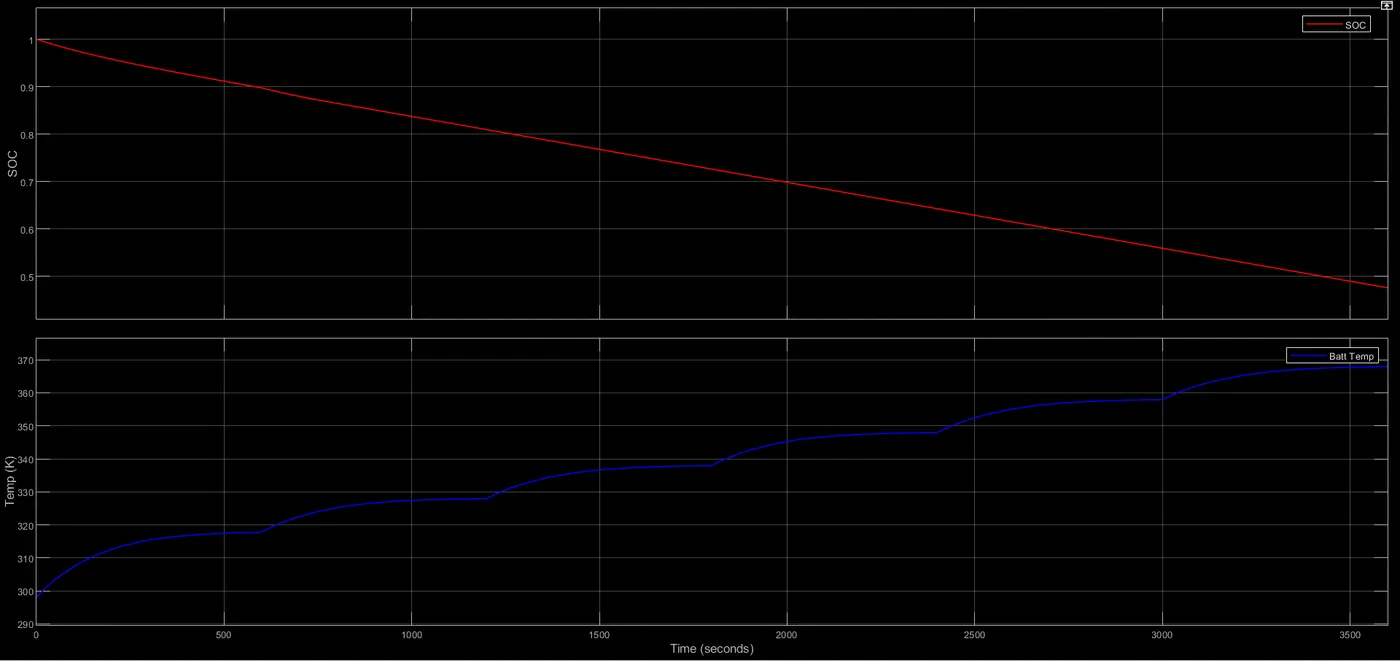
- With the surfact contact now being 10`m^2`, which is quite high, and may even exceed the size of the battery, the temperature rises to the maximum temperature it is being exposed to by the heater i.e. 368K. This is a very high temperature (95 degree C) and could destroy the battery along with alarming safety concerns such as an explosion or fire, however in this basic model all of that has not been simulated
- The SOC is draining slightly faster comparatively. For instance, in Study 1, by 500sec, the SOC was at 93%, but here it is at about 91%
2) Summarize thermal management techniques for an electric car battery pack
The performance of an EV is highly dependant on the battery pack, and one of the most important parameters affecting the performance of the battery (and hence the vehicle) is the operating temperature of the cells and the battery pack. All batteries will eventually age and experience degradation in performance, but without adequate thermal management, it won't be possible to maximize the life cycle and performance of the battery pack.
Operating outside the limits specified, be that charge and discharge rates, or allowable temperatures at which the pack can function adequately, will accelerate the degradation in performance and efficiency of the EV.
Battery Thermal Management Systems (BTMS) are designed with 4 functions to ensure proper thermal management:
- Cooling: to remove excess heat
- Heating: for cold climates
- Insulation: to protect from high temperature difference between cell and environment. If the cell temperature is to be maintained but the environment is at a much lower or higher temperature than the cell, then natural heat transfer is inevitable unless an insulation layer is present.
- Ventilation: allow for natural cooling and removing any unwanted gases produced by the pack
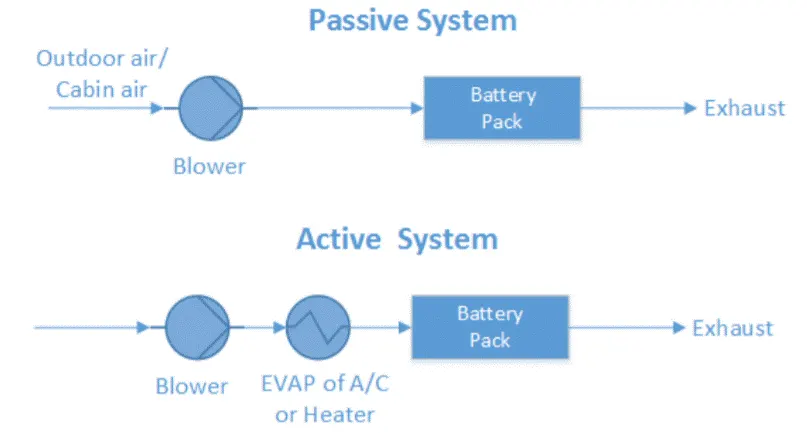
i) Air cooling and heating: air systems use air as the thermal medium. The intake air could be direct either from atmosphere or from the cabin (passive) and could also be conditioned air after a heater or
evaporator of an air conditioner (active)
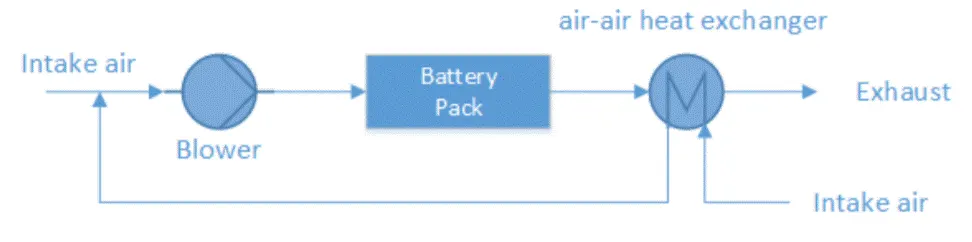
In addition, to make better use of this system, heat from the exhaust can be extracted and re-used whenever the battery needs to be heated through an air-air heat exchanger.
Evaluation: high reliability, low cost, low maintenance, but poor thermal management. At the same flow rate, the volume of air is much higher than volume of water, but the heat transfer coefficient is much lower than that of water, meaning it will require more space and energy for air to dissipate as much energy as water. At higher discharge current rate, the difference in temperature between different cells could reach 5 degree C, which could be more than the difference between the cell temperature and the ambient temperature. So, if thermal runaway starts in one cell, with an air cooling system, the system won't be able to prevent all the cells from catching fire.
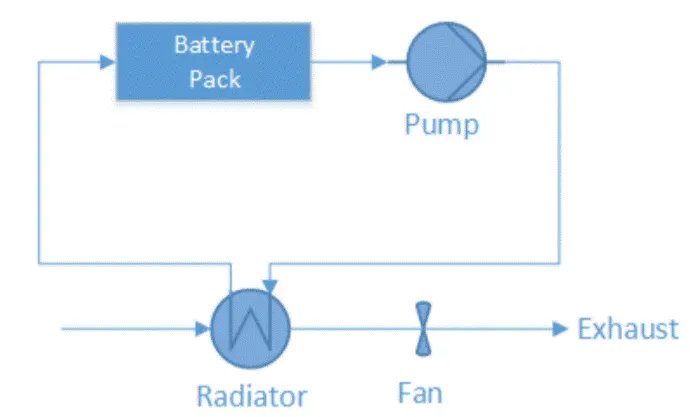
ii) Liquid Cooling and Heating: By different heat-sinks for cooling, liquid systems can also be categorized into either passive systems or active systems. In passive liquid system (figure on the left below), the heat-sink for cooling is a radiator. This system has no ability to heat. Heat transfer fluid is circulated by the pump within a closed system. The circulating fluid absorbs heat from battery pack and releases heat via a radiator. The cooling power depends strongly on the temperature between ambient air and battery. Fans behind the radiator can improve the cooling performance, but if ambient air is higher than the battery temperature or the difference between them is too small, the passive liquid system becomes ineffective.
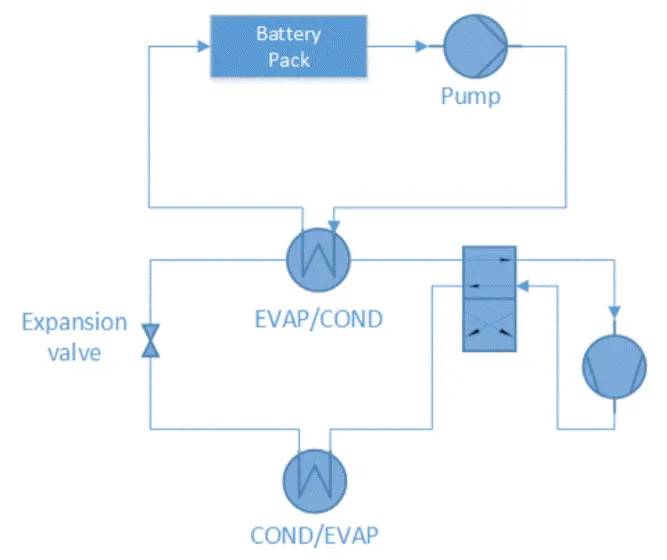
In an active liquid system (figure on the right below), there are two loops. The upper is called the primary loop and the lower the secondary loop. The primary loop is similar to the loop in a passive liquid system, where the heat transfer fluid is circulated by pump. The secondary loop is actually an air conditioning loop (A/C loop). The upper heat exchanger instead of being a radiator works as an evaporator (EVAP) for cooling operation and connects both loops. During heating operation, the 4 way valve will be switched, and the upper heat exchanger works as a condenser (COND) and the lower heat exchanger works as an evaporator.
iii) Direct Refrigerant Cooling and Heating: Similar to active liquid systems, a direct refrigerant system (DRS) consists of an A/C loop, but DRS uses refrigerant directly as heat transfer fluid circulating through the battery pack.
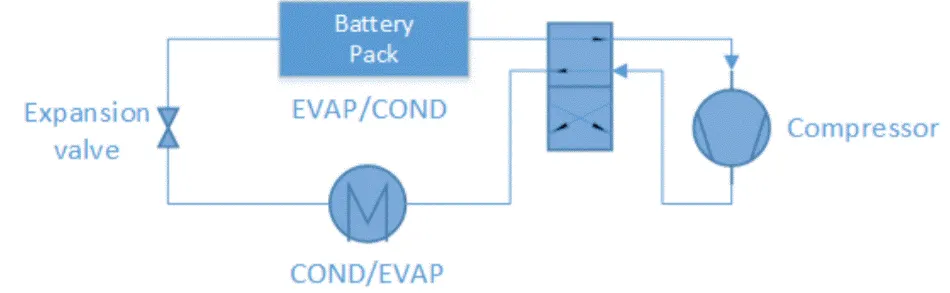
Evaluation: much more efficient than liquid cooled systems since the refrigerant is directly used to cool the system, as opposed to a liquid absorbing heat and then being cooled in order to cool the system. However, because a refrigerant loses its cooling ability everytime it is recirculated, it needs to be replaced once in a while.
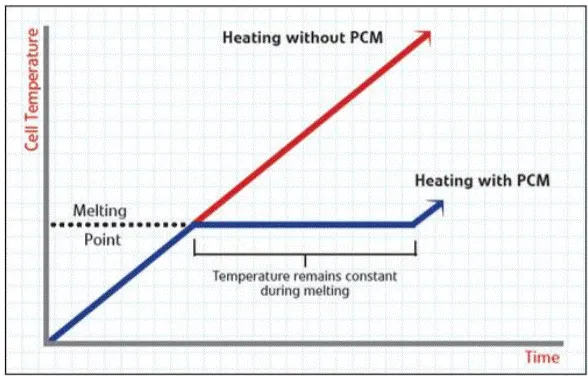
iv) PCM: a phase change material used as a conductor that will transition between solid and liquid. When the battery gets too hot, the PCM will absorb the heat. Phase change only happens at constant temperature, so once the PCM has absorbed maximum latent heat, all the heat energy from the pack will make the PCM melt and change to liquid. Temperature remains constant during a phase change, so this procedure will delay the pack from increasing its temperature any further. Once the heat is transferred to the surroundings, the PCM returns back to its solid phase
Evaluation: high thermal conductivity so if one cell fails, thermal runaway will not propagate because the PCM-graphite matrix absorbs and spreads the heat quickly