DC Machine Characteristics
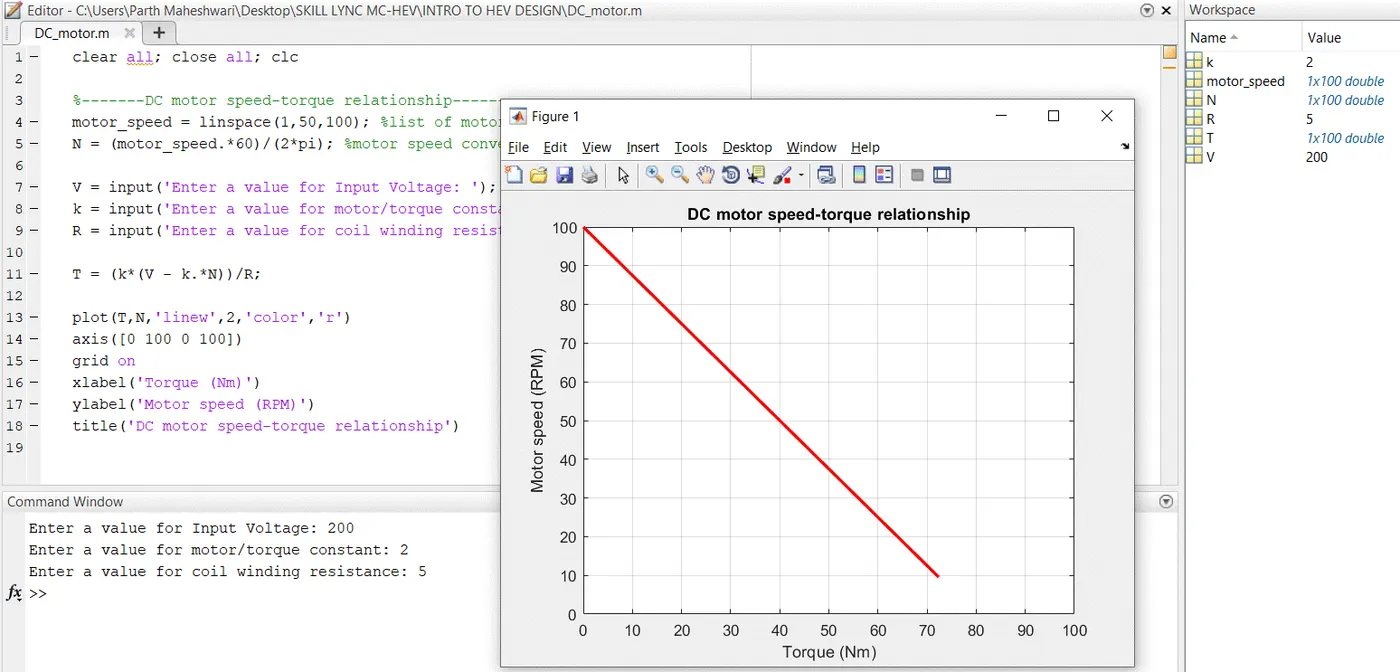
1) Implement DC machine torque speed characteristics equations in MATLAB script file. It asks user to input data and plots speed (RPM) versus torque (Nm).
- A DC machine is an electromechanical alternation device, and it consists of a DC motor and a DC generator
- A DC motor converts electrical DC power from a voltage/battery/power source to mechanical power
- A DC generator does the opposite i.e. converting mechanical power from the wheels to electrical power
- With respect to HEVs, a DC motor is used to power the wheels to move the vehicle, and the DC generator comes alive during regenerative braking to charge the battery.
The performance of a DC motor can be judged by its speed-torque characteristics, so it is important to understand the relationship before selecting a DC motor for operation.
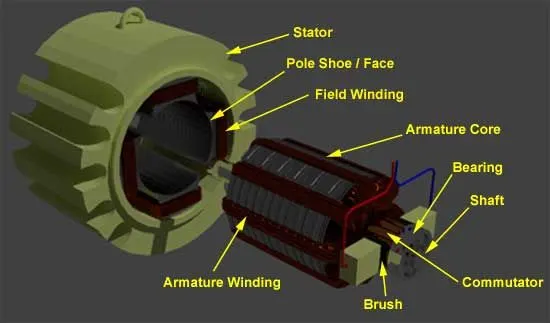
Derivation of the speed-torque relationship:
Voltage to power this DC motor will be for:
`V = IR + E_b` [where `E_b` is back-emf: opposing voltage that stems from the rotation of the winding and armature]
`E_b` is proportional to the speed of the motor:
`E_b = k_eomega`
And motor torque is proportional to current:
`T = k_tI`
`V = T/k_tR + k_eomega`
`V = (TR+k_tk_eomega)/k_t`
Since the total electrical power in = mechanical power out + losses
`VI = Tomega+I^2R`
`(IR+E_b)I = (k_tI)omega+I^2R`
`I^2R + k_eIomega = k_tIomega+I^2R`
Thus: `k_e = k_t`
So now:
`V = (TR+k^2w)/k`
`T = (kV - k^2omega)/R` ----------- inversely proportional relationship between speed and torque: the higher the motor speed, the lower the torque
Code:
clear all; close all; clc

%-------DC motor speed-torque relationship-------
motor_speed = linspace(1,50,100); %list of motor speeds in m/s
N = (motor_speed.*60)/(2*pi); %motor speed converted to RPM

V = input('Enter a value for Input Voltage: ');
k = input('Enter a value for motor/torque constant: ');
R = input('Enter a value for coil winding resistance: ');

T = (k*(V - k.*N))/R;

plot(T,N,'linew',2,'color','r')
axis([0 100 0 100])
grid on
xlabel('Torque (Nm)')
ylabel('Motor speed (RPM)')
title('DC motor speed-torque relationship')
Output:
2) How can you distinguish between power cables and signal cables? Also, prepare a table where these cables are used in the wiring of an electric vehicle.
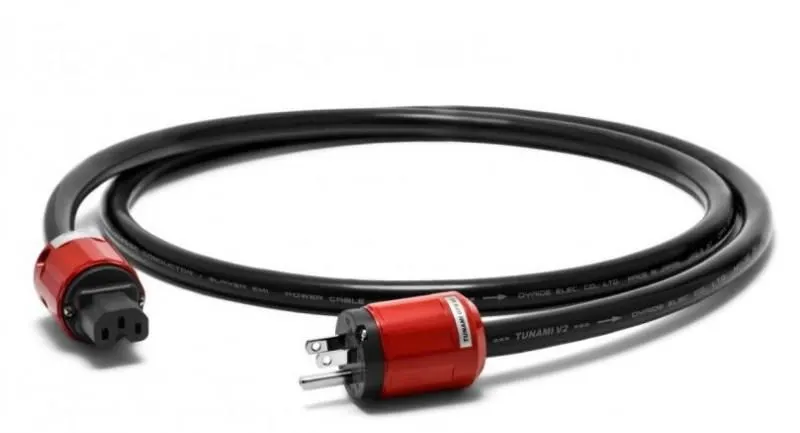
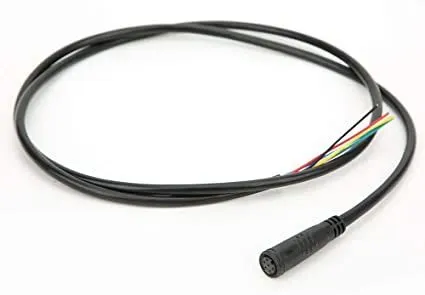
| Power cables | Signal cables |
|
- high power & current rated - operate at high voltage - large cross-sectional area - used in powering components such as motors, industrial machines, transformers, transmission lines |
- low power & current rated - operate at low voltage - small cross-sectional area - used in data transmission and signal processing through ECU, automation control, test and measurement applications |
 |
 |
3) What voltage levels are considered as high & low for a battery pack of electric vehicles?
- Nominal voltages in most HEVs/PHEVs today range from 100-200V, while for EVs it is from 400-800V. Outside of the given range would be considered low and high voltages.
- Higher voltages allow more power to be transferred (through power cables) with fewer losses over the same diameter of the copper cables.