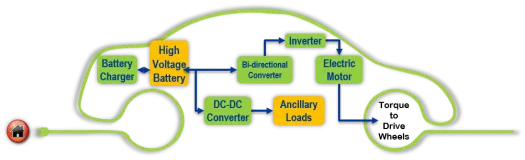
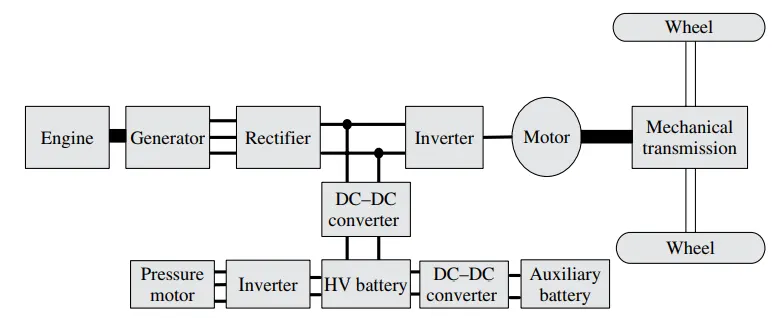
1) Which types of power converter circuits are employed in electric and hybrid electric vehicles?
| Type of power converter |
Description |
| DC - AC converter (Inverter) |
- DC power from the battery to AC power used in an EV induction motor. The inverter can change the speed at which the motor rotates by varying the frequency of the AC signal.
- Increase/decrease power and torque of the motor by adjusting the amplitude of the AC signal.
|
| DC - DC converter (chopper) |
- Step up (boost converter): low to high voltage for heavy duty work in a high power consumption load
- Step down (buck converter): high to low voltage for a light load source
- Controlled by varying duty cycle
- Unidirectional ones: applications include sensors, controls, entertainment, utility, and safety equipments
- Bidirectional ones : manages charge/discharge of the battery and also the DC bus voltage. Applications include battery charging, regenerative braking, and backup power
|
| AC - DC converter (rectifier) |
- AC power from generator converted to DC to charge the battery during regenerative braking
|
2)
Code:
clear all; close all; clc

%------------calculating steady state speed of vehicle------------

%constants given
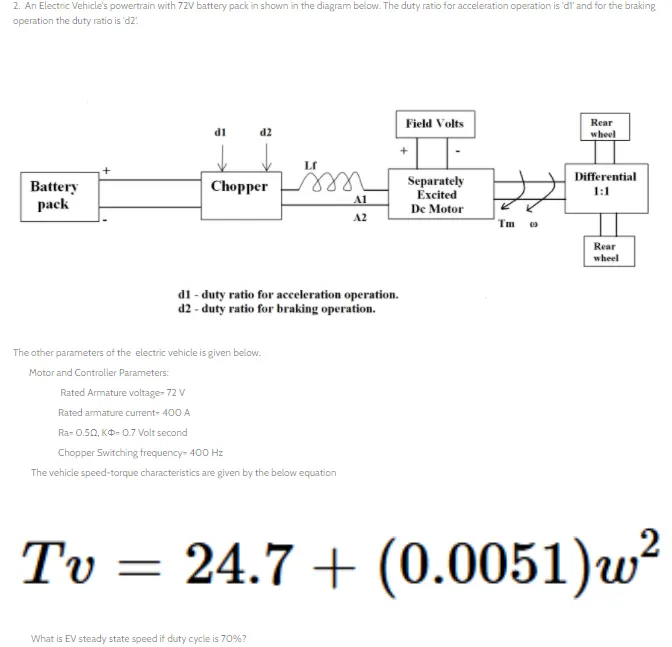
Vmax = 72; %rated armature voltage
Voutput = 72*0.7;
Imax = 400; %rated armature current
Ra = 0.5; %armature resistance
k = 0.7; %motor constant
f = 400; %in Hz - chopper switching frequency
w = linspace(1,100,100);

%-----------Vehicle speed-torque characteristic eqn-------------
Tv = 24.7 + 0.0051.*w.^2;

%-----------Motor speed-torque characteristic eqn-------------
%T = (k*(Voutput - k*w))/Ra;
Tm = 70.56 - 0.98.*w;

plot(w, Tv,'linew',1.5,'color','r')
hold on
plot(w, Tm,'linew',1.5,'color','b')
title('Steady state speed of vehicle')
xlabel('Speed w (rad/sec)')
ylabel('Torque (Nm)')
legend('Vehicle speed-torque','Motor speed-torque')
Output:
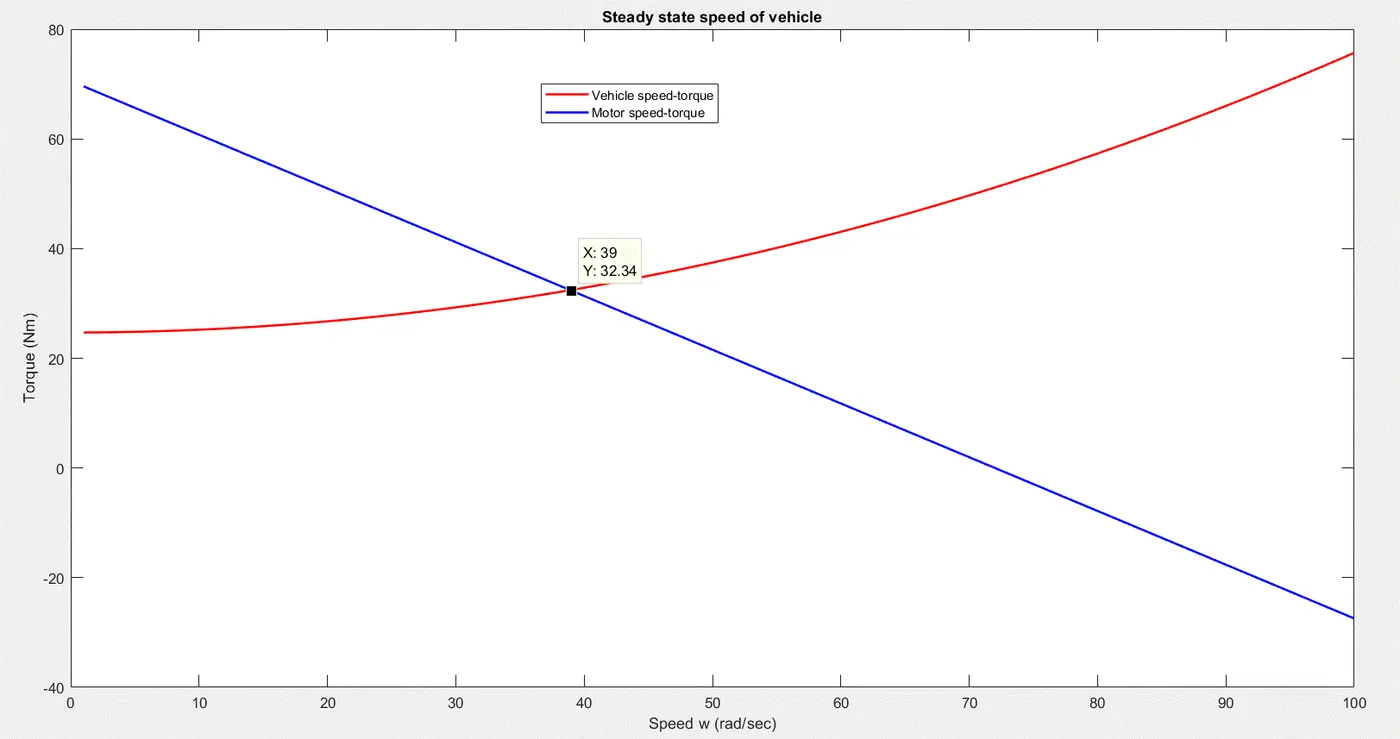
Therefore:
EV steady state speed is w = 39rad/sec
3) Refer to the blog on the topic: Induction Versus DC brushless motors by Wally Rippel, Tesla.
Explain in brief about author’s perspective.
| Induction motors |
DC brushless motors |
- Currents flowing in the stator windings produce a rotating magnetic field that enters the rotor
- Speed is controlled by altering frequency of the fed-in voltage, which alters the RMS speed
- These motors don't have magnets and don't require inverters because of the ability to start under load, but incorporating one will better the overall torque performance, which is quite low
- High levels of heating affect efficiency. Cooling strips are needed
- Operates at about 85% power factor, so lower peak efficiency
- Smaller size/weight ratio: takes less space, generates more motor output by varying frequency drive (VFD). Best for high range performance (EVs)
- As motor size increases, magnetic losses don't necessarily increase, making it more suitable where high performance is desired
- Lower cost since no use of magnets
|
- The rotor includes two or more permanent magnets that generate a magnetic field
- Current flows within the core windings to produce torque interaction between stator and rotor. Inverter is required due to unavailability of starting torque and lack of current control.
- Easier cooling as not much heat is produced
- Higher peak efficiency due to ability to operate at 100% power factor
- Greater size/weight ratio: takes more space, increases kerb weight. Best for low-medium range performance (HEVs/PHEVs)
- As motor size increases, increase in magnetic losses causes load efficiency to drop, thus not suitable for high performance
- Permanent magnets are expensive, hence more costly motors
|