Induction Motor Characteristics I
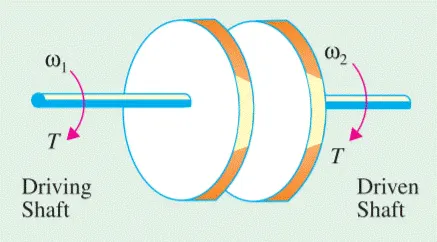
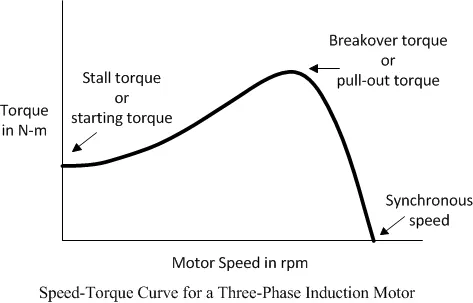
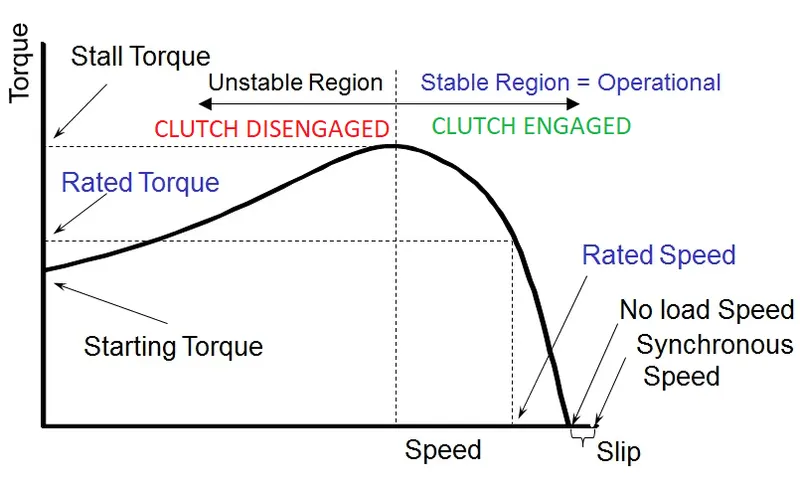
1) How is the induction motor operation similar to the clutch?
| Clutch operation | Induction Motor operation |
|
|
 |
|
2) Calculate the starting time of a drive with the following parameters:
J = 10 kg-m2, Tm = 15 + 0.5wm, Tl = 5+0.6ωm
The "starting time" of a motor drive refers to the time it takes to reach steady state operation. It could be during braking, acceleration, deceleration, etc.
At steady state: `T_m = T_L`
`15+0.5omega_m = 5+0.6omega_m`
`10=0.1omega_m` --> `omega_m = 100(rad)/(sec)`
It is to be realized that the drive starts off in a transient state and reaches steady state at `omega_m = 100` (calculated above). Hence, a safe estimation would be that the transient state is over when 95% of the change in speed has occured. Beyond this point, the motor can be considered fully operational at steady state, where `T_m` and `T_L` counterbalance each other to keep the vehicle moving at constant speed. Hence, it is determined that there is net torque acting on the vehicle until `omega_m = 95`, which can be used as the upper bound to calculate the starting time.
`T = T_m-T_L`
`T=J(domega_m)/dt`
`10-0.1omega_m=10(domega_m)/dt` --> `1-0.01omega_m=(domega_m)/(dt)`
`intdt=int1/(1-0.01omega_m)domega_m`
t = `int_(0)^(95)1/(1-0.01omega_m)domega_m`
t = `[-100lnabs(1-0.01omega_m)]_0^95`
t = 299.57 seconds
3) A drive has following equations for motor and load torques:
Tm = (1+2ωm), Tl = 3 √ωm
Obtain the equilibrium points and determine the stability
As steady state is reached, the equilibrium or operational points can be found by `T_m = T_L`:
`1+2omega_m=3sqrtomega_m` -----> `omega_m = 0.25 and omega_m=1`
Condition for stability:
`(dT_L)/(domega_m)-(dT_m)/(domega_m)>0`
If `domega>0` then `T_L>T_m` -------- When the change in speed is positive, the load torque needs to be greater so that it can prevent the speed from reaching an extremely high value (which would happen if motor torque exceeded load torque) and losing its stability.
If `domega<0` then `T_m>T_L` -------- When the change in speed in negative, the motor torque needs to be greater so that it can prevent the car from coming to a complete stop (retardation), which would happen if the motor torque was insufficient to support the load torque when the speed of the car is going down. This would also be unstable.
`(d(3sqrtomega_m))/(domega_m) - (d(1+2omega_m))/(domega_m) >0`
`(3)/(2sqrtomega_m)-2>0`
When `omega_m = 0.25` ----> stable
When `omega_m = 1` ----> unstable
Code:
clear all; close all; clc

Wm = linspace(0,2);

%---------governing equations--------
Tm = 1 + 2.*Wm; %motor torque
Tl = 3.*sqrt(Wm); %load torque

plot(Wm,Tm,'linew',1.5,'color','r')
hold on
plot(Wm,Tl, 'linew',1.5,'color','b')
axis([0 2 0 5])
xlabel('Motor speed (rad/sec)')
ylabel('Motor torque (Nm)')
[xout,yout] = polyxpoly(Wm,Tm,Wm,Tl);
plot(xout,yout,'k.','markersize',18)
text(0.23,1.3,'Stable','fontsize',11)
text(0.95,2.8,'Unstable','fontsize',11)
legend('Motor torque','Load torque')
grid on
title('Speed-torque relation of an Induction Motor drive')
Output:
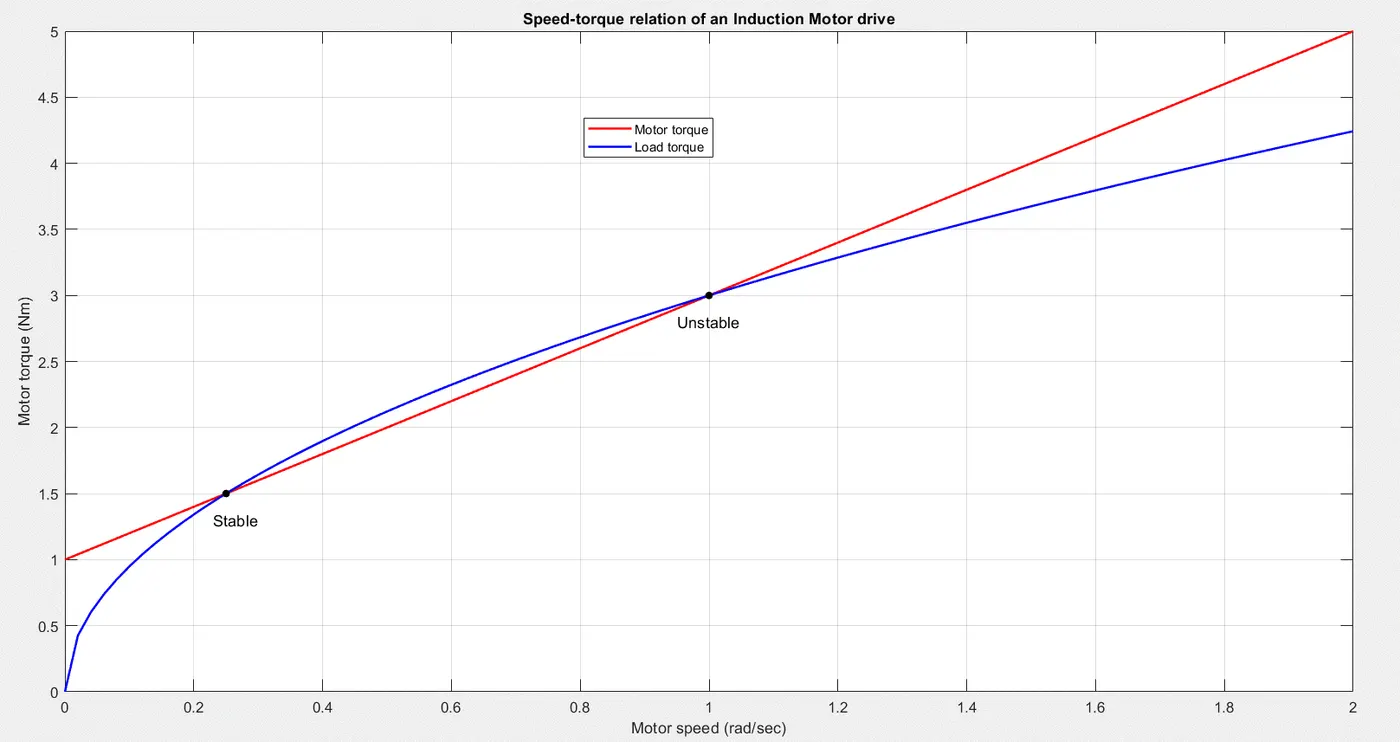
- `omega_m=0.25` is stable because when dw > 0, the load torque is greater than motor torque, and when dw < 0, the motor torque is greater than load torque
- This is not true for the unstable region, hence the motor cannot operate at `omega_m =1` once it has reached steady state