Question 1:
Compare four different types of fuel cells and state their applications.
| Type of FC |
Adv |
Disadv |
Operating temp, Stack size, Efficiency |
Applications |
| Proton Exchange Membrane (PEMFC) |
- Solid electrolyte - eliminating possibility of corrosion, no replishment needed due to it being solid
- Works well at low temperatures too - in countries like canada and sweden
- Quick startup time irrespective of condition
|
- Expensive catalyst (biggest cost factor in FC production)
- Sensitive to fuel impurities - hydrogen supplied must be as pure as possible
|
- < 120C
- < 1 - 100kW
- 60% direct H2, 40% reformed fuel
|
Suitable for automotive because:
- PEMFCs offer high power density, low weight and volume
- Operate at low temperatures (around 80C) and thus quick startup time, results in less wear and tear and increased durability
|
| Solid oxide (SOFC) |
- High efficiency
- Can accept various fuels like methanol, ethanol, methane, etc
- Solid electrolyte
|
- Corrosion and breakdown of cell components at high temperatures
- Requires significant thermal shielding
- Long startup time - have to wait until a decent amount of power is generated
- Can produce CO2 if taken fuels like ethanol, methanol, methane, due to the presence of carbon
|
- 500C - 1000C
- 1kW - 2MW
- 60%
|
Suitable for stationary power generation and utility because:
- Operate at extremely high temperatures (around 1000C) and thus slow startup. These properties already make it unsuitable for automotive
- Produces natural heat which can be recirculated and used to heat homes in cold climates
- High temperature reduces need for catalyst and reformer (for fuels) hence reducing system cost
|
| Alkaline (AFC) |
- Made up of various materials, allowing flexibility in minimizing cost
- Low startup time
|
- Sensitive to CO2, can poison the AFC
- Liquid electrolyte - maintenance needed to ensure it is at the right level
- Electrolyte conductivity isn't the best
|
|
Electrical power for onboard systems in spacecrafts |
| Direct Methanol (DMFC) |
- Low cost fuel
- Can operate at low temperatures
- Higher energy density than hydrogen
- Easier to store and transport using current infrastructure due to its liquid form
|
- Contains carbon so emits CO2
- Reaction of methanol with oxygen is much slower, so response is sluggish
- Methanol crossover from anode to cathode easily, reducing the cell voltage
|
|
Due to methanol crossover, power produced is limited. However, DMFCs compactness allows high power density, which can be supplied in small amounts for a long time. Ideal for smaller vehicles like forklifts, auxiliary systems in automobiles, consumer electronics like laptops and cameras |
Question 2:
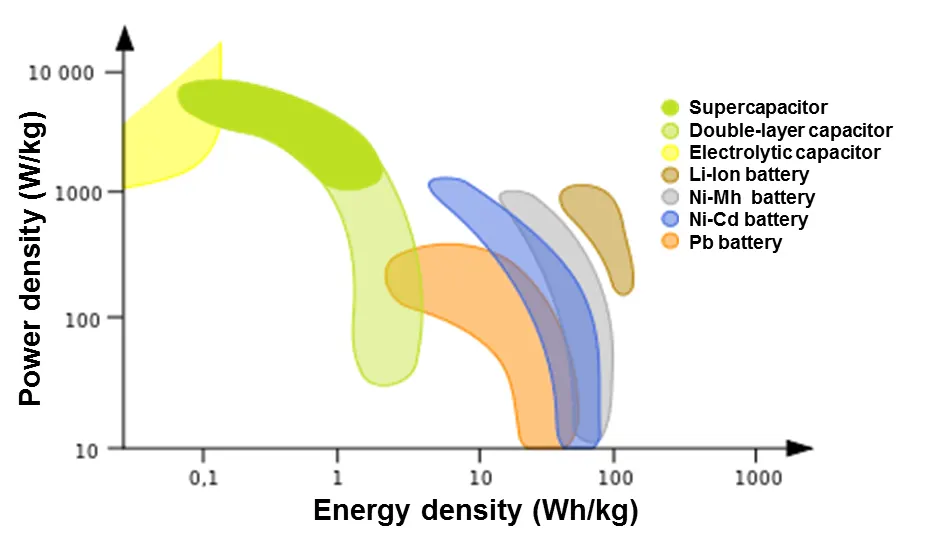
Using a plot with energy density on the X axis and power density on the Y axis, arrange various battery types like lithium ion, lead acid, Nickel Cadmium, Ultracapacitor, fuel cell.