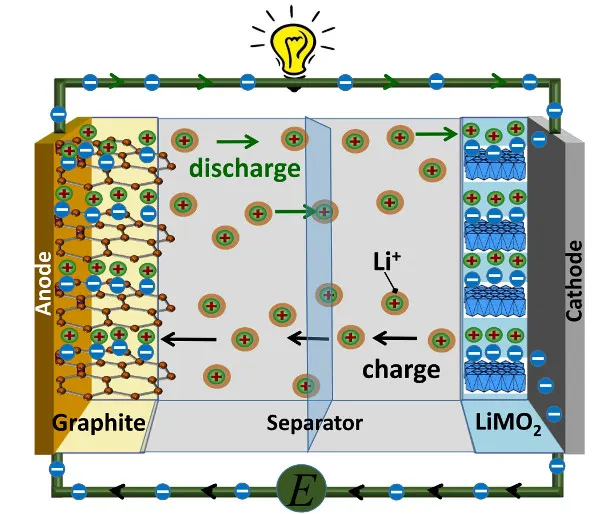
Battery and Ultracapacitor
Question 1:
Consider a scenario where an aggressive driver is accelerating very rapidly and braking harshly in a city driving. Is battery better a choice to supply power than UC in this scenario?
- True
- False
Why?
False. If its a pure BEV, then there is no choice but for the battery to be the power generator during both steady and transient states, and the battery will have to cover for the rated power and also the peak power demand. This will mean that the battery pack will be larger, more expensive, and requires more thermal management and maintenance.
However, if the vehicle is a hybrid in the sense that there is the presence of both battery and ultracapacitor, then that has several advantages.
An ultracapacitor is able to discharge and charge very rapidly, much faster than a battery, making it ideal for transient states like aggressive acceleration and harsh braking. Not only does this allow for the battery to be more compact, efficient, and cost effective, it also allows for maximum energy saving through regenerative braking.
If an UC is used for transient states, the battery can be designed to support the average power demand, while the peak demand is supported by the UC. Although the battery is a good absorbant of regenerative braking energy, the problem is that during harsh braking the insurge of current is extremely high, which exceeds the charging current limitation for the battery. In addition, such high insurge of current always carries risks like destroying armature windings and coils of the motor/generator and temperature sensitive parts in the battery. Due to this, a significant portion of this braking energy during harsh or high speed braking cannot be recovered and has to be dissipated as heat. UCs have higher C rating for both charge and discharge, which means they are a better option to absorb this braking energy (and transfer to battery if needed).
Hence, a high power density device such as a UC is much better suited for transient states than a high energy density device such as a battery.
Question 2:
Consider the following components.
1) Lead acid battery 2) Nickel cadmium battery 3) Nickel Metal hydride battery 4) Lithium ion (specify chemistry) battery 5) Ultra Capacitor
Note: In case of a range of energy density, take the average value for the plot.
Create a plot with energy density on the X Axis and cell voltage on the Y axis.
Comment on the capabilities of these batteries based on the plot created.
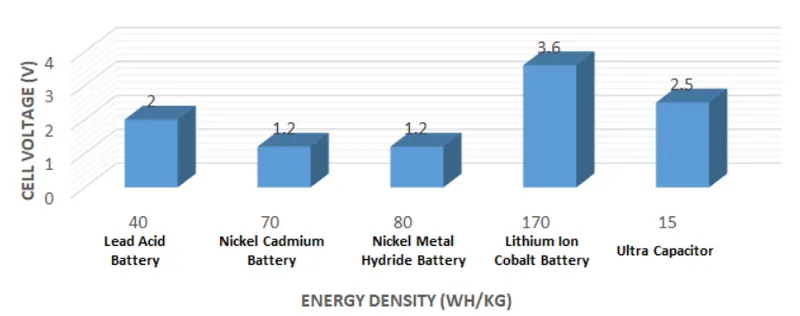
Evidently, lithium ion based batteries have the greatest energy density and cell potential, which is why they are currently the most preferred battery choice. Toyota uses NiMH batteries in its Prius HEV and its Mirai 2021 FCEV, possibly because it is more durable and carries lower risk of thermal runaway than lithium ion.
The lead-acid battery represents the oldest rechargeable battery technology. Lead-acid batteries can be found in a wide variety of applications, including small-scale power storage such as starting, lighting, and ignition power sources for automobiles, along with large, grid-scale power systems.
Ultracapacitors are always used as a supplement to a battery but become the primary power source during transient states for better load management for the battery and the overall powertrain system, since its ability to charge and discharge quickly is unparalled in the battery world currently.
Question 3:
For the above-mentioned components on the same plot (retain the previous plot) created in the previous
Create a plot with power density on the X axis and cell voltage on the Y axis.
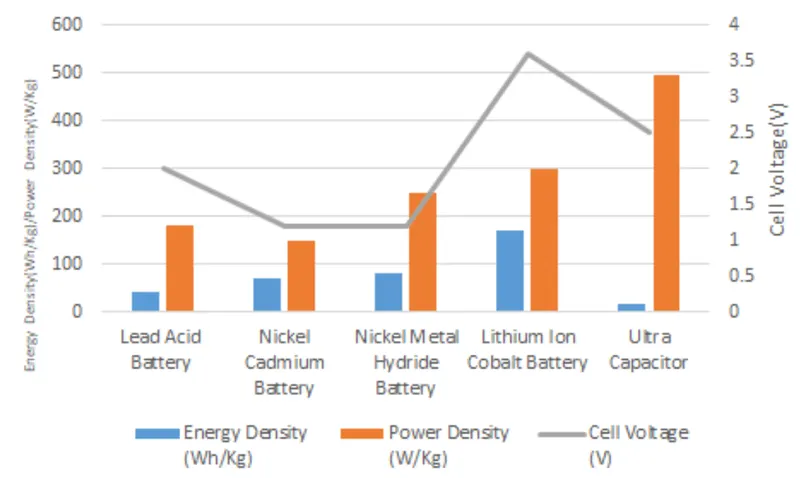
When it comes to power density, this graph demonstrates why UCs currently do so well as a secondary power option coupled with batteries in xEVs today. They become the primary choice of power generation and regenerative braking during transient states like rapid acceleration or deceleration due to their high power density and high C rate for charging and discharging.
Question 4:
Consider the following scenario:
A battery has just been manufactured in the battery and has been connected to a charger for the first time. The electrode marked as (1) in the picture below is the negative electrode.
- True
- False
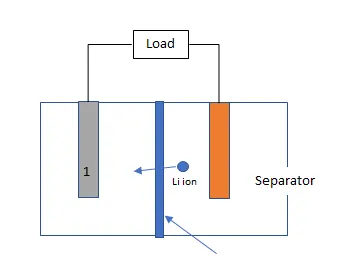
True. During discharging, the intercalated lithium ions travel from anode (negative) to cathode (positive). So during charging, those lithium ions need to be transferred back from cathode to anode to increase the cell potential. Especially during the first charge, there will be little to no lithium ions present at the graphite anode, so they certainly need to travel to the anode to intercalate between the graphite layers to load up on charge.