Components & Properties of the Fuel Cell
Question 1:
Name the components of a fuel cell 1 to 5 in this diagram.
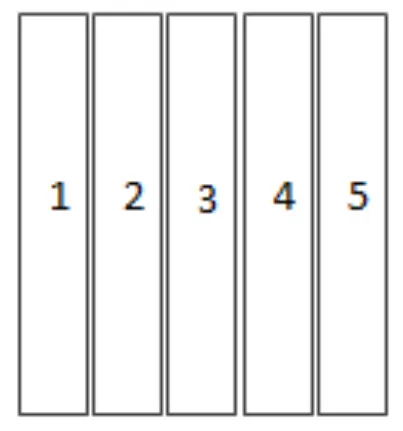
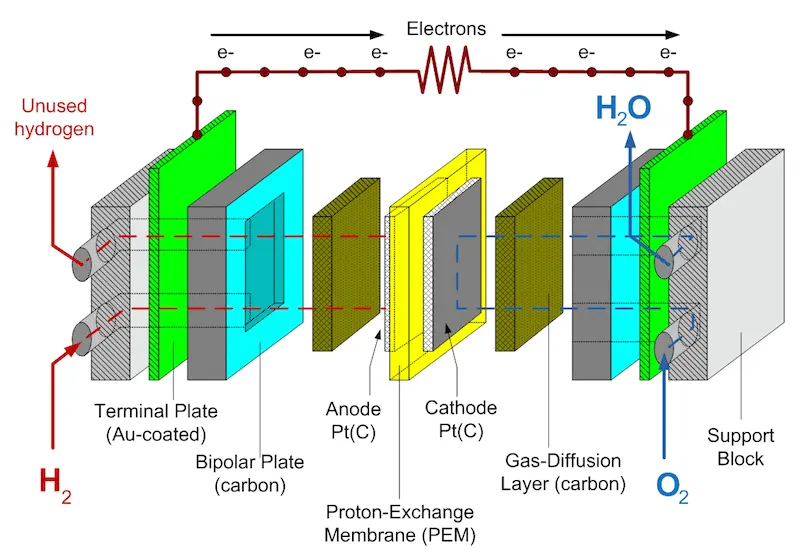
1. Current collector
2. Bipolar plate
3. Gas diffusion layer
4. Electrode: Anode/Cathode
5. Proton Exchange Membrane
Question 2:
Oxygen is an important medium for the conduction of ions across the membrane of the MEA? (True or False)
How does moisture help in conduction of ion?
Hydrogen from the anode needs to travel through the membrane to react with the oxygen at the cathode. However, only a hydrogen ion can travel through the membrane. When both hydrogen gas and oxygen gas are sitting at the electrode catalyst layer, an electrical conductive path is created between them. Oxygen then "pulls" electrons from hydrogen such that it gives up electrons to become hydrogen ions `H^+`, while oxygen has also become an oxygen ion. In this process the electrons are passed between the current collectors from the anode to the cathode, powering the load with the current flow. The hydrogen ions `H^+` can now move through the membrane. However, they still need a driving force and will have trouble getting from anode to cathode without help. Water molecules present in the PEM combine with those hydrogen ions to form`H_3O^+` ions. Water acts as the medium for the conduction of ions from anode to cathode. So, although oxygen plays an important role in turning hydrogen from a gas to an ion for membrane travel, it is untrue that oxygen acts as the medium itself.
Moisture in the membrane provides that driving force to the `H^+` ions to move it from anode to cathode. Too much moisture would flood the membrane with water and may resist the flow of ions. Too less water would not only fail to provide that driving force needed, but also dry up the membrane. A dry membrane will be prone to cracks and thus reduction in active area of the cell, which could significantly affect the amount of current and power that the cell can generate.