Ultracapacitor modelling
Modelling an UC requires equations that make up the parameters of a UC:
- `V_(UC)=V_(max)*SOC-IR_(losses)`
- `OCV=intI/Cdt`
- Charge `Q=C*V_(max)`
- `SOC_(UC)=SOC_(nom)-int(I_(UC)*eta_c)/Qdt` where; `eta_c` = coulombic efficiency of flowing charges
It is important to note that UC discharge current is not the same as UC charge current.
Battery discharge and charge currents are different for the reason that charge and discharge resistance of a battery cell are different.
The same applies to UCs i.e. the current demanded by the motor from the UC for propulsion purposes is different than the current demanded by the UC from the motor for regenerative energy purposes.
- `I_(dischar)=(V_(max)*SOC_(UC)-sqrt((V_(max)*SOC_(UC))^2-(4RP_(UC))/eta_(dc)))/(2R)`
- `I_(char)=(V_(max)*SOC_(UC)-sqrt((V_(max)*SOC_(UC))^2-4RP_(UC)*eta_(dc)))/(2R)`
where;
R = lump resistance of the UC cell
`P_(UC)` = Power demanded by UC from motor or vice versa
`eta_(dc)` = efficiency of the DC/DC converter needed to step up/step down voltage to feed into the DC bus or to transfer it back to the UC, respectively.
MODELLING:
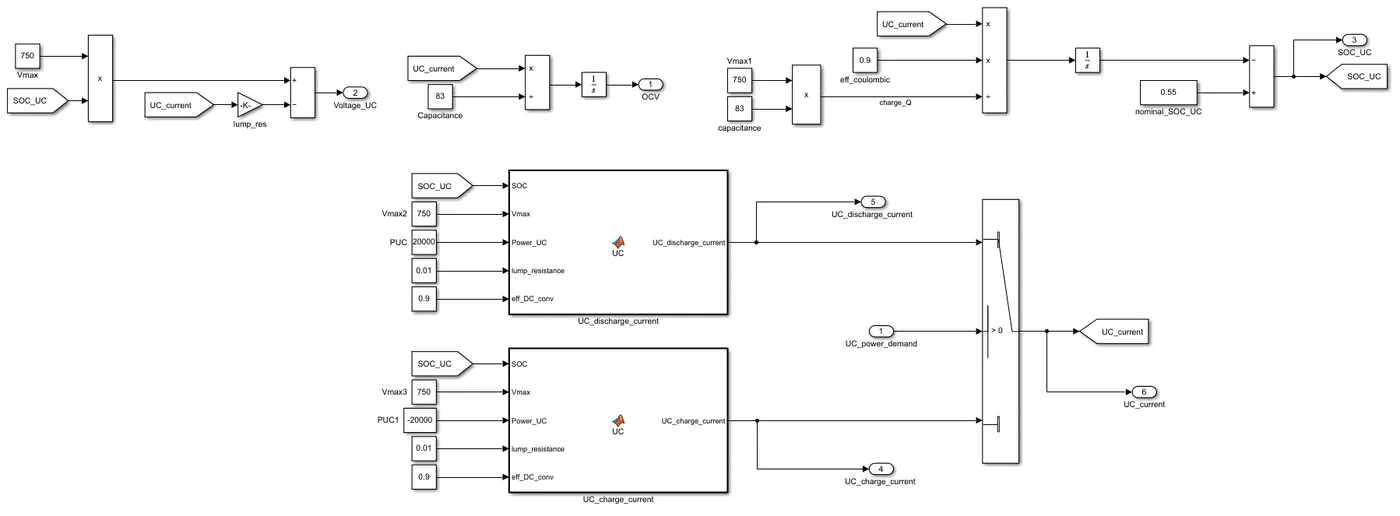
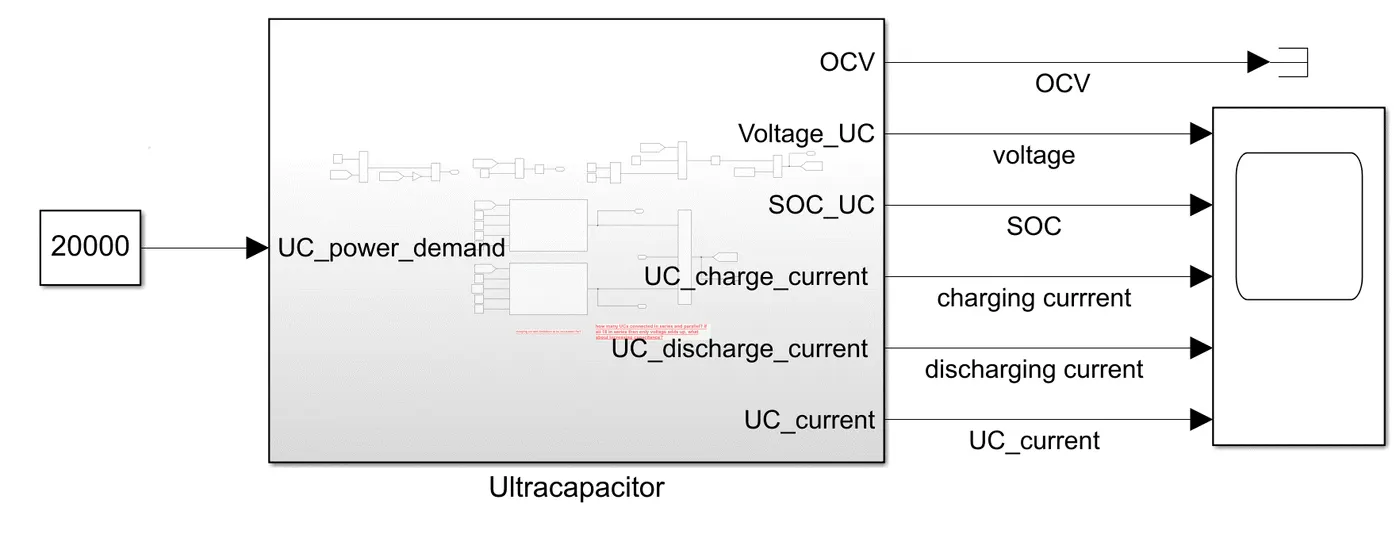
Here, the UC power demand is given as 20,000W which is a positive, and that will activate the discharge current equation. The UC current will hence be the discharge current.
RESULTS:
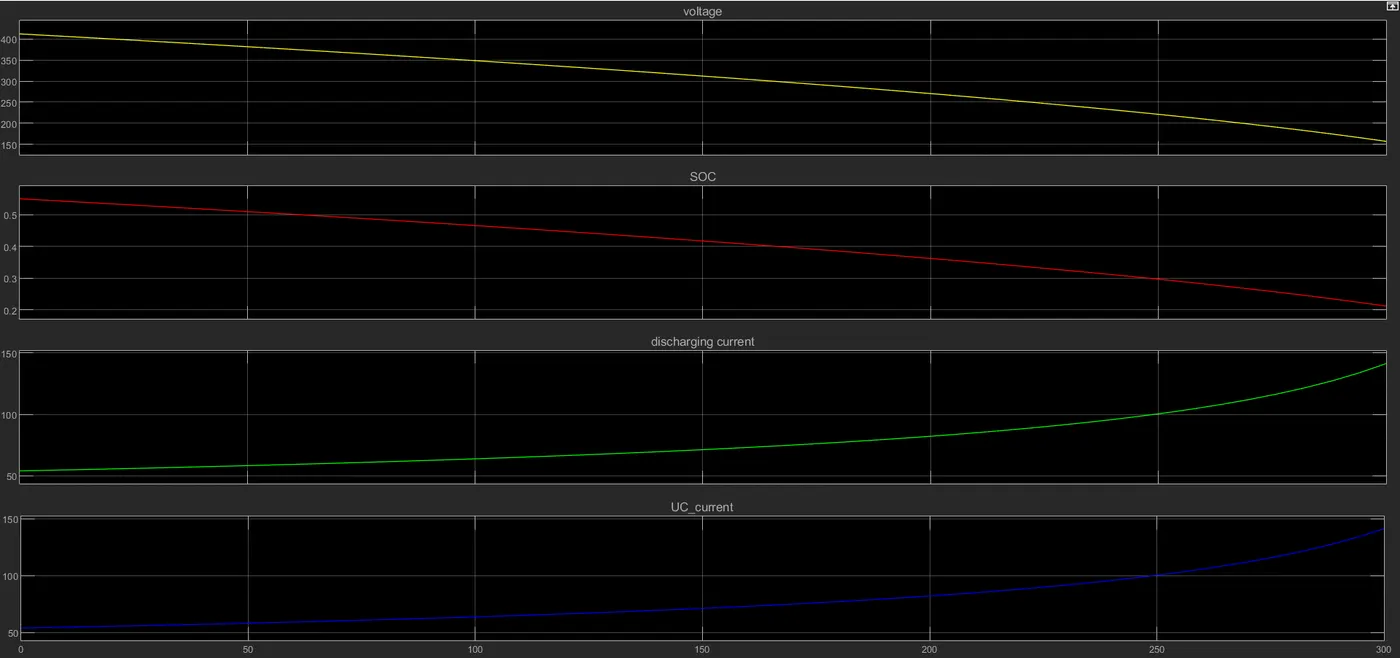
- As the UC discharges current, SOC and voltage reduce while the current increases to meet power demand.
When UC power demand is negative (given as -20,000W) i.e. power is demanded by the UC from the motor to be charged, the charging current equation will be activated.
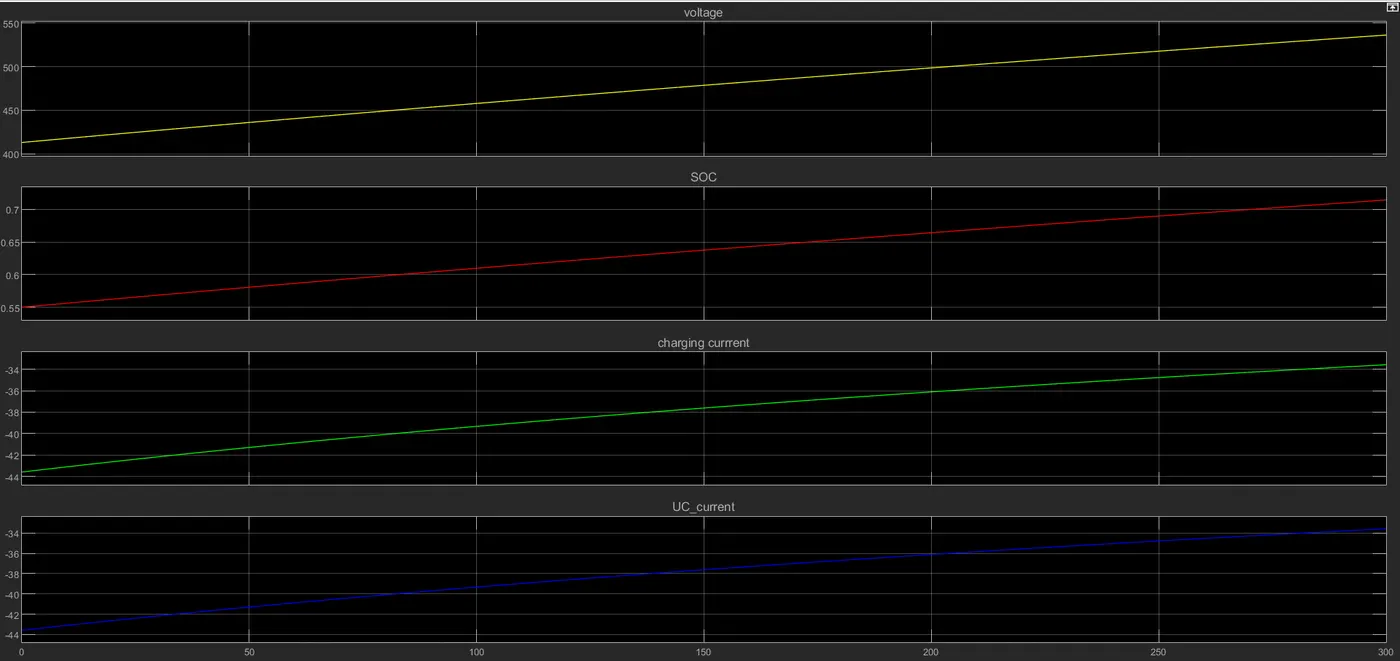
- As evident, the UC is now being charged as voltage and SOC are increasing. During charging the UC, the max charging current and voltage needs to be accounted for, otherwise the dielectric material in the UC between plates will breakdown from high electrical stress.