Wide-Open Throttle (WOT) Condition I
1) What is the ratio of hill-climbing power required by fully loaded tata ultra truck to the half-loaded one?
The following data is for TATA ULTRA-1014:
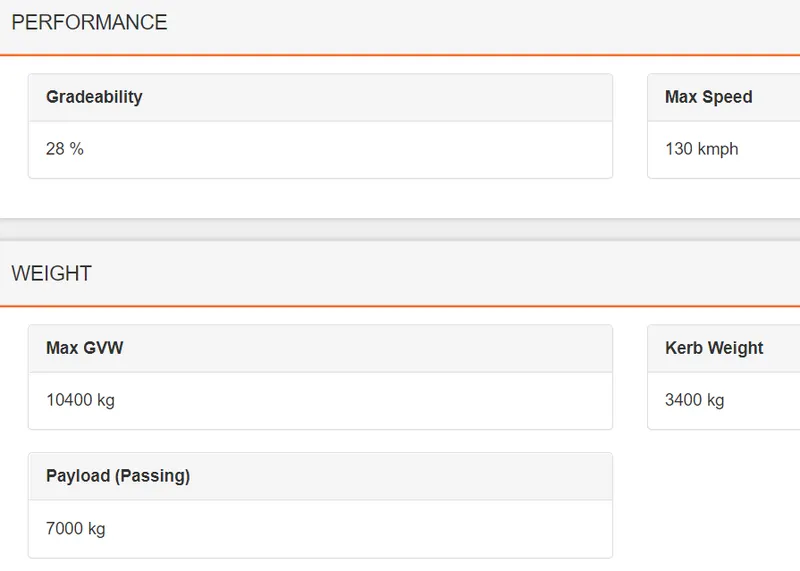
Fully loaded truck would be 10,400kg, whereas half-loaded would be 3400 + 7000/2 = 6900kg
Since hill-climbing power is simply calculated by P = mgvsin`theta`, the ratio of hill climbing power required by the two differently loaded trucks will only depend on the total mass, since the velocity and gradeability of the trucks would be the same. Hence, the hill-climbing power ratio will be:
10,400/6900 = 1.51
2) A flyover is planned to be constructed on a national highway. Keeping in mind about the gradeability for trucks, how much can be the minimum length of the flyover, considering the minimum height at the summit should be 5.5 meters? State your assumptions.
Assuming the gradeability is 16 degrees, the minimum length would be a simple trignometric calculation:
sin 16 = 5.5/L ---> L = 19.95m
3) Prepare a new drive cycle excel file for the given model and also include a hill-climbing angle to it. Comment on the results.

- Once a drive cycle file was created in Excel, it was opened in MATLAB, output type selected as "Column vectors" (this is done so that only data is imported) and the data was imported into the workspace using the "Import Data" command.

- Two separate column vectors are created in the workspace.
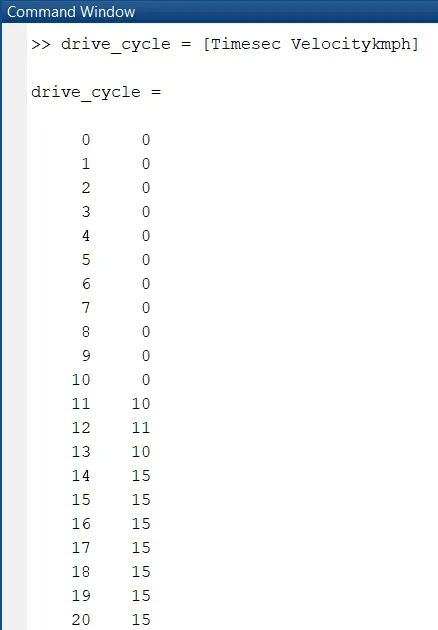 --------->
- A table is created combining those two individual column vectors.
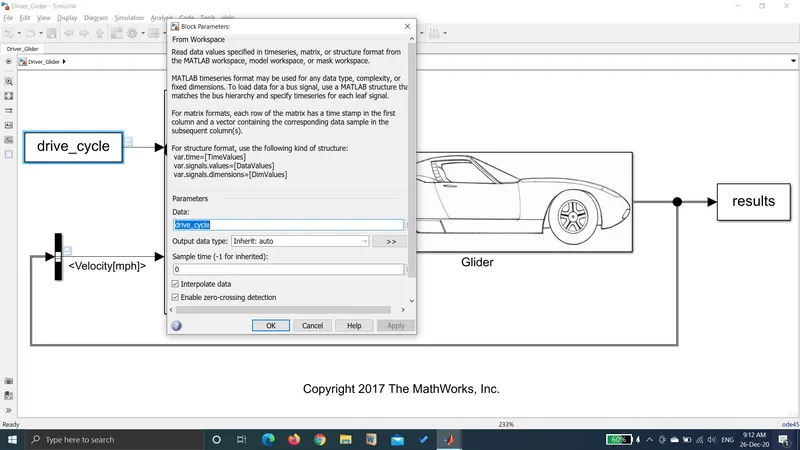
- Data is fed into the model
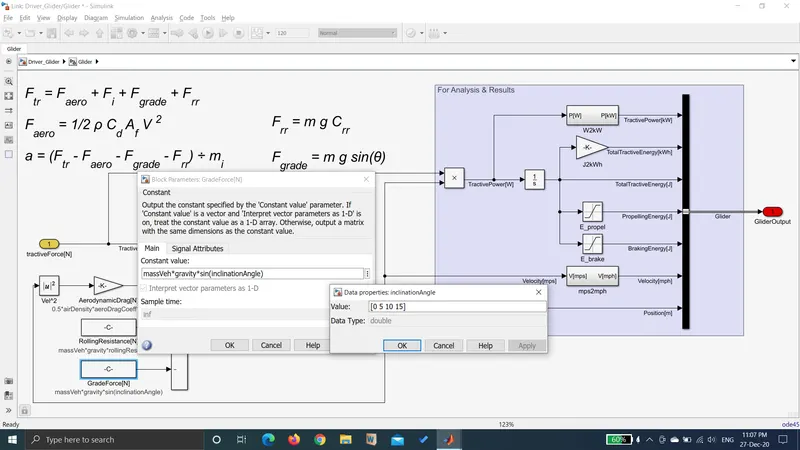
- Glider subblock is opened, and various hill inclination angles are incorporated through the 'GradeForce' block
Output:
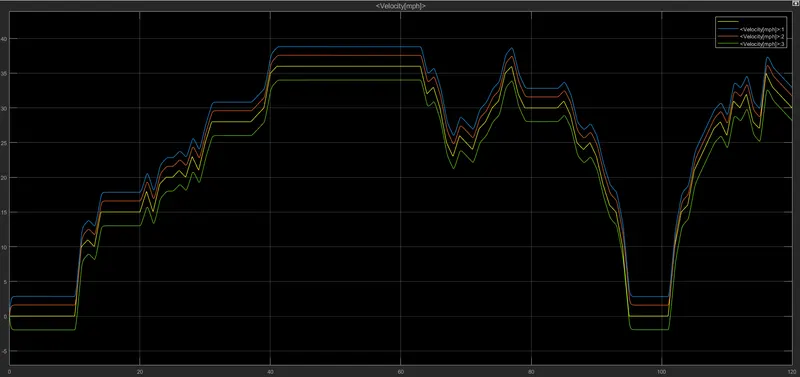
- The yellow graph is the reference drive cycle that was inputted earlier, and the blue, orange and green are drive cycles with 5,10, and 15 degrees respectively.
- The closer the overlap with the reference drive cycle, the more appropriate is the tractive force for the given vehicle model to meet the reference drive cycle.
- With the three hill angles here, it is evident that the tractive force is not the most appropriate for this vehicle model that needs to travel at the given degrees of elevation, since the reference drive cycle is not exactly met.
4) Model the WOT (Wide Open Throttle) response of GM EV1 car. Compare it with the official figures of the performance of a real vehicle. What is the variation in acceleration time with a 5% change in vehicle parameters?
The WOT test is essentially about how fast top speed can be reached. To determine that, the total amount of tractive force needed to accelerate the vehicle needs to be deduced. Through derivations and calculations, the total force available from the motor that is used to drive the wheels to top speed is determined as:
`(Geta_GT_m)/r` [where G = gear ratio, `T_m` = motor torque, `eta_G` = gear efficiency, r = radius of the wheel]
The total force needed to overcome by the motor to accelerate the vehicle consists of:
- Rolling resistance force
- Aerodynamic force
- Vehicle inertia force
- Rotational inertia force of moving parts
---> `mu_(rr)mg + 1/2rhoAC_dv^2 + ma + (IG^2a)/(r^2eta_G)`
---> `(Geta_GT_m)/r` = `mu_(rr)mg + 1/2rhoAC_dv^2 + ma + (IG^2a)/(r^2eta_G)`
---> `(Geta_GT_m)/r` = `mu_(rr)mg + 1/2rhoAC_dv^2 + (dv)/(dt)(m + (IG^2)/(r^2eta_G))`
- Because a motor has two main operating regions where it performs differently (i.e. the constant torque and constant power region), both cases need to be considered to determine how fast top speed can be reached. This therefore will lead to two different equations.
- Until a certain rotor speed (critical speed `omega_(rated)`), the motor operates at rated torque. That rotor speed for a GM EV1 car is 733rad/sec. Beyond this, there is a reduction in torque and an increase in rotor speed such that the motor operates at constant power of 102kW.
After rearranging and substituting the values:
---> `(dv)/dt = 3.08 - 0.000137v^2` ---------------- Acceleration in constant torque region
---> `(dv)/dt = 65.38/v - 0.0465 - 0.000137v^2` --------------- Acceleration in constant power region
Using MATLAB to solve:
clear all; close all; clc;

%GT/r = umg + 0.5*p*A*Cd*v^2 + dv/dt(m + IG^2/(r^2*G_eff)); amount of force needed to accelerate vehicle

%-----------------Parameters-----------------
% G = 11; r = 0.3; T = 140; m = 1540; Cd = 0.19; u = 0.0048; p = 1.25;
% A = 1.8; v_critical = 19.8; G_eff = 0.95;

%dv/dt = 3.08 - 0.000137v^2; %before critical velocity is reached (constant torque region)

%dv/dt = 65.38/v - 0.0465 - 0.000137v^2; %after critical velocity is reached (constant power region)

t = linspace(0,30,301); %time step of 0.1s
vel = zeros(1,301);
d = zeros(1,301);
dt = 0.1;
for n = 1:300
    if(vel(n) < 19.8)
        vel(n+1) = vel(n) + dt*(3.08 - 0.000137*(vel(n))^2); %before critical velocity is reached (constant torque region)
    else
        if(vel(n) > 36) %max speed reached
        vel(n+1) = vel(n);
    else
        vel(n+1) = vel(n) + dt*(65.38/(vel(n)) - 0.0465 - 0.000137*(vel(n))^2); %after critical velocity is reached (constant power region)
        end
    end
      d(n+1) = d(n) + dt*vel(n);
end

%--------;---Plotting------------
vel = vel.*3.6;
d = d./1000;
figure;
subplot(2,1,1)
plot(t,vel,'linew',1.5,'color','r')
xlabel('Time(sec)')
ylabel('Velocity(kmph)')
title('WOT condition of a GM EV1 car')
hold on
subplot(2,1,2)
plot(t,d,'linew',1.5,'color','r')
xlabel('Time(sec)')
ylabel('Distance(km)')
Output:
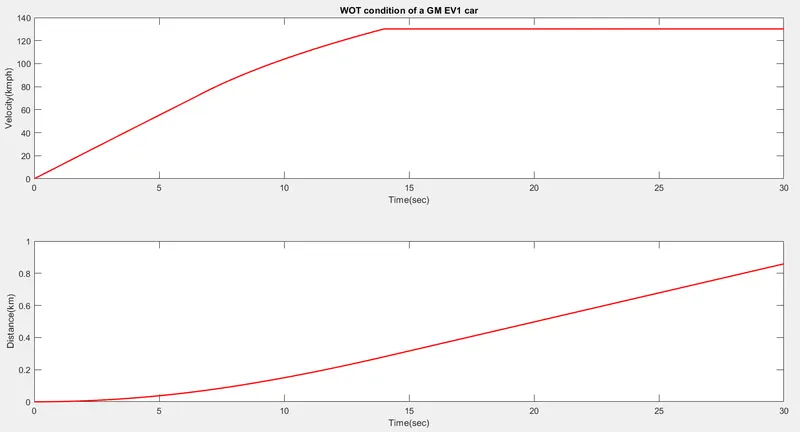
- Top speed is 130kmph - it takes about 14 seconds at full throttle to accelerate to top speed
- Distance travelled in those 14 seconds is about 0.25km
After 5% increase in vehicle parameters for comparison:
%-----------------5% increase in Vehicle Parameters-----------------
% G = 11*1.05 = 11.55 ; r = 0.3*1.05 = 0.3150; T = 140; m = 1540*1.05 = 1617; Cd = 0.19; u = 0.0048*1.05 = 0.005;
%p = 1.25; A = 1.8*1.05 = 1.89; v_critical = 19.8; G_eff = 0.95;

for n = 1:300
    if(vel(n) < 19.8)
        vel(n+1) = vel(n) + dt*(2.93 - 0.0001368*(vel(n))^2); %before critical velocity is reached (constant torque region)
    else
        if(vel(n) > 36) %max speed reached
        vel(n+1) = vel(n);
    else
        vel(n+1) = vel(n) + dt*(62.31/(vel(n)) - 0.0484 - 0.0001368*(vel(n))^2); %after critical velocity is reached (constant power region)
        end
    end
      d(n+1) = d(n) + dt*vel(n);
end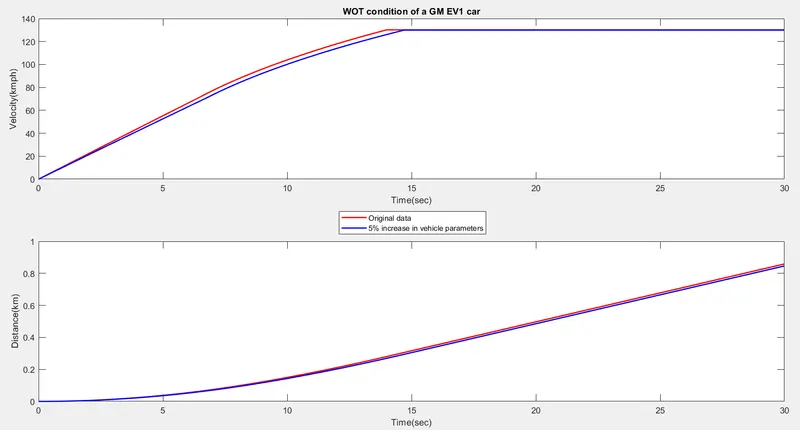
- Factors such as greater rolling resistance, greater aerodynamic drag, greater vehicle mass, and greater vehicle radius lead to a higher time required to reach top speed - about 15 seconds relative to 14 seconds with original data.
- Difference in distance travelled is minimal.