Nernst's Equation & Polarization curve
Question:
Define Nernst equation for fuel cell and then define what parameters affect the reaction in a fuel cell in what way.
Nernst's equation for fuel cells: `E_(cell)=E^0+(RT)/(nF)*ln((prod_(r))/(prod_p))`
where;
`E_(cell)` = cell potential
`E^0` = standard cell potential
R = universal gas constant
T = temperature in K
F = Faraday's constant
n = number of moles of electrons transferred
`(prod)_r` = partial pressure of reactant(s)
`(prod)_(p)` = partial pressure of product(s)
The Nernst equation demonstrates how the cell potential changes as the reaction progresses i.e. the effect of temperature and partial pressures of reactants and products on cell potential.
Parameters affecting the fuel cell:
- Cell potential - a high cell potential is desirable since that will allow the FC to generate more power. However, too high of a cell potential would mean the current density is too low due to the polarization curve of a FC, which leads to a sluggish reaction and losing more fuel to cover for the activation losses. So a moderate cell potential is ideal if its coupled with a decent current density, as that will give good power and good efficiency.
- Temperature - one of the most important parameters, the performance improvement at higher temperatures is mainly due to increased membrane proton conductivity, enhanced electrode kinetics for the oxygen reduction reaction (ORR) and the hydrogen oxidation reaction (HOR), and improved mass transfer of the reactants. In addition, increasing the temperature can also increase the tolerance of electrocatalysts to contaminants, especially for the sensitive FCs like AFC and PEMFC. However, higher operating temperatures can lead to membrane dehydration, increased hydrogen crossover rate, and the degradation of components such as bipolar plates, resulting in a shortened fuel cell lifetime.
- Number of moles of electrons transferred - the more electrons are transferred, the better the flow of current and thus more electricity produced
- Partial pressure - a higher partial pressure of the reactants in the fuel cell (by increasing the flow rate of the reactants) will lead to an increase in the open circuit voltage. However, partial pressure of both hydrogen and oxygen decreases when temperature increases for PEMFCs (decreases exponentially after 80 degrees C), which increases activation losses and reduces cell performance. So a good balance between both partial pressure and temperature is needed, which will probably be around the 80 degree C for PEMFCs.
Question:
Consider the following operating points of a fuel cell during a short period of operation.
- 0.15 W/cm2
- 0.3 W/cm2
- 0.27 W/cm2
Where would these points go in the diagram below? Which among the three points is the best operating point and why?
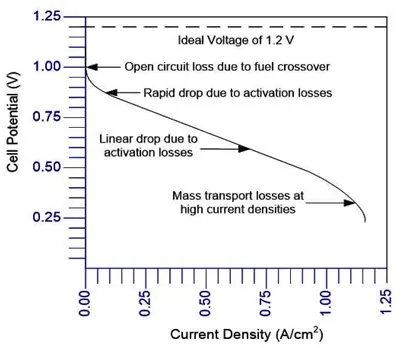
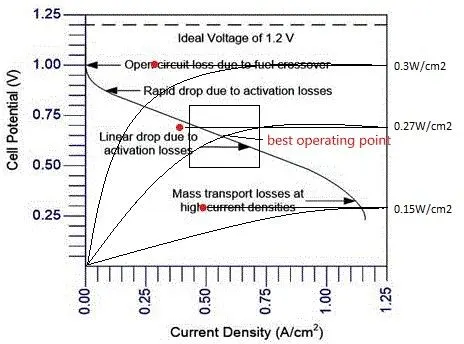
- On the left section of this polarizing curve is where the cell potential is high while the current density is low. Although this zone produces the most amount of power density, due to the low current density, the reaction is sluggish. A sluggish reaction doesn't allow to cover for the activation losses, and thus demands for more energy to overcome the membrane barrier. Hence, this zone wouldn't be the ideal operating point.
- On the right section of the curve is where the current density is high whereas the cell potential is low. Not only does this zone produce the lowest power density, producing a low cell voltage is undesirable because the FC stack is usually connected to a boost converter that needs a minimum voltage to operate.
- In the middle section is where ohmic losses (most natural losses in any electrical system) are present. In this region there is a good balance between fuel efficiency and power output. Since low current density or low cell voltage isn't desirable, the best operating region happens to be in the middle, producing 0.27W/cm2