Project
Aim:
To study and analyze the BAJA All-Terrain Vehicle model using Simulink and comparing the different models that are given.
Objective:
- To prepare a technical report explaining the functions of the subsystems and blocks used in the model and explaining the differences between the five models provided.
- To observe the results.
Types of Model to Study:
There are 5 types of models given to study
- BAJA ATV model without Dashboard (cvtModel)
- BAJA ATV model with Dashboard (cvtModel_dashboard)
- BAJA ATV model data Lookup Table (cvtModel_data)
- BAJA ATV model Mapped Lookup Table (cvtModel_mapped)
- BAJA ATV model Mapped with dashboard Lookup Table (cvtModel_dashboard_mapped)
Theory:
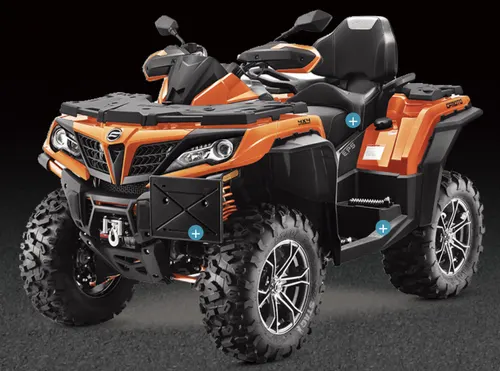
ATV:
An all-terrain vehicle (ATV), also known as a light utility vehicle (LUV), is a vehicle that travels on low-pressure tires, with a seat that is straddled by the operator, along with handlebars for steering control. As the name implies, it is designed to handle a wider variety of terrain than most other vehicles.
The rider sits on and operates these vehicles like a motorcycle, but the extra wheels give more stability at slower speeds. Although most are equipped with three or four wheels, six-wheel models exist for specialized applications. Multiple-user analogs with side-by-side seating are called utility terrain vehicles (UTVs) or side-by-sides to distinguish the classes of vehicles. Both classes tend to have similar powertrain parts.
BAJA SAE:
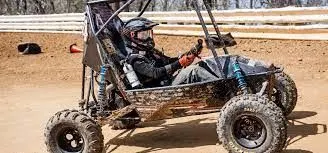
BAJA SAE is an inter-college competition run by the Society of Automotive Engineers (SAE) International. Teams of students from universities all over the world design and build small off-road cars. The cars all have engines of the same specifications. Each team is competing to have its design accepted for manufacture by a fictitious firm. The students must function as a team to design, build, test, promote and complete a vehicle within the limits of the rules, also to generate financial support for their project, and manage their educational priorities.
Starting in 2022, all cars will be required to utilize a 4WD drive train system. Top teams have locked into a standard design in recent years, so the new drive train requirements serve as an opportunity for students to design systems from the ground up and shake up the design possibilities.
CVT:
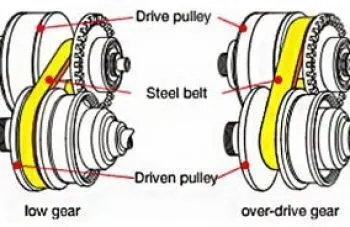
A continuously variable transmission (CVT) is an automatic transmission that can change seamlessly through a continuous range of gear ratios. This contrasts with other transmissions that provide a limited number of gear ratios in fixed steps. The flexibility of a CVT with suitable control may allow the engine to operate at a constant RPM while the vehicle moves at varying speeds.
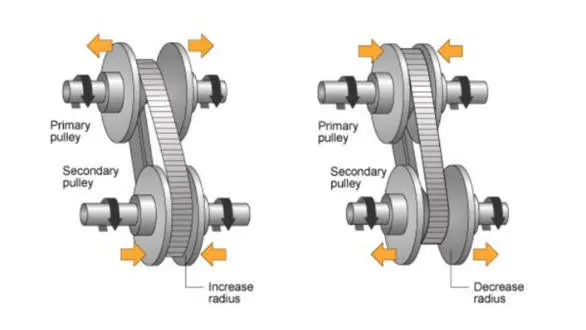
The most common type of CVT uses a V-belt which runs between two variable diameter pulleys. The pulleys consist of two cone-shaped halves that move together and apart. The V-belt runs between these two halves, so the effective diameter of the pulley is dependent on the distance between the two halves of the pulley. The V-shaped cross-section of the belt causes it to ride higher on one pulley and lower on the other, therefore the gear ratio is adjusted by moving the two sheaves of one pulley closer together and the two sheaves of the other pulley farther apart.
Procedure:
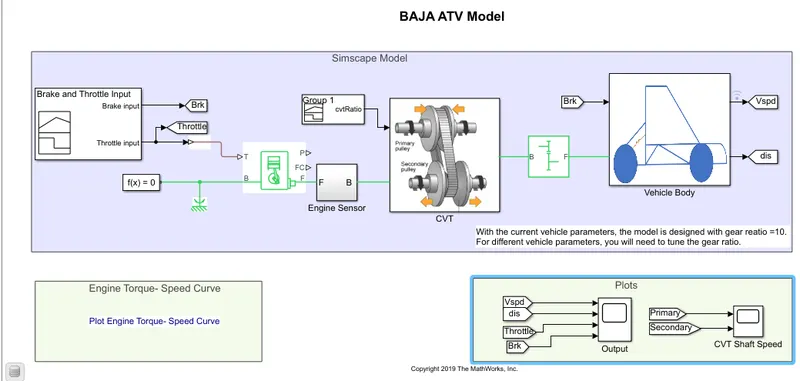
- BAJA ATV model without Dashboard (cvtModel):
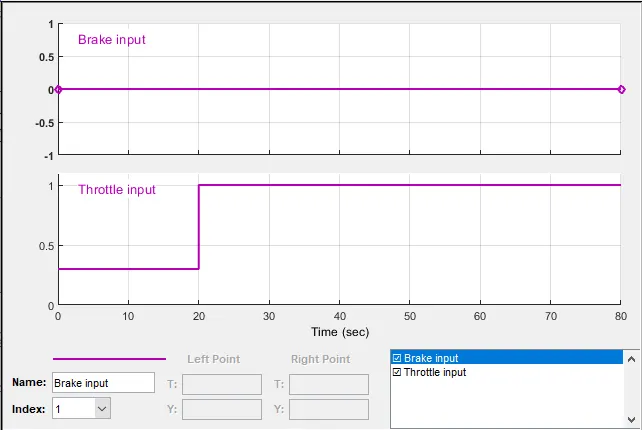
- The throttle and brake inputs are given into a signal builder are connected to a generic engine block ‘T’ port with the help of a Simulink-PS converter and brake input is connected to a scope.
- The Engine block port (B) is connected to a mechanical rotational reference and a solver.
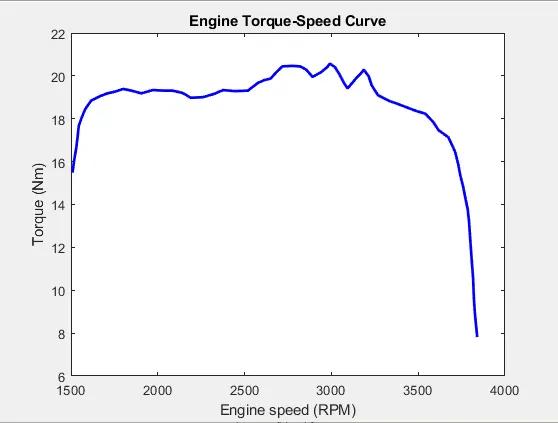
- The torque and speed vectors are inputted from the MATLAB workspace.
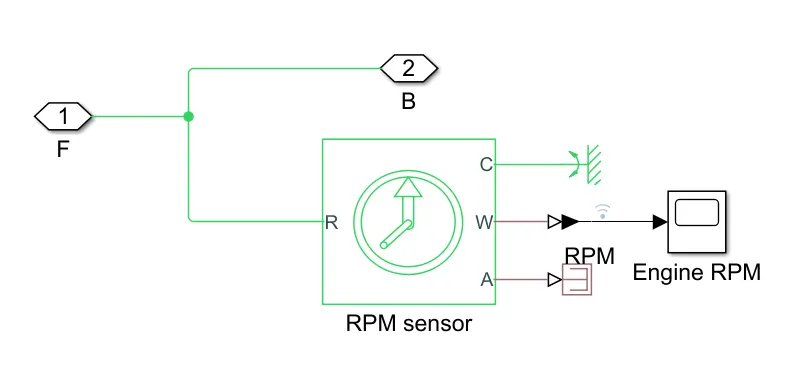
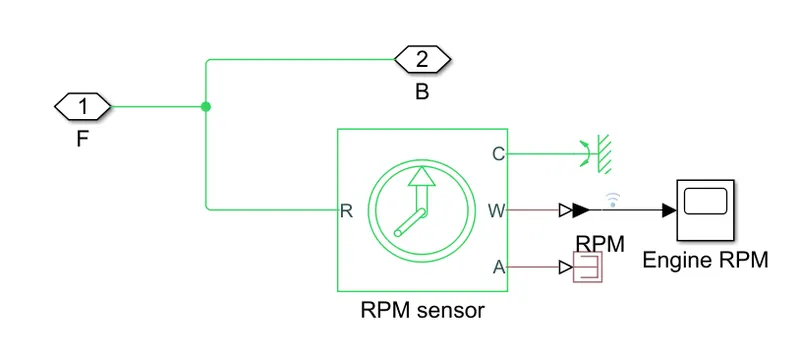
- In the generic Engine, the Engine Crankshaft port (F) is connected to the Engine sensor sub-block which contains the Ideal rotational Motion sensor used for engine RPM.
- The engine will generate an rpm from the crankshaft output.
- The output speed is given to a simple gear mechanism to reduce the speed where the gear ratio is ‘4’.
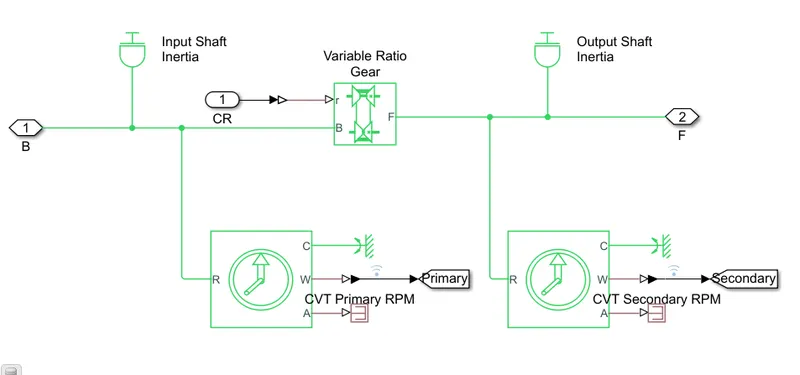
- The speed attained from the gear reducer is given to the Variable Ratio Transmission block in CVT by the signal builder.
- In the CVT Block, the variable CVT ratio controls the speed and the controlled output speed is sent to the vehicle axle.
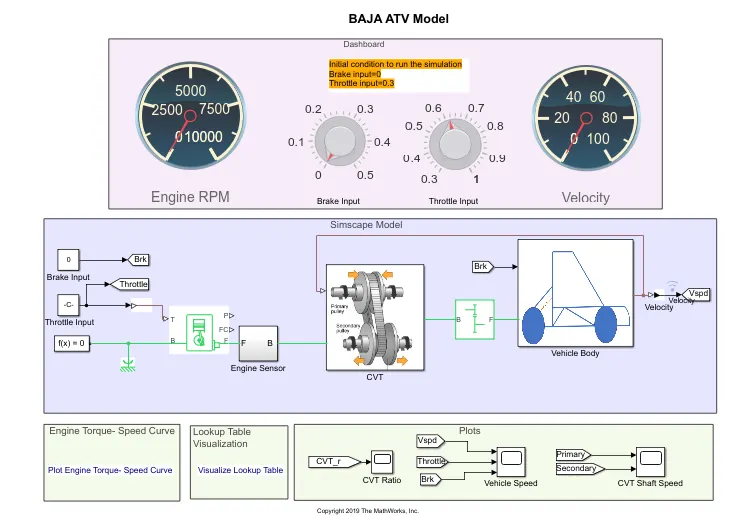
- The Vehicle Body is a complicated circuit block that connects to the Rear and Front end tires of the Vehicle.
- The brake signal is given by the signal builder and the input is given to the Double Shoe Brake for applying the brake to the axle.
- The power from the CVT is connected to the axle. The vehicle is rear-wheel drive. The output is from the gearbox from the rear axle and input inertia is added to simulate axle inertia.
- The shoe brake “S” port is connected to the Axle.
- The vehicle accelerates according to speed.
- The velocity is connected to the scope to check the plots from the vehicle body.
Engine Sensor:
CVT Subblock:
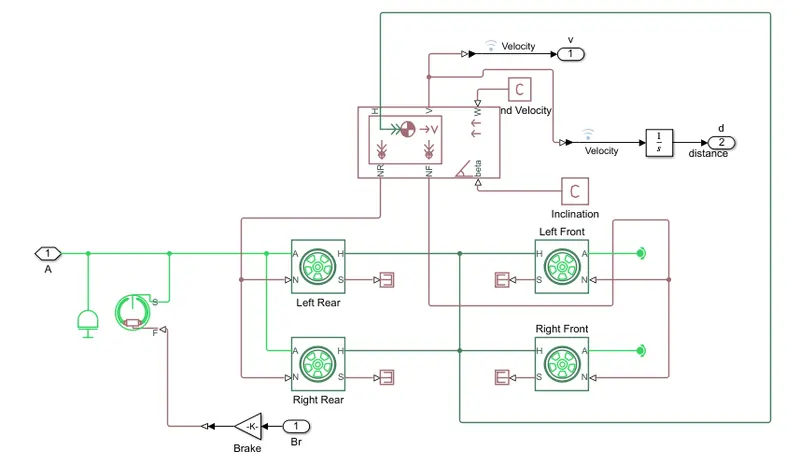
Vehicle Body Sub-block:
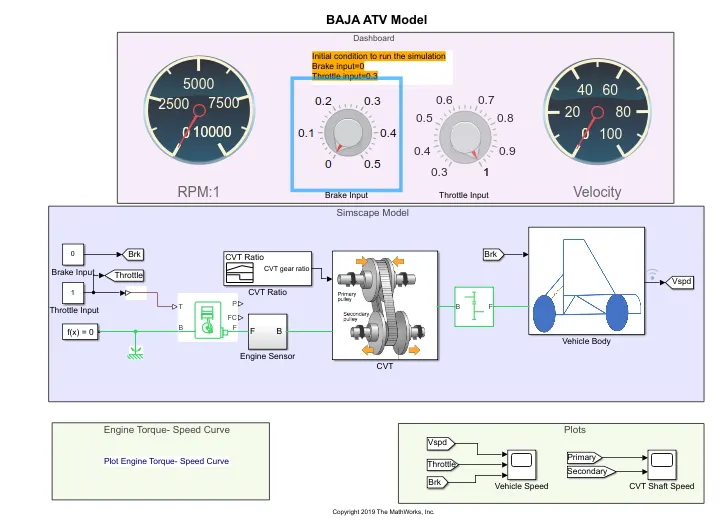
- BAJA ATV model with Dashboard (cvtModel_dashboard):
- This model is similar to that of the BAJA ATV model explained previously but it contains small changes.
- User-defined inputs are given using the knobs instead of the throttle and brake inputs.
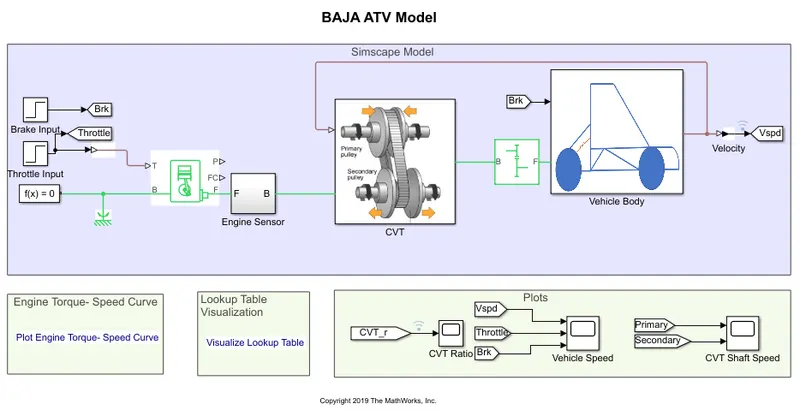
- BAJA ATV model data Lookup Table (cvtModel_data)
- The model is similar to the 1st Model with additional inputs given to the CVT ratio and speed data which are extracted using the “To Workspace” block.
- BAJA ATV model Mapped Lookup Table without Dashboard (cvtModel_mapped)
- The model is similar to the 1st There’s a small difference between the BAJA ATV model and the Mapped table is that the former uses the signal builder whereas the latter uses the step input blocks and the 2D Lookup table for the same throttle and brake signals and the CVT Ratio respectively.
- The interpolation and extrapolation methods are set to linear and the file names are given as Lookuptable_data.mat
Engine Sensor:
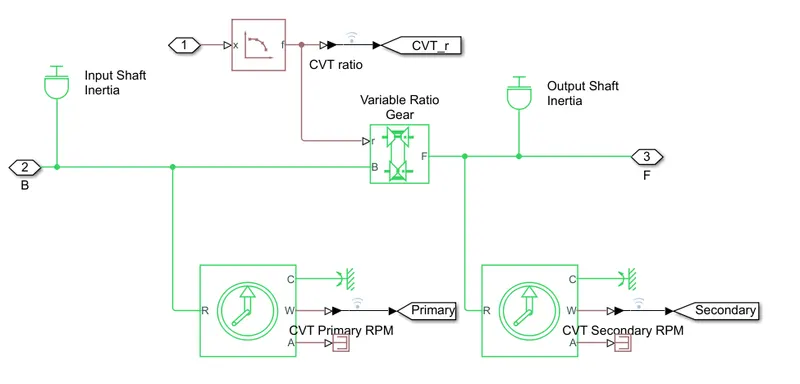
CVT Sub-block:
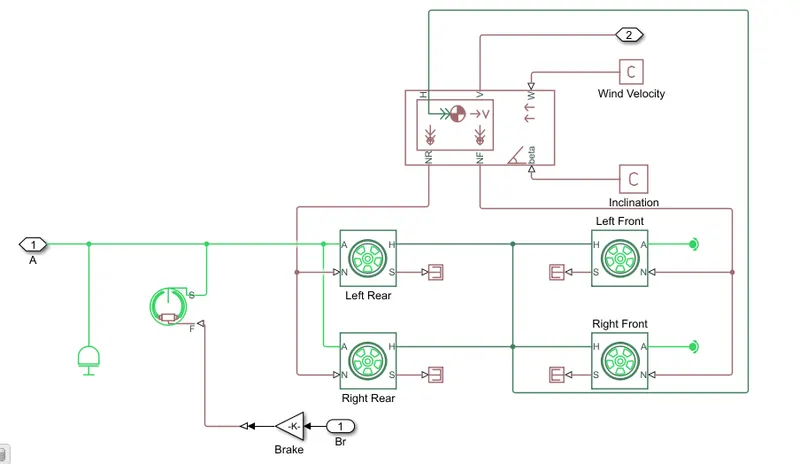
Vehicle body sub-block:
- BAJA ATV model Mapped with dashboard Lookup Table (cvtModel_dashboard_mapped):
- This model is similar to the BAJA ATV Model mentioned just above and the only additional attachment is that the inputs are controlled by a user with the knob and the vehicle speed.
Blocks Used:
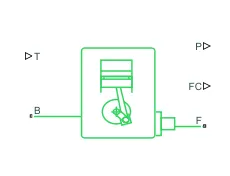
- Generic Engine Block:
The Generic Engine represents a system-level model of spark ignition and diesel engines suitable for use at the initial stages of modelling when only basic parameters such as speed-power and speed-Torque are available. The throttle input signal lies between zero and one and specifies the torque demanded from the engine as a fraction of the maximum possible torque. If the engine speed falls below the stall speed, the engine torque is blended to zero. If the engine speed exceeds the maximum speed, the simulation stops and issues an error message.
Ports:
F- It is a mechanical rotational conserving port that represents the engine block.
B- It is a mechanical rotational conserving port that represents the engine crankshaft
T- It is a Physical signal input port that specifies the normalized engine throttle level
P- It is a physical signal output port that represents the instantaneous engine power, in W.
FC- It is a physical signal output port that represents the fuel consumption rate.
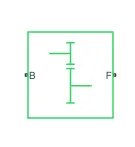
- Simple Gear:
The simple gear represents a fixed ratio gear or gearbox. No inertia or compliance is modeled in this block. It constrains the connected driveline axes of the base gear and follower gear to rotate with a fixed ratio.
The gear ratio is the ratio of the number of teeth in the Follower to the number of teeth in the base gear.
Port:
B- Rotational mechanical conserving port represents the input shaft.
F- Rotational mechanical conserving port represents the output shaft.
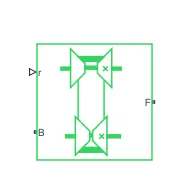
- Variable Ratio Transmission block:
It represents a variable ratio gearbox such as implemented by mechanical belt CVT, electric, or hydraulic transmissions. The physical signal input r defines the ratio of input to output angular shaft velocities.
Ports:
B- Represents Base Pulley or Drive Pulley.
F- Represents Follower Pulley or Driven Pulley.
r- Represents input Variable Transmission Ratio.
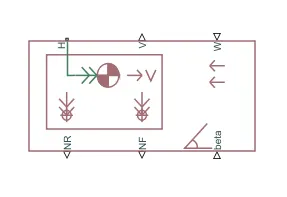
- Vehicle Body block:
It represents a two-axle vehicle body in longitudinal motion. The block accounts for body mass, aerodynamic drag, road incline, and weight distribution between axles due to acceleration and road profile. The vehicle can have the same or a different number of wheels on each axle. Optionally include pitch and suspension dynamics or additional variable mass and inertia. The vehicle does not move vertically relative to the ground.
Ports:
Connections W and beta are physical signal input ports corresponding to headwind speed and road inclination angle, respectively. If the variable mass is modeled, the physical signal input ports CG and M are exposed. CG accepts a two-element vector representing the x and y distance offsets from vehicle CG to additional load mass CG. M represents the additional mass. If both variable mass and pitch dynamics are included, the physical signal port J accepts the inertia of the additional mass about its own CG.
Beta- Represents physical signal input for road inclination angle.
W- Represents the physical signal input for the headwind speed
CG- Represents the physical signal input for the mass relative to the CG of the vehicle, externally.
M-Represents the physical signal input port for mass.
J- Represents the physical signal input for the externally defined mass which accepts the inertia.
NR- Represents the physical signal output port for the rear axle which is considered positive acting downward.
NF- Represents the physical signal output port for the front axle which is considered positive acting downward.
V- Represents the physical signal output port for vehicle velocity.
H- Represents the mechanical translational conserving port associated with the horizontal motion of the vehicle body. The resulting traction motion developed by tires should be connected to this port.
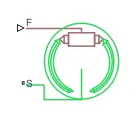
- Double shoe brake block:
The double shoe brake block represents a brake arranged as two pivoted rigid shoes symmetrically installed inside or outside a drum and operated by one actuator. The actuator force causes the shoes to exert a friction torque on a shaft connected to the drum.
Positive force creates friction torque that resists shaft rotation. Optionally include thermal effects and expose thermal conserving port H by setting Thermal port to Model.
Port:
F- Represents Physical signal input port associated with the applied actuating force.
S- Represents rotational conserving port associated with the rotating drum shaft.
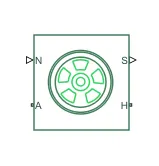
- Tire(magic formula) block:
Tire block represents the longitudinal behavior of a highway tire characterized by the tire Magic Formula. The block is built from Tire-Road Interaction (Magic Formula) and Simscape Foundation Library Wheel and Axle blocks.
Ports:
A- Represents the mechanical rotational port associated with the axle where the tire is placed.
N- Represents the physical input signal port associated with the positive normal force acting downwards on the tire.
H- Represents the mechanical translational port associated with the wheel hub that transmits the thrust generated by the tire to the remainder of the vehicle.
S- Represents the physical signal output port associated with the relative slip between the tire and road.
Result:
- BAJA ATV model without Dashboard (cvtModel):
- Torque speed plot:
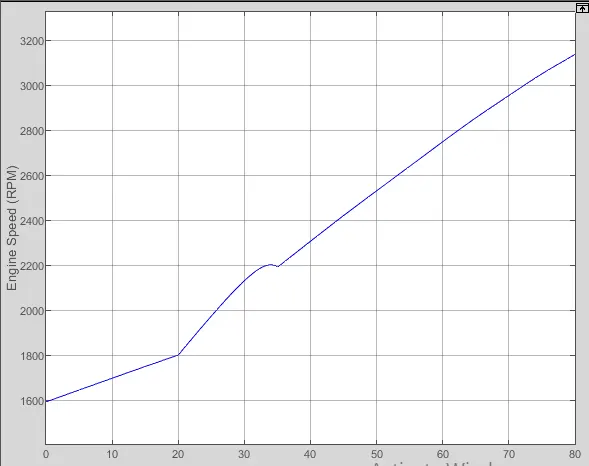
- Engine Speed Plot:
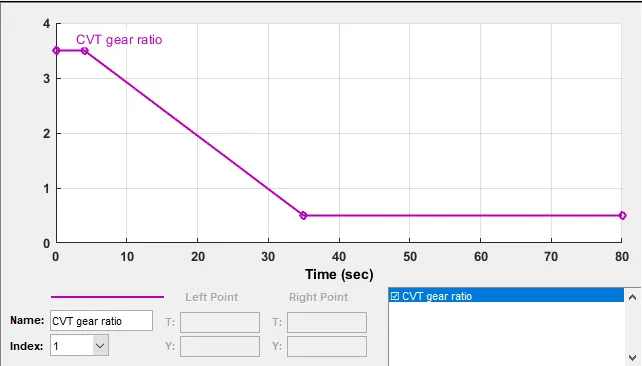
- CVT gear ratio graph
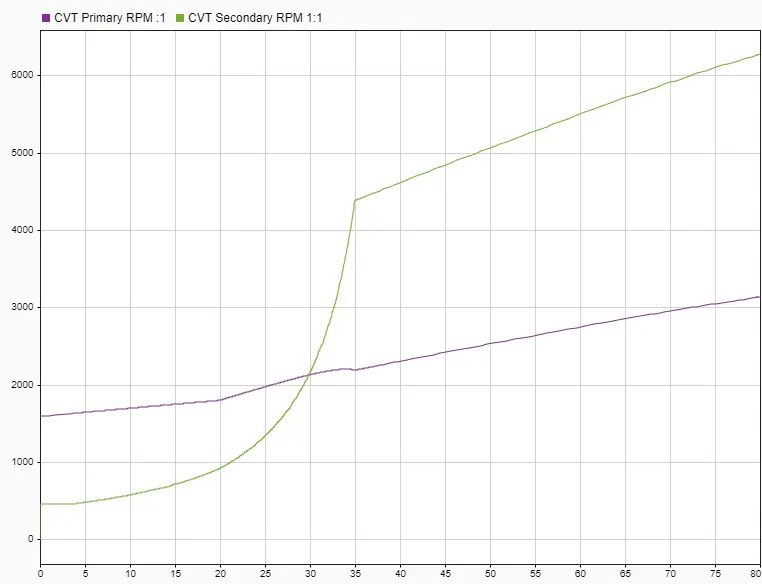
- Cvt speed graph
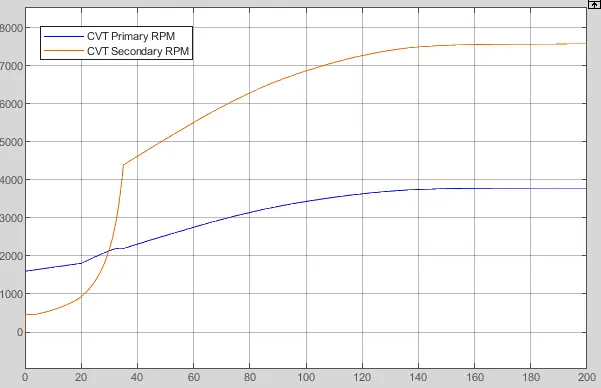
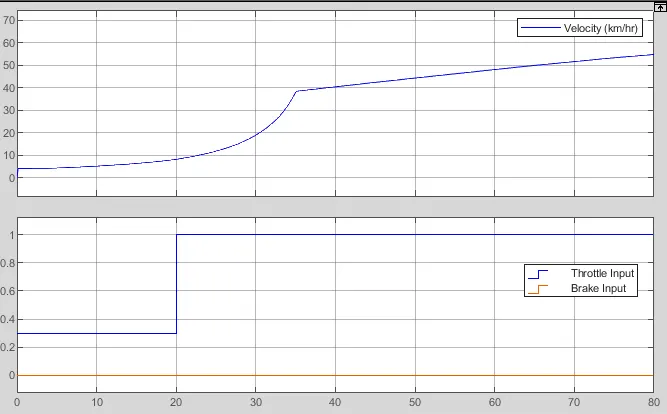
- Speed vs throttle and brake, velocity plot
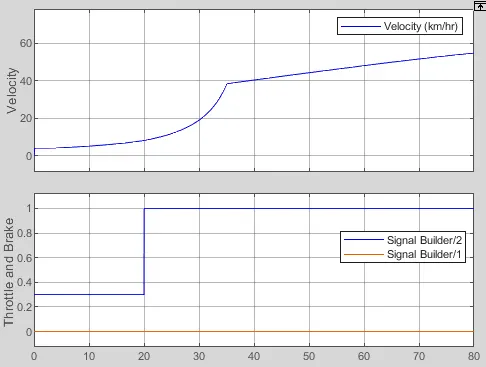
- BAJA ATV model with Dashboard (cvtModel_dashboard):
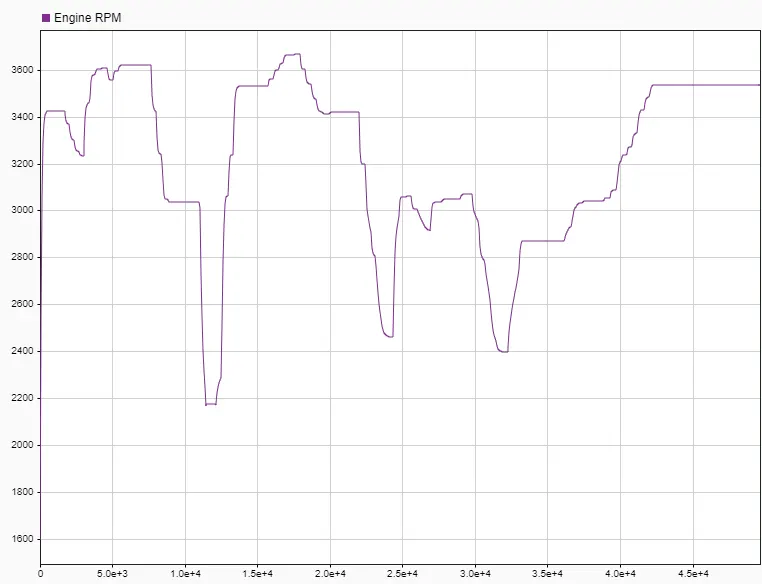
- Engine speed plot
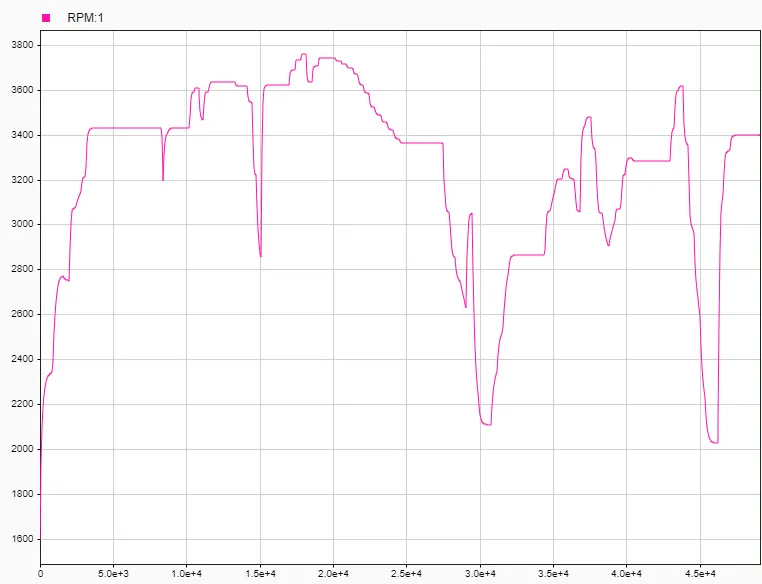
- CVT driven and driver graphs
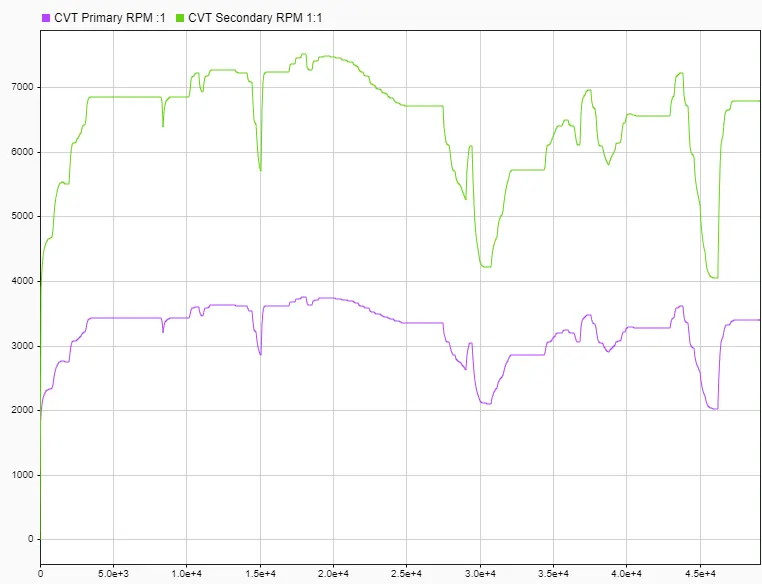
- Speed vs throttle input
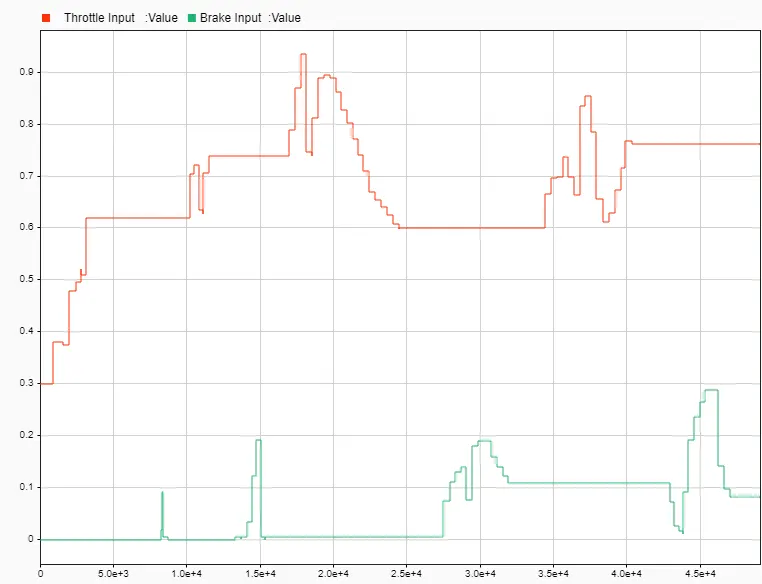
- BAJA ATV model data Lookup Table (cvtModel_data):
- Workspace block
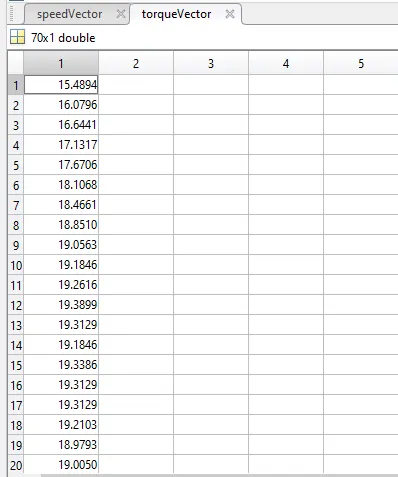
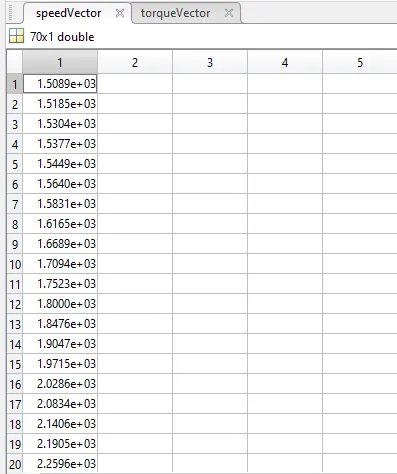
- BAJA ATV model Mapped Lookup Table (cvtModel_mapped):
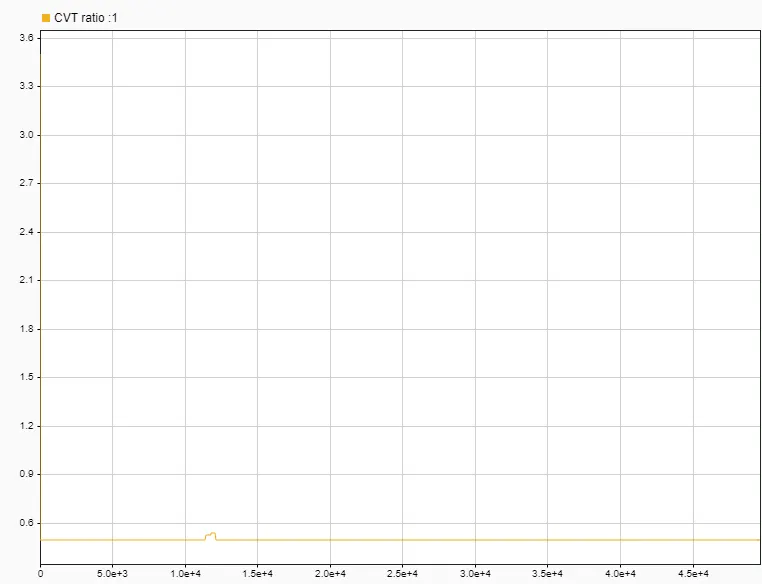
- CVT ratio plot
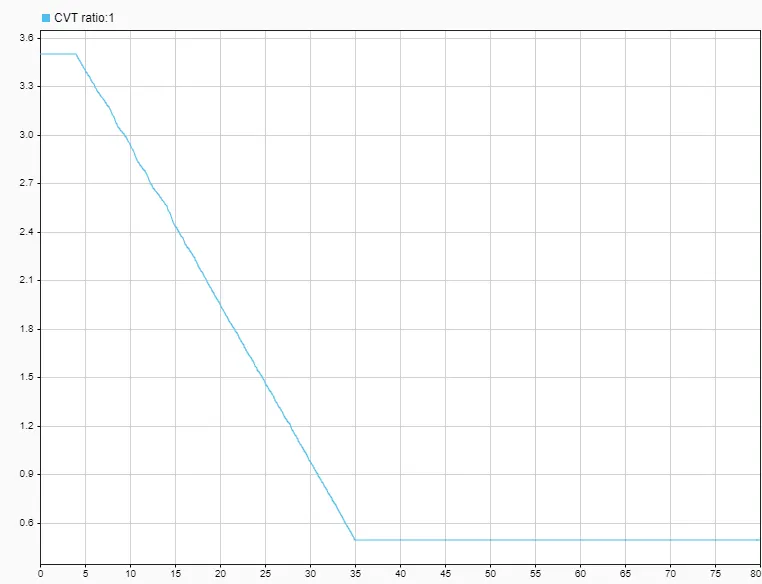
- CVT ratio vs vehicle velocity
- Speed vs throttle plot
- BAJA ATV model Mapped with dashboard Lookup Table (cvtModel_dashboard_mapped):
- CVT ratio plot
- Engine RPM plot
- CVT speed reduction plot
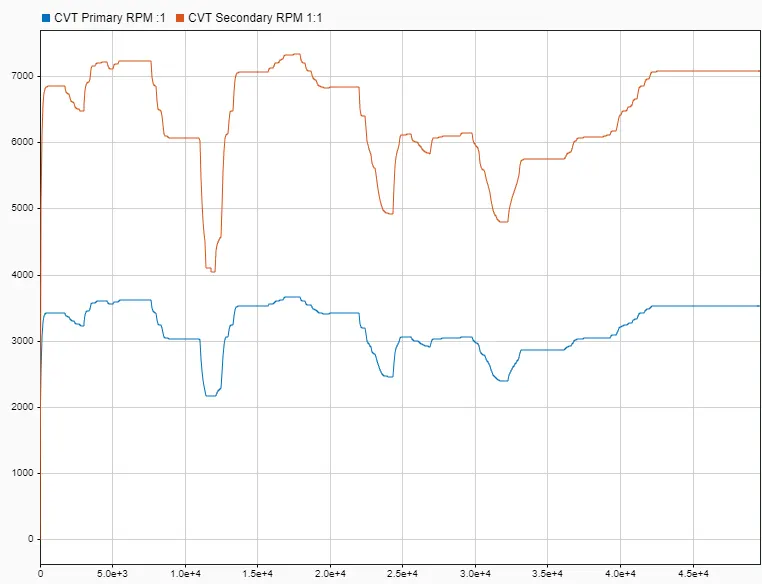
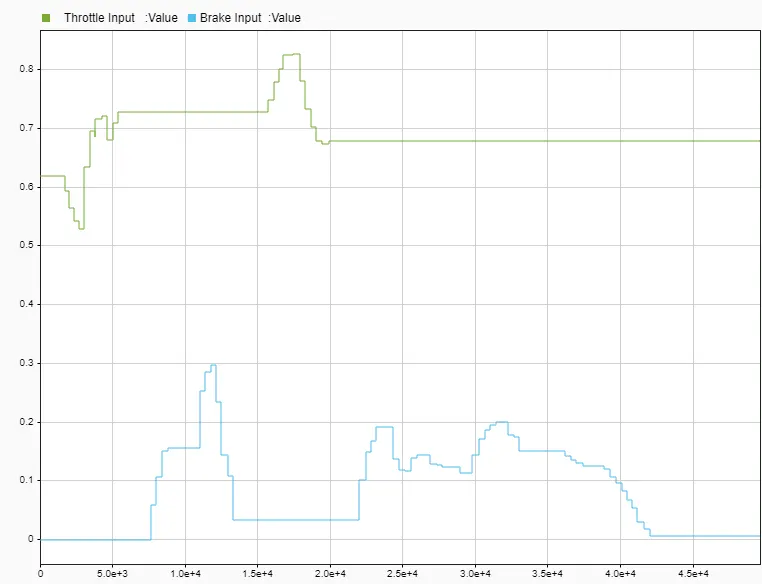
- Speed vs throttle plot
Learning Outcomes:
- Learned to analyze the models.