Week-11 Challenge: Braking
Aim:
The main aim of this project is mentioned below
- For a defined driving cycle, calculate the energy required for braking.
- Why electric motor can’t develop braking torque at a high speed similar to starting? How electric and mechanical brakes are coordinated?
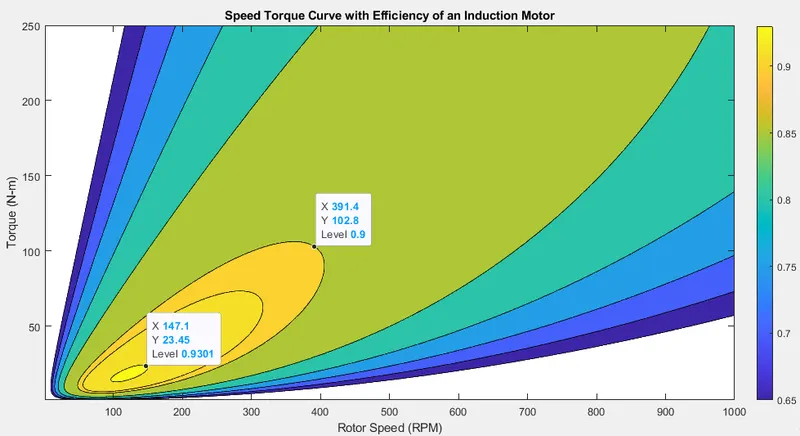
- Make a MATLAB program that plots the contour of given motor speed, torque, and efficiency values. Attach the code as a .m file attach a screenshot of all the plots.
Theory:
Braking:
Braking is the process of controlling the velocity of an object by inhibiting its motion. An object in motion possesses kinetic energy and to bring the object to a stop this kinetic energy must be removed. Removing the kinetic energy can be accomplished by dissipating the energy to the atmosphere through friction or by converting it into another form of energy. The most common type of braking is a mechanical brake which inhibits motion through friction brake pads. A mechanical brake applies a friction force to convert the kinetic energy of the vehicle into thermal energy which then dissipates into the atmosphere. Braking systems which don't use friction are referred to as regenerative braking systems (RBSs). In RBSs, the kinetic energy is converted into other forms of useful energy, which can be stored for later use, increasing fuel efficiency.
The necessity of Braking:
In an automobile, if the pressure from the accelerator pedal is removed, the vehicle tends to slow up because of wind resistance, engine drag, and road friction. These forces would stop the vehicle but in the present-day traffic, this would be quite impracticable and dangerous.
Requirements of a good braking system:
- The brakes should stop the vehicle within a reasonable distance. The retardation shall be smooth and free from jerks or shudder.
- The braking system should be very reliable to promote the highest degree of safety on the road.
- The braking system should not be affected by water, heat, road grit or dust, etc.
- The wear and tear of the material of the brake lining should be minimum for its longer life.
Classification of Brakes:
- Mechanical Brakes
- Hydraulic Brakes
- Power Brakes (Air brakes, Air- Hydraulics, Vacuum Brakes, and Electric Brakes)
Starting Torque:
The starting torque is the required amount of energy that is used to overcome the inertia of standstill. That is also known as pull-up torque it is the minimum torque generated by a motor to accelerate it from static position to the operating speed. Starting torque is the torque transferred by the shaft coupling during run-up (see Start-up process). It is calculated based on the ratio of power (P) to angular velocity (ω) and is represented as a rotational speed function.
Braking Torque:
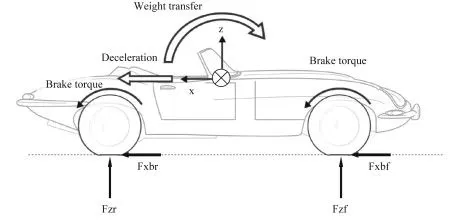
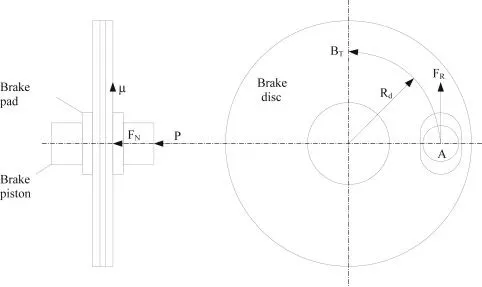
Brake torque is essentially the power of the braking system. The brake caliper acts on the disc at a certain distance from the hub center, known as the effective radius. The force exerted by the caliper, multiplied by the effective radius of the system equals the brake torque.
Procedure:
- For a defined driving cycle, calculate the energy required for braking.
The energy required for braking:
- For the Energy required for the braking, we need to calculate the Braking Energy
`"Braking Energy"= 1/2×m×(v_f-v_i )^2`
Where,
m = Mass
`v_f` = Final Velocity
`v_i` = Initial Velocity
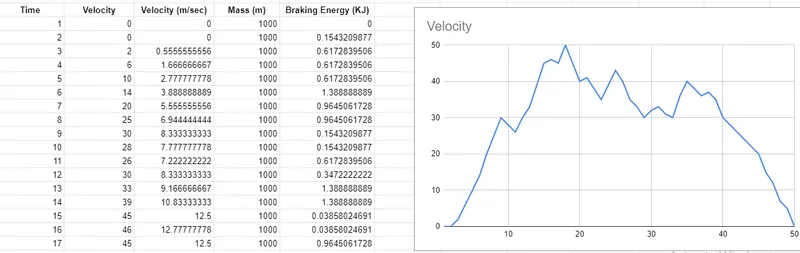
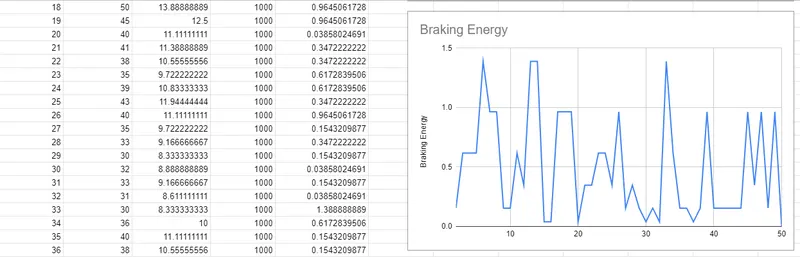
- The above formula is used in an excel sheet stating the different velocities at different times is taken and made into the plot and the plot is observed.
- Why electric motor can’t develop braking torque at a high speed similar to starting? How electric and mechanical brakes are coordinated?
- The Torque Speed characteristic of a motor is not the same in the braking and motoring region.
- At low starting torques in EV, motors have high torque producing capability. With the increase in speed, the torque value decreases.
- During the Starting Stage, the speed values are low and thus torque produced is much higher.
- In the Braking stage, the speed of the motor has high values and the braking torque has low values.
- Braking power is limited by the motor’s power rating and the charging power limit of the battery pack.
Electric and Mechanical Braking Coordination:
During the Initial braking time, mechanical brakes are used in larger proportion than regenerative braking.
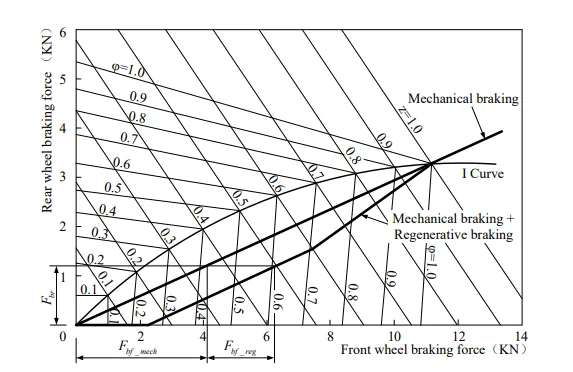
To ensure directional stability and enough efficiency in the process of braking, ECE R13 braking regulations constituted by the United Nations economic commission for Europe put forward explicit requirements for front and rear braking force of the dual-shaft vehicle. Under various loading conditions, we must ensure that the braking strength is satisfied.
There are two different brake control strategies namely, series and parallel control. The series-parallel regenerative braking control strategy of hybrid electric vehicles is designed according to the basic idea of parallel braking control strategy as well the characteristics of a regenerative braking system of hybrid electric vehicles and the working characteristics of key components of regenerative braking system such as driving motor and power battery.
Series:
We apply mechanical brakes and electric brakes one after the other.
Parallel:
We apply both mechanical and electric brakes simultaneously. The mechanical braking of the parallel braking system can distribute the braking force of the front and rear wheels in a fixed proportion and the regenerative braking supplement the braking force insufficient on the supplementary driving wheel, which forms the distribution curve of braking force required by the driver. The mechanical friction braking force applied on the front and rear axle is in direct proportion with the hydraulic pressure in the brake master cylinder. Regenerative braking force is a function of the hydraulic pressure in the main cylinder. Regenerative braking force is a function of the hydraulic pressure in the brake master cylinder, which is also a function of the deceleration speed of vehicles braking.
Electric Driven Intelligent Brake:
After stepping on the brake pedal, the system produces a natural and adequate braking force that corresponds to the operation. The energy regenerated needs to be increased. EDIB controls the regenerative brake and friction brake support both of these requirements.
- Make a MATLAB program that plots the contour of given motor speed, torque, and efficiency values. Attach the code as a .m file and attach a screenshot of all the plots.
- Initially, we open the MATLAB and click Ctrl+ N to open the Editor tab.
- Now, give the input torque and Input speed values.
%Inputs
Speed = linspace(1,1000,500);   % Input Torque
Torque = linspace(1,250,500); % Input Speed- Convert the torque and speed from 3D to the 2D array.
% To convert the 3D to 2D array 'meshgrid' is used
[w,T] = meshgrid(Speed, Torque);- Give the coefficient of Losses values such as Copper loss, Iron loss, Windage (Wind Resistance) loss, and Constant.
% Losses
kc = 0.25;      % Copper Loss Constant
ki = 0.008;    % Iron Loss Constant
kw = 0.00003;    % Windage Loss constant
c = 25; % Constant loss- Now give the Equations for each of the losses.
% Equations for Losses
Copper_loss = kc*(T.^2);
Iron_loss = ki*(w);
Windage_loss = kw*(w.^3);- Give the Output and Input power equations.
% Output Power Equation
P_out = w.*T;

% Input Power Equation
P_in = P_out + Copper_loss + Iron_loss + Windage_loss + c;
- Give the Efficiency Equation.
% Efficiency Equation
efficiency = P_out./P_in;
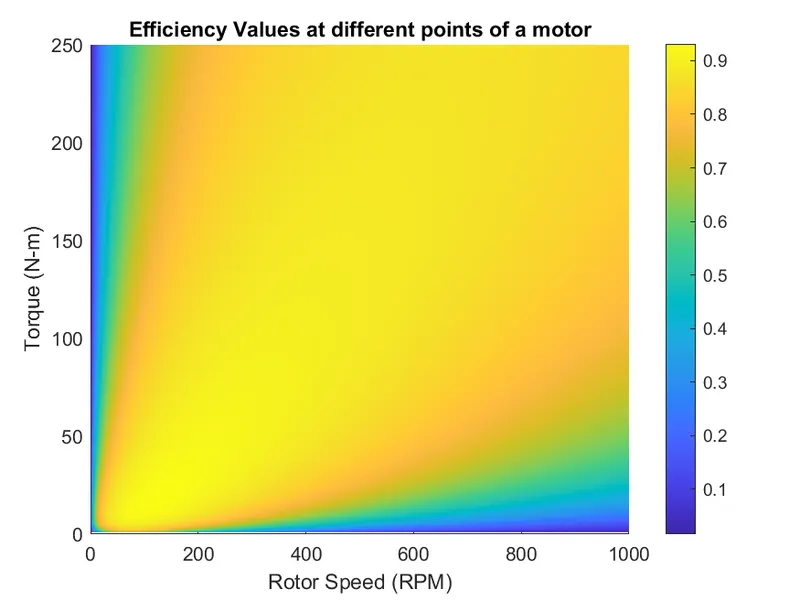
- Now, plot the Speed torque curve with the efficiency of a motor and Efficiency Values at different points of a motor graph.
% Plotting
figure(1)
box off
grid off
contourf(w,T,efficiency,V);
colorbar
xlabel('Rotor Speed (RPM)')
ylabel('Torque (N-m)')
zlabel('Efficiency')
title('Speed Torque Curve with Efficiency of an Induction Motor')
saveas(1, 'Speed Torque Curve with Efficiency of an Induction Motor.png')

figure(2)
surf(w,T,efficiency)
colorbar
shading interp
view(0, 90)
xlabel('Rotor Speed (RPM)')
ylabel('Torque (N-m)')
zlabel('Efficiency')
title('Efficiency Values at different points of a motor')
saveas(2, 'Efficiency Values at different points of a motor.png')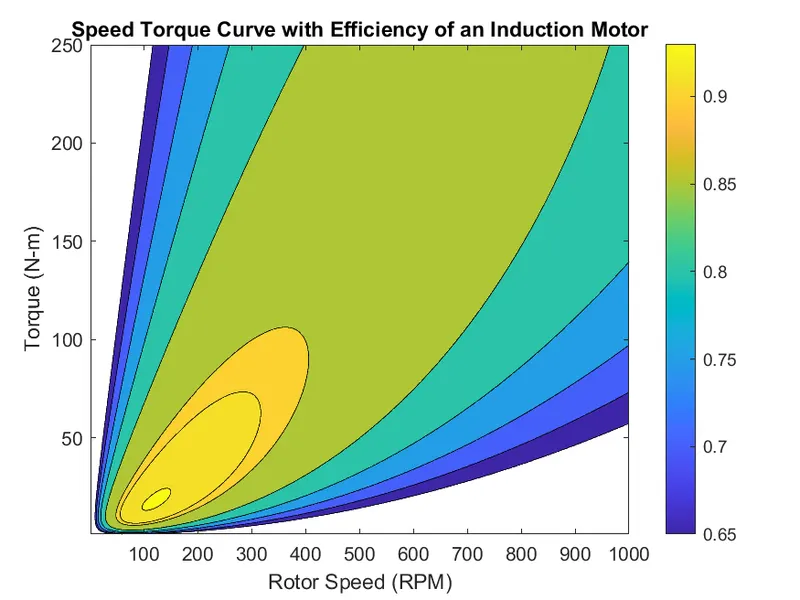
Code:
clear;clc;

%Inputs
Speed = linspace(1,1000,500);   % Input Torque
Torque = linspace(1,250,500);   % Input Speed

% To convert the 3D to 2D array 'meshgrid' is used
[w,T] = meshgrid(Speed, Torque);

% Losses
kc = 0.25;      % Copper Loss Constant
ki = 0.008;    % Iron Loss Constant
kw = 0.00003;    % Windage Loss constant
c = 25;         % Constant loss

% Equations for Losses
Copper_loss = kc*(T.^2);
Iron_loss = ki*(w);
Windage_loss = kw*(w.^3);

% Output Power Equation
P_out = w.*T;

% Input Power Equation
P_in = P_out + Copper_loss + Iron_loss + Windage_loss + c;

% Efficiency Equation
efficiency = P_out./P_in;

% Efficiency Space to calculate
V = [0.65,0.7,0.75,0.8,0.85,0.9,0.91,0.93,0.95];

% Plotting
figure(1)
box off
grid off
contourf(w,T,efficiency,V);
colorbar
xlabel('Rotor Speed (RPM)')
ylabel('Torque (N-m)')
zlabel('Efficiency')
title('Speed Torque Curve with Efficiency of an Induction Motor')
saveas(1, 'Speed Torque Curve with Efficiency of an Induction Motor.png')

figure(2)
surf(w,T,efficiency)
colorbar
shading interp
view(0, 90)
xlabel('Rotor Speed (RPM)')
ylabel('Torque (N-m)')
zlabel('Efficiency')
title('Efficiency Values at different points of a motor')
saveas(2, 'Efficiency Values at different points of a motor.png')
Result:
- For the Brake Energy Calculations, at the peak speed of 50 KMPH, we get the braking energy as 96.45KJ.
- The Braking torque and starting torque differences and the conditions are explained
- The Efficiency is calculated and observed that at a speed of 147.1 RPM and Torque of 22.96 N-m, the efficiency is 93%, and the efficiency that can be attained at the Torque of 102.8 N-m to the speed of 391.4RPM gaining the efficiency of 90%.