Week 1 Understanding Different Battery Chemistry
- Preparing a Table that includes materials and chemical reactions occurring at the anode and cathode of LCO, LMO, NCA, NMC, LFP, and LTO type of lithium-ion cells.
Lithium-Ion Cells:
A lithium-ion battery or Li-ion battery is a type of rechargeable battery. Lithium-ion batteries are commonly used for portable electronics and electric vehicles and are growing in popularity for military and aerospace applications. In the batteries, lithium ions move from the negative electrode through an electrolyte to the positive electrode during discharge, and back when charging. Li-ion batteries use an intercalated lithium compound as the material at the positive electrode and typically graphite at the negative electrode. The batteries have a high energy density, no memory effect (other than LFP cells), and low self-discharge. They can however be a safety hazard since they contain flammable electrolytes, and if damaged or incorrectly charged can lead to explosions and fires.
Chemistry, performance, cost, and safety characteristics vary across types of lithium-ion batteries. Research areas for lithium-ion batteries include extending lifetime, increasing energy density, improving safety, reducing cost, and increasing charging speed, among others. Research has been underway in the area of non-flammable electrolytes as a pathway to increased safety based on the flammability and volatility of the organic solvents used in the typical electrolyte. Strategies include aqueous lithium-ion batteries, ceramic solid electrolytes, polymer electrolytes, ionic liquids, and heavily fluorinated systems.
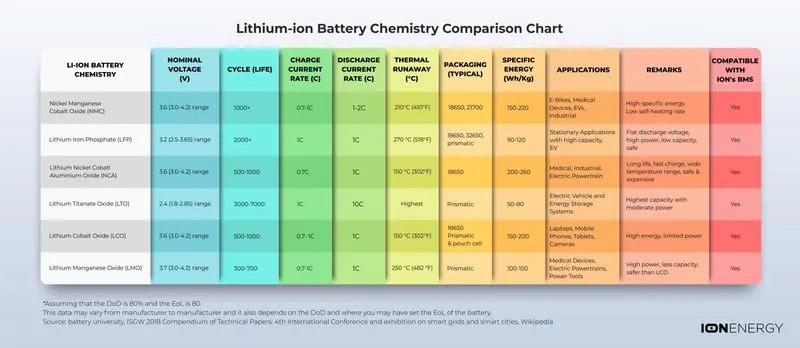
Types of Lithium-ion batteries:
- Lithium Cobalt Oxide (LCO):
- Lithium Manganese Oxide (LMO):
- Lithium Nickel Manganese Cobalt Oxide (NMC):
- Lithium Iron Phosphate (LFP):
- Lithium Nickel Cobalt Aluminum Oxide (NCA):
- Lithium Titanium Oxide (LTO):
|
Abbreviation |
Chemical Formula |
Anode Material |
Cathode Material |
Anode reaction |
Cathode Reaction |
Complete Reaction |
|
|
LCO |
Lithium Cobalt Oxide |
`LiCoO_2` |
Graphitic Carbon |
Lithium Cobalt Oxide |
`LiC_6⇌C_6+Li^++e^-` | `CoO_2+Li^++e^(-)⇌LiCoO_2` | `C_6+LoCoO_2⇌LiC_6+CoO_2` |
|
LMO |
Lithium Manganese Oxide |
`LiMn_2 O_4` |
Graphite |
Manganese Oxide |
`LiC_6⇌C_6+Li^++e^-` | `MnO_2+Li^++e^(-)→LiMnO_2` | `C_6+LiMn_2 O_4⇌LiC_6+Mn_2 O_4` |
|
NMC |
Lithium Nickel Manganese Cobalt Oxide |
`LiNiCoMnO_2` |
Graphite Carbon |
Nickel Manganese |
`LiC_6⇌C_6+Li^++e^-` | `Li_(1-x) (Ni_(1-x-y) Mn_x CO_y ) O_2+xLi^++xe^(-)→LiNiMnCoO_2` | `C_6+LiNiMnCoO_2⇌LiC_6+NiMnCoO_2` |
|
LFP |
Lithium Iron Phosphate |
`LiFePO_4` |
Graphite Carbon |
Lithium Iron Phosphate |
`LiC_6⇌C_6+Li^++e^-` | `Li_(1-x) FePO_4+xLi^++ye^(-)→LiFePO_4` | `C_6+LiFePO_4⇌LiC_6+FePO_4` |
|
LTO |
Lithium Titanium Oxide |
`Li_2 TiO_3` |
Graphite Carbon |
Lithium titanate |
`Li_7 Ti_5 O_12→Ti_5 O_12+4Li+4e^-` | `4Li_(1-x) Mn_2 O_4+4Li^++4e^(-)→4LiMn_2 O_4` | `4Mn_2 O_4+Li_4 Ti_5 O_12⇌4LiMn_2 O_4+Ti_5 O_12` |
|
NCA |
Lithium Nickel Cobalt Aluminium Oxide |
`LiNiCoAlO_2` |
Graphite Carbon |
Nickel Cobalt Aluminum |
`LiC_6⇌C_6+Li^++e^-` | `NiCoAlO_2+Li^++e^(-)→LiNiCoAlO_2` | `C_6+LiNiCoAlO_2⇌LiC_6+NiCoAlO_2` |
- Compare the differences between each type of Lithium-Ion battery based on their characteristics
Lithium Cobalt Oxide:
- The Lithium cobalt oxide batteries are made from lithium carbonate and cobalt.
- The cobalt oxide acts as the cathode and the Graphitic Carbon acts as Anode.
- During Discharge, lithium ions move from anode to cathode with the flow reversed when the battery is charging.
- The battery has drawbacks including relatively short battery life and limited specific power. These are not safe as other types.
Lithium Manganese Oxide:
- In Lithium Manganese Oxide batteries have Manganese Oxide have cathode material. The graphite acts as an anode.
- The architecture forms a three-dimensional spinel structure that improves ion flow on the electrode that results in lower internal resistance and improved current handling.
- An Advantage of spinel is high thermal stability and enhanced safety but the cycle and calendar life is limited.
Lithium Nickel Cobalt Aluminum Oxide:
- Lithium nickel cobalt aluminum oxide battery shares similarities with NMC by offering high specific energy with good specific power and a long life span.
- Cost and Safety are a concern.
Lithium Nickel Manganese Cobalt Oxide:
- Lithium Nickel Manganese Cobalt is a very successful cathode combination.
- It can be used as Energy/Power Cells.
- It has high specific energy or power.
Lithium Iron Phosphate:
- Lithium Iron Phosphate batteries use Phosphate as Cathode Material.
- They provide Low resistance properties that enhance their thermal stability and safety.
Lithium Titanium Oxide:
- Lithium Titanium Battery is a rechargeable battery that has a faster charging rate compared to other Li-ion batteries.
- It is costly and provides low energy density.
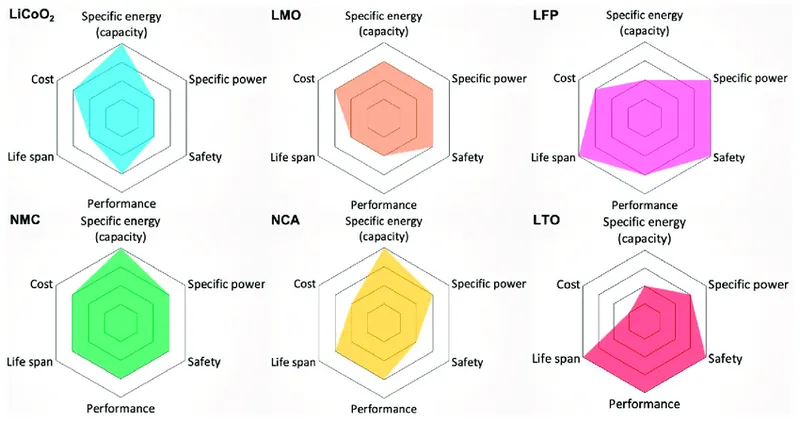
Here, an Image shows the Different Li-ion battery performances. The innermost Hexagon Shows the lowest and Outermost Hexagon show the highest properties.
From this chart, we can select the component based on the requirement.
Image courtesy: Google images.