Project 2 Thermal modeling of battery pack
Aim:
The aim is as follows:
For a 10 cell series lithium-ion battery model, simulate the thermal effects and compare life cycle performance at various temperatures, charge & discharge rates using MATLAB.
Lithium-Ion Battery:
A lithium-ion battery is a type of rechargeable battery. Lithium-ion batteries are commonly used for portable electronics and electric vehicles and are growing in popularity for military and aerospace applications. In the batteries, lithium ions move from the negative electrode through an electrolyte to the positive electrode during discharge, and back when charging. Li-ion batteries use an intercalated lithium compound as the material at the positive electrode and typically graphite at the negative electrode. The batteries have a high energy density, no memory effect (other than LFP cells), and low self-discharge. They can however be a safety hazard since they contain flammable electrolytes, and if damaged or incorrectly charged can lead to explosions and fires.
Chemistry, performance, cost, and safety characteristics vary across types of lithium-ion batteries. Research areas for lithium-ion batteries include extending lifetime, increasing energy density, improving safety, reducing cost, and increasing charging speed, among others. Research has been underway in the area of non-flammable electrolytes as a pathway to increased safety based on the flammability and volatility of the organic solvents used in the typical electrolyte. Strategies include aqueous lithium-ion batteries, ceramic solid electrolytes, polymer electrolytes, ionic liquids, and heavily fluorinated systems.
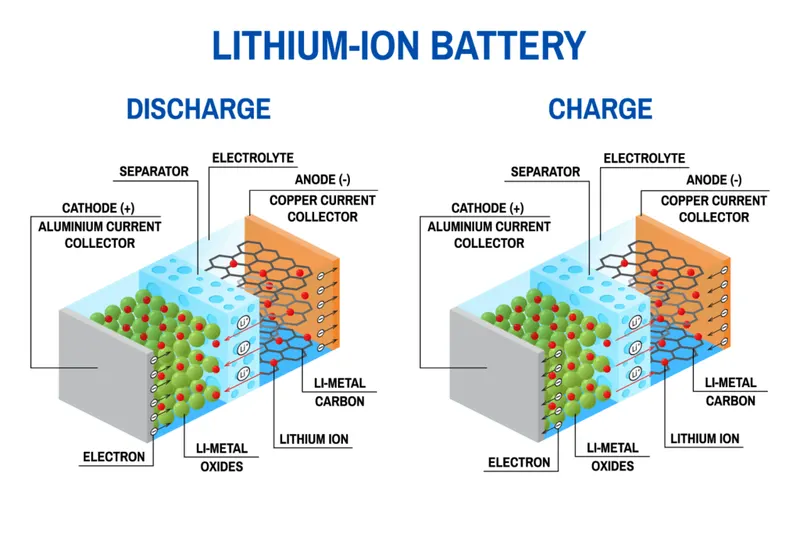
Types of Lithium-ion batteries:
- Lithium Cobalt Oxide (LCO)
- Lithium Manganese Oxide (LMO)
- Lithium Nickel Manganese Cobalt Oxide (NMC)
- Lithium Iron Phosphate (LFP)
- Lithium Nickel Cobalt Aluminum Oxide (NCA)
- Lithium Titanium Oxide (LTO)
Construction:
For a 10 cell series lithium-ion battery connected in series:
- First, we create a battery and show the thermal port in the battery.
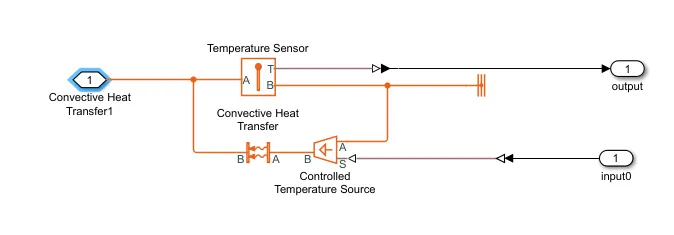
- Now connect the Convective Heat Transfer block to the H port of the battery. A-port of the convective heat transfer block is connected to a constant temperature source.
- The temperature sensor block is installed to check the temperature of the battery.
- The SOC port of the battery is connected to a scope.
- The battery is created with the thermal sensors and we need to create the same batteries 10 times and connect in series.
- Three batteries are created as a pack and 3 such battery packs are created and an additional battery is created.
- The Positive and negative end of a battery pack is connected to the controlled current source and the Solver and an electrical reference are added to the Controlled Current Source.
- The Sine signal is used to check the random increase and decrease in the Current making the battery discharge the current.
- A signal generator is connected to the controlled current source.
- The output SOC and temperatures are connected to a MUX and it is then connected to a scope.
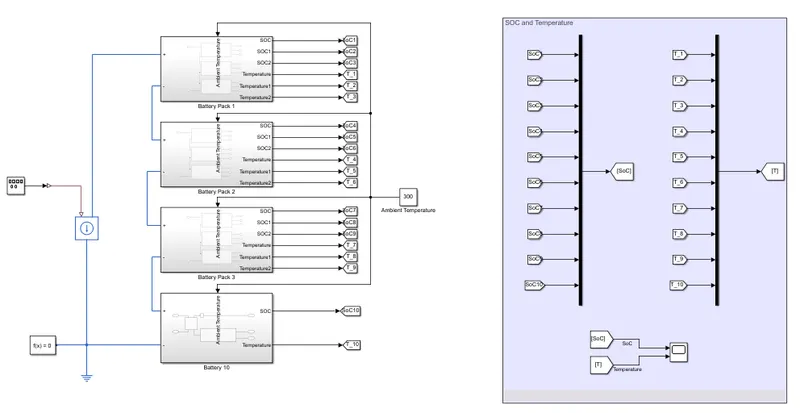
Inside Battery Pack:
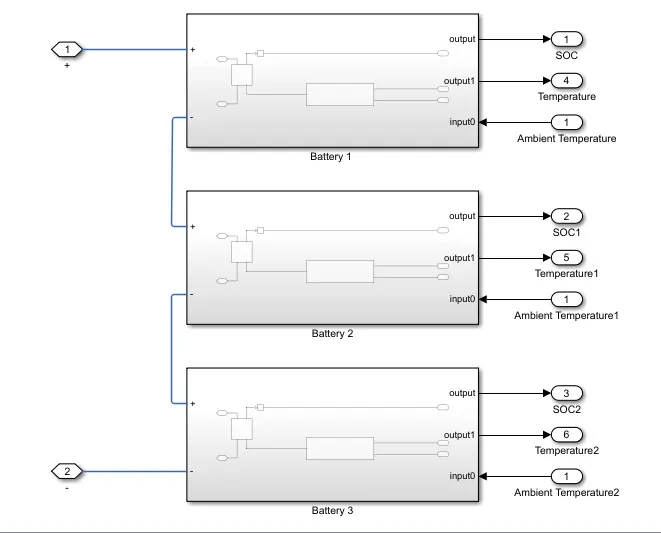
Inside Battery:
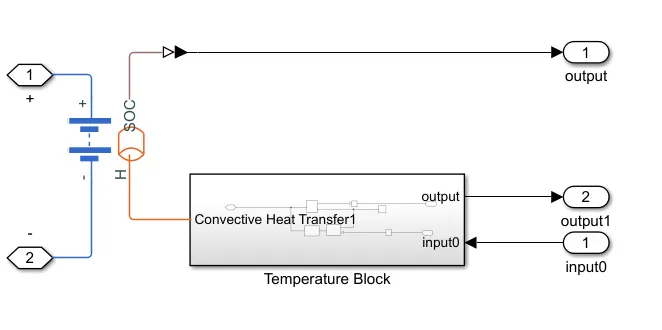
Inside Temperature Block:
Output:
Where Battery Thermal Parameters are equal:
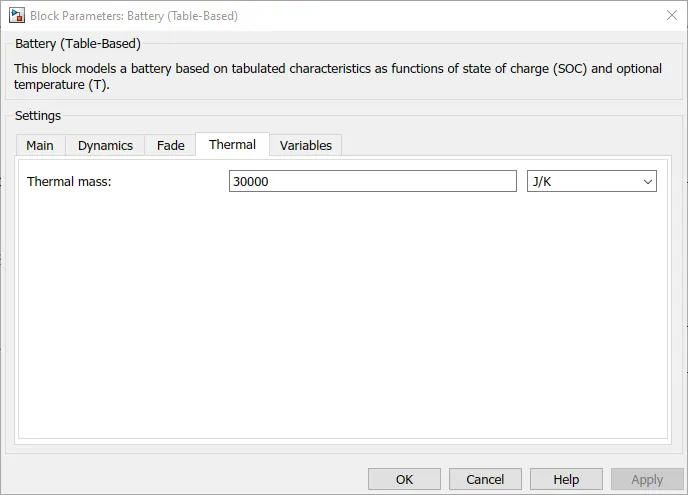
The battery thermal mass is given as 30000 J/K for every battery and we run the model for a given set of time.
The Graph shows the SOC and the Temperature plots. It can be seen that the values of the SOC are coinciding with each other.
The SOC plots show the sine wave and the SOC decreases from a state of fully charged and increases and decreases based on the discharge of the current.
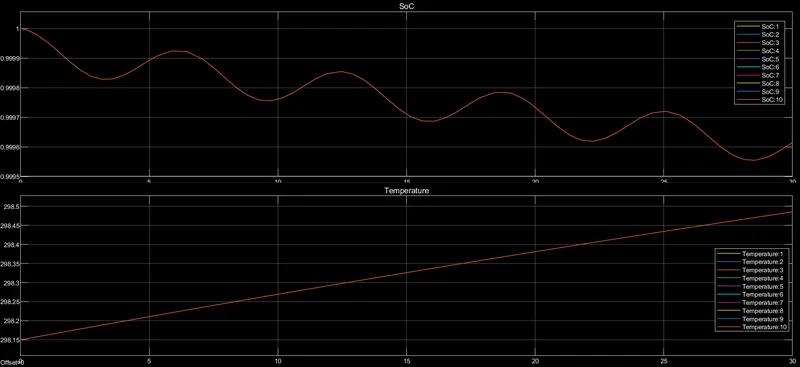
The temperature plot shows us that the temperature increases throughout the run time as the current is continuously discharging and charging, the heat is dissipated throughout the run time.
For Faulty/ Different Battery Thermal Parameter:
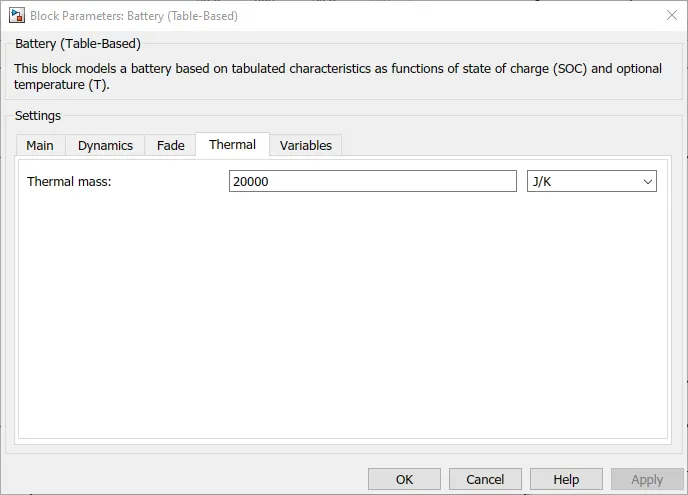
The Last battery thermal mass is changed to 20000J/K to check how the battery performs compared to the other ones.
The SOC plot shows that the Faulty battery discharges faster than the original batteries. This is due to the thermal runaway (Explained in terms used section).
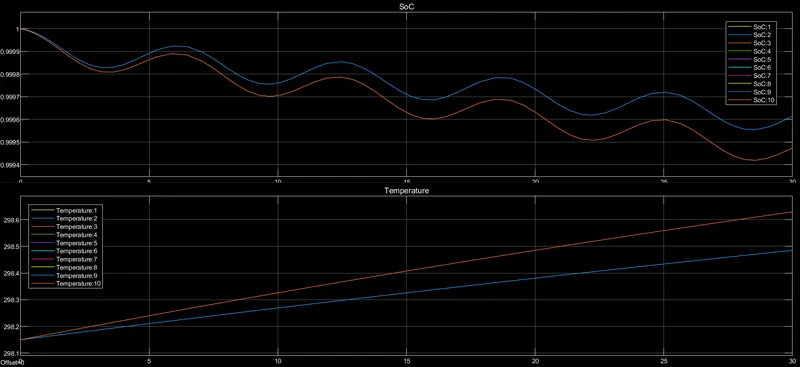
The temperature increases more often than the regular battery as the current is discharged more rapidly, the temperature increases as the discharging causes the dissipation of heat around the battery, and this increases the battery temperature.
Terms Used:
Thermal Runaway:
Thermal runaway describes a process that is accelerated by increased temperature, in turn releasing energy that further increases temperature. Thermal runaway occurs in situations where an increase in temperature changes the conditions in a way that causes a further increase in temperature, often leading to a destructive result. It is a kind of uncontrolled positive feedback.