Underbody Coating
Under Coating:
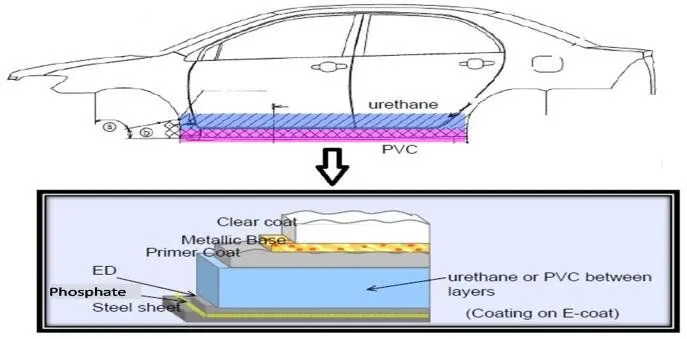
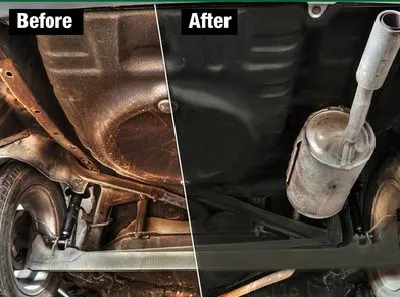
Undercoating is the sprayed application of a wax or rubber-based composite onto the entire underside of the vehicle. It's designed to create a rust-proof layer between the underside of the vehicle and the water, ice, and salt of the road.
In Indian road conditions, a car's underbody is most prone to corrosion. Underbody coating provides long-term protection from corrosion to a car’s underbody. It also protects parts like internal body panels, frame rails, and other inner cavities that are not physically accessible but are prone to corrosion.
Benefits
• Minimizes Sound: It minimizes the sound from underneath the car resulting in a noiseless, smooth driving experience.
• Heat Insulation: It insulates the interior of the car from extreme temperatures from beneath the vehicle providing a comfortable cabin experience.
• Anti-chipping property: If any stone hits the coating it does not get chipped away hence protects the underbody from exposure to water.
Purpose:
Each year vehicles are improved to help combat the ever-present fact of corrosion, but the protection is minimal and fades quickly. Both rustproofing and undercoating are designed to protect your vehicle from corrosion, which is simply a technical term for the oxidization of metal. Rust forms on your car the moment you drive it out of the dealership. Rust is simply a mix of iron, oxygen, and water. Factor in winter and salt and your vehicle is under severe attack.
Process:
The PVC is mixed with plasticizers and solvents so that it may be sprayed. Once applied to the underbody of the car, the solvent evaporates in a baking oven, leaving the PVC to set.
The volatile solvents and plasticizers used, such as phthalate compounds, have been implicated as damaging to health and the environment, these solvents and plasticizers being released not only during application but through their life. When the car is disposed of, the PVC remaining in the shredder waste may be burnt; this action may release dioxins, hydrogen chloride, and other chlorinated chemicals.
Current industrial application methods used to apply PVC plastisols to underbodies often lead to an over-spray of the PVC onto the vertical body panels. In such cases, removal of the PVC over-spray necessitates the use of solvents and manual labor. Additionally, some PVC plastisol spray misses the vehicle shell entirely; such over-spray is non-recyclable, leading to material wastage, and the overspray creates a hazardous working environment for workers who manually apply such underbody coating materials.
Plastisols of polymers other than PVC, such as styrene block copolymers are also known, with the advantage that they contain little or no chlorine, but with the disadvantage of containing plasticizers. Recently, efforts have been made to develop underbody coatings from epoxy and polyurethane powders, using very low molecular weight precursors that chemically crosslink after application, to give a tough coating. These materials are reactive and can be toxic and hazardous if precautions are not taken.
The PVC-plastisol mixture can be conveniently applied to automobiles on a production line process, where PVC is sprayed onto each car as one of the processes in the production line sequence. The PVC is heated at around 150 to `180^0 C` for around 15-20 minutes.
WO 009618 (Henkel) discloses thermoplastics having a melting range of `50^0 C` to `180^0 C` having polar groups, and suggests using the main binder from lacquer systems, but without the presence of, or with only very small amounts 25 of crosslinkers. Particular suggested powder lacquer binders include those based on polyurethane having a melting range of between `80^0 C` and `180^0 C` with a melt flow index (MFI) of 30 and 40 g/10 minutes, polyethylene-acrylate copolymer powders having an (MFI) between 5 and 15 g/10 minutes, thermoplastic polyurethanes, polyamide powders having an (MFI) between 15 and 40 g/ 10 minutes, ethylene-vinyl acetate copolymer powders and pretreated LDPE (low-density polyethylene).
Underbody sealants are required to remain tough and flexible at temperatures as low as `-40^0 C`, and they must adhere to the material making up the underbody, including the anodic and cathodic protection on the car body.