Week-3 Challenge: ADVISOR Tool
Objective:
The main objective is as below:
- For the EV_defaults_in file, if cargo mass is 500 kg with all other default conditions, can the vehicle travel for 45 km with FTP drive cycle? Conclude your observations.
- In the above case, try changing the battery capacity and repeat the simulation.
- Perform gradeability test with PRIUS_Jpn_defaults_in file. Compare your results in the table and conclude.
Theory:
ADVISOR:
Advanced Vehicle Simulator (ADVISOR) was first developed in November 1994 at the National Renewable Energy Laboratory. It was designed as an analysis tool to assist the US Department of Energy (DOE) in developing technologies for hybrid electric vehicles (HEV) through the Hybrid Electric Vehicle Propulsion System contracts with Ford, General Motors, and DaimlerChrysler. Its primary role is to highlight the system-level interactions of hybrid and electric vehicle components and their impacts on vehicle performance and fuel economy.
ADVISOR was created in the MATLAB/Simulink environment. MATLAB provides an easy-to-use matrix-based programming environment for performing calculations while Simulink can be used to represent complex systems graphically using block diagrams.
ADVISOR uses three primary graphical user interface (GUI) screens to guide the user through the simulation process. With the GUIs, the user can iteratively evaluate the impacts of vehicle parameters and drive cycle requirements on vehicle performance, fuel economy, and emissions. The GUIs facilitate interaction with the raw input and output data that is present in the MATLAB workspace. The vehicle model is depicted graphically using Simulink block diagrams to define the connections between components. The model then reads the input data from the MATLAB workspace during the simulation and outputs the results to the workspace to be viewed in the results window.
Procedure:
- For the EV_defaults_in file, if cargo mass is 500 kg with all other default conditions, can the vehicle travel for 45 km with FTP drive cycle? Conclude your observations.
- Launch the MATLAB App. And open the advisor file location and open the ‘advisor.m’ file.
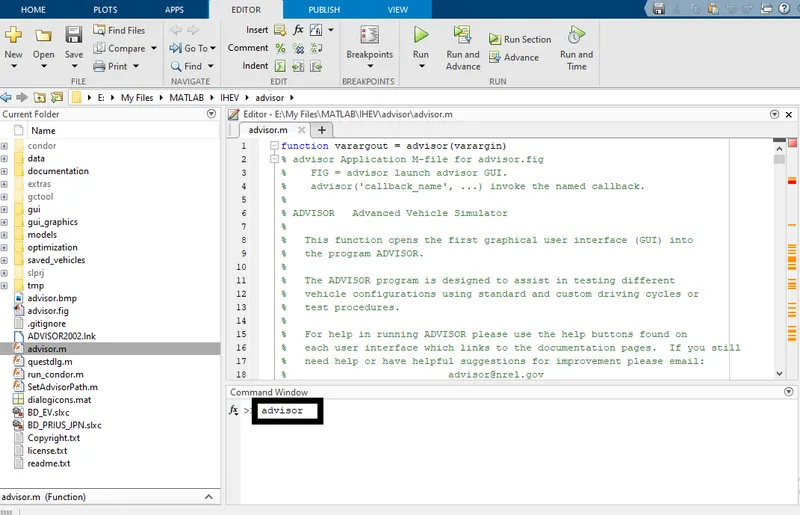
- Once the file is opened in the editor menu, enter “advisor” in the command window and then click enter.
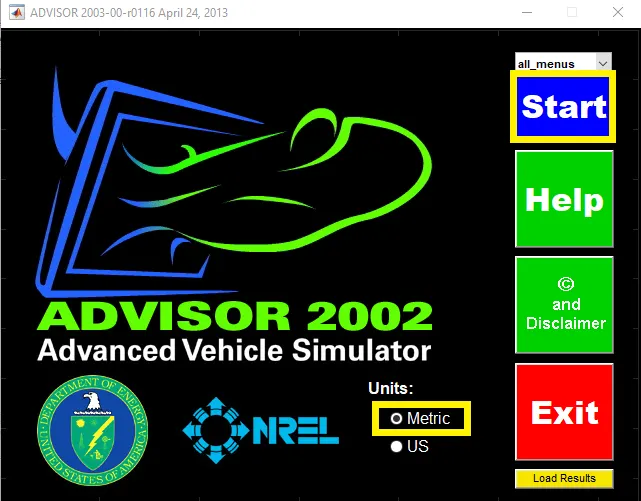
- A new window opens and the ADVISOR opens. Now, select the ‘Metric’ option and then click START.
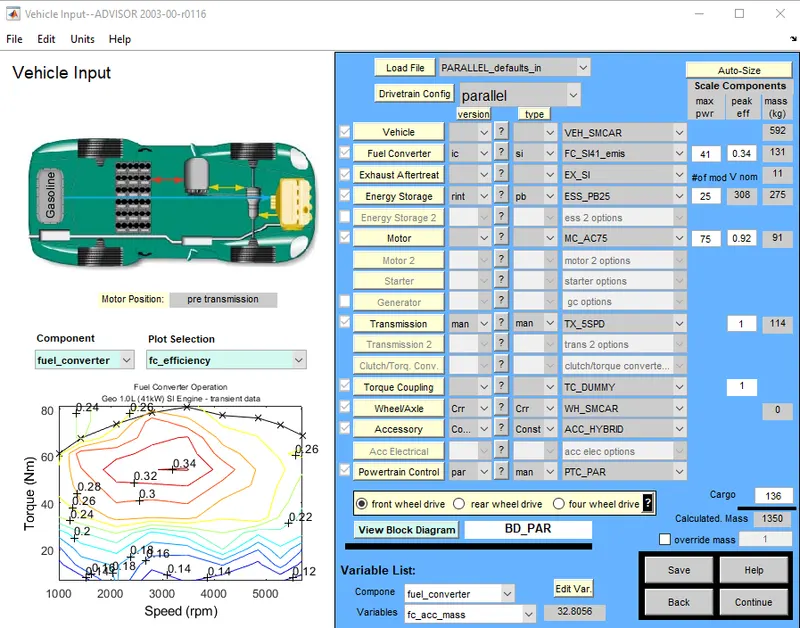
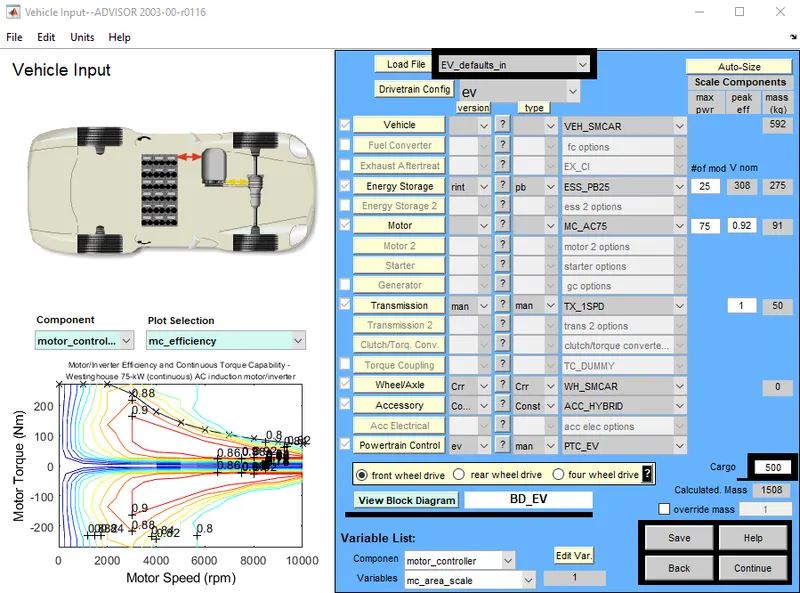
- A default vehicle input is opened, In the Load, file drop-down select the ‘EV_defaults_in’ file.
- Change the Cargo Mass to 500kg. and click Continue.
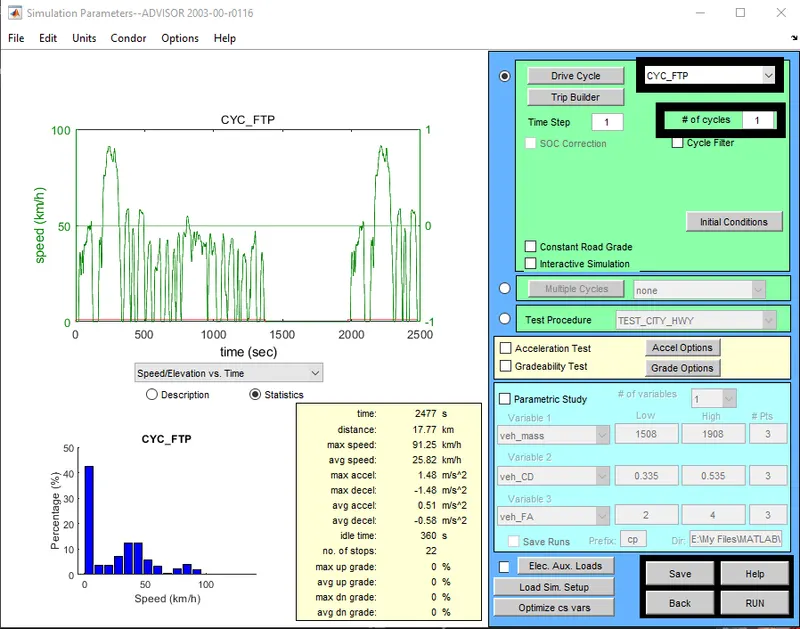
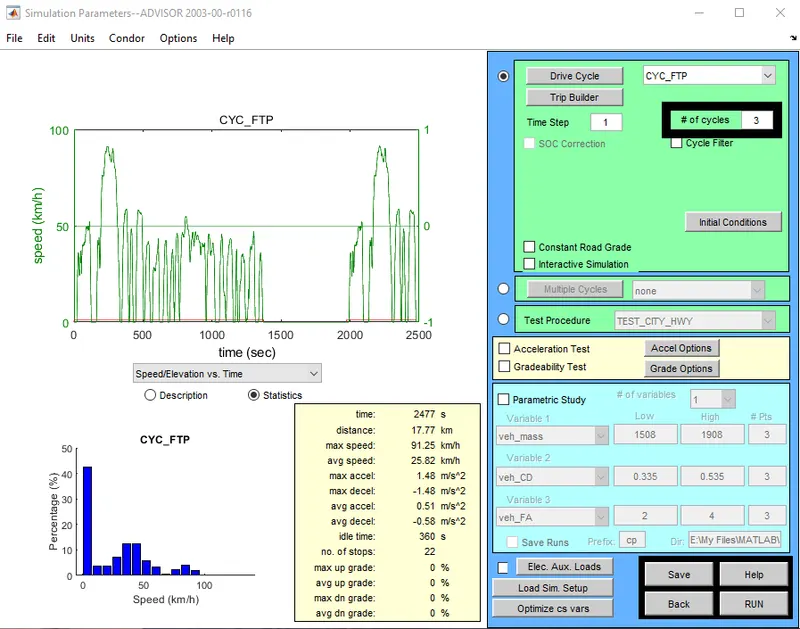
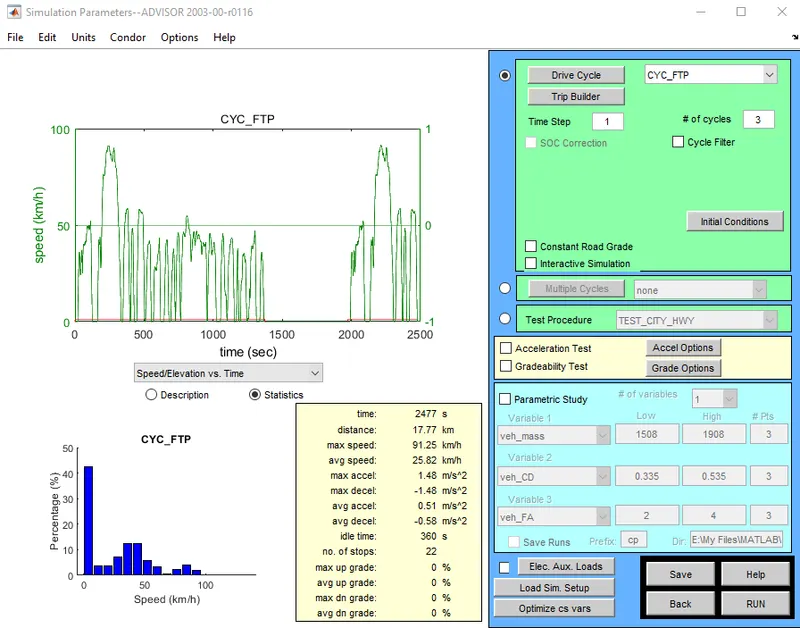
- A new Window called Simulation Parameter Opens and changes the drive cycle to ‘CYC_FTP’ and lets the ‘no. of cycles’ be 1 and click RUN.
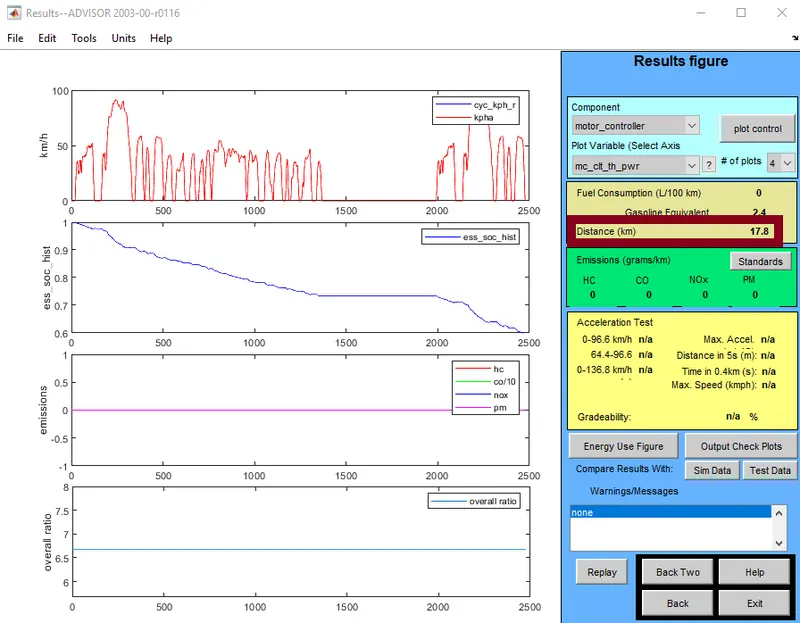
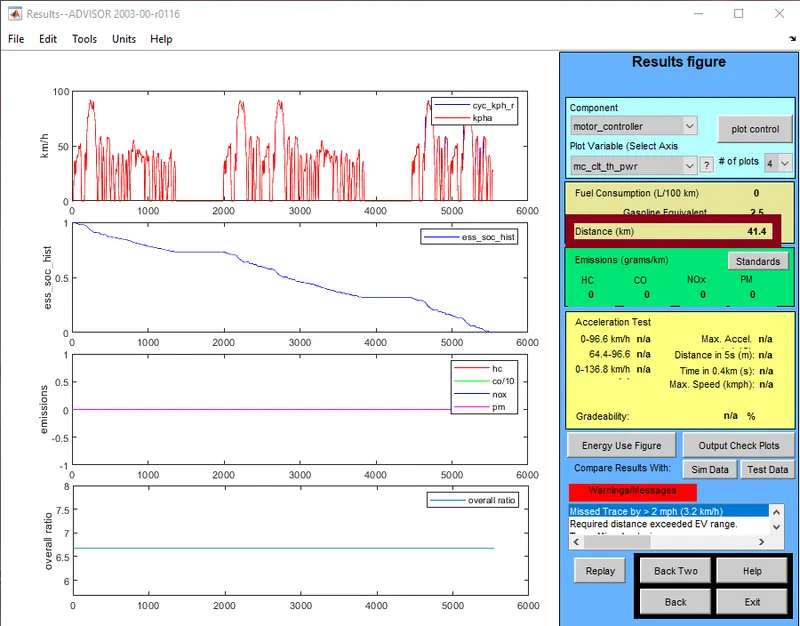
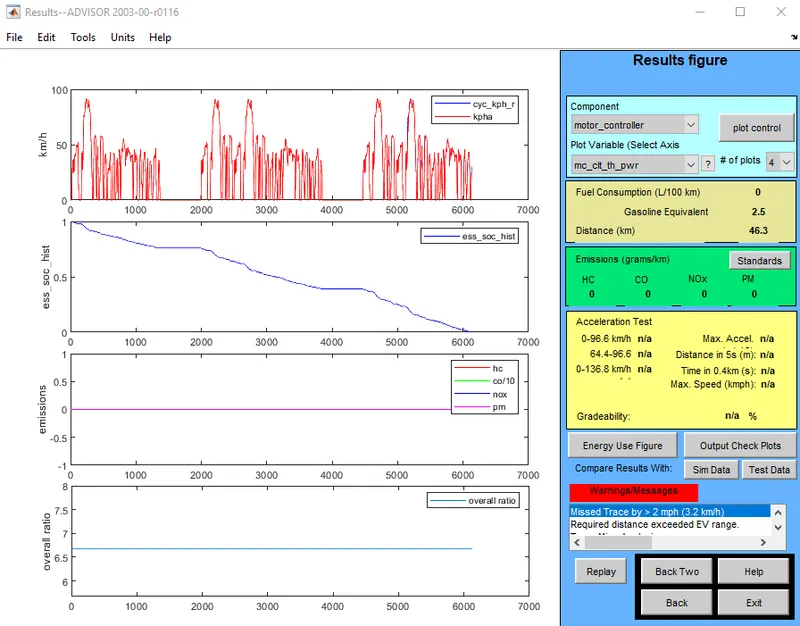
- The New Results window opens and the graphs and distance can be seen.
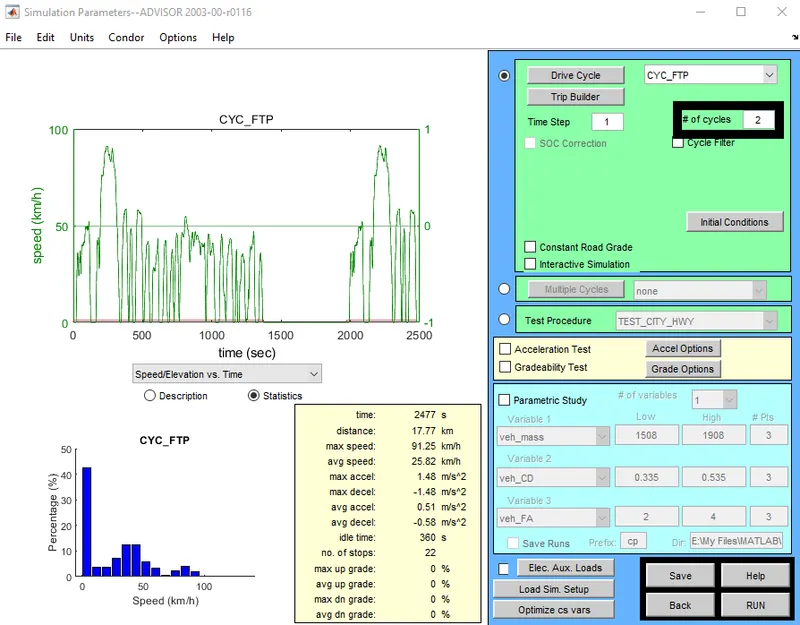
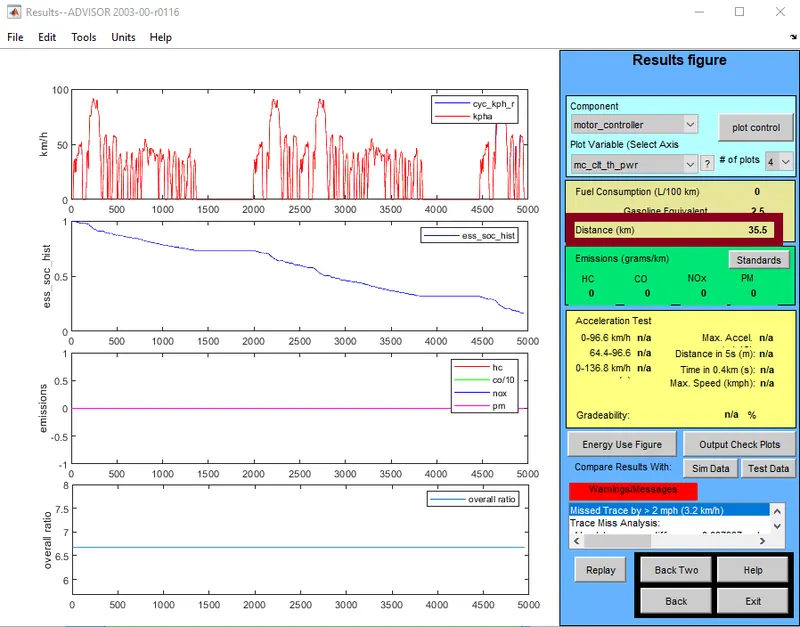
- Now change the ‘No. of cycle’ as 2 and 3 and click RUN for both cases.
- In the above case, try changing the battery capacity and repeat the simulation.
- Now, considering the above case, we need to change the Energy Storage ‘#of mod V nom’ value to 28.
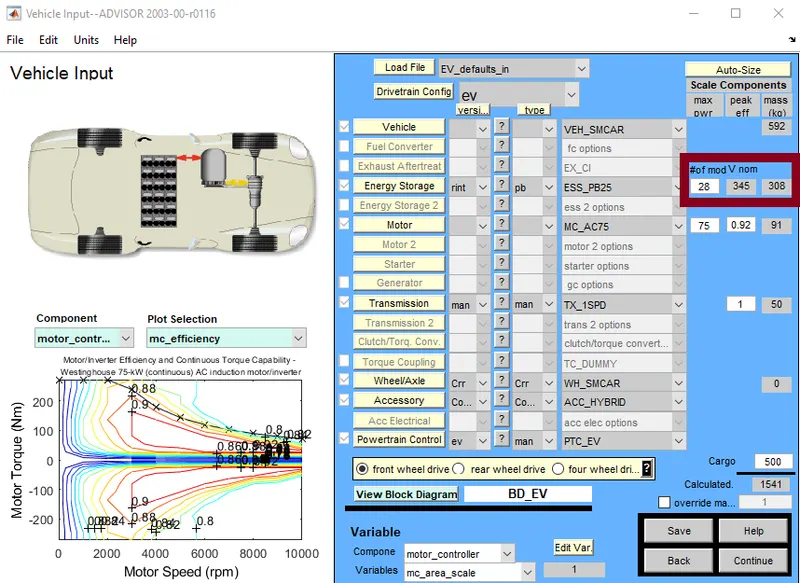
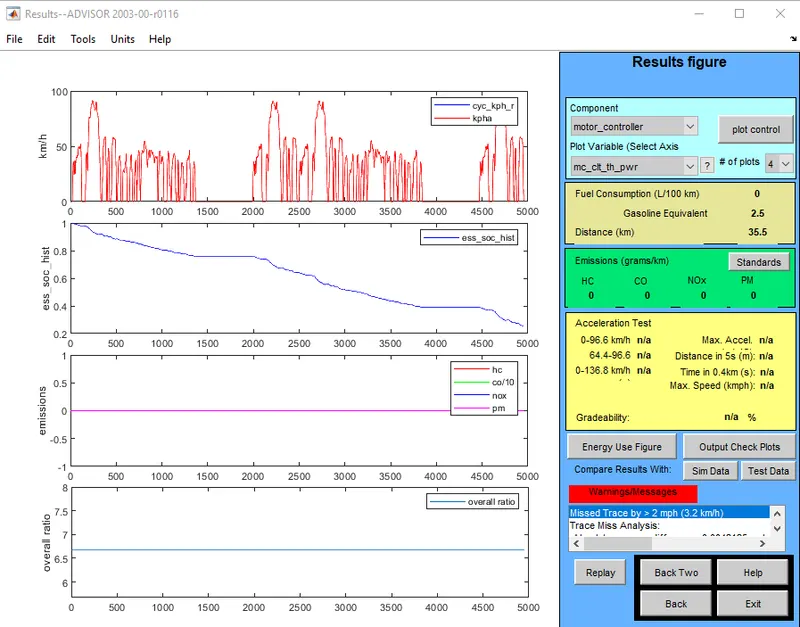
- Click Continue and New Window opens and change the No. of Cycles values to 2 and 3 and Click RUN and Observe the Graphs and Distance respectively.
- Perform gradeability test with PRIUS_Jpn_defaults_in file. Compare your results in a table and conclude.
- In the Load, file drop-down selects the ‘EV_defaults_in’ file and click Continue.
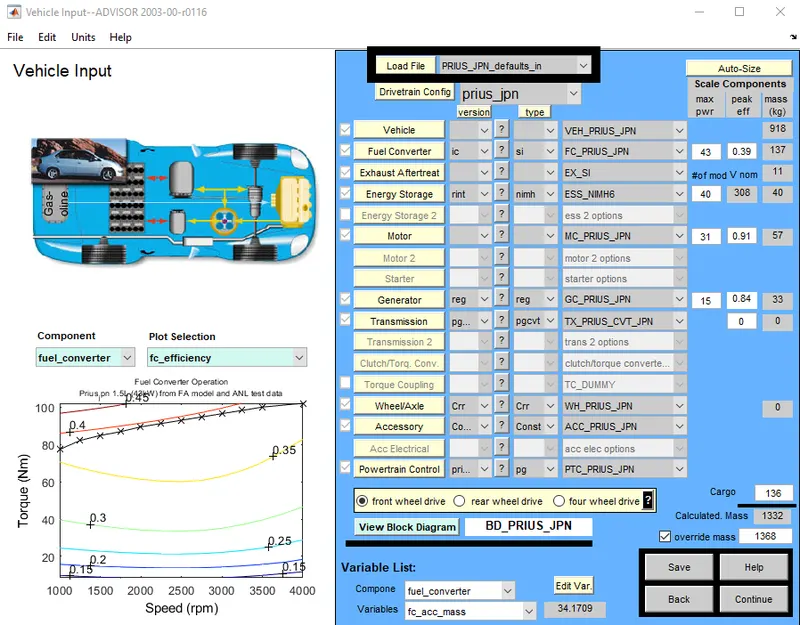
- A Simulation Parameter Window opens.
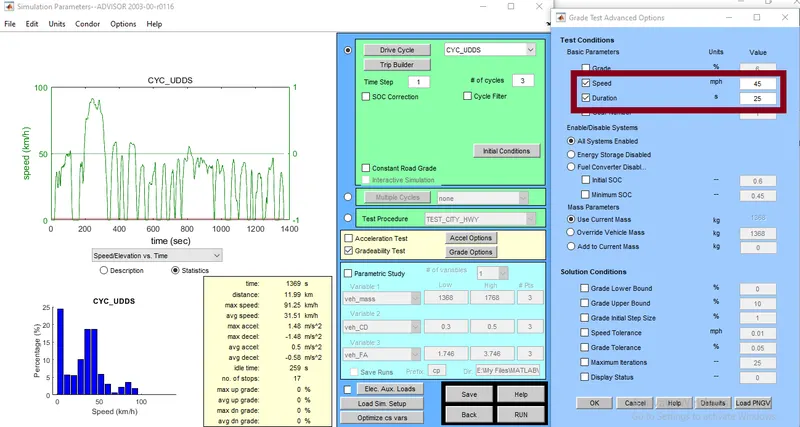
- Check the Grade-ability test box and click on the Grade options to open a new dialog box.
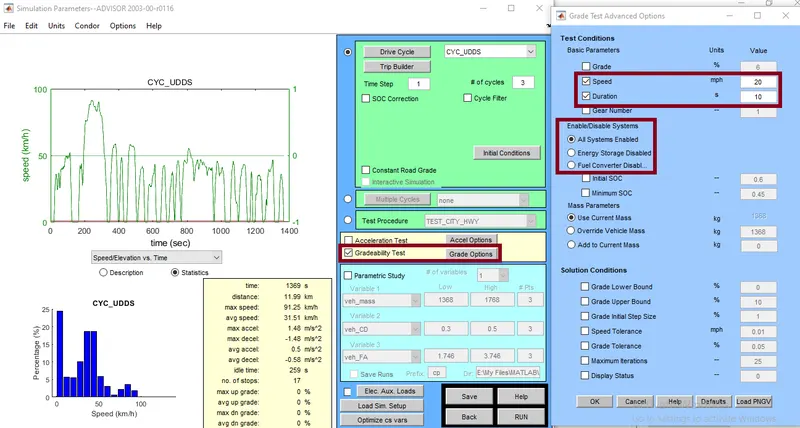
- Now in the Enable/Disable Systems Section, select All systems enabled.
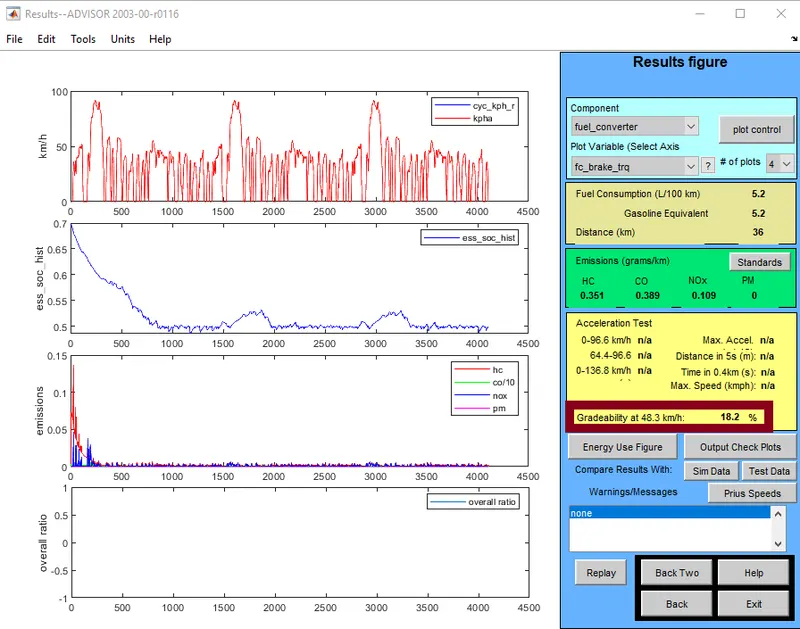
- In the Speed give different values like 20, 30, and 45 mph respectively at the duration of 10 seconds and Click ok.
- Now, Click RUN to check the Grade-ability.
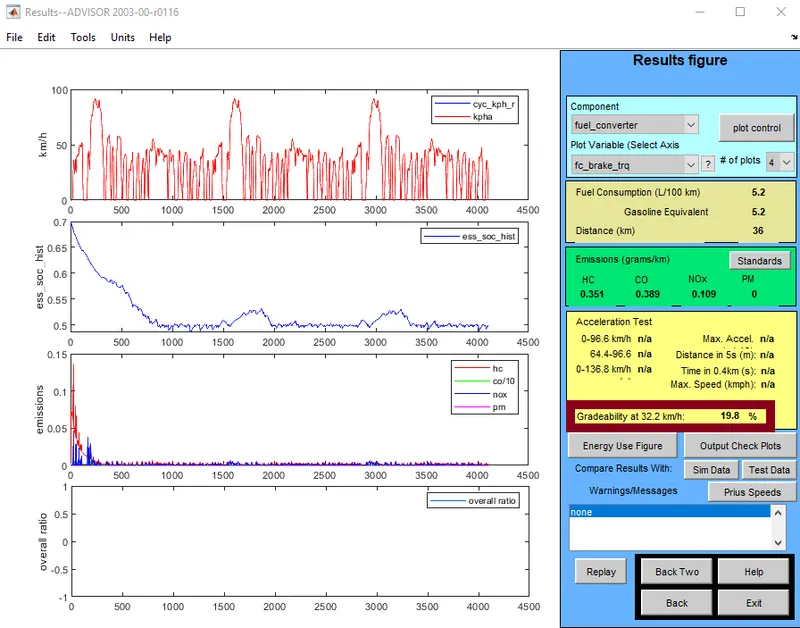
For 30Kms:
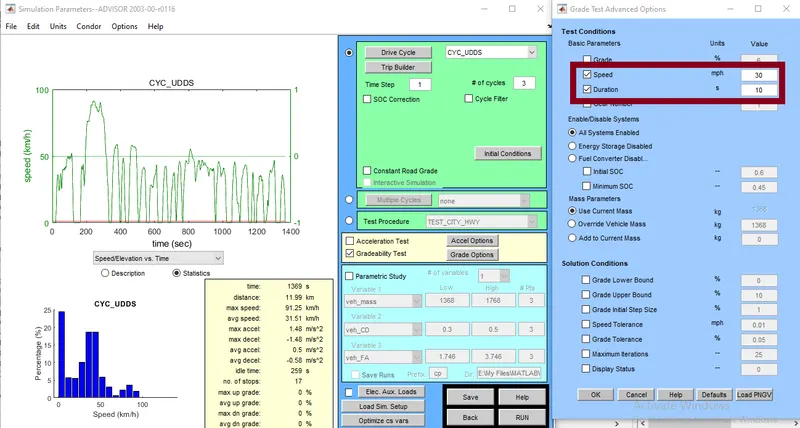
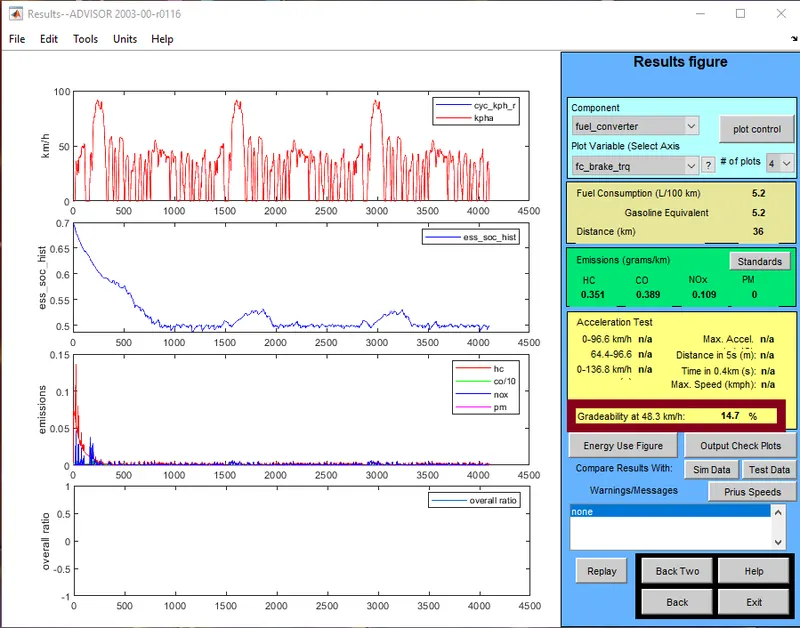
At 45 KMS:
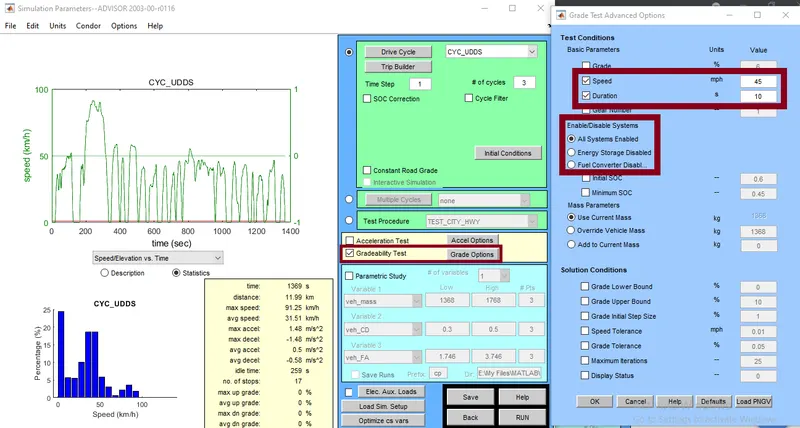
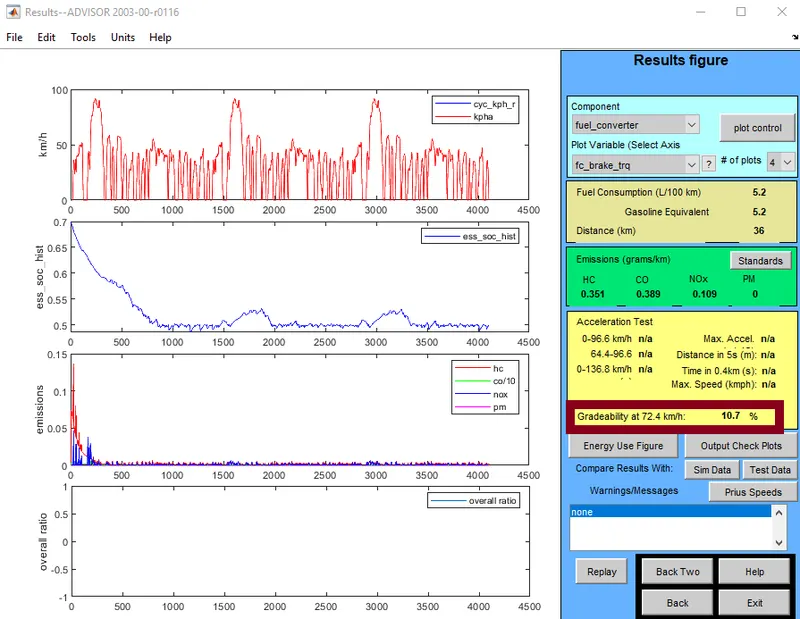
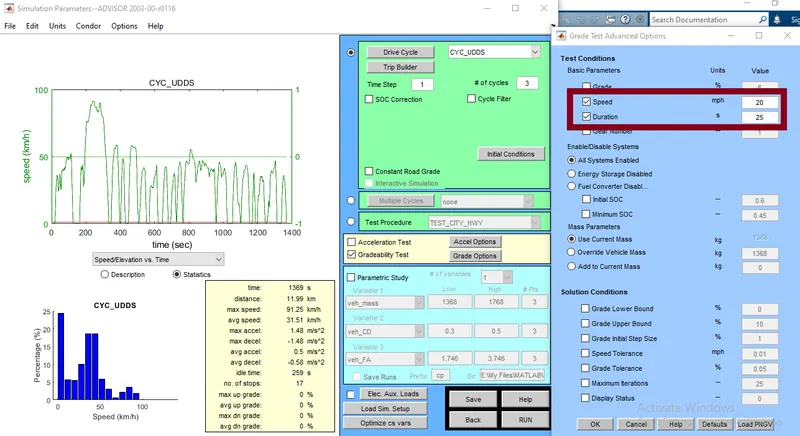
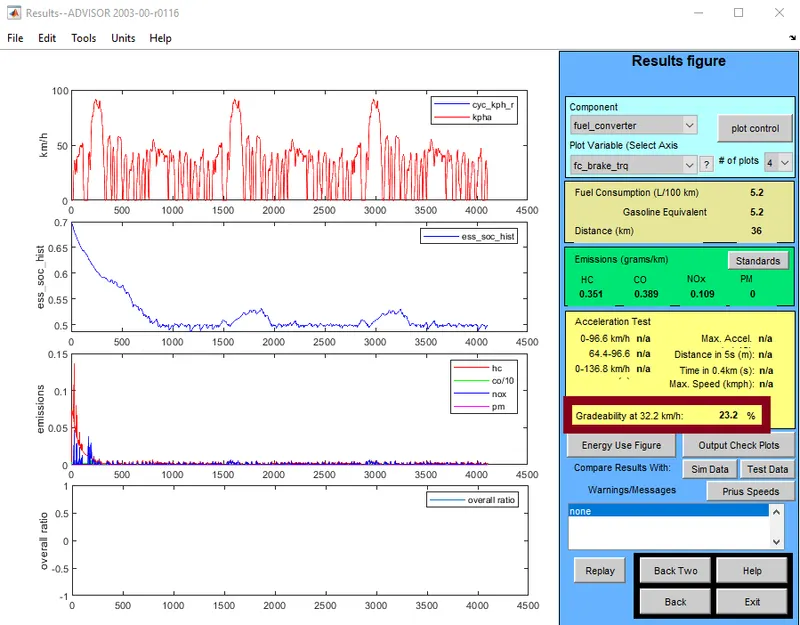
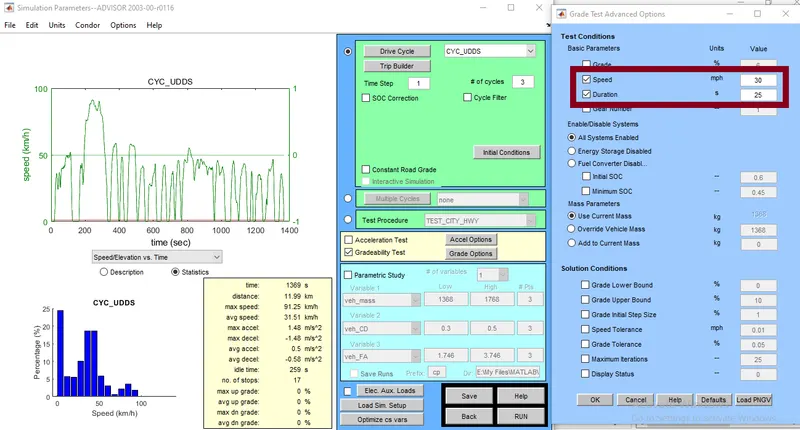
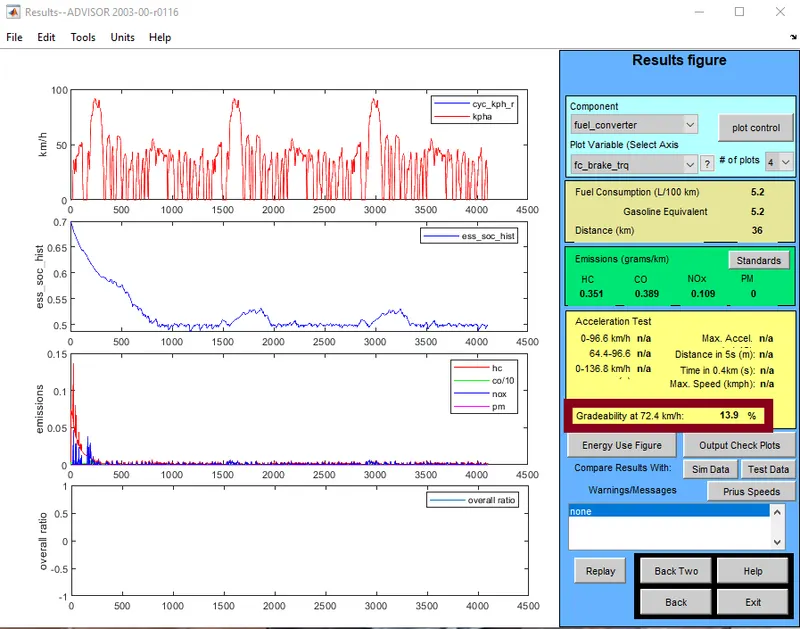
- After checking for the duration of 10 seconds, change the duration to 25 seconds and follow the same process and observe the results.
At 20 KMS:
At 30 KMS:
At 45 KMS:
Results:
- The distance of 45km can’t be reached by the system as the Battery capacity isn’t enough to cover the distance. It can travel to 41.4kms by draining the battery completely.
- The observations are formatted as a table
For the Battery Mod of 28:
|
No. of Cycles |
Distance Covered (km) |
Voltage |
Battery Weight |
|
2 |
35.5 |
345 |
308 |
|
3 |
46.3 |
345 |
308 |
- It is observed that just by increasing the battery module from 25 to 28. The Number of drive cycles also plays an important role to make the battery power efficient.
- To cover the given distance of 45kms, at least a 28 module 345 volt battery can be used.
- The observations are specified in the form of a Table.
For time Duration of 10 secs:
|
Vehicle Speed (mph) |
Critical Vehicle Speed (Km/h) |
Grade-ability % |
|
20 |
32.2 |
19.8 |
|
30 |
48.3 |
14.7 |
|
45 |
72.4 |
10.7 |
For time Duration of 25 secs:
|
Vehicle Speed (mph) |
Critical Vehicle Speed (Km/h) |
Grade-ability % |
|
20 |
32.2 |
23.2 |
|
30 |
48.3 |
18.2 |
|
45 |
72.4 |
13.9 |
- From the tables, we can see that there is a decrease in the Grade-ability for both the time durations with the increase in the vehicle speed.
Learning Outcomes:
- Learned to use the advisor tool.
- Learned to observe different cases and how it is acting on a vehicle.
Links
ADVISOR Tool: ADVISOR Tool