To calculate dead and live load for industrial steel structures and to apply them using TSD
- Calculate dead load in design report based on IS code and apply dead load on the model
- Finishes of 50mm
- Slab as per design
- Brickwall 150mm thickness
- Roofing load based on purlin size
- Ceiling loading 0f 0.3KN per sq m
AIM : To calculate dead load as per IS Code and apply dead load on model
INTRODUCTION : Loads cases and load combinations are generated, assigned for the structure using tekla and validation of those loads is an important part of Tekla Structural Designer as it ensures a valid model for the analysis and design routines
Load calculation :
Slab load : model slab in software
Finishes : 50mm x 24 KN/m^3 = 0.05 x 24 = 1.2 KN/m2
Brick wall width = 155mm
Unit weight = 20 KN/m^3
Floor height (Ground floor to First floor) = 5.2m
Brick wall loading for ground floor = 20 x (155/1000) x 5.2 = 16.12KN/m
Floor height (First floor to roof ) = 6.8 m
Brick wall loading for ground floor = 20 x (155/1000) x 6.8 = 21.08KN/m
Roofing load based on purlin size :1.5KN/m^2
Ceiling loading 0f 0.3KN per sq m
PROCEDURE :
- Open tekla software
- Click on Load tab and then load cases
- Add loads : Dead load, Service load, Imposed load, Wind load, Crane load, Seismic load.
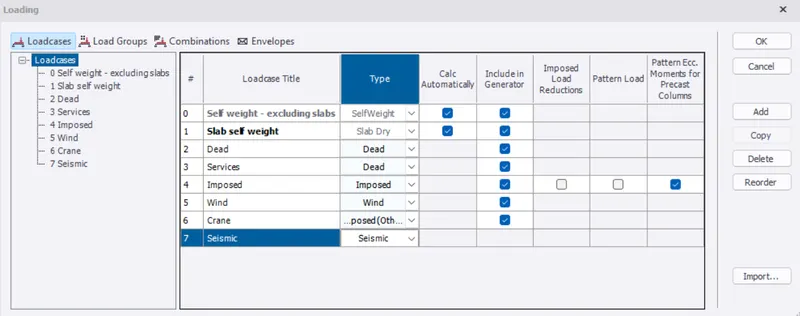
- Click ok
- Now click on Load combinations in load tab
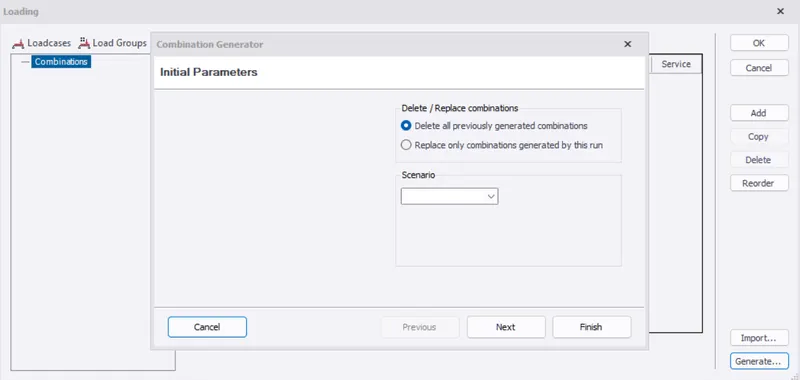
- Click on generate, we get initial paramters. Check and click on next
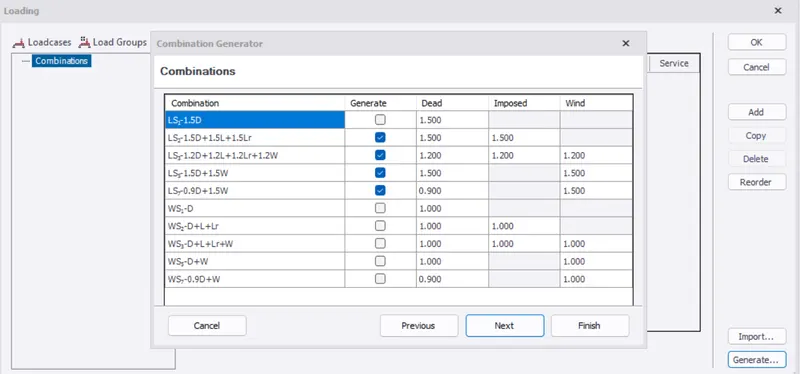
- We get combination. check and click on next
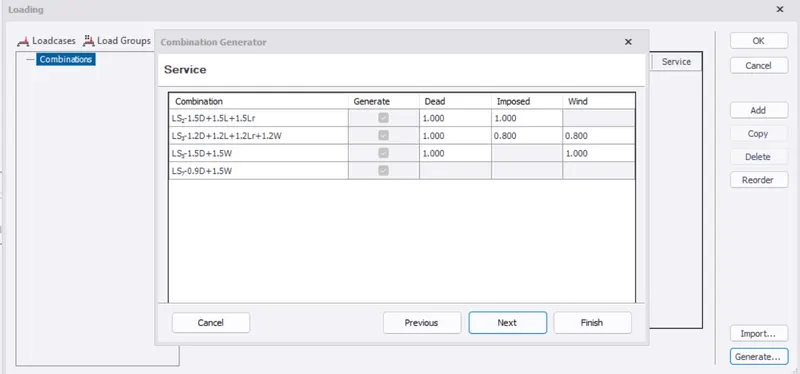
- We get service. Check and click on next
- We get NHF. click on finish
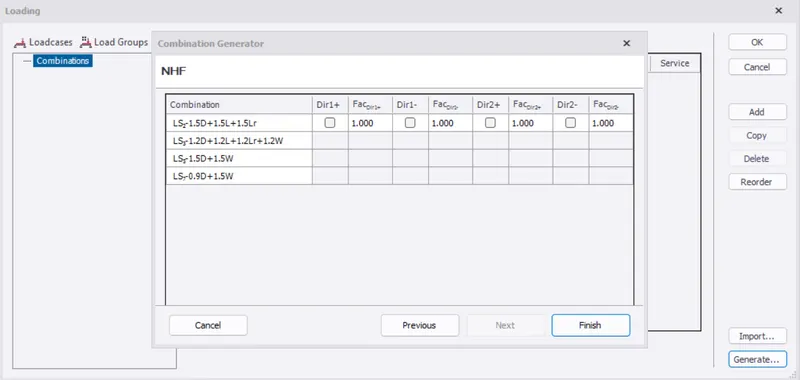
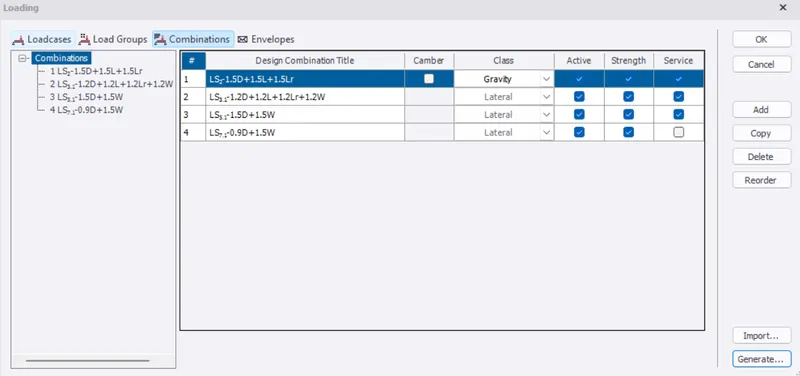
- Combinations are generated
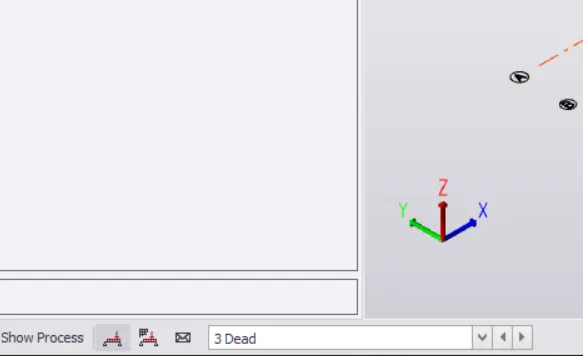
- Select dead load from bottom
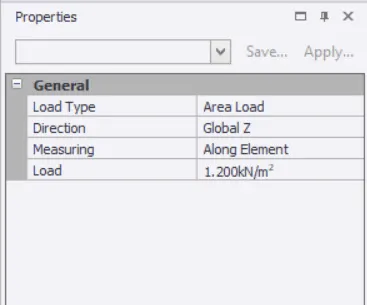
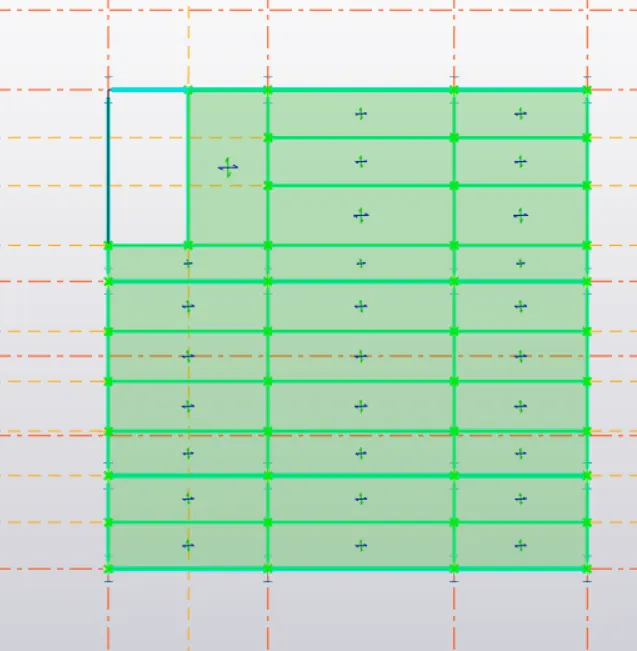
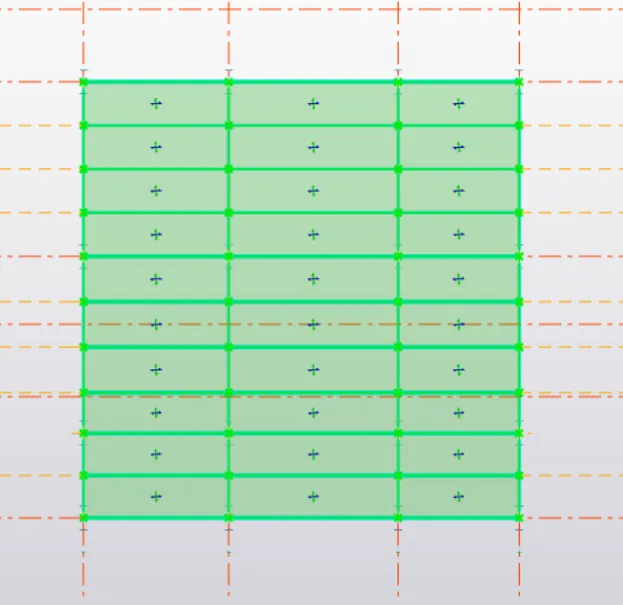
- Now select area load from panel load (Load tab)
- Enter property details as : direction = Z and load = 1.2KN/m2
- Assign the load on every floor level
Ground floor 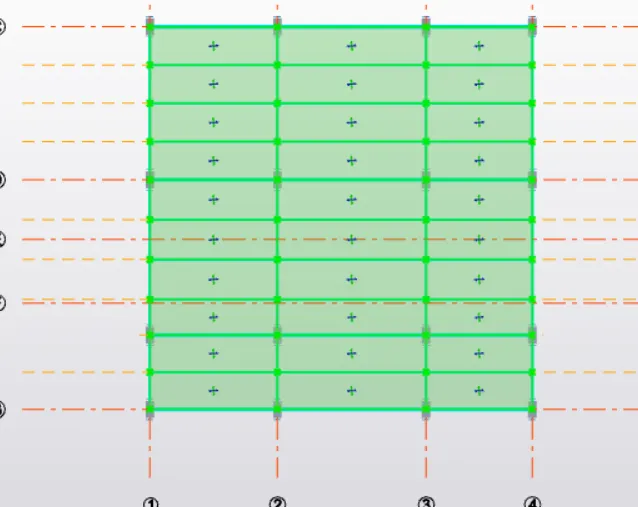
- First floor
- Roof level floor
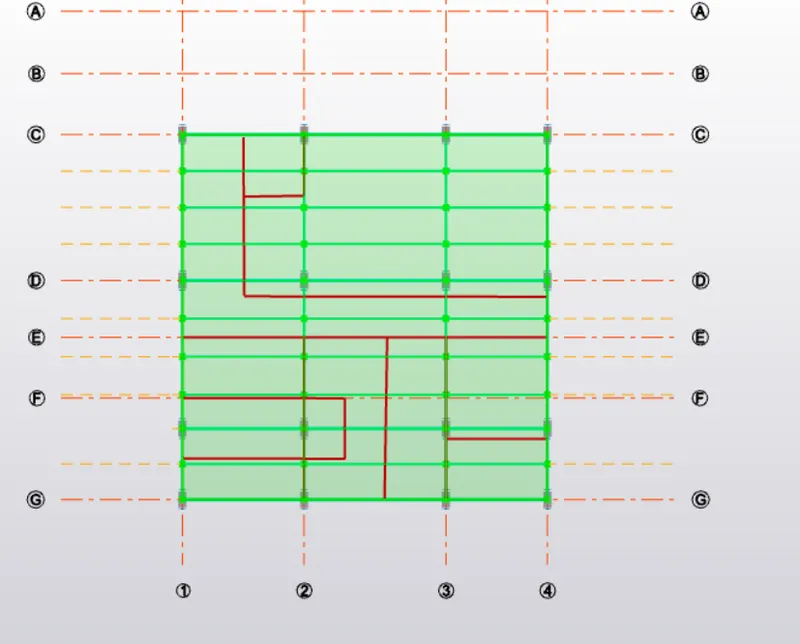
- Now to apply brick load to Groundfloor
- Select "Full udl" in load tab
- Select peripherals of the plan and apply load =16.12 KN/m2
- Now select Line load and draw inside walls of brick load = 16.12KN/m2
- Now to apply brick load to First floor
- Select "Full udl" in load tab
- Select peripherals of the plan and apply load =21.08 KN/m2
- Now select Line load and draw inside walls of brick load = 21.08KN/m2
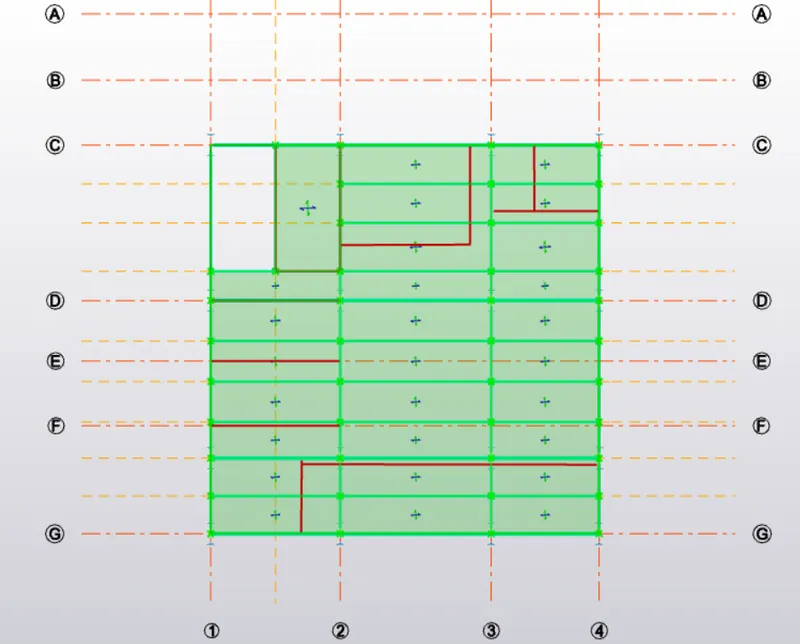
- Select area in the panel loads
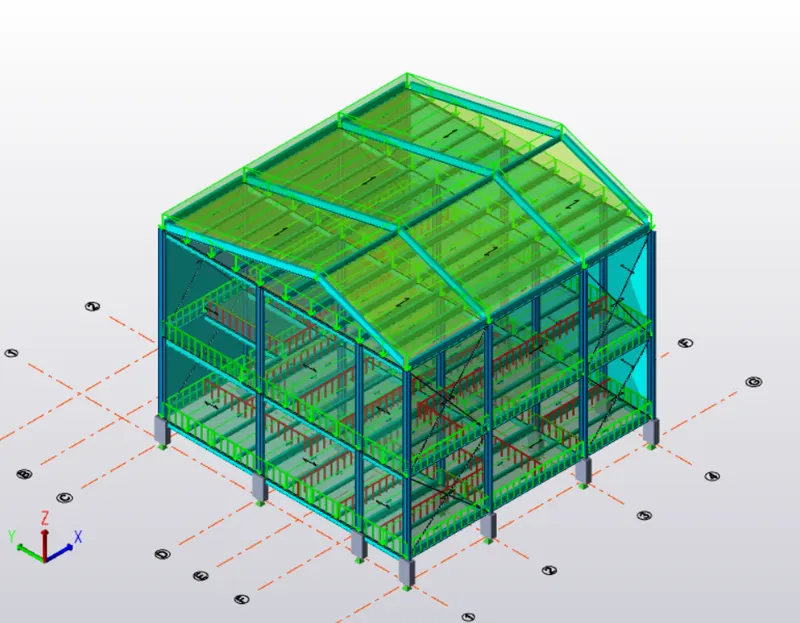
- Apply the load on roof panel (Load = 1.5KN/m^2)
RESULTS :
- Calculate live load in design report based on IS code and apply live load on the model
- Assume the loading based on IS 875
- Roof loading
- Consider equipment loading as 5KN per sq m
AIM : To calculate live load in design based on IS code and apply live load on the model
INTRODUCTION : Loads cases and load combinations are generated, assigned for the structure using tekla and validation of those loads is an important part of Tekla Structural Designer as it ensures a valid model for the analysis and design routines. Imposed Loads are assigned according to IS 875 Part 2
Work areas without machinery/equipments = 2.5KN/m^2
Work areas with machinery/equipments (Heavy) = 10KN/m^2
Staircase : 4KN/m^2
Toilets : 2KN/m^2
Canteen : 3KN/m^2
Store room : 2.4KN/m^2
Conference room : 4KN/m^2
Meeting room : 4KN/m^2
Office room : 4KN/m^2
Manager room : 4KN/m^2
Corridor : 4KN/m^2
Roof access not provided is taken as : 0.75KN/m2
PROCEDURE :
- Now click on imposed loads at bottom
- Select area load in the panel loads
- Assign loads on the all floors according to the IS 875part 2
- Assign imposed loads wherever patch loads are necessary
- Ground floor
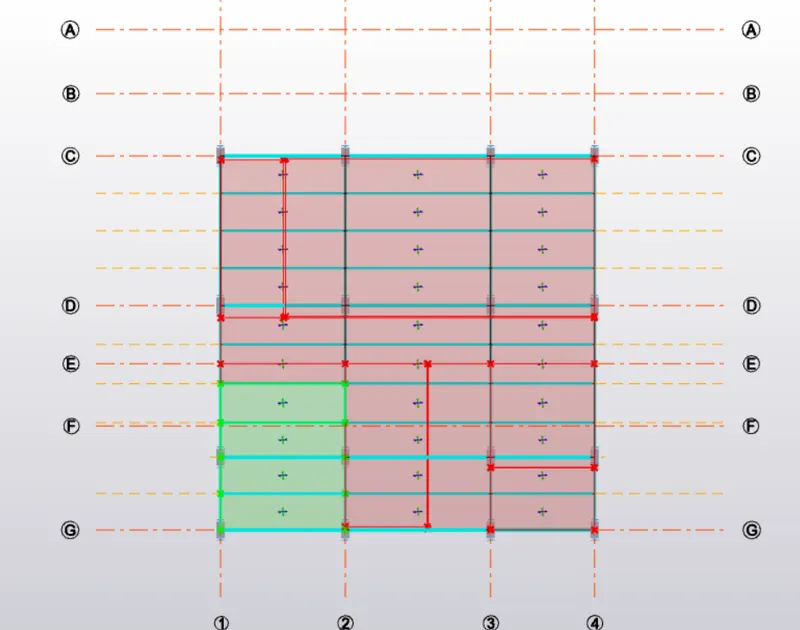
- First floor
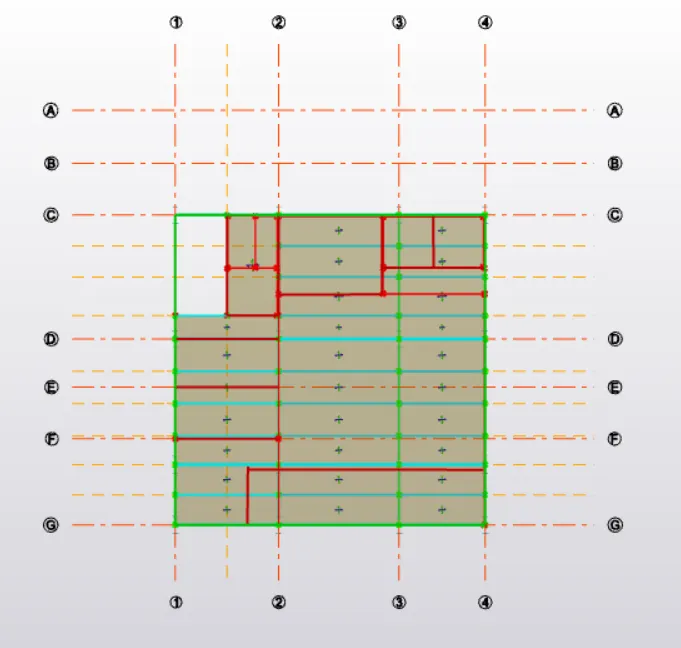
- Roof level
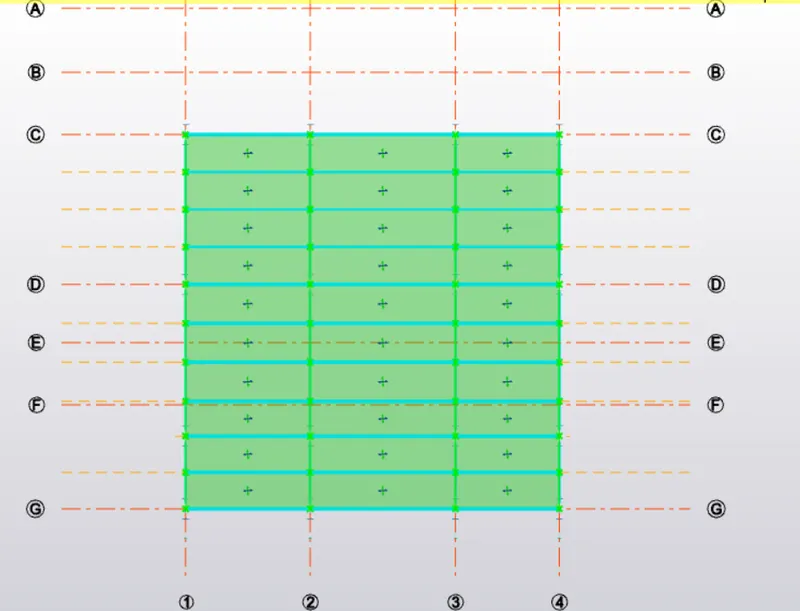
RESULTS :
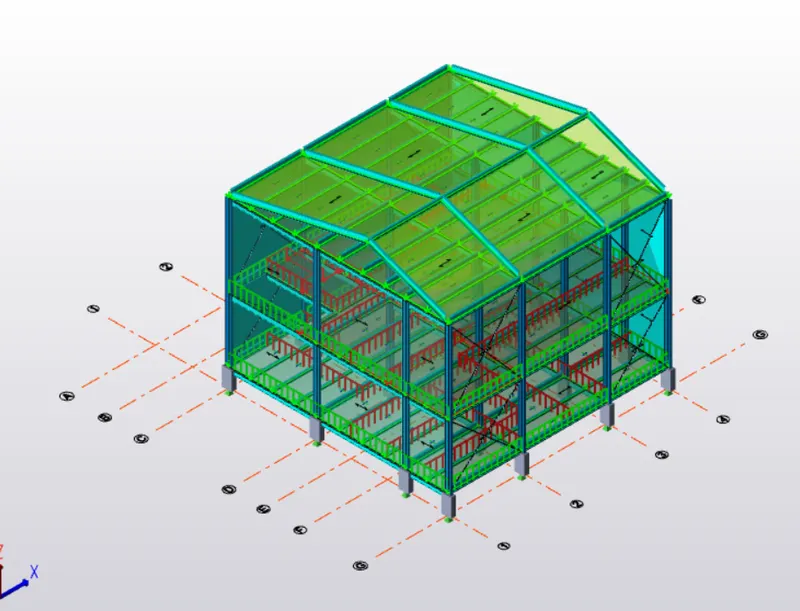
- Generate a calculation for 5T crane loading based on following inputs
- Centre to Centre of wheel = 10m
- Weight of crab = 40 KN
- Number of wheels = 4
- Wheel base = 2m
AIM : To generate ca calculation for 5T Crane loading
INTRODUCTION : Industrial buildings generally have cranes which run on rails which is supported by the building structure. Three main loads are considered such as vertical loads (Wheel loads), Lateral loads and Longitudinal forces
PROCEDURE & RESULTS :
Crane load = 50KN
span of crane girder c-c = 14 m
span of gantry girder c-c = 5.5 m
lateral span of girder = 5.5 m
Weight of crab = 40KN
Total number of wheels= 4
Wheel base = 2m
Selfweight of rail section = 300 N/m
Selfweight of gantry girder = 1500 N/m
Yield stress of steel = 250 N/m2
Maximum concentrated load = 90KN = Maximum wheel load
Self weight of crane will act as uniformly distributed load of intensity = 50/14 = 3.5714 KN/m
Calculating RA and RB
RA(14) - (90X13)-3.5714X14X7
RA = 58.57 KN
RB(14)-(90X1)-(3.5714X14X7)
RB = 31.418 KN
The reaction from the crane girder is distributed equally on 2 wheels at the end of the crane
Maximum wheel load on each wheel of crane = 58.5/2 = 29.25 assume 30KN
Calculating RC and RD
RC(5.5)-30(2.75+2.25)-30(2.75-0.75)
RC= 38.18 KN
RDX5.5-30(0.75+2.75)-30(0.5)
RD = 21.81 KN
BM Under wheel due to live load = RD X 2 = 43.62 KNm
BM Due to impact = 0.1 x 43.62 = 4.362 KNm
Total BM due to live load and impact load = 43.62 + 4.362 = 47.982 KNm
Total dead load = Selfweight of rail section + Selfweight of gantry girder = 1.8KN/m
BM due to dead load = wl^2/2 = (1.8 x5.5^2)/2 = 6.806KNm
Maximum BM= 47.982 + 6.806 = 54.788 KNm
Maximum shear force due to wheel load = RCX5.5 - 30X5.5-30X2.5 = 43.63KN
Lateral forces transverse to rails = 5% of the weight of crab and weight lifted = 0.05(40+10) = 2.5KN
Lateral force on each wheel = 2.5/2 =1.25KN
Maximum horizontal reaction due to lateral force by proportion at C = Lateral force x (Reaction at c due to vertical load/Maximum wheel load due to vertical load)
= 1.25 x (38.18/30) = 1.59 = 1.6KN
At D = 2.5-1.6 =0.9KN
BM Due to lateral load by proportion = (1.25/30)x43.63 = 1.817 KNm