Week - 2 - Explicit and Implicit Analysis
EXPLICIT AND IMPLICIT ANALYSIS
INTRODUCTION
Numerical analysis employs both explicit and implicit techniques to arrive at numerical approximations for the solutions of time-dependent ordinary and partial differential equations that call for computer simulations of physical processes. While implicit techniques arrive at a solution by solving an equation involving both the current state of the system and the later one, explicit methods determine the state of a system at a later time from the state of the system at the current time. Incremental loads are required for all dynamic and nonlinear analyses. To tackle these issues, "implicit" and "explicit" strategies are frequently employed. Mass (inertia) and damping have little impact on static analysis. Nodal forces related to mass/inertia and damping are taken into account in dynamic analysis. Both the explicit solver and the implicit solver can be used for dynamic analysis. Each step's solution in a nonlinear implicit analysis requires iterations in order to achieve equilibrium within a predetermined tolerance. Since the nodal accelerations are immediately solved in explicit analysis, iteration is not necessary.
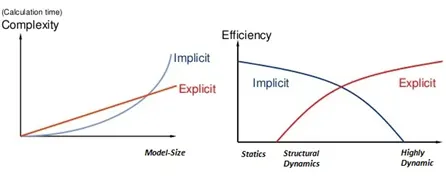
Difference between Implicit and Explicit
Implicit and Explicit analysis dissociate in the approach to time incrementation. In Implicit analysis, each time increment has to converge, but users can set quite long time increments. Conversely, explicit analysis doesn’t have to converge each increment, but time increments must be super small for the accuracy of solution.
Implicit transient analysis has no time step limit. Implicit time steps are most often larger than explicit time steps.
Formulations:
The matrix equation is reduced by the partial differential equations in linear problems to:
[K]{x} = {f}
Where
k = stiffness matrix
x = displacement/deflection
F = force
For static non-linear situations like:
[K(x)]
{x} = {f} → [k0 + k1• x + k2 • x2 +…] {x} = {f}
The matrix equations change in dynamic issues to:
[M]{x´´} + [C]{x´} + [K]{x} = {f}
x´ = velocity
x´´ = acceleration
C = damping matrix
M = mass matrix
When to use Implicit?
When the structure is being affected by the boundary conditions slowly and the effects of strain rates are minimal, implicit methods should be employed. After it is possible to determine the increase in stress as a function of strain, geometry can be examined utilising implicit techniques. Each time increment in the model establishes the global equilibrium. This implies that every increment must converge. The solver determines all local finite element variables (stresses, strain, etc.) for each increment after the global equilibrium has converged.
When to use Explicit?
When the strain rates are equal to or greater than 10-3 per second, explicit approaches should be utilised. Examples of these occurrences include vehicular accidents, ballistic explosions, drops, and more. In these situations, in addition to the variation in stress with strain, the rate of strain must also be taken into account. There are no iterative processes or convergence criteria to evaluate. The local finite element variables are the solver's primary emphasis. For a particular increment, the solver calculates all of the local finite element variables before moving on to the next one.
AIM
As demonstrated in the PDF, F(u) = u3+9u2+4u use this equation and solve using both Explicit and Implicit Methods ( have a tolerance of 0.001).
- Write a detailed report about Implicit and explicit methods.
- Do the calculations in a spreadsheet, try to plot the graph and compare them (optional).
EXPLANATION
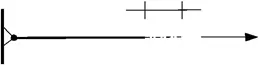
Assume the instance of a simple bar in tension. Consider a scenario where the force in the bar is a nonlinear function of the displacement.
f(u)=u+u^3/3 (1)
As a result of (1), the stiffness of the bar is
k(u)=df/du=1+u^2 (2)
u
 F
F
Figure 1 A simple bar in tension
Explicit Analysis
Using equation (1), it is evidently possible to plot a graph of force, f, versus displacement, u. However, if the stiffness is known but not the nonlinear force against displacement relationship, it is still possible to numerically create the force versus displacement graph. Utilizing an incremental explicit load control strategy is one approach. Next, this is demonstrated. The tension bar is loaded in this example using three equal load increments (or steps) of ∆F = 1 unit each. The variables are: k for stiffness, u for displacement, f for internal force in the bar, and f for external force acting on the bar. ∆u or ∆F are used to represent incremental displacements or incrementally applied external forces, respectively. The equation ∆F = k∆u is put to use. The analysis goes on like this:
Step 1
u0 = 0.0, ⇒ k (u0) = 1, ∆F = 1, ∆u1 = ∆F/k (u0) = 1.0, u1 = u0 + ∆u1 = 1.0
Step 2
⇒ k (u1) = 1 + 12 = 2, ∆F = 1, ∆u2 = ∆F/k(u1) = 1/2, u2 = u1 + ∆u2 = 1.5
Step 3
⇒ k(u2) = 1+1.52 = 3.25, ∆F = 1, ∆u3 = ∆F/k(u2) = 1/3.25, u3 = u2+∆u3 ∼= 1.81
Finally, the three stages provide the results listed below.
Fext = ∆F + ∆F + ∆F = 3.0
`f_int =u^3/3^3 =1.81+〖1.81〗^3/3 ≅ 3.79`
Because Fext = fint, it is clear from the results that exterior and internal forces are not in equilibrium. The key findings for the explicit analysis are presented in Table 1.
Table 1: Results of an explicit analytical summary
|
Step i |
∆Fi |
∆ui |
ui |
(Fext)i |
(fint)i |
fint − Fext = R |
|
1 |
1.0 |
1.000 |
1.00 |
1.0 |
1.333 |
0.333 |
|
2 |
1.0 |
0.500 |
1.50 |
2.0 |
2.625 |
0.625 |
|
3 |
1.0 |
0.308 |
1.81 |
3.0 |
3.790 |
0.790 |
Implicit Analysis
The only difference between an implicit analysis and an explicit analysis is that before moving on to the following phase, Newton-Raphson iterations are employed to impose equilibrium at the conclusion of each stage. In essence, a small force is used to move the solution forward at the start of a step. However, unless the stiffness is linear for the specified step, internal and exterior forces won't be in equilibrium. Therefore, modifications must be made to the displacement in order to reach equilibrium. This is done by minimizing the residual using Newton-Raphson iterations, where R (u) = fint − Fext. The residual is expanded as a Taylor series about the present displacement uj, which results in
`R^(j+1)=R^j (u^j )+dR(u^j )/du δu^(j+1 )+⋯= R^(j )+k(u^(j ) )δu^(j+1)+⋯`
The following adjustment is derived by ignoring higher order terms in the series, setting Rj+1 = 0 and solving for δuj+1
δuj+1 = −[k(uj)]−1Rj. (4)
The number of iterations required to lower the norm of the residual, , below the selected tolerance threshold (in the example below, a tolerance of 102), is indicated by the iteration variable, j.
The process of the implicit analysis is as follows (results are approximations; they are more accurate when performed on a computer to machine precision):
Step 1
u0 = 0.0, ⇒ k(u ) = 1, ∆F = 1, ∆u = ∆F/k(u ) = 1.0, u = u + ∆u = 1.0
Check the residual, Fext = ∆F = 1, fint = u + u3/3 = 4/3, R(0) = fint − Fext = 1/3
R(0) > 10 2 ⇒ Newton-Raphson iterations are necessary.
Calculate the correction to u1 = u1(0)
δu(1) = −[k(u1(0) )] 1R(0) = −2 1(1/3) = −0.16667.
⇒ The updated value of u1(1) = u1(0) + δu(1) = 1 + (−0.16667) = 0.83333.
Check the residual again, Fext = 1, fint = u1(1) + (u1(1))3/3 = 1.02623
R(1) = fint − Fext = 0.02623
R(1) > 102 ⇒ another Newton-Raphson iteration is necessary.
Calculate the new total correction to u1 = u1(0)
δu(2) = δu(1) − [k(u1(1) )] 1R(1) = −0.16667 − (1.6944 1)0.02623 = −0.1821.
The updated value of u1(2) = u1(0) + δu(2) = 1 + (−0.18215) = 0.81785.
Check the residual, Fext = 1, fint = u1(2) + (u1(2))3/3 = 1.000197
R(2) = fint − Fext = 0.000197
R(2) < 10 2 ⇒ no further iterations are necessary.
Therefore, the final value is u1 = u1(2) = 0.81785.
Step 2
k(u1) = 1 + 0.817852 = 1.66888, ∆F = 1, ∆u2 = ∆F/k(u1) = 0.59920
u2 = u1 + ∆u2 = 1.41705
Check the residual, Fext = ∆F = 1, fint = u2 + u23/3 = 2.36554
R(0) = fint − Fext = 0.36554
R(0) > 102 ⇒ Newton-Raphson iterations are necessary.
Calculate the correction to u2 = u2(0)
δu(1) = −[k(u2(0))] 1R(0) = −3.425081(0.36554) = −0.10672.
⇒ The updated value of u2(1) = u2(0) + δu(1) = 141705 + (−0.10672) = 1.31033.
Check the residual again, Fext = 1, fint = u2(1) + (u2(1))3/3 = 2.060260
R(1) = fint − Fext = 0.060260
R(1) > 102 ⇒ another Newton-Raphson iteration is necessary.
Calculate the new total correction to u2 = u2(0)
δu(2) = δu(1) − [k(u2(1))]1R(1) = −0.10672 − (3.027291)0.06026 = −0.12663.
The updated value of u2(2) = u2(0) + δu(2) = 1.41705 + (−0.12663) = 1.29042.
Check the residual, Fext = 1, fint = u2(2) + (u2(2))3/3 = 2.00663
R(2) = fint − Fext = 0.00663
R(2)< 102 ⇒ no further iterations are necessary.
Therefore, the final value is u2 = u2(2) = 1.29042.
Step 3 is completed similar to steps 1 and 2, the final value is u3 = 1.6097.
Table 2 lists the outcomes of the implicit analysis.
The table clearly shows that the internal and external forces are achieving equilibrium.
Table 2: Results of an implicit analysis summary
|
Step i |
∆Fi |
ui |
(Fext)i |
(fint)i |
fint − Fext = R |
|
1 |
1.0 |
0.81785 |
1.0 |
1.000197 |
0.000197 |
|
2 |
1.0 |
1.29042 |
2.0 |
2.00663 |
0.00663 |
|
3 |
1.0 |
1.61 |
3.0 |
3.001 |
0.001 |
Plot of results
Figure 2 presents a visualization of the findings. The graphic clearly shows that the explicit analysis deviates from the precise solution. The explicit analysis more nearly matches the precise solution when 20 increments are employed. However, the explicit analysis still veers off the precise solution even with more increments. The deviation from the exact solution demonstrates the absence of internal and external force equilibrium. An implicit analysis is necessary to address this issue. In Figure 2, the outcomes of the implicit analysis. The incremental stages are corrected using the Newton-Raphson iterations, leading to the precise solution within the predetermined tolerance. Only three increments are needed to reach excellent agreement, and only two Newton-Raphson iterations are needed for each step. The non e.m and non i.m scripts in MATLAB are used to complete the explicit and implicit analyses.
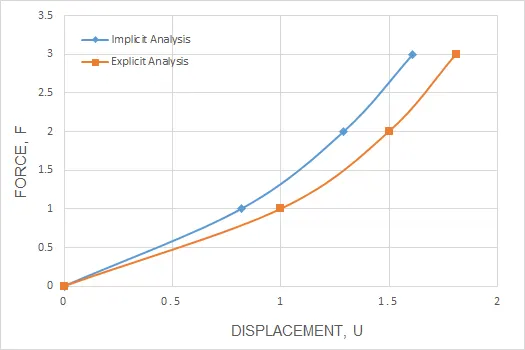
Figure 2 Comparison of explicit and implicit results of load versus displacement
CONCLUSION
If the circumstances in your analysis occur very slowly, the implicit solver is really helpful. Ideal analyses typically take more time than one second. The ability for users to set any size time increment is an advantage.
The stiffness matrix's inversion yields the unknown x. (K).
Enforced equilibrium solutions for Newton-Raphson.
- The Newton technique is applied.
- More precise
- Large models take a very long time.
- Additional computer storage is necessary
- Less than 10-3 strains per second are experienced.
- A wise choice for dynamic structure types with sluggish load rates; Displacements applied gradually, Low frequency reaction, Oscillation and Vibration
For quick events, the explicit solver is excellent (mostly less than 0.1 second). The explicit solver determines the size of the time increment and sets it. The density of the substance affects the speed of sound in that medium. Mass scaling refers to this. The mesh (element size and quality), young modulus, and density all affect the explicit time step.
- By inverting the mass matrix, an unknown x is discovered (M).
- Direct answers.
- Methods of central difference are employed.
- Less precise
- Efficient in terms of computation for big models and quick Dynamic reaction time
- Less computer storage is needed.
- Equal to or greater than 10-3 strains per second.
- An excellent choice for structures subject to wave propagation, car crashes, blast effects, drop test and Stamping of metal
This question doesn't have a simple solution. The type of issues solved by implicit and explicit solutions are same. Technically, both should result in the same result in any situation. The same issue can be examined using both methods. The method of time incrementation is the key distinction between implicit and explicit.
- The time increment can be defined thanks to the implicit analysis. Users can specify the size of the time increment. For global equilibrium, this increment must be completed iteratively. Consequently, it takes some time to calculate.
- Calculation of explicit time increments happens quite quickly. Simply because global equilibrium does not require iteration. Additionally, there will be no manual adjustment of the time increment. Simple assumption is made by the solver, which results in a very minimal time increment.