(ANSYS_P14) - Universal Joint
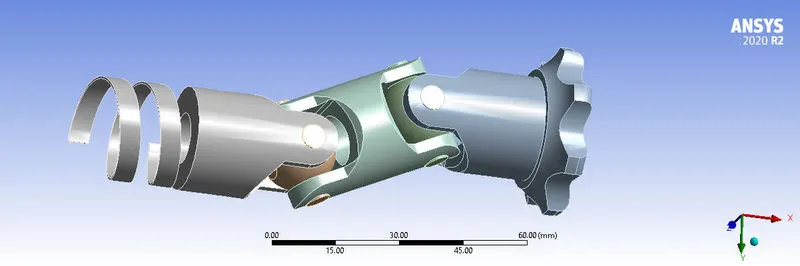
OBJECTIVE:Transient structural simulation of a univeral joint mechanisim model in ANSYS Workbench.
TASK
For this challenge, I will have to perform a transient structural analysis on a double universal joint with a spring using three different materials: Structural Steel, Stainless Steel and Titanium alloy. The three materials must be used on the joint with the springs alone. I need to obtain the Equivalent stress and total deformation for all the three cases and compare them. Submit a report regarding the same.
JOINTS
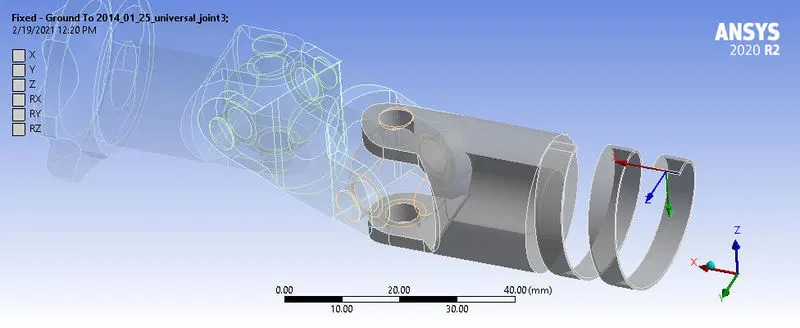
- Fixed Joint
A fixed joint is specified on the spring with respect to the ground.
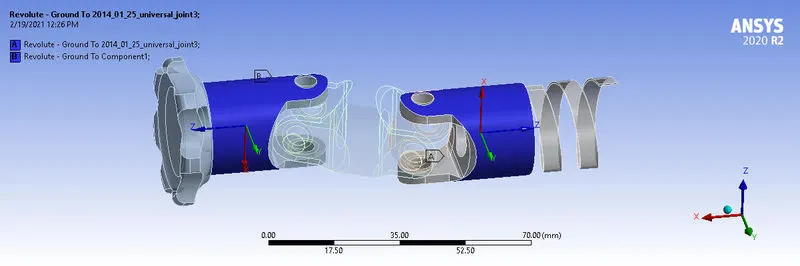
- Revolute Joint
A revolute joint is specified on the components specified below with relation to the ground.
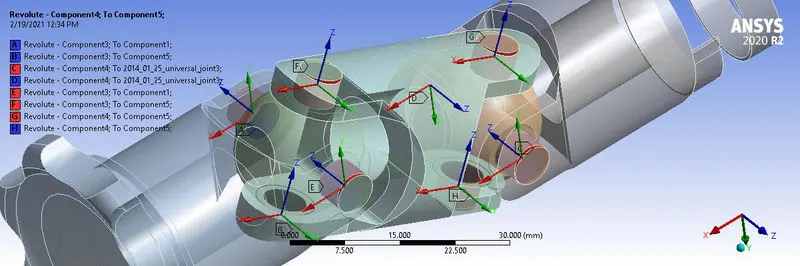
- Revolute Joint
Eight revolute joints are specified on the pins specified below with relation body to body.The axis of rotation is in the Z-axis.
MESHING
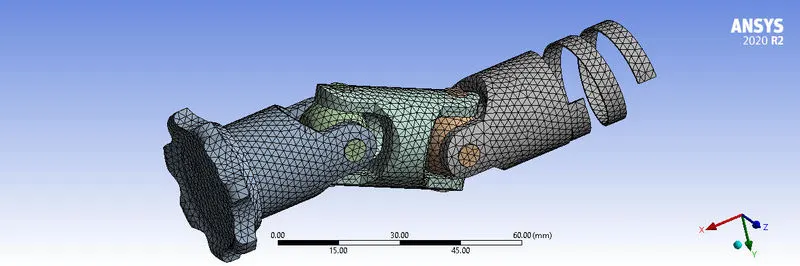
A sizing of 2mm is assigned to all the the faces to ensure quality mesh at those areas.
ANALYSIS SETTING
9 STEPS ARE USED
For step 1,
- Auto Time Stepping: off
- Defined by : Time
- Time Styep: 0.1
- Solver Type : PROGRAM CONTROLLED
- Weak Spring :Controlled
- Large deflection: ON
- Output controls : Set all to YES
JOINT LOAD
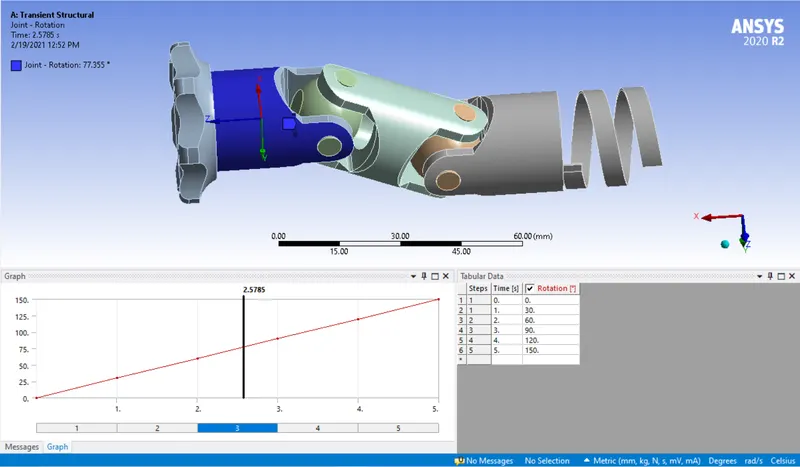
- Joint load is assigned to the component in the image below
- Selecting a rotation , tabular data is inputed from 30 to 150
OUTPUT REQUEST
CASE_1
Spring material is Stainless Steel
- Total Deformation
- Equivalent Stress
CASE_2
Spring material is Structural Steel
- Total Deformation
- Equivalent Stress
CASE_3
Spring material is Titanium Alloy
- Total Deformation
- Equivalent Stress
RESULTS
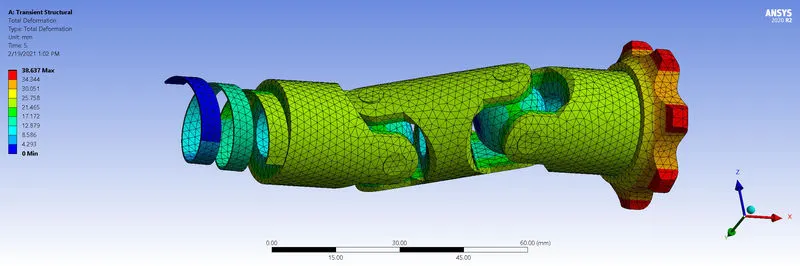
Spring material is Stainless Steel
- Total Deformation
- Equivalent Stress
CASE_2
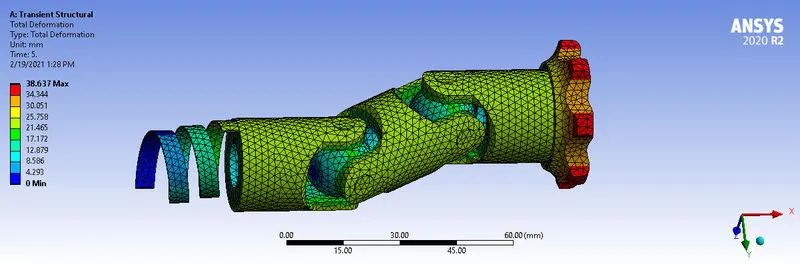
Spring material is Structural Steel
- Total Deformation
- Equivalent Stress
CASE_3
Spring material is Titanium Alloy
- Total Deformation
- Equivalent Stress
DISCUSSION
| MATERIAL | DEFORMATION(mm) | STRESS (Mpa) | ULTIMATE STRENGTH (Mpa) | YIELD STRENGTH (Mpa) |
| Structural Steel | 38.63 | 1354.80 | 460 | 250 |
| Titanium Alloy | 38.63 | 666.73 | 1070 | 930 |
| Stainless Steel | 38.64 | 1312.60 | 580 | 207 |
The deformation of all three materials were approximately equal.
In regards to strength , structural steel developed the most resistance to motion of the applied force therefore is the strongest material amongst the rest. Stainless steel was just behind structural steel but titanium produced the least stresses considering the other two.
All three materials had their component undergo plastic deformations from the load applied , but only titanium alloy did not exceed its ultmate strength therefore resisted any fracturing from the load applied. The remaining two had fracture occuring at highly stress concerntrated areas.
CONCLUSION
This task was simulated succesfully and the effect of material variation on the spring was analysed and deduced.
The files were unable to be uploaded in the provided plateform so i attached a google upload link below
https://drive.google.com/drive/folders/1qcucXNs2hkBlw-MmICaJcvnqEYDzSeRK?usp=sharing