(ANSYS_P8) -Wire Bending Challenge
OBJECTIVE: To perform an analysis to simulate the bending of a wire in ANSYS.
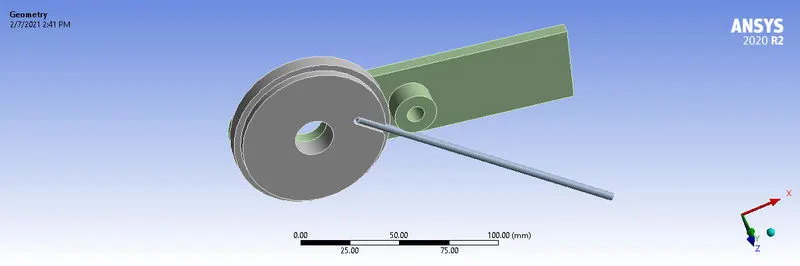
ANALYSIS
An analysis is done on a bending wire by varying three different wire materials and analysing them based on their equivalent strain and stresses.
MATERIAL AND THEIR PROPERTIES
Stainless Steel-(Wheels)
Density: 7850 kg/m^3
Youngs Modulus: 200000Mpa
Poisson Ratio: 0.3
Tensile Yield Strength: 250 Mpa
Copper Non-Linear (Workpiece )
Density: 8300 kg
Youngs Modulus: 110,000 Mpa
Poisson Ratio: 0.34
Tensile Yield Strength: 280 Mpa
Magnesium Non-Linear (Workpiece )
Density: 1800 kg
Youngs Modulus: 45,000 Mpa
Poisson Ratio: 0.35
Tensile Yield Strength: 193 Mpa
Aluminium Non-Linear (Workpiece )
Density: 1800 kg
Youngs Modulus: 71,000 Mpa
Poisson Ratio: 0.33
Tensile Yield Strength: 280Mpa
MESHING
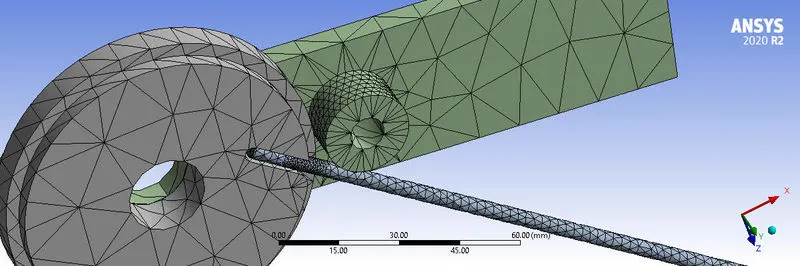
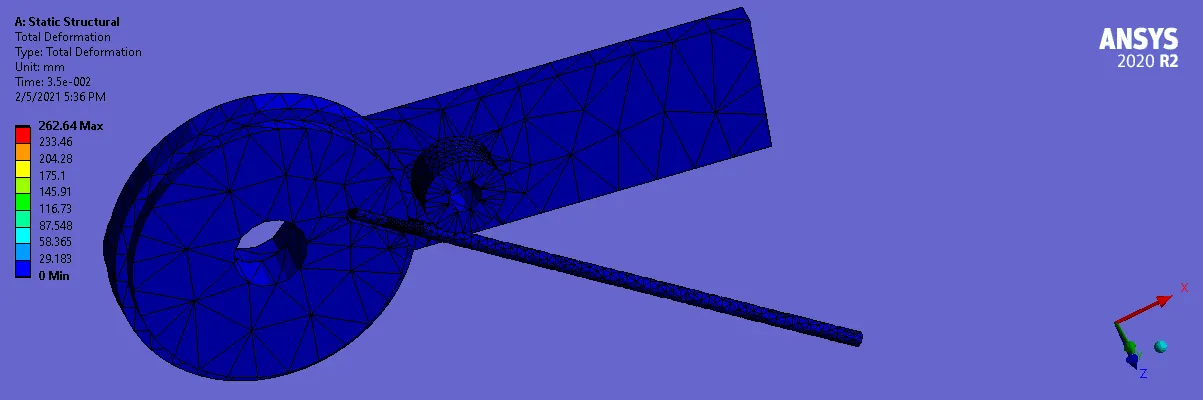
Meshing is done by setting a method using tetrahedron elements
- A sizing of 2.2mm is set to critical faces on the wire wheel and lever
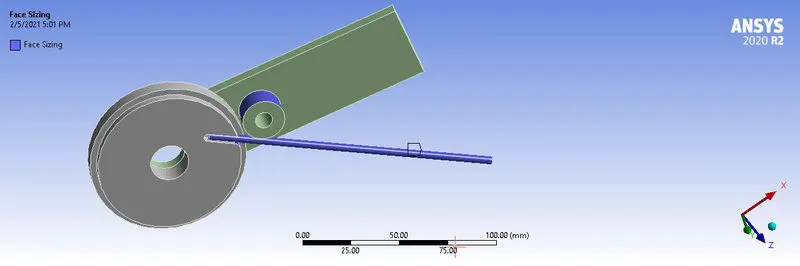
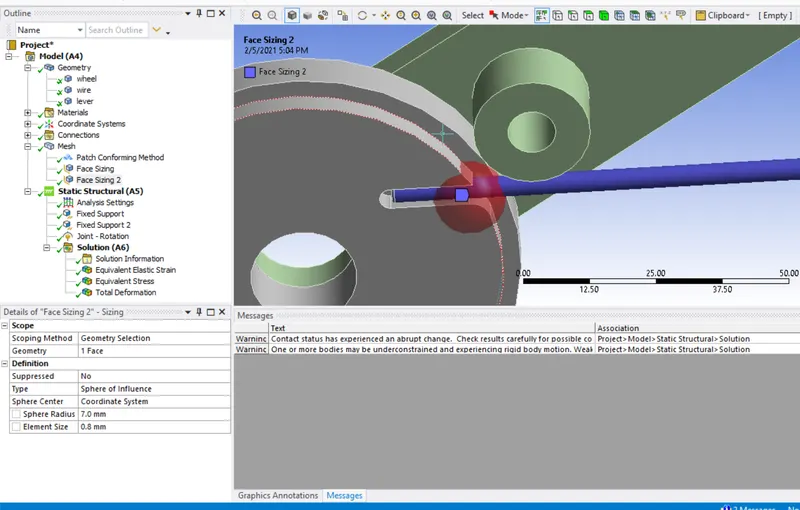
- A coordinate system is created on an area around the wire and meshing is set using a sphere of influence with raduis of 7mm and element size of 0.8
- A general default mesh is made for the remaining faces and can be seen below
PROCEDURE
CONTACT
- The contacts between the wheels and the wire are specified with frictional type connection.
- Two cantacts are set : Wheel (contact) ,wire (target) : lever (target), wire (contact)
- Friction value of 0.2
- Augumental Langrange
- Normal Stiffness factor of 0.1
- Update stiffness by each iteration
- Interface treatment of add offset and ramped effect
ANALYSIS SETTING
8 STEPS ARE USED
For step 1,
- Auto Time Stepping: On
- Defined by : Time
- Initial time : 0.1
- Minimum time : 0.01
- Maximum time : 0.2
- Solver Type : Direct
- Weak Spring :Controlled
- Large deflection: ON
For step 2-8,
- Auto Time Stepping: On
- Defined by : Time
- Carry on time: ON
- Minimum time : 0.01
- Maximum time : 0.2
- Solver Type : Direct
- Weak Spring :Controlled
- Large deflection: ON
- Output controls : Set all to YES
BOUNDARY CONNECTIONS
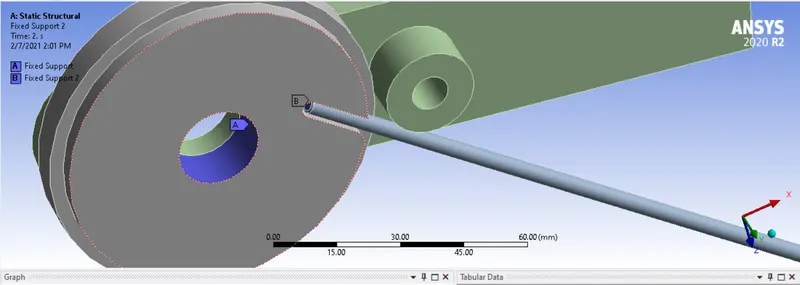
- Joint set was the fixed support on the wheel and the left end of the wire
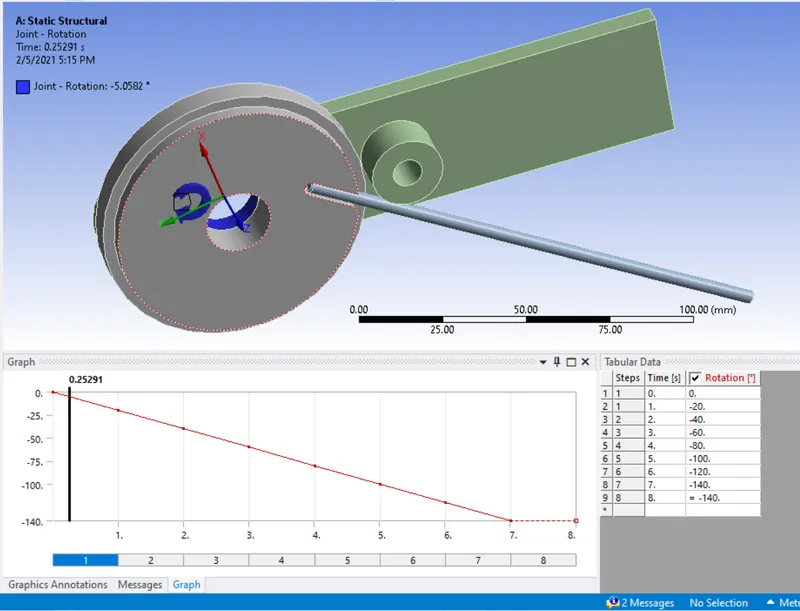
- Revoulte joint on the lever.
- Rotation joint load is defined specifying the rotation
RESULTS
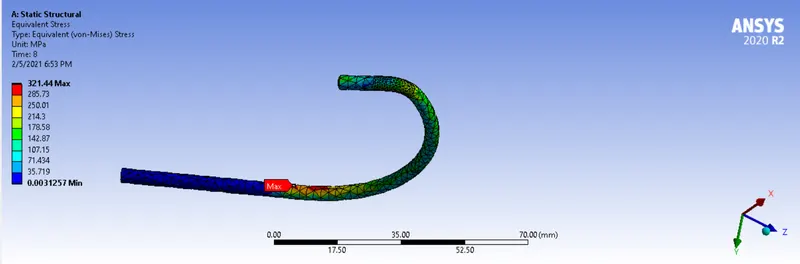
Equivalent Stress Aluminium
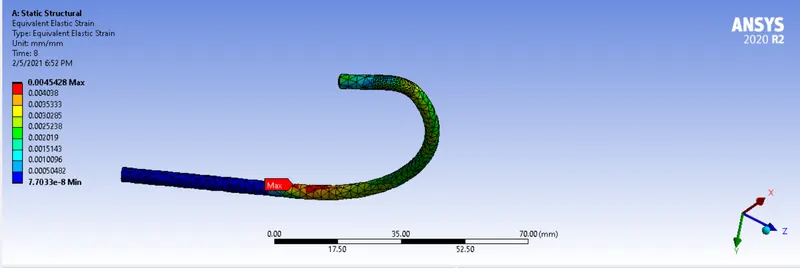
Equivalent Strain Alumimium
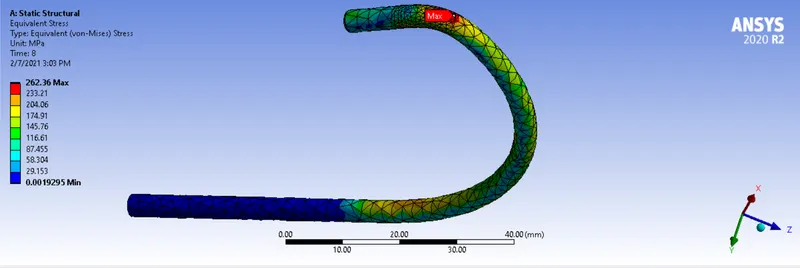
Equivalent Stress Magnesium
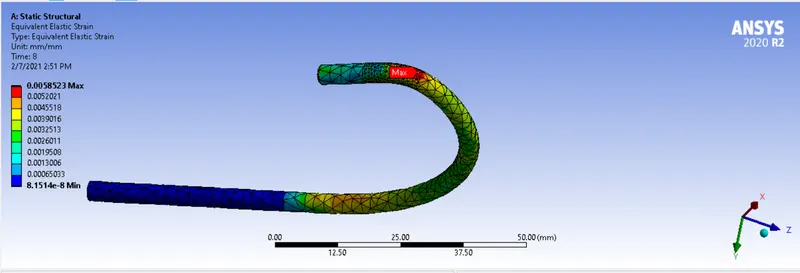
Equivalent Strain Magnesium
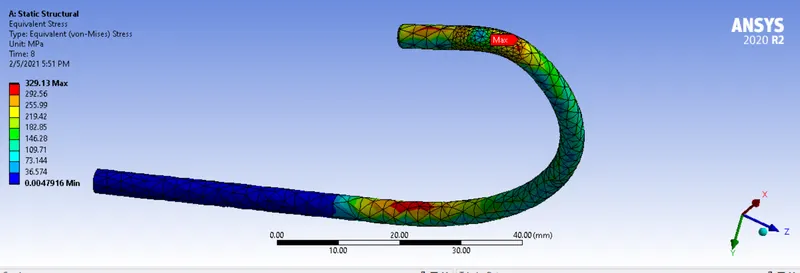
Equivalent Stress Copper
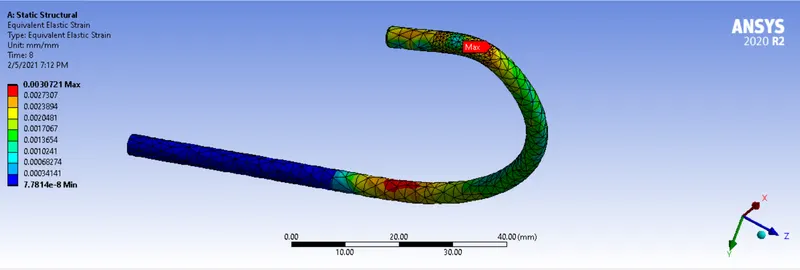
Equivalent Strain Copper
| MATERIAL | STRESS (Mpa) | STRAIN | YOUNG MODULUS (Mpa) |
| COPPER | 329.13 | 0.0031 | 110000 |
| ALUMINIUM | 321.44 | 0.0045 | 71000 |
| MAGNESIUM | 262.36 | 0.0059 | 45000 |
DISCUSSION
The higher the young modulus of a material , the stiffer it is. When a material is stiff , more equivalent stresses would be developed as a result to resistance to deformation. This theory is proven as copper developed the highest stresses and magnesium the least . The copper wire can be said as the strongest among the three because it withstood deformation the most compared to the other two. Maximum stresses was developed at the curve edge of the wheel.
CONCLUSION
This simulation was run succefully and the copper material was found to withstand deformation the most.
Files ccan be accessed through my google drive here
https://drive.google.com/file/d/1vXjeysi5qdb0-TySGRKLx9VmwIqhFc-j/view?usp=sharing
https://drive.google.com/file/d/1wRpi7D7gQnxwYsRv0mrro-87dFyGhIiN/view?usp=sharing
https://drive.google.com/file/d/10LQeptInW0VGph2GwbDAOHvwk3o_-n-G/view?usp=sharing