- Explicit and Implicit Analysis LS-DYNA
Nonlinear Static - Explicit and Implicit Analysis
By Enos Leslie
Mechanical Engineer
22nd March 2021
Introduction
solved by incremental load scheme. The example as presented is certainly contrived.
The Problem
Consider the case of a simple bar in tension as shown in Figure 1. Suppose that the force in the bar is a nonlinear function of the displacement. Tolerance of (10-2)
Explicit Analysis
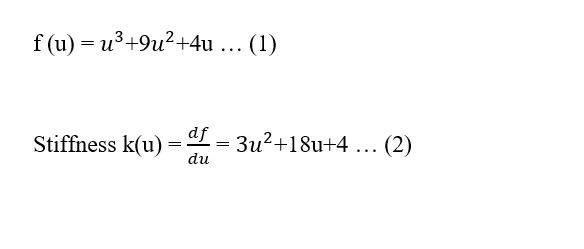
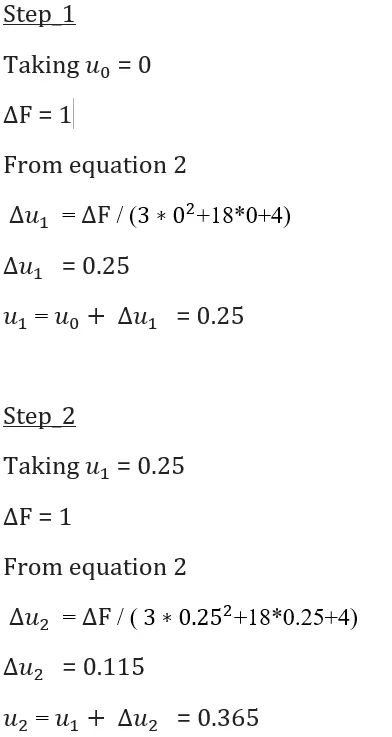
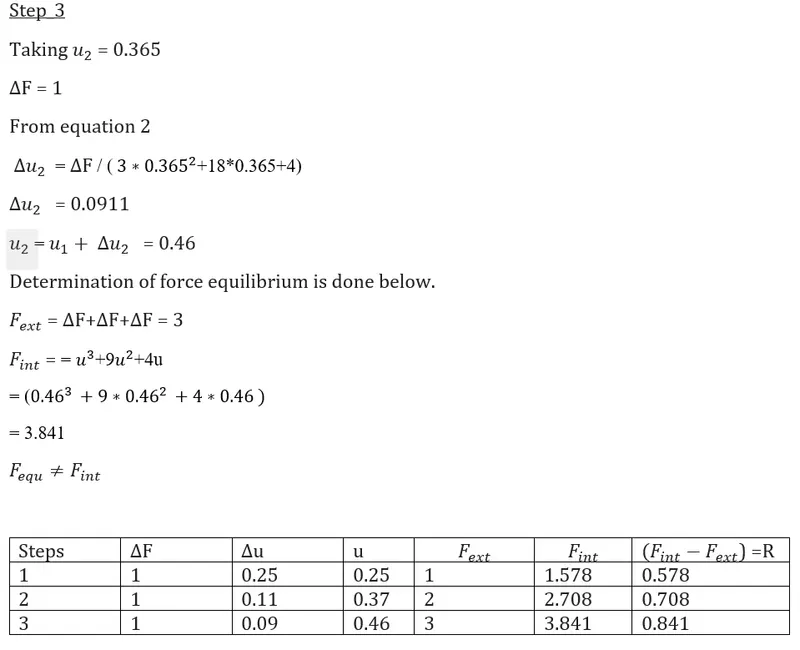
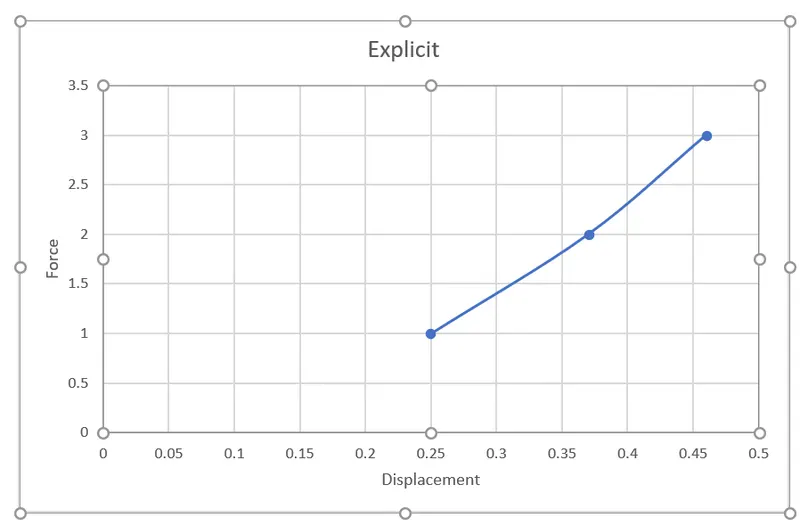
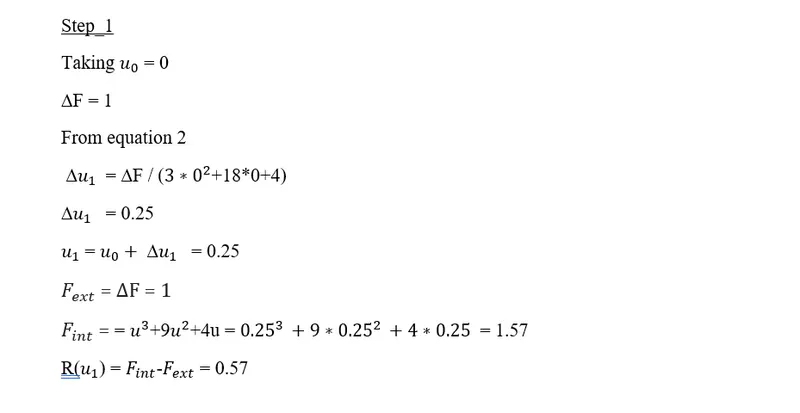
The nonlinear force versus displacement relationship is stiffness is known then it is possible to construct the graph of force versus displacement numerically. One method is to use an incremental explicit load control scheme. For this example, three equal load increments (or steps) of ∆F = 1 unit each are used to load the tension bar. The variables used are u_ for displacement, f_ for internal force in the bar, F_ for external force applied to the bar and k for stiffness. Incremental displacements or incremental externally applied forces are represented as ∆u or ∆F, respectively.
∆F = k*∆u.
The analysis proceeds as follows:
Implicit Analysis
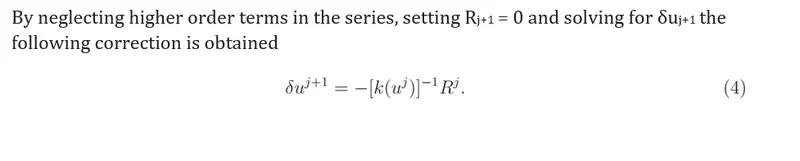
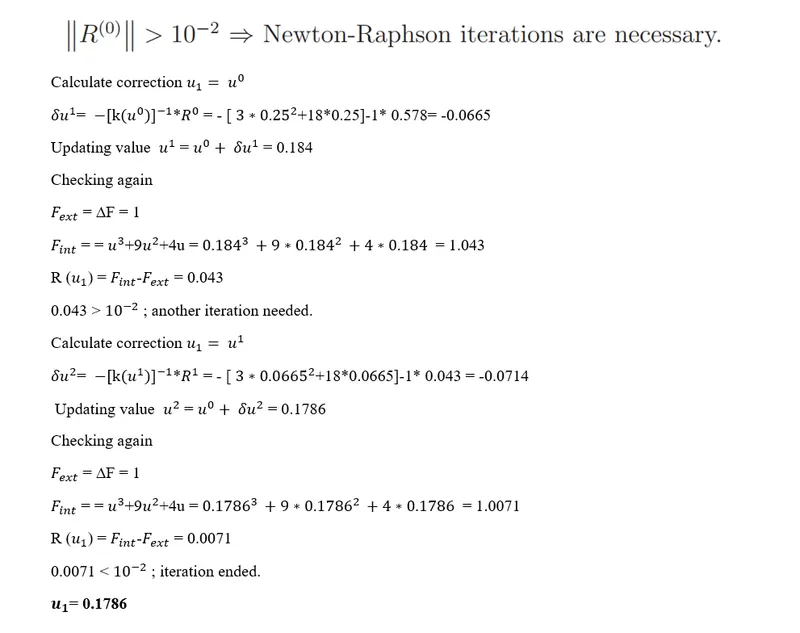
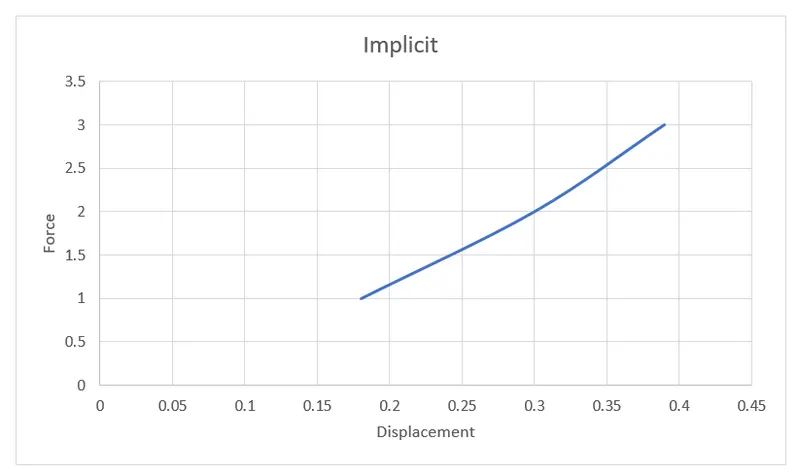
An implicit analysis is the same as the explicit analysis, except that at the end of each step Newton-Raphson iterations are used to enforce equilibrium before moving to the next step. Basically, an incremental force is applied to advance the solution forward at the beginning of a step. However, internal forces and external forces will not be in equilibrium unless the stiffness is linear for the given step. Hence, to achieve equilibrium, corrections must be made to the displacement. This is accomplished by using Newton-Raphson iterations to minimize the residual. Expanding the residual as a Taylor series about the current displacement gives

Step_2 & Step 3
Th e above procedure is followed to solve the step 2 and 3
= 0.29658
= 0.3911
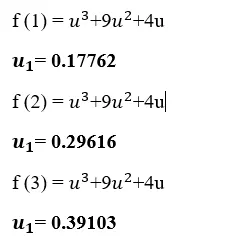
EXACT SOLUTION
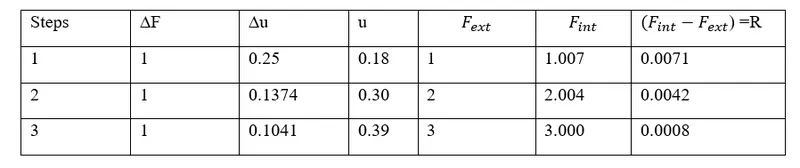
Solution was made from MATLAB and the results are expressed below.
CONCLUSION
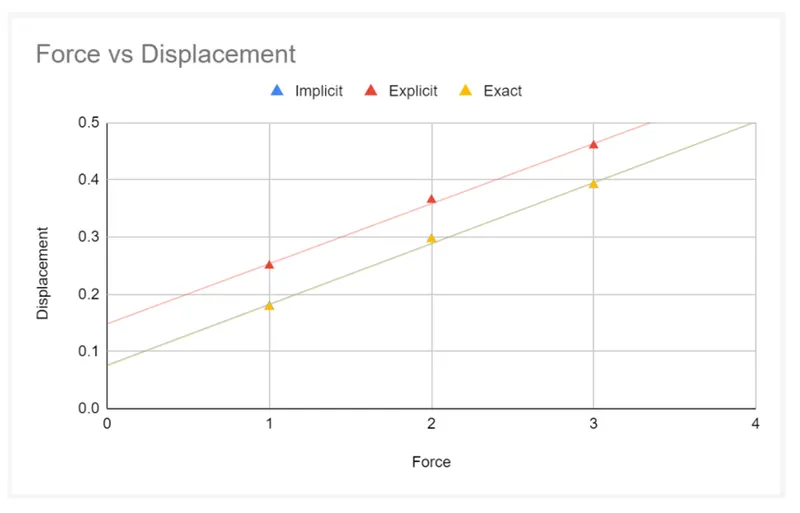
It is important to note how the initial increment due to the incremental load advances the solution forward. Then if an implicit analysis is employed, Newton-Raphson iterations are used to make corrections to the displacement to achieve equilibrium. Once satisfactory equilibrium is achieved,
a new load increment is applied to advance the solution and the process is repeated. Note that an exact expression for force versus displacement is not always known. The implicit solution was the closest with the exact compared to the explicit. The explicit method drifts from the actual solution.