(ANSYS_P2) Bevel Gear Challenge
OBJECTIVE: Grid dependency test for a bevel gear with different mesh sizes.
INTRODUCTION
Grid dependency testing involves a method used in simulation analysis whereby analysis is done to determine the best possible mesh parameter which produces results closest to the actual solution. This is done by starting the simulation with a coarse mesh and reducing gradually till the results converge. That is checking the results for say maximum stress along the way until the results are very close to each other or no change at all is seen.
But on the other hand if the mesh is too fine , the simulation would demand a lot of computing power so, the aim of this project is to analyse the optimum mesh size for produceing the optimum results.
MODEL
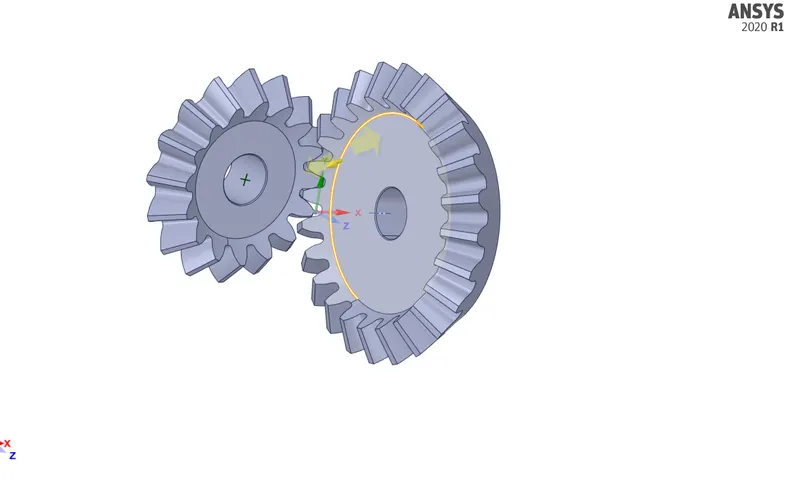
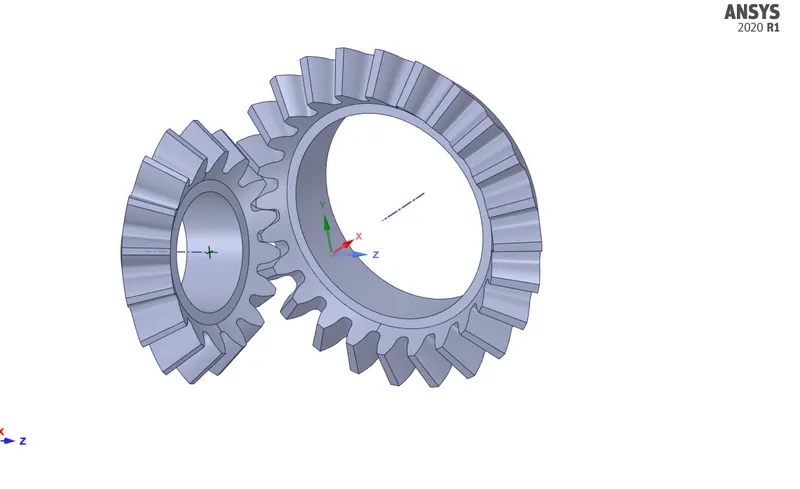
The model above is a bevel gear and the interior section is removed to reduce the simulation time.
MESH SIZE
- 8mm (case_1)
- 6mm (case_2)
- 5mm (case_3)
- 4mm (case_4)
These mesh sizes are used to determine the option which results do not vary soo much.
MATERIALS
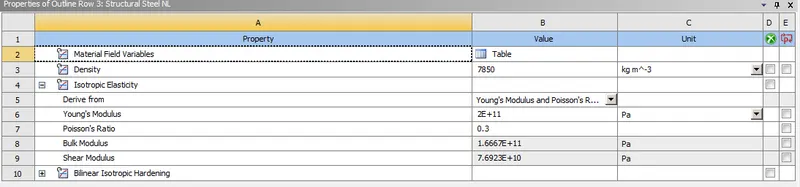
- Structural Steel
CONTACTS
Frictional contacts is defined to specify the parts which are going to make contacts during the simulation and these are specified by contacts and target.Augumented Lagrange is selected to increase the stiffness of the gears and interface treatment of adjust to touch is selected.
JOINTS
Two body to ground joints is created and the inner circumference of the gears are selected. A Revolute cordinate is defined for both gears.
MESHING
Tetra elements of 8mm size is used firstfot the meshing of the gears and this is varied with 6mm, 5mm, and 4mm.
ANALYTICAL SETTINGS
Using a multi time of 6 steps, the rotation of the gears is done in 6 steps with each step 1 s. The results are calculated at an initial time step of 0.2 with maximum at 0.5.
The left gear is defind with a revolution of 20 degree increment as it can be seen from the image below
The right step is defined with a moment of -10Nm to provide the moment needed to drive the gears.
RESULTS
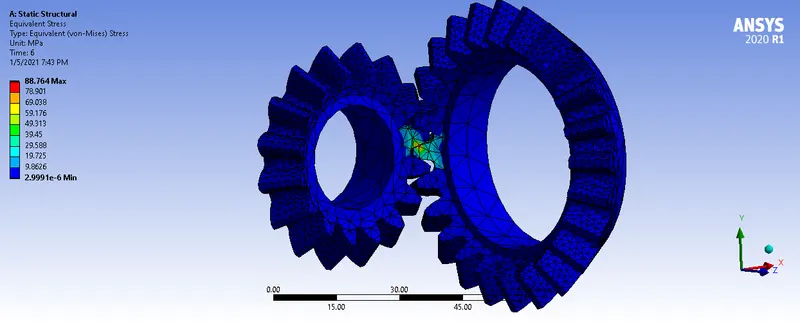
Below are the simulation results of all the cases with regards to stress intensity, deformation and eqiuvalent von-mises stress. At each time step the minimum and maximum value is presented and can be seen analysed it the graphs below.
- 8mm (case_1)
Maximum stress
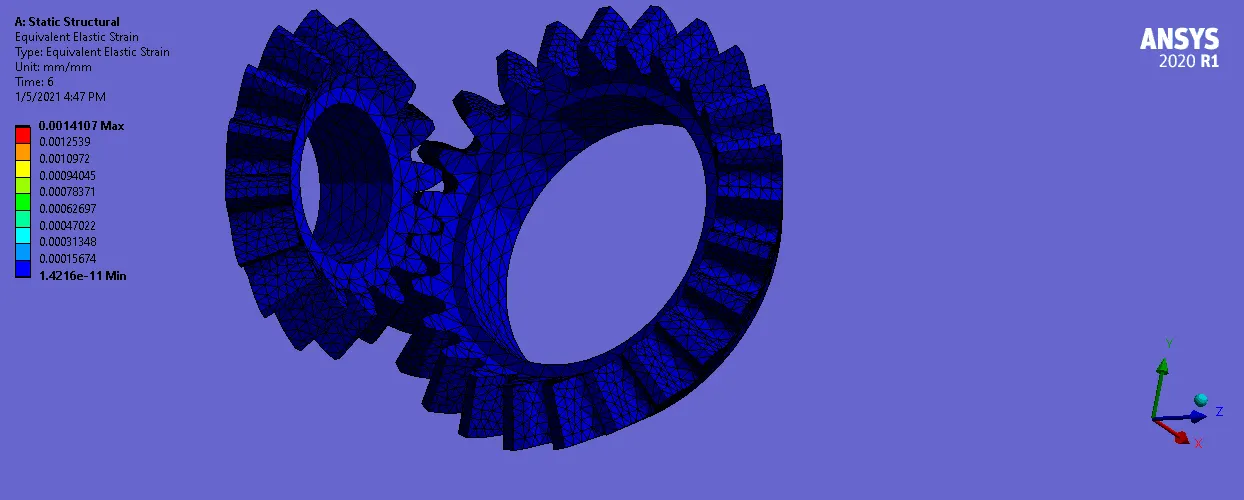
Mazimum strain
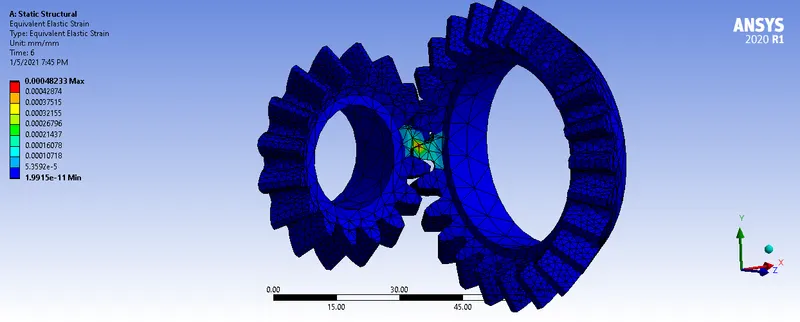
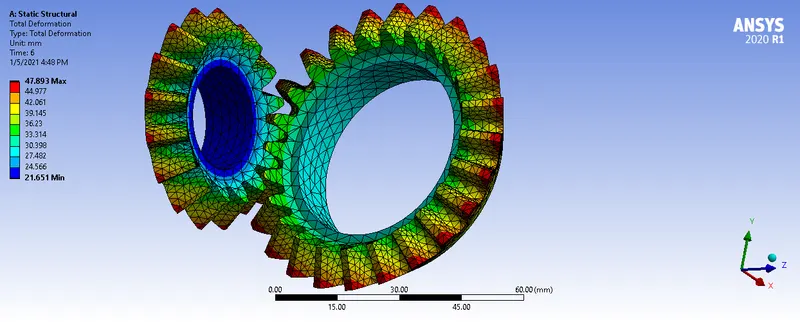
Deformation
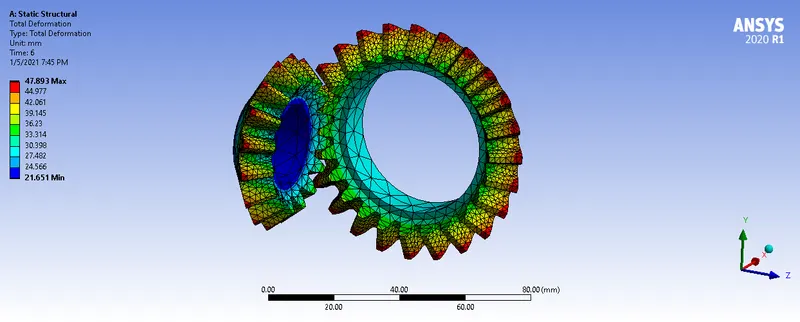
- 6mm (case_2)
Maximum stress
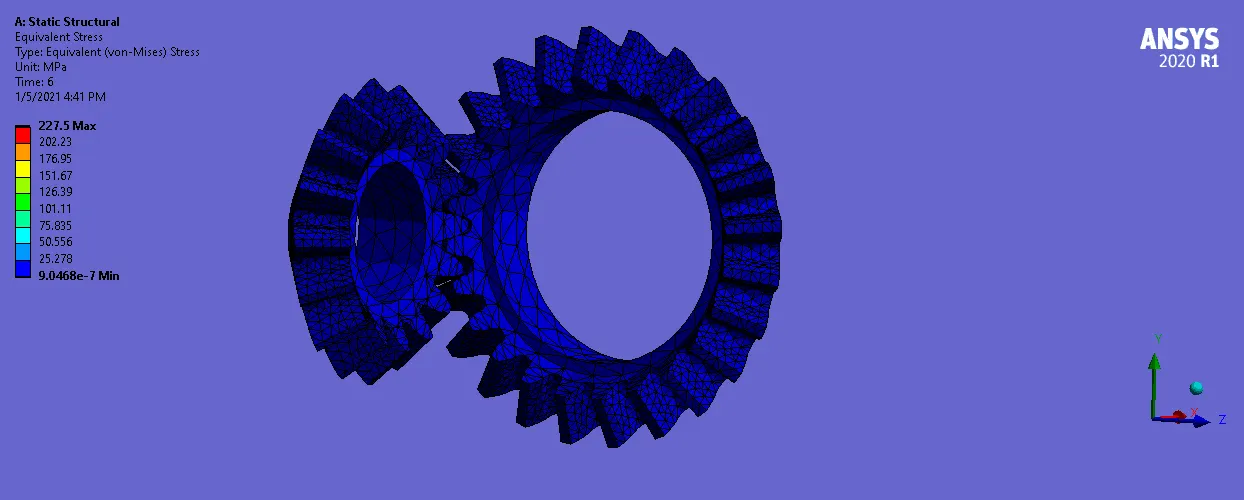
Mazimum strain
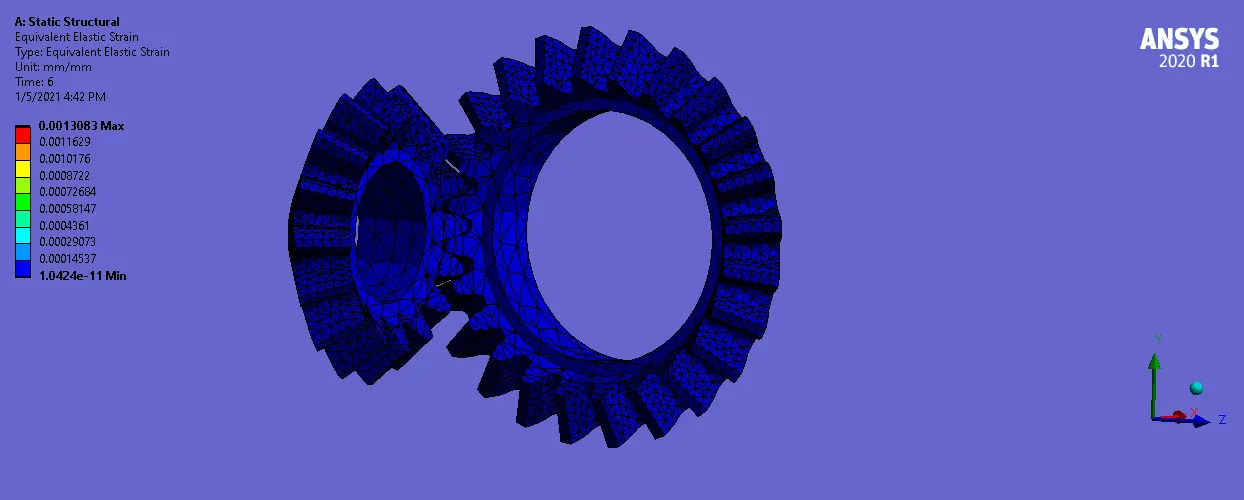
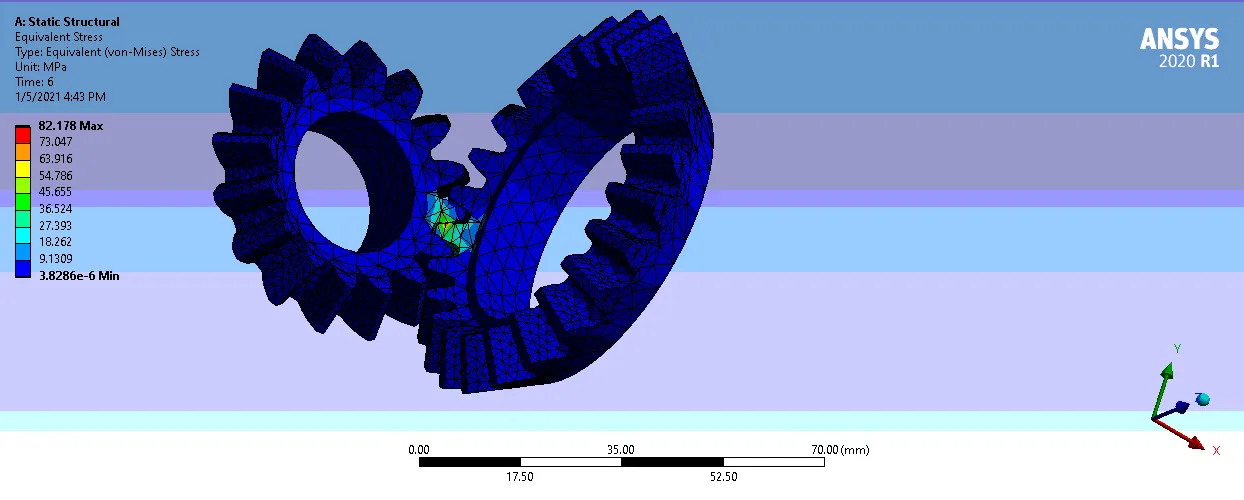
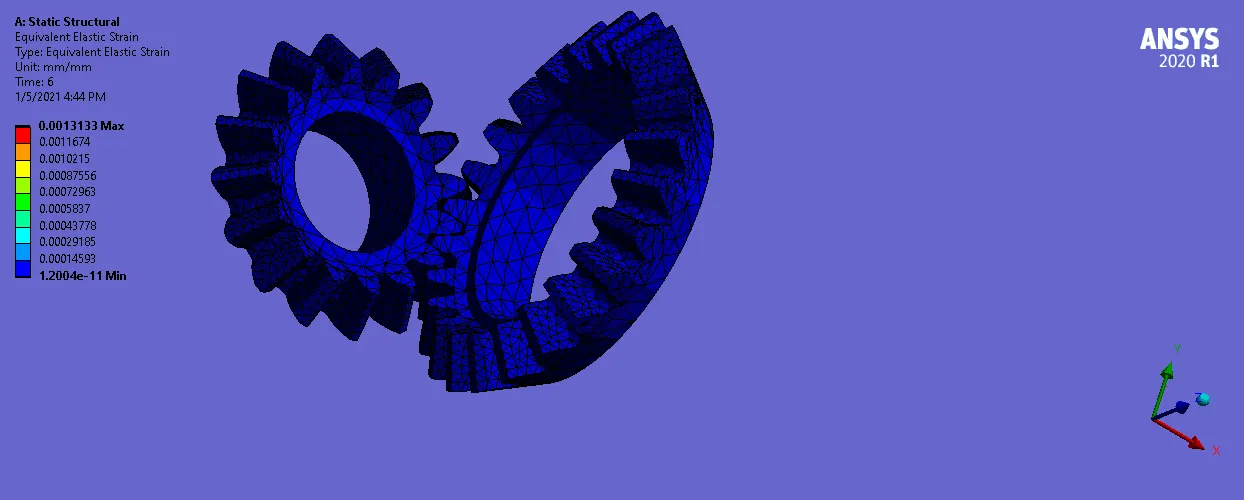
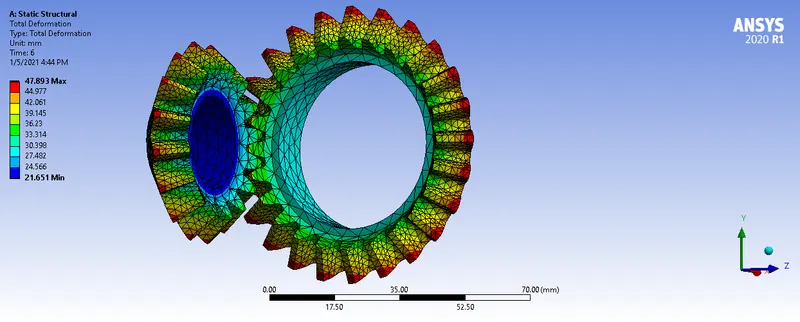
- 5mm (case_3)
Maximum stress
Maximum strain
Deformation
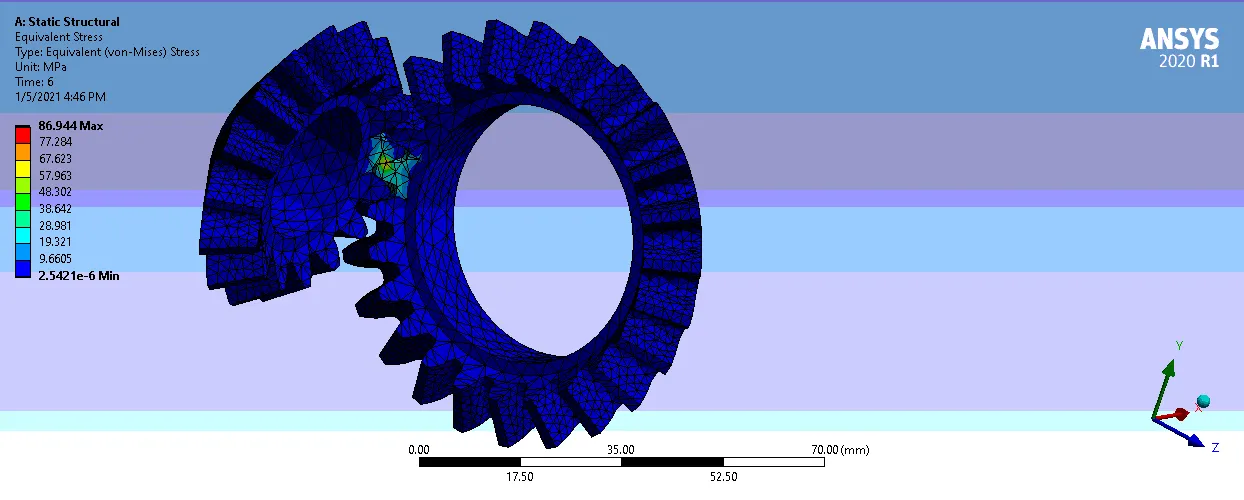
- 4mm (case_4)
Maximum stress
Mazimum strain
Deformation
RESULTS AND DISCUSSION
| Case(mesh_size) | Maximum deformation(mm) |
Maximum Stress (Mpa) |
Maximum Strain (mm/mm)*e-4 |
| 1-(8mm) | 48 | 117 | 4.8 |
| 2-(6mm) | 48 | 413 | 6.3 |
| 3-(5mm) | 48 | 82 | 4.7 |
| 4-(4mm) | 48 | 86 | 4.9 |
From the above results it can be seen that , the output variable which are the stress ,strain and deformaion results has seen significant change from mesh size 8mm to 6mm. But after applying 5mm and 4mm , there is less change developed in the results of 5mm and 4mm mesh sizes.
CONCLUSION
The grid dependency method used in this simulation was successful as we were able to see that after mesh size of 5mm and below, the results produces very litttle change and can be considered that mesh sizes below 5mm would produce results closer to the actual results.
Upload was not succesfull so i have the links pasted here
https://drive.google.com/drive/folders/1kqjfgrZxnVsneAg_BNkAx7FSTYkDmTev?usp=sharing