(ANSYS_P13)-Long Piston With Cam
OBJECTIVE:Simulating the frictional effect of a piston and cam mechanisim model in ANSYS Workbench.
TASK
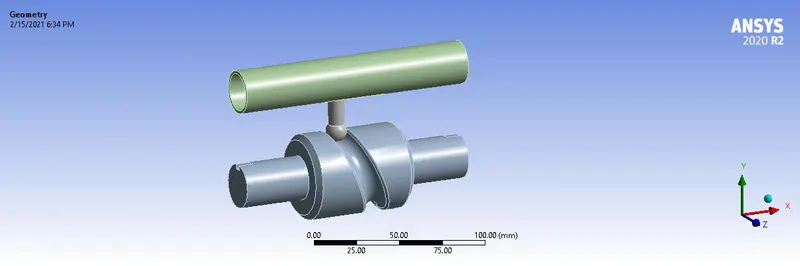
For this challenge, you will have to perform a transient analysis on a piston and cam mechanism model that has been provided to you. You need to run the analysis with Frictionless contact, Frictional with 0.1 and 0.2 as the frictional contact for a total of 3 cases. Find out the Equivalent Stress, Directional Deformation and Equivalent Elastic Strain and compare them for all the three cases. Give an inference as to why the results vary between cases.
CONNECTIONS
- The barrel and the barrel cam are specified with rigid stiffness to at as point masses
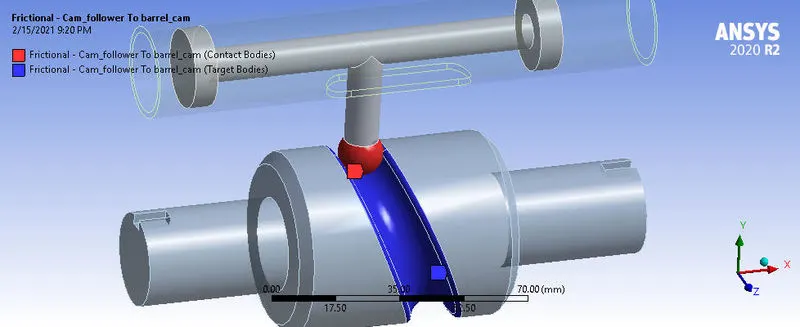
- A contact is defined with Cam follower as the contact and cam barrel as the target
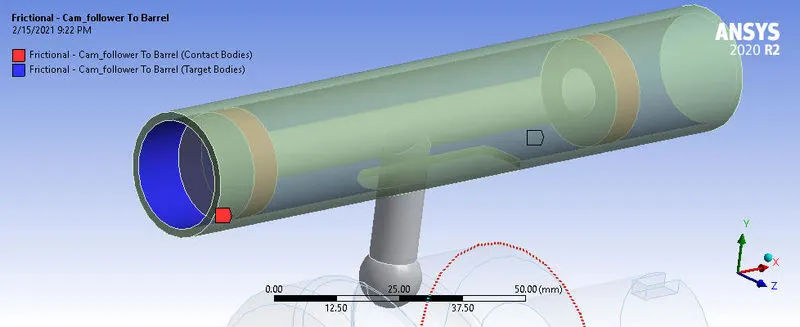
- Second contact is defined with Cam follower as the contact and barrel as the target
- Frictional values are edited as requested for each case above
JOINTS
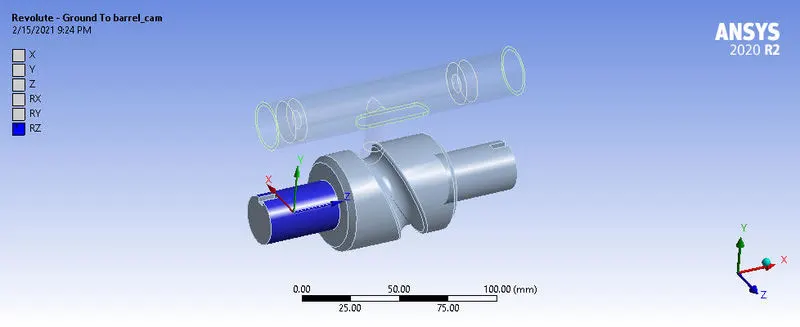
- Revolute Joint
A revolute joint is specified on the cam barrel with respect to the ground
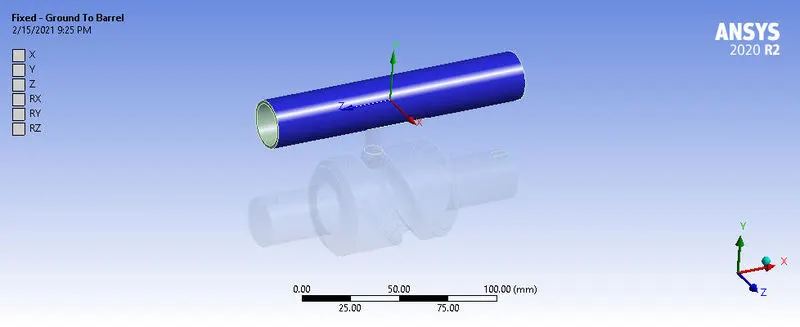
- Fixed Joint
A fixed joint is attributed to the barrel to restrict all movements.
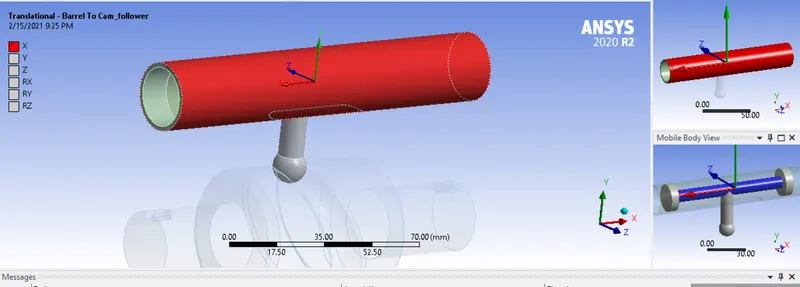
- Translational Joint
A translational joint is specified for the cam follower and this selected with a reference to the barrel
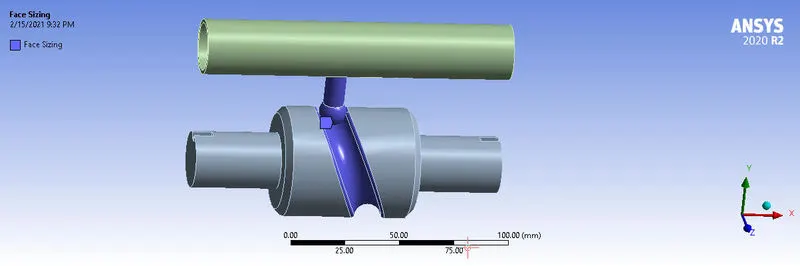
MESHING
A sizing of 3mm is assigned to all the contact faces to ensure quality mesh at those areas.
ANALYSIS SETTING
9 STEPS ARE USED
For step 1,
- Auto Time Stepping: On
- Defined by : Time
- Initial time : 0.1
- Minimum time : 0.05
- Maximum time : 0.2
- Solver Type : PROGRAM CONTROLLED
- Weak Spring :Controlled
- Large deflection: ON
For step 2-9,
- Auto Time Stepping: On
- Defined by : Time
- Initial time : 0.1
- Minimum time : 0.05
- Maximum time : 0.3
- Solver Type : PROGRAM CONTROLLED
- Weak Spring :Controlled
- Large deflection: ON
- Output controls : Set all to YES
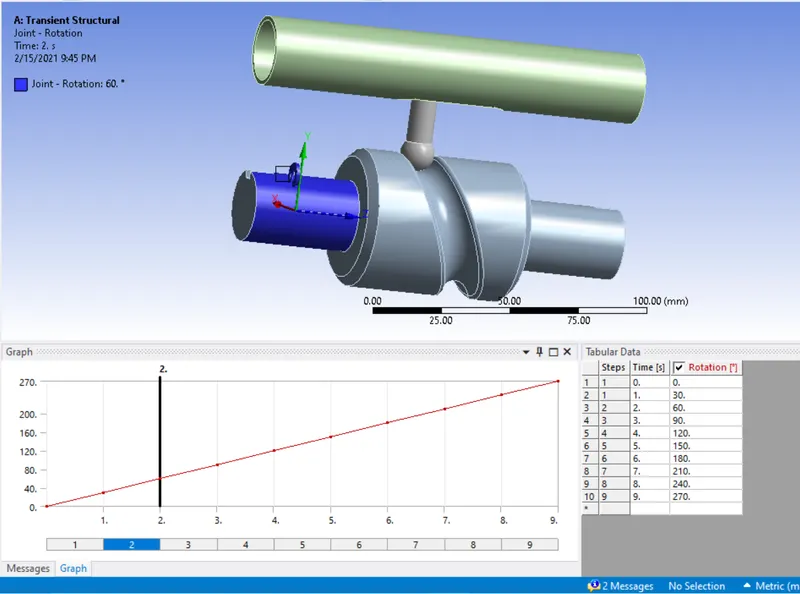
JOINT LOAD
- Joint load is assigned to the barrel cam.
- Selecting a rotation , tabular data is inputed from 30 to 270
OUTPUT REQUEST
CASE_1
- FRICTIONLESS
- DIRECTIONAL DEFORMATION
- EQUIVALENT STRESS
- EQUIVALENT STRESS
CASE_2
- FRICTION-0.1
- DIRECTIONAL DEFORMATION
- EQUIVALENT STRESS
- EQUIVALENT STRESS
CASE_3
- FRICTION-0.2
- DIRECTIONAL DEFORMATION
- EQUIVALENT STRESS
- EQUIVALENT STRESS
RESULTS
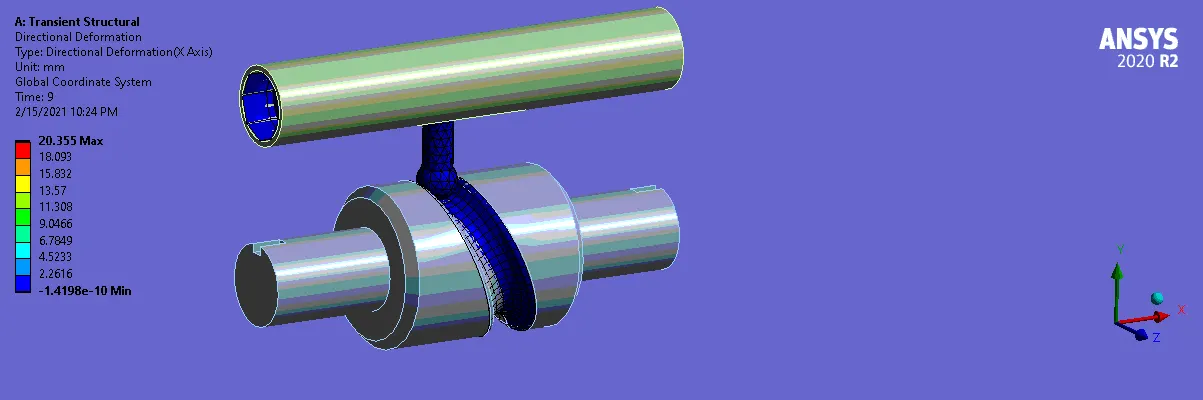
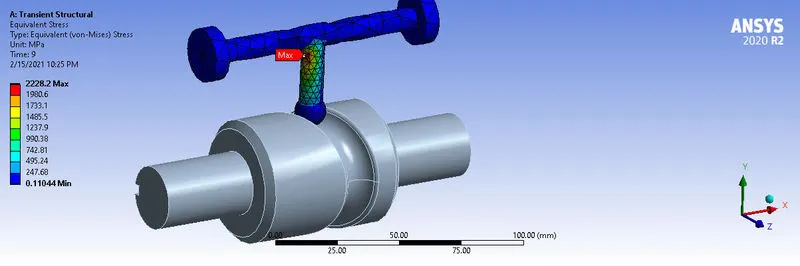
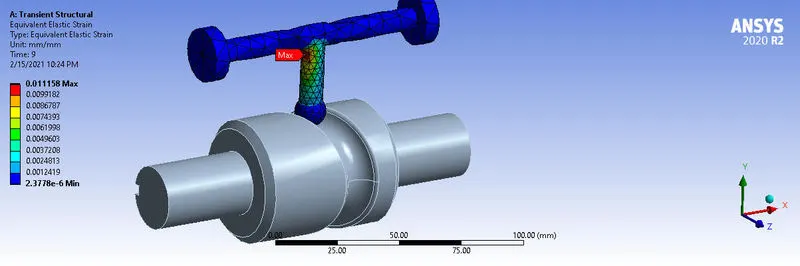
CASE_1
- FRICTIONLESS
- DIRECTIONAL DEFORMATION (20.36)
- EQUIVALENT STRESS(2342.9Mpa)
- EQUIVALENT STRAIN(0.017)
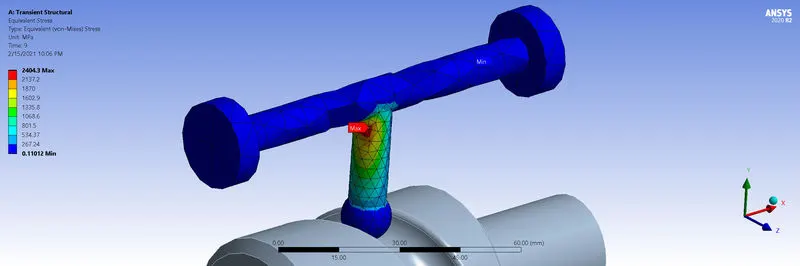
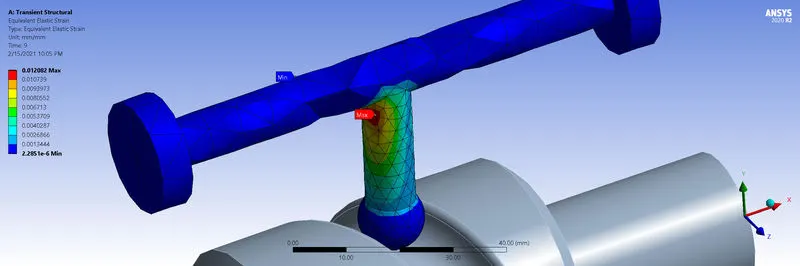
CASE_2
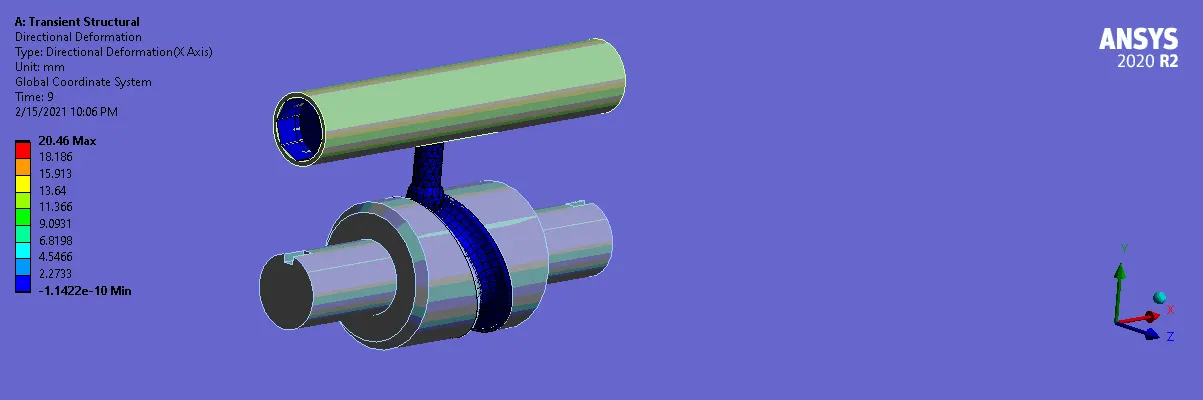
- FRICTION-0.1
- DIRECTIONAL DEFORMATION (20.46)
- EQUIVALENT STRESS (2443Mpa)
- EQUIVALENT STRESS (0.0122)
CASE_3
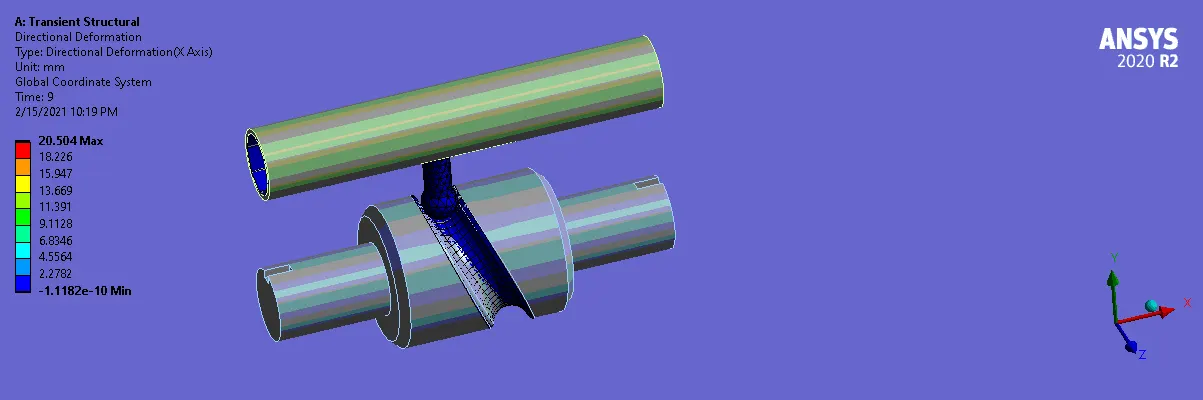
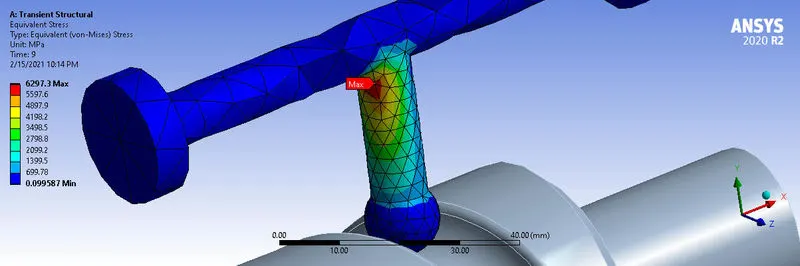
- FRICTION-0.2
- DIRECTIONAL DEFORMATION (20.50mm)
- EQUIVALENT STRESS (6297Mpa)
- EQUIVALENT STRAIN (0.03165)
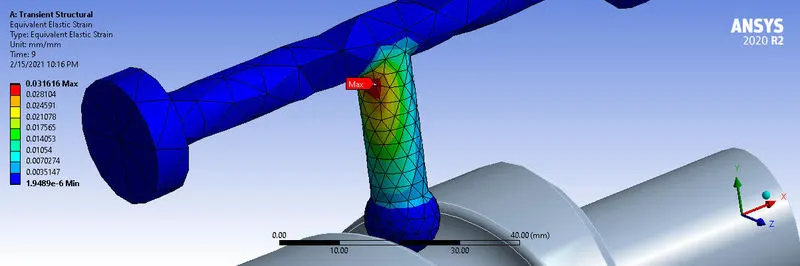
DISCUSSION
| FRICTION STATUS | DEFORMATION(mm) | STRESS (Mpa) | STRAIN (mm/mm) |
| NA | 20.36 | 2342 | 0.017 |
| 0.1 | 20.46 | 2443 | 0.012 |
| 0.2 | 20.50 | 6297 | 0.031 |
By varying the frictional coefficients, the e was change in the uotput results.
The stress developed was increasing with increase in frictional coefficient as well as the elastic strain. This can be attributed to the fact that friction itself is an opposition to motion and therefore if increased, it creates more resistance to motion on the surfaces therefore requiring more force to enhance motion. he higher the resistance to deformation , the grater the stresses developed.It also was realised that the increase in friction enhanced the directional deformation in the x -axis. Increasing the friction , increased the ease of movement of the cam follower in the x-direction thereby enhancing motion. But to much frictional coefficient (0.2) can be catatrosphic as the stresses developed trippled for the third case.
CONCLUSION
This task was simulated succesfully and the effect of friction was analysed and deduced.
Files can be located below
https://drive.google.com/drive/folders/14FD8q9i9_H2jeVpvzEiG5FoSH9oFtAQn?usp=sharing