Week - 10 Hyperelastic Material Models
AIM: To simulate and validate the specimen with given data.
KEYWORDS: Mooney Rivlin constants, Ogden material constant, Dogbone specimen, Tensile, Engineering Stress, Engineering Strain, etc.,
SOFTWARE: LS-Dyna
OBJECTIVE:
1) To calculate the Mooney Rivlin and Ogden material constants and compare both using stress-strain data from a Dogbone specimen tensile test with 100 percent strain.
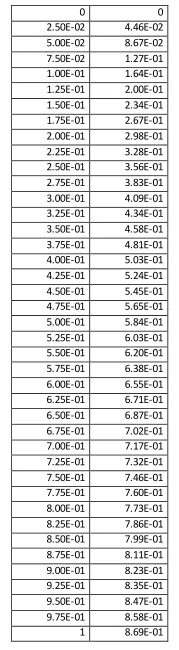
2) The given material data is the engineering stress-strain in MPa/(mm/mm).
3) The comparison should be shown from the d3hsp file and using simulation.
INTRODUCTION:
Hyper-elastic Material:
Hyperelastic material models are regularly used to represent the large deformation behavior of materials with FEA. They are commonly used to model mechanical behaviors of unfilled/filled elastomers. In addition to elastomers, hyperelastic material models are also used to approximate the material behavior of biological tissues, polymeric foams, etc. Linearly elastic materials are described through two material constants (like Young’s modulus and Poisson ratio). In contrast, hyperelastic materials are described through a strain-energy density function. The strain-energy density can be used to derive a nonlinear constitutive model (i.e., stresses as a function of large strain deformation measures like deformation) which are derived by researches and some acceptable models we are using popularly such as Neo-Hookean, Mooney-Rivlin, and Signorini models, Ogden, Yeoh, Arruda-Boyce.
Mooney Rivlin:
The strain energy density function for an incompressible Mooney–Rivlin material is defined as

Where Cij">Cij are empirically determined material constants, I1 and I2 are the first and the second invariant. By varying the Index values of i and j we can change the constitutive equations and use them appropriately for our component. Similarly, we will be having multiple coefficients C. This changing of the index will be basically changing the order of the polynomial of the energy density equation. We need to find out the coefficients of these material models for a different order of the polynomial and extract the best fit curve data from the D3HSp file and compare it with the material curve.
Ogden Material:
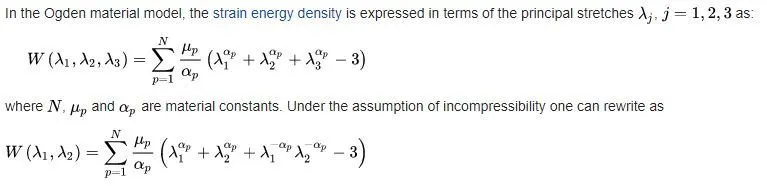
The Ogden material model is a hyperelastic material model used to describe the non-linear stress–strain behavior of complex materials such as rubbers, polymers, and biological tissue. The model was developed by Raymond Ogden in 1972. The Ogden model, like other hyperelastic material models, assumes that the material behavior can be described by means of a strain energy density function, from which the stress–strain relationships can be derived.
Procedure:
1. Experimental Data:
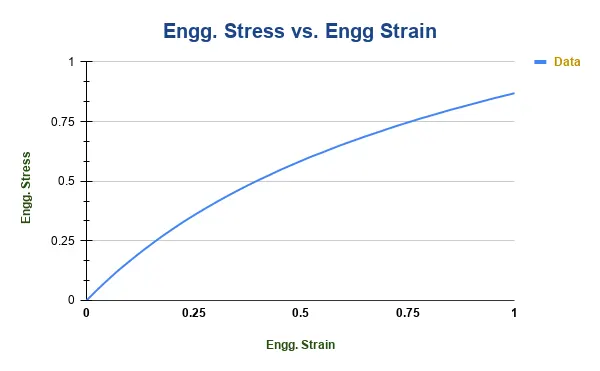
1) The given data of Engg stress and Engg strain of hyperelastic material is shown in the image given below are plotted in excel.
2. Part Definition:
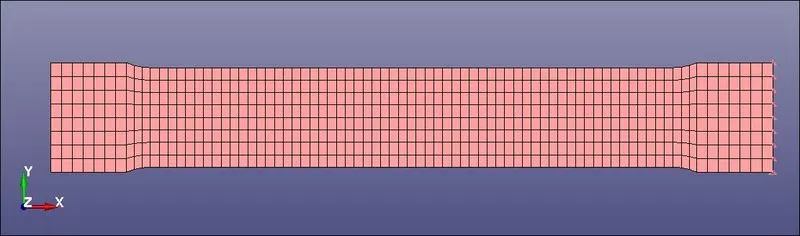
1) To verify and validate the given material data with material models of Mooney-Rivlin and Ogden a dogbone specimen is taken for the analysis.
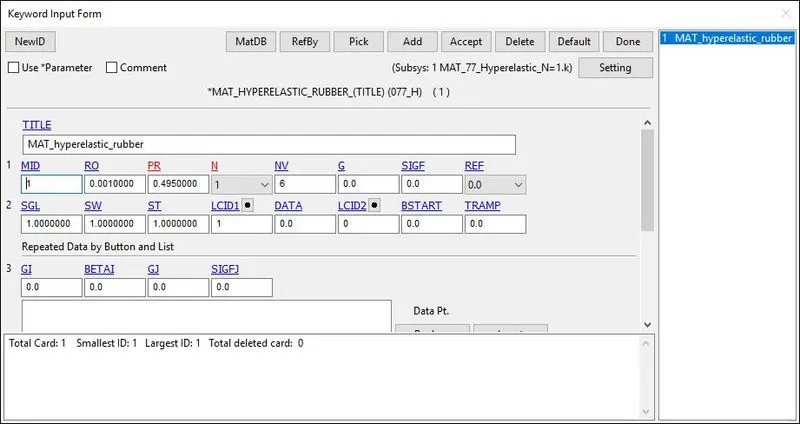
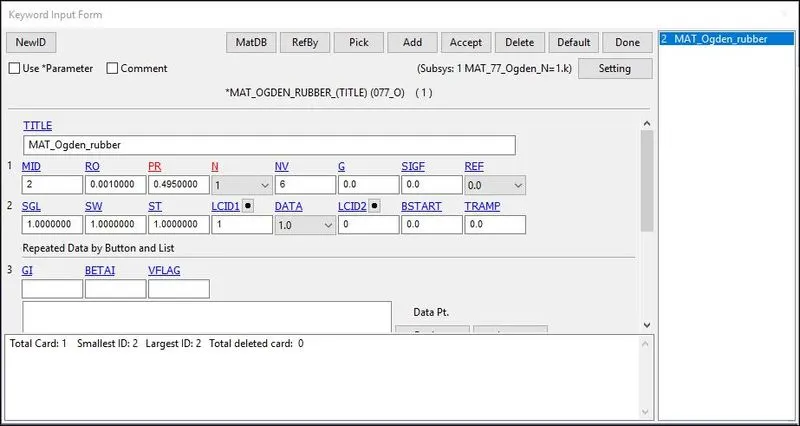
2) To find the Mooney-Rivlin and Ogden constants the value of N is set to 1-3. The value of density and Poisson’s ratio is taken as the generic value for the rubber material.
For N>0, data from a uniaxial test are used.
SGL Specimen gauge length
SW Specimen width
ST Specimen thickness
3) The value of SGL, SW, and ST is set to unity (1.0), then the curve LCID1 is defined using *DEFINE_CURVE engineering stress versus engineering strain.
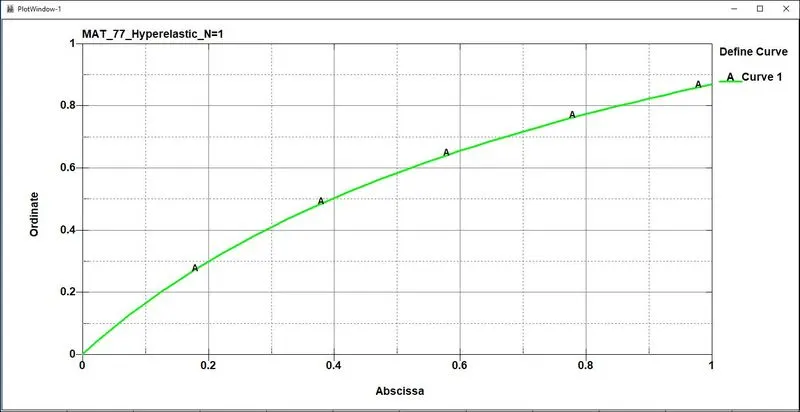
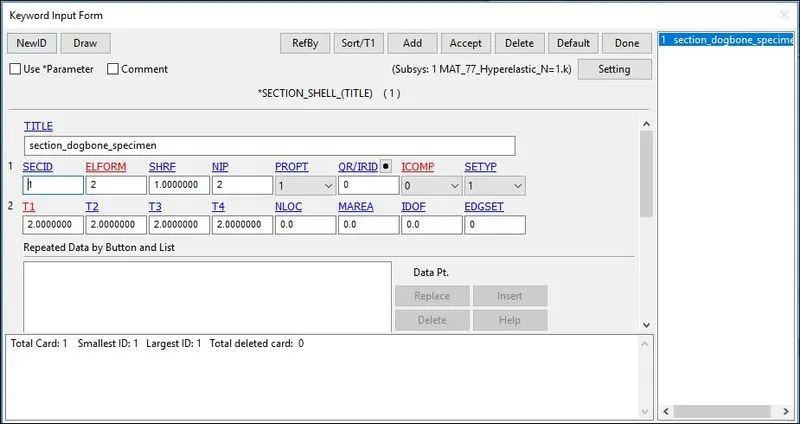
4) The section property of the dogbone specimen is assigned as a shell element with 2 mm thickness and ELFORM=2.
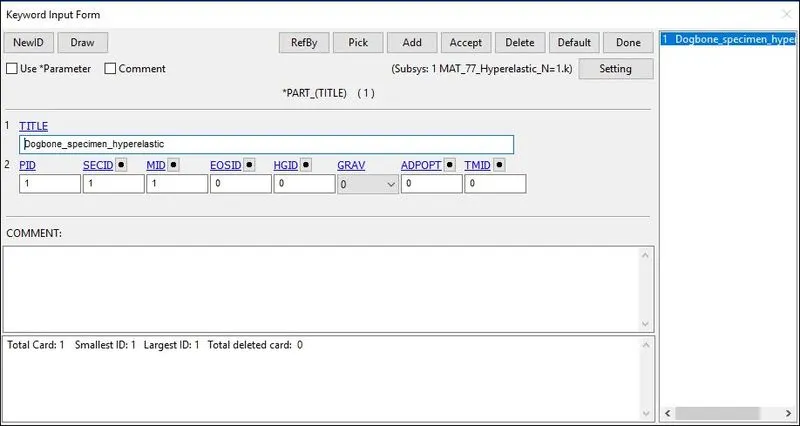
5) The Material and Section are assigned to the dogbone specimen part.
3. Boundary Condition:
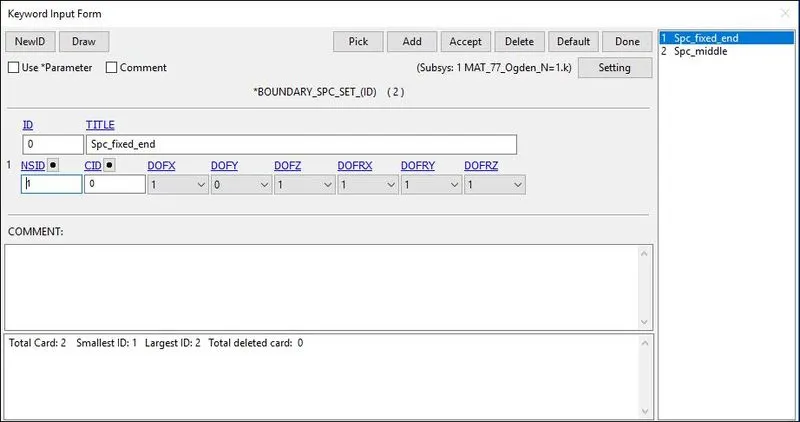
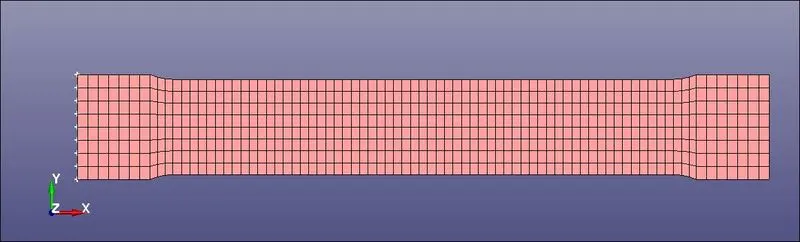
1) The nodes at the fixed end are constrained in the X and Z direction only and the Y direction is not constrained because of lateral expansion during the tensile test.
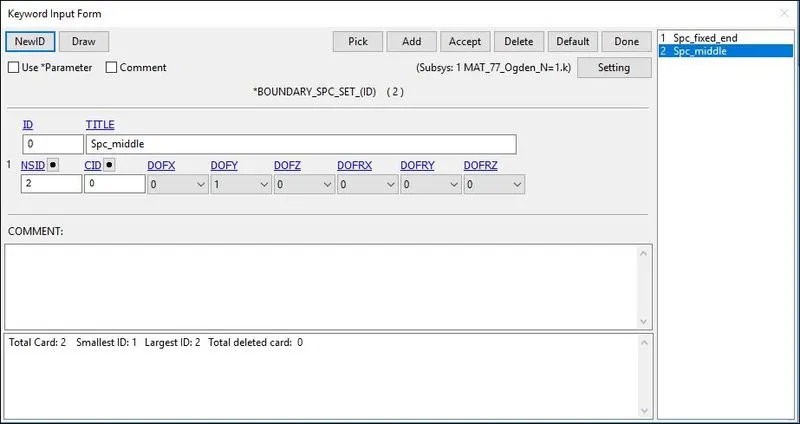
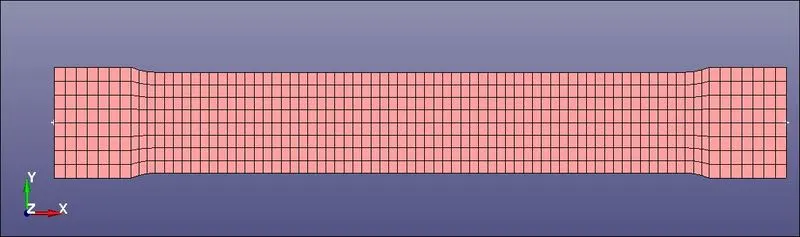
2) The nodes at the middle are constrained in the Y direction since the neutral axis passes through the middle of the specimen in the X-direction.
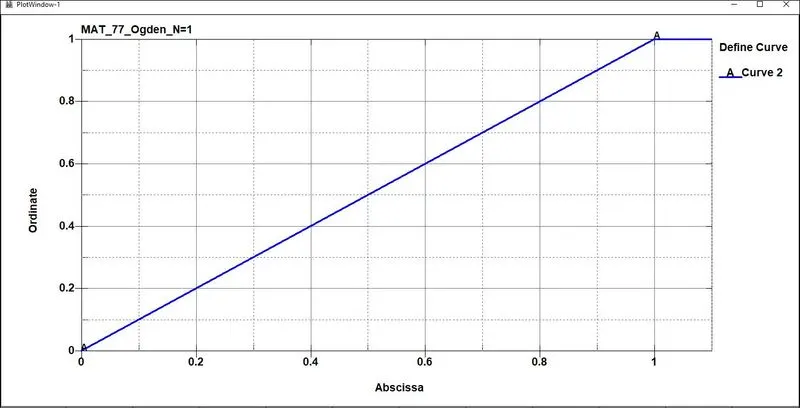
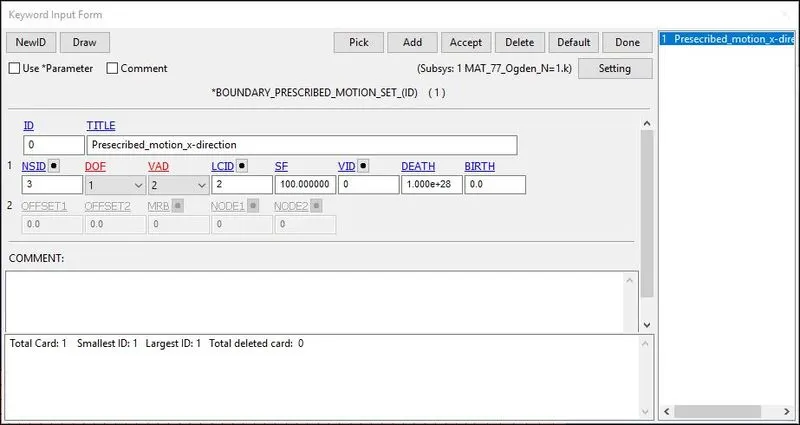
3) The nodes of the pulling end are assigned with a boundary prescribed motion in X direction using displacement load curve LCID.
4. Control Cards:
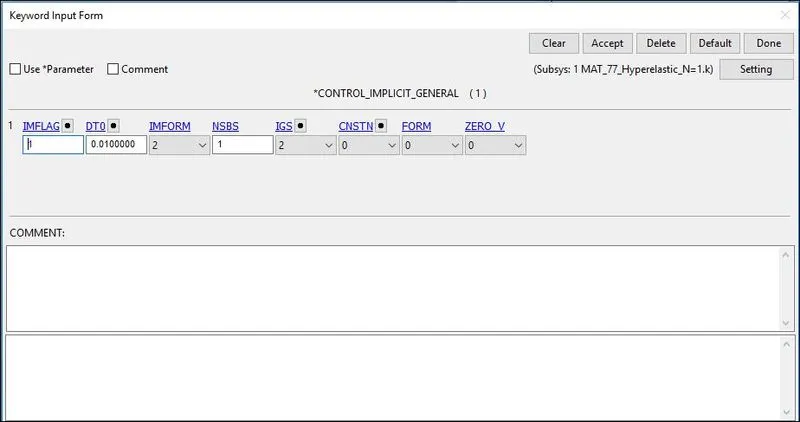
1) *CONTROL_IMPLICIT_GENERAL
Activate implicit analysis and define associated control parameters. This keyword is required for all implicit analyses
- IMFLAG: Implicit/Explicit analysis type flag: 1- implicit analysis
- DT0: Initial time step size for implicit analysis: 0.0100000
- IMFORM: Element formulation flag for seamless spring back: 2 retain original element formulation (default)
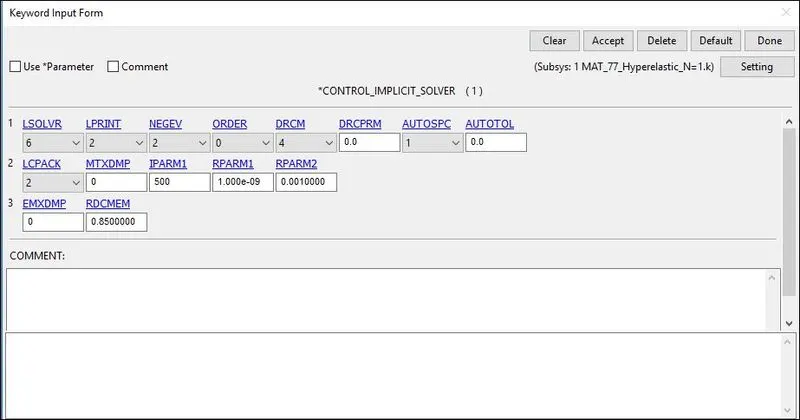
2) *CONTROL_IMPLICIT_SOLVER
The linear equation solver performs the CPU-intensive stiffness matrix inversion
- LSOLVR: Linear equation solver method: 6 (double-precision solver)
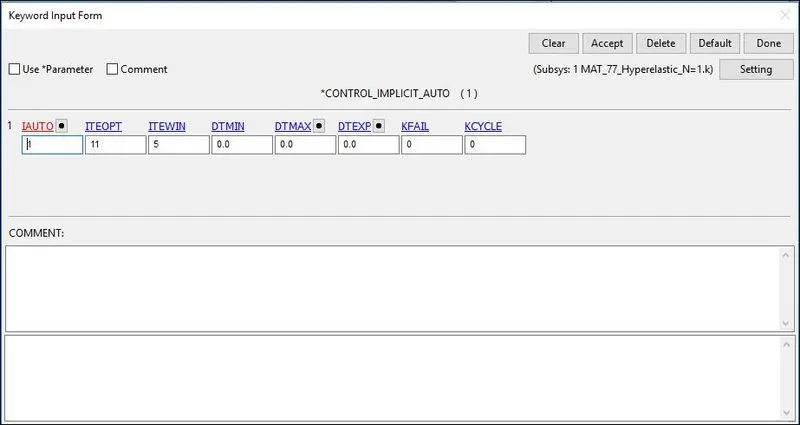
3) *CONTROL_IMPLICIT_AUTO:
This card has been defined to adjusts the time step size
- IAUTO: set to 1 which automatically adjusts the timestep size.
- ITEOPT: optimizes the operation count step:11
- ITEWIN: is the iteration window: 5
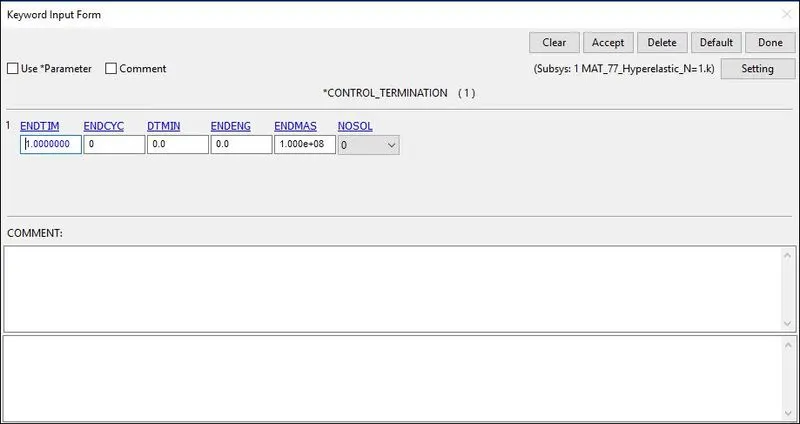
4) *CONTROL_TERMINATION:
This card is used to mention the termination time of the simulation.
- ENDTIM: 1 (Termination time)
5. Analysis setup for Material model validation:
1) The d3hsp file for each material model is opened in notepad++ and the material constants of Mooney-Rivlin and Ogden as well as final fit data of stretch and Engg. stress is obtained for each case.
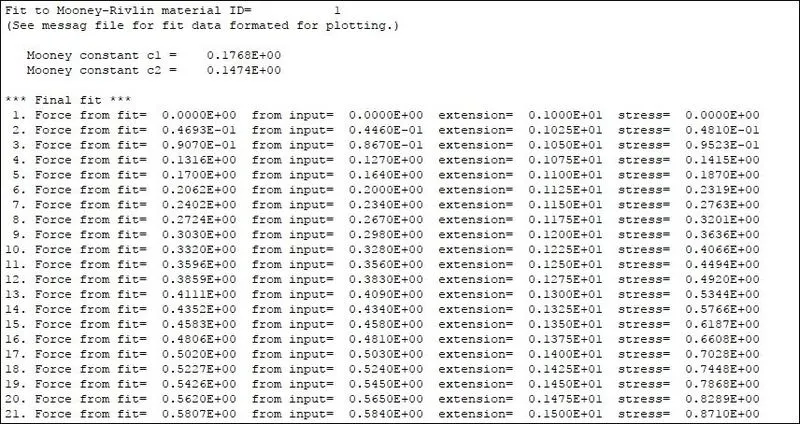
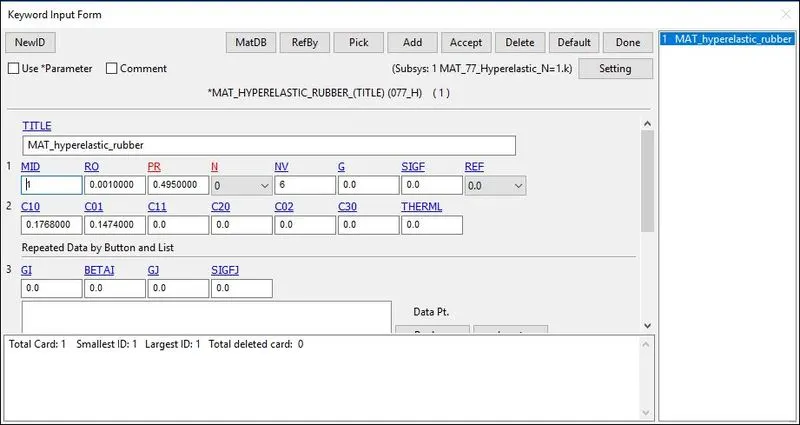
2) From the output files of material verification, the d3hsp file is opened in notepad++. The Mooney-Rivlin constants obtained are
C10 = c1 = 0.1768E+00
C01 = c2 = 0.1474E+00
For material model validation, the value of N is changed to 0 in the material card. These values are inputted to the material card MAT_77_H. The data obtained from the d3hsp file is an extension (stretch) and True stress which is converted to Engg. strain and Engg, stress to verify with experimental data.
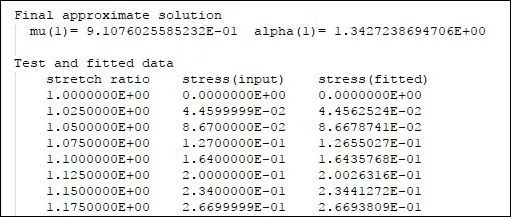
3) From the d3hsp output file of the Ogden material model the Ogden constants obtained are
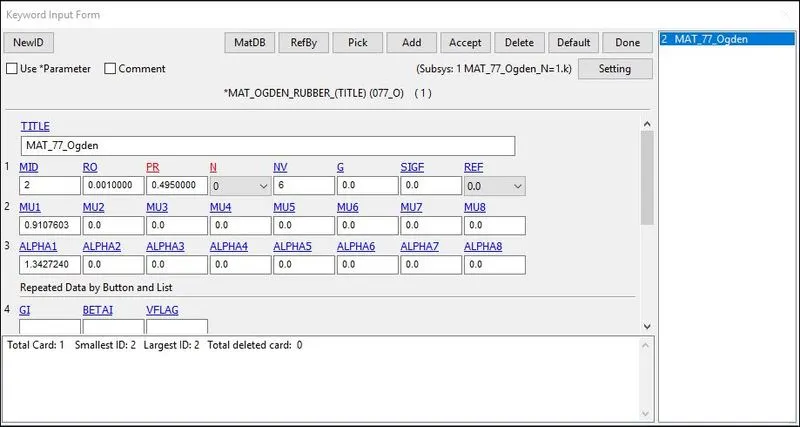
μ1=9.1076025585232E-01
α1=1.3427238694706E+00
4) These values are inputted to the material card MAT_77_O. The data obtained from the d3hsp file is Engg Stress and stretch ratio which is converted to Engg strain to verify with experimental data.
5) The keywords used for material model validation is the same as that of material model verification except for the changes to the material card(N=0) and addition of database extent binary to compute elastic strain. The keyword file is saved and made to run in the LS-DYNA program manager to get the requested output file.
RESULTS & DISCUSSION:
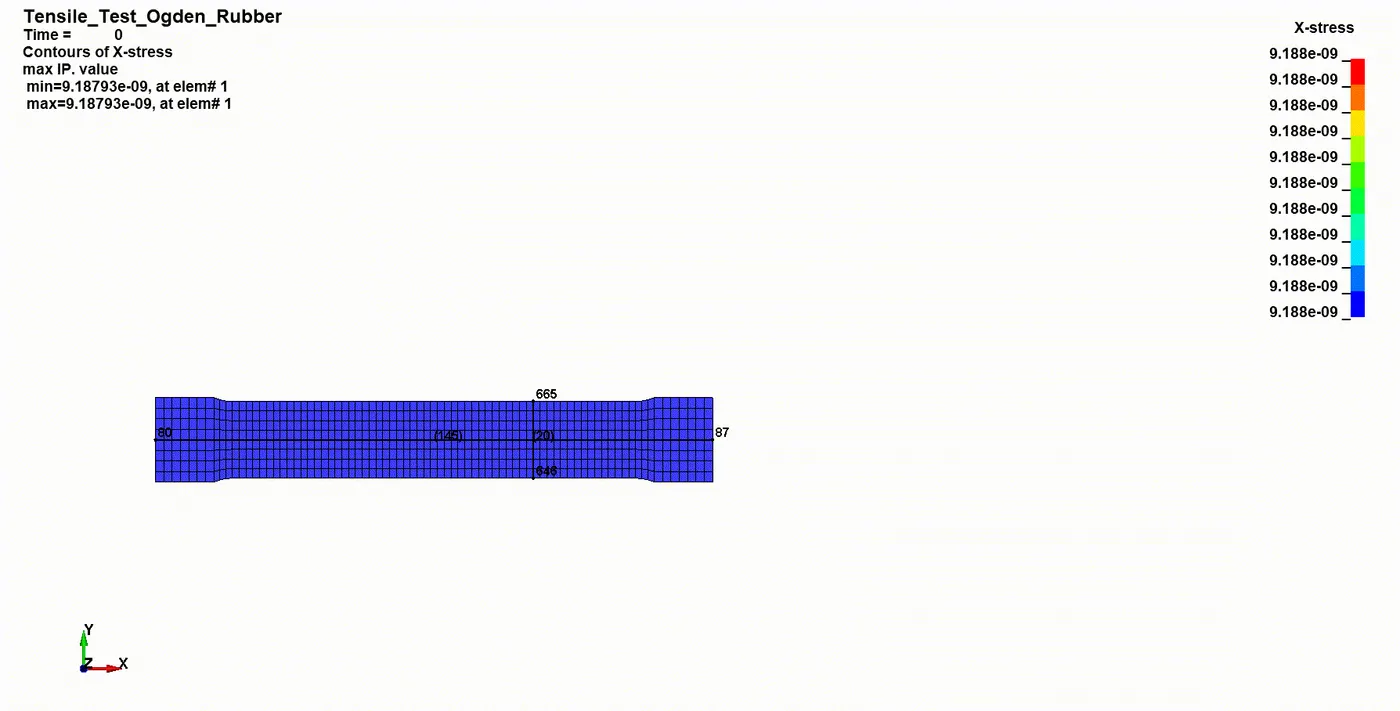
CONTOUR PLOTS OF X-STRESS FOR HYPERELASTIC:
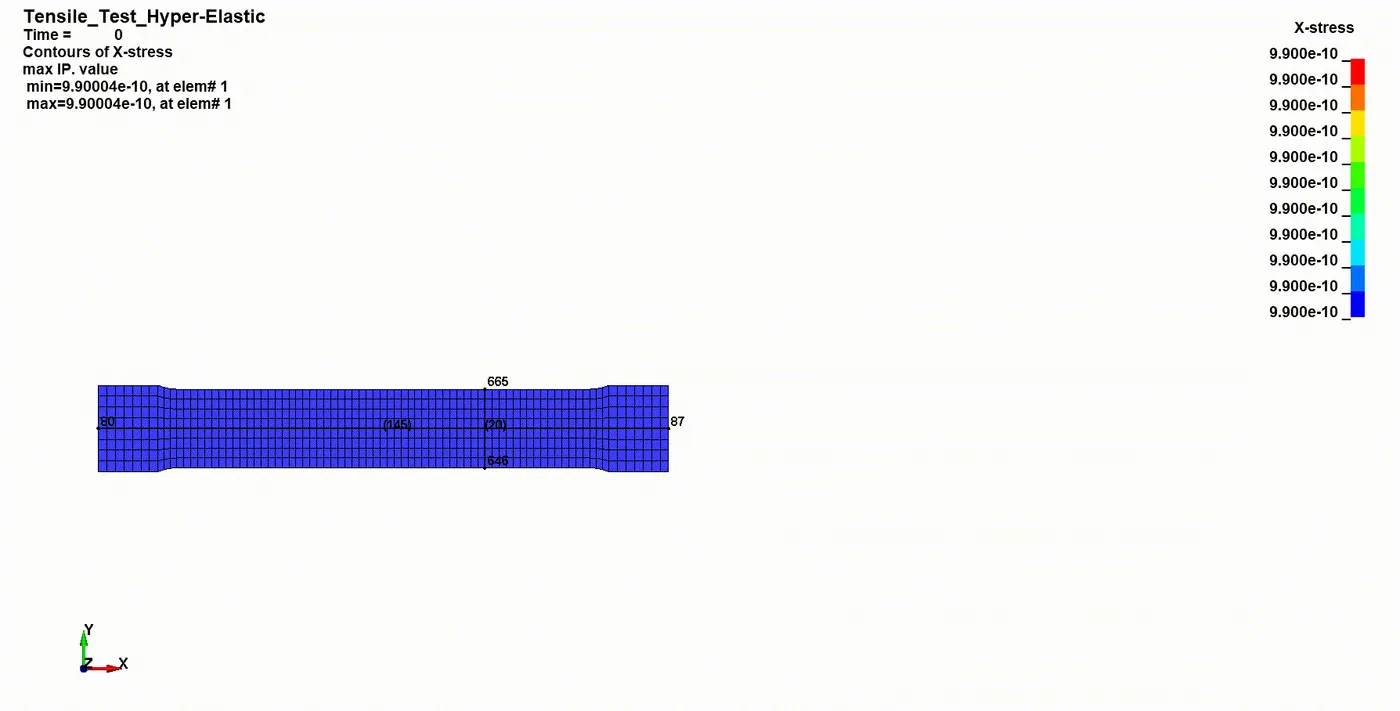
CONTOUR PLOTS OF X-STRESS FOR OGDEN RUBBER:
3. Material Model Verification:
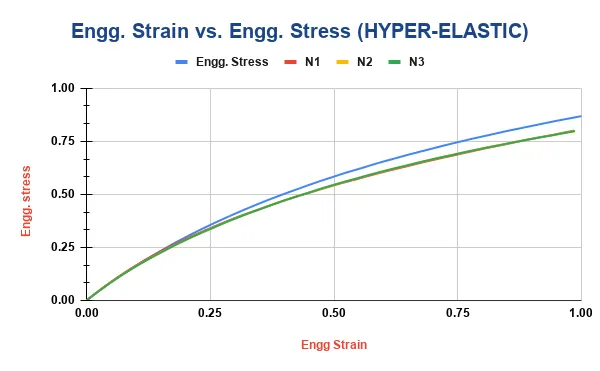
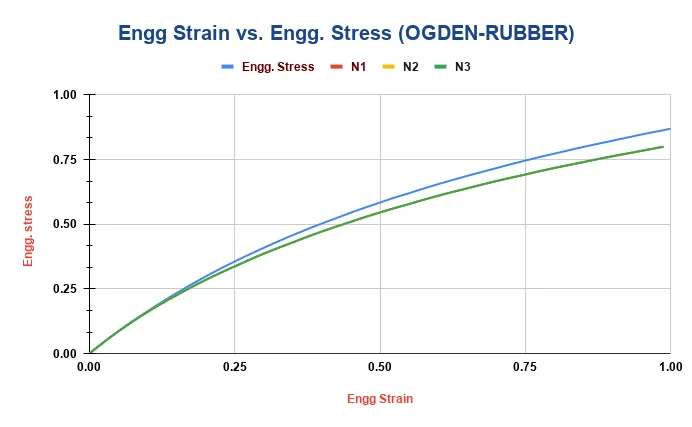
From the data obtained from the d3hsp file for different polynomial values i.e, (N=1,2,3) curves are plotted with Engg. stress vs Engg. strain in excel with comparison to Experimental data is as shown in the below images. It is observed from the graph, that the curves for different polynomial are superimposing and are better adjusted with the experimental data. The Ogden material model gives a close fit compared to the Mooney-Rivlin material model.
4. Comparison of Mooney-Rivlin and Ogden material model:
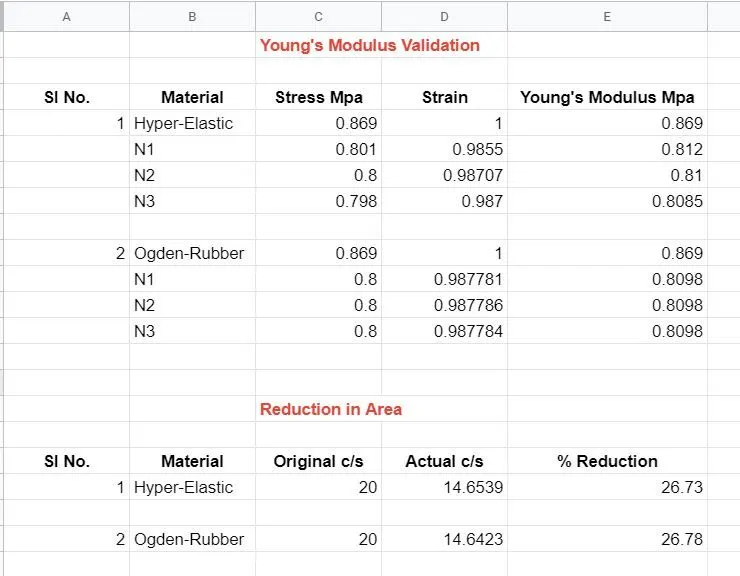
From this data, we can easily found that the reduction in area is comparatively less for hyperelastic than Ogden material, moreover, the constants are almost the same results as the constants of hyperelastic material. The Ogden material model gives a close fit compared to the Mooney-Rivlin material model.
CONCLUSION:
1) The Mooney-Rivlin and Ogden material constants are obtained from the d3hsp file by inputting the value of polynomial N=1 in the material card MAT_77_H and MAT_77_O
2) The stretch stress curve data obtained from d3hsp for both hyperelastic constitutive models were verified with experimental material data and found to be a close fit.
3) The simulation results of the tensile test for both material models with experimental data showed a slight deviation due to the high non-linear behavior of the given hyperelastic material and the generic values of density and Poisson’s ratio.
4) From the simulation results, both hyperelastic constitutive material models were found to be valid to describe the behavior of the given material data.
5) The Ogden material model has more polynomials ranging from 1 to 8 and is easy to use and gives better adjustment to experimental data at the cost of computational time.
6) Learned to verify and validate the hyperelastic material model for the given material data.