Assignment 4
AIM: To run the simulation for 7 different cases and obtain the results.
- LAW1_Elastic
- LAW36_Elasto_plastic
- LAW2_EPSMAX_Failure
- LAW2_EPSMAX_Crack
- LAW2_EPSMAX_No_Fail
- LAW2_Johnson_Cook
- LAW27_Elasto_Plastic_Brittle
KEYWORDS: Epsilon max, Elastic, Yield, Von_moses stress, Kinetic energy, Internal energy etc.,
SOFTWARE: Hypermesh
OBJECTIVE:
1. Initially run the simulation by using Failure johnson model and named as Law2_epsmax_failure and save the results.
2. By modifying the failure johnson parameters of previous model and named as Law2_epsmax_crack.
3. By deleting the Failure johnson card and run the simulation as Law2_epsmax_nofail.
4. By deleting the Eps_p_max value and run the simulation as Law2.
5. By changing the card image of previous model from Law2 to Law1 Elastic and save the results.
6. Again change the card image of previous model from Law1 to Law36 Elasto_plastic and save the results.
7. Importing the Law27 model with recommended shell properties and run the simulation.
8. compare all the obtained results and conclude.
INTRODUCTION:
Altair RADIOSS is a multidisciplinary finite element solver developed by Altair Engineering. It can solve both linear and non-linear problems. It is a finite element solver using implicit and explicit integration schemes for the solution of engineering problems, from linear statics and linear dynamics to nonlinear transient dynamics and mechanical systems. This multidisciplinary solver enables designers to maximize performance related to durability, NVH, Crash, safety, manufacturability, and fluid-structure interaction.
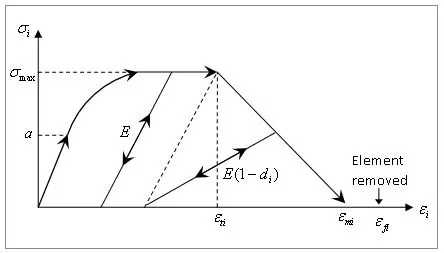
Fig 1: Stress-Strain curve
The above graph shows the Yield stress point (a), Maximum stress (Sig_max), Plastic region, strain rate, strain hardening etc., It defines the stress-strain curve based on the properties of Law1, Law2, Law27, Law36 and gives results accordingly.
Here, there are 7 different cases are simulated and obtained the results accordingly based on the parameters and some recommended properties. The simulation defines the Energies, Stresses, Yield criterion, fracture point, strain hardening, fatigue and normal resultant force. There are some cases studied here,
- LAW1_Elastic
- LAW36_Elasto_plastic
- LAW2_EPSMAX_Failure
- LAW2_EPSMAX_Crack
- LAW2_EPSMAX_No_Fail
- LAW2_Johnson_Cook
- LAW27_Elasto_Plastic_Brittle
Here, the shell properties are shown and punch datas are shown in the below figure.
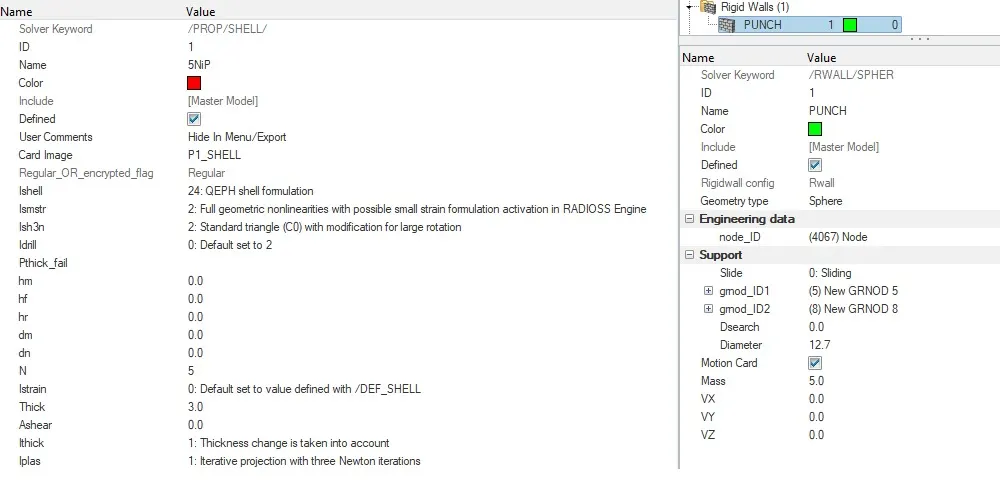
Fig 2: Shell properties and Punch (Rigid) data
The failure of a material is usually classified into brittle failure (fracture) or ductile failure (yield). Depending on the conditions (such as temperature, state of stress, loading rate) most materials can fail in a brittle or ductile manner or both.
Case_1:
Law1_Elastic:
This keyword /MAT/ELAST defines an isotropic, linear elastic material using Hooke's law. This law represents a linear relationship between stress and strain. It is available for truss, beam, shell and solid elements. Useful for elements attached to rigid body. This material law is used to model purely elastic materials. This material law is used to model purely elastic materials. The material stiffness is determined by only two values; the young's modulus (E), and poisson's ratio (n). The shear modulus (G) can be computed using E and n, as shown below:
G = E / [2*(1+n)]
The main cons of this law is not used for large deformation because it can regain to its orginal shape.
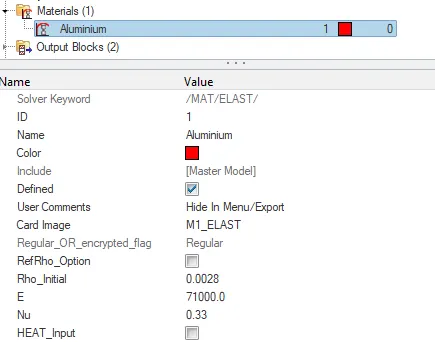
Fig 3: Material properties
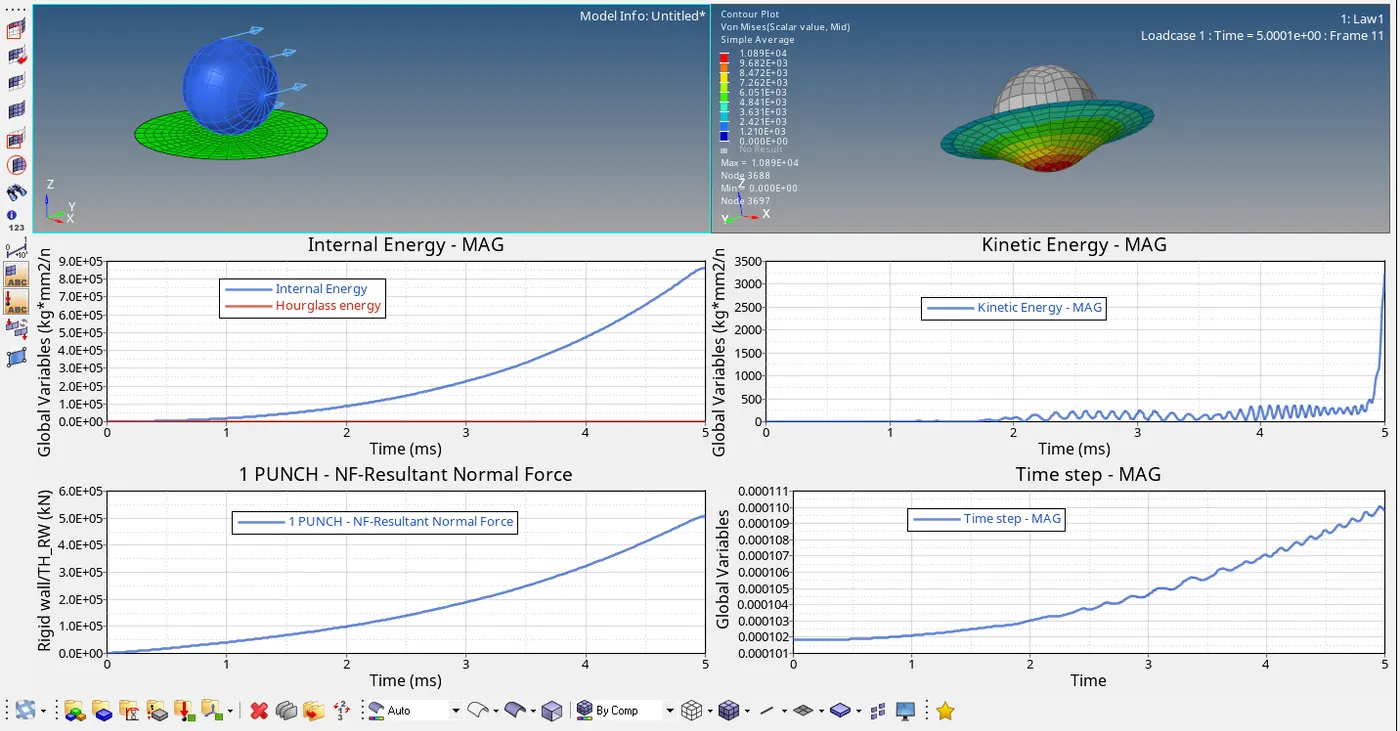
Fig 4: Simulated results for Case_1
The above figure shows the simulation of Law1_Elastic. Here, the material is used as aluminium and the properties are rho = 0.0028 g/mm3 , E = 71000 N/mm2 , Nu = 0.33. The run time of the simulation is 5.01 ms and the Tfreq = 1. The simulation is based on the impact of Rigid ball on the circular plate, in this case the energy dissipation is 800 KJ and varies smoothly. There is no hourglass energy formed because the number of intergration point as 5 and the energy error is 1.3%. The max von moses stress formed is 10.89 kN/mm2 which is max when compared to all the cases, which defines the yield criteria and fracture point. The Kinetic energy is varies smoothly because of elasticity there is no failure will cause to the model.
Case_2:
LAW36_Elasto_plastic:
This law models an isotropic elasto-plastic material using user-defined functions for the work-hardening portion of the stress-strain curve (for example, stress vs. plastic strain) for different strain rates.
- The first point of yield stress functions (plastic strain vs stress) should have a plastic strain value of zero. If the last point of the first (static) function equals 0 in stress, default value of εpmax is set to the corresponding value of εp">εp .
- Element deletion:
- Once εp (plastic strain) reaches εpmax">εpmax , in one integration point, the element is deleted.
- If ε1 reaches εt, the stress is reduced using the following relation: (1)
σ=σ[(εm−ε1)/(εm−εt)]
- If ε1 (largest principal strain) reaches εm ( ε1>εm ), the stress in element is reduced to 0 (but the element is not deleted).
- Once ε1 (largest principal strain) reaches εf (maximum tensile failure strain), the element is deleted
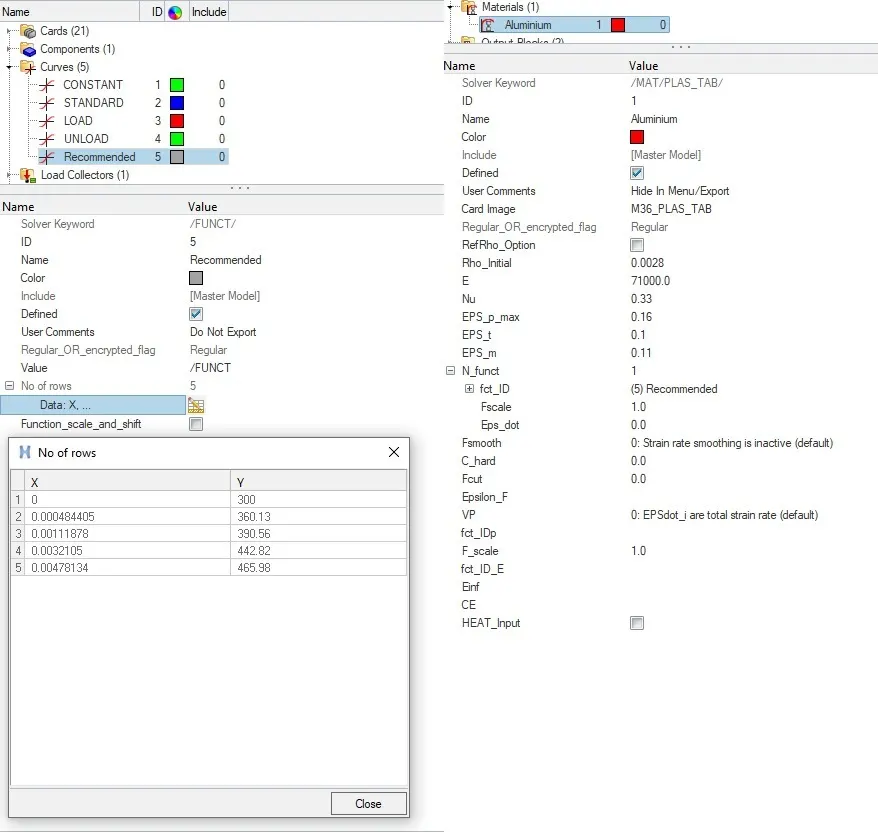
Fig 5: Material property and Curve formation
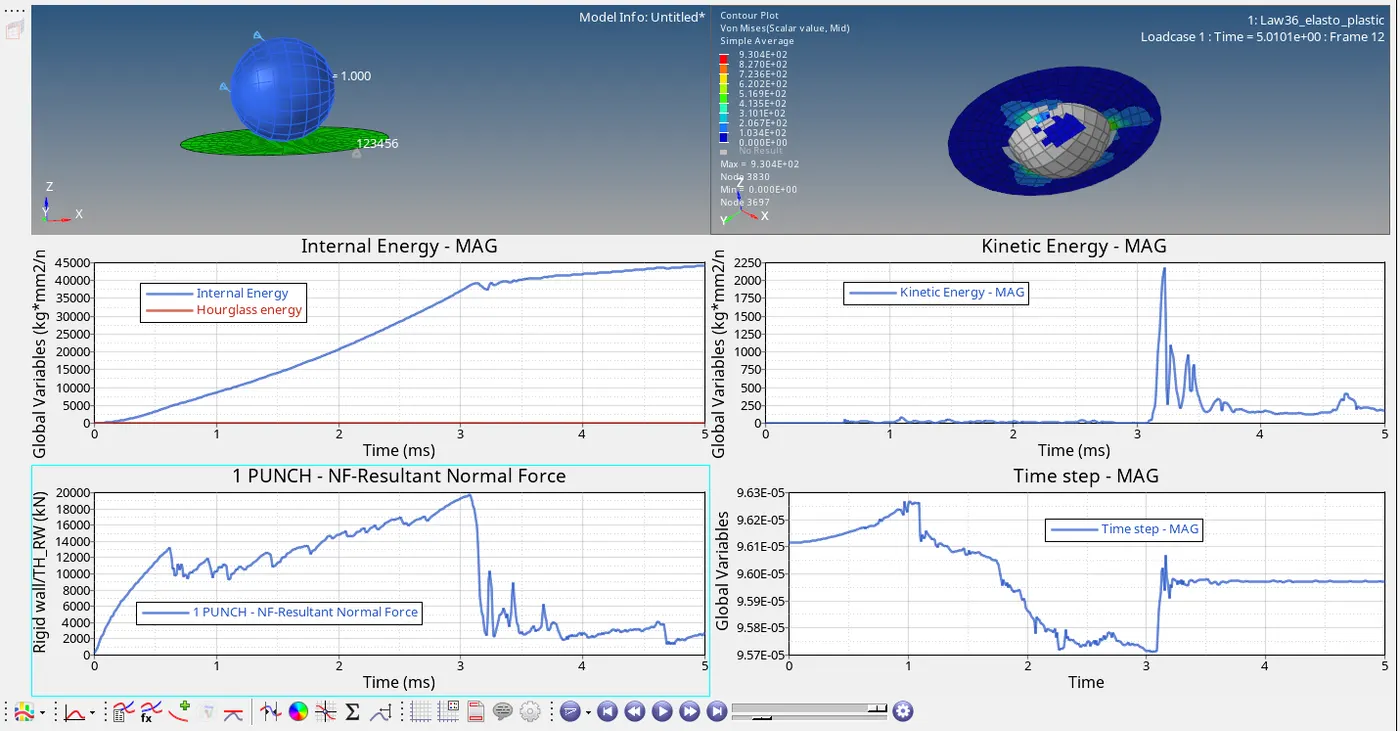
Fig 6: Simulated results for Case_2
In this case, the material properties are shown in above fig which defines the eps_p_max, eps_t, eps_m. The simulation shows upto 3 ms the deformation of the plate is smooth after that elements are cracked and deleted at the critical point. At that point, the time step as suddenly increases and also the normal force of the punch reaches the max point. The max von moses stress is 930 N/mm2 and the energy error is -1.4% . The energy dissipation is almost linear upto 3ms and varies randomly because of the element crack and deletion. The Kinetic energy is varied peak at the time 3 ms in which the element deletion is occured, due to remaining elements present in the plate the energy dissipation is remain constant and decrease in the kinetic energy.
Case_3:
LAW2_EPSMAX_Failure:
Here, the Failure johnson is included which defines the damage factor (D1 , D2, D3, D4, D5). The material card image is used as Law2_Plast_Johns. the material as yield stress, max stress, eps_p_max are defined.
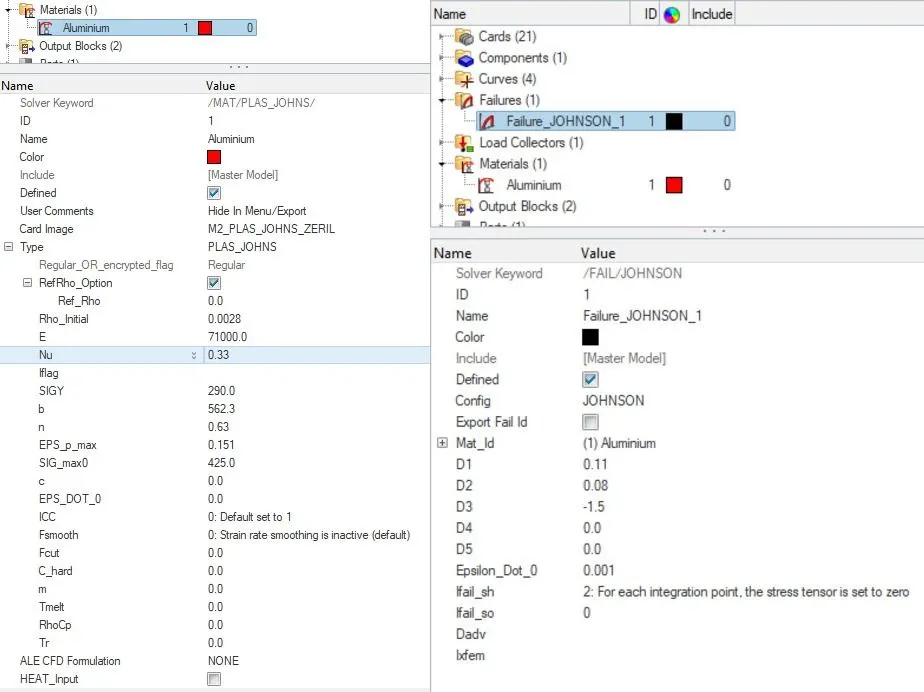
Fig 7: Material property and Failure johnson card
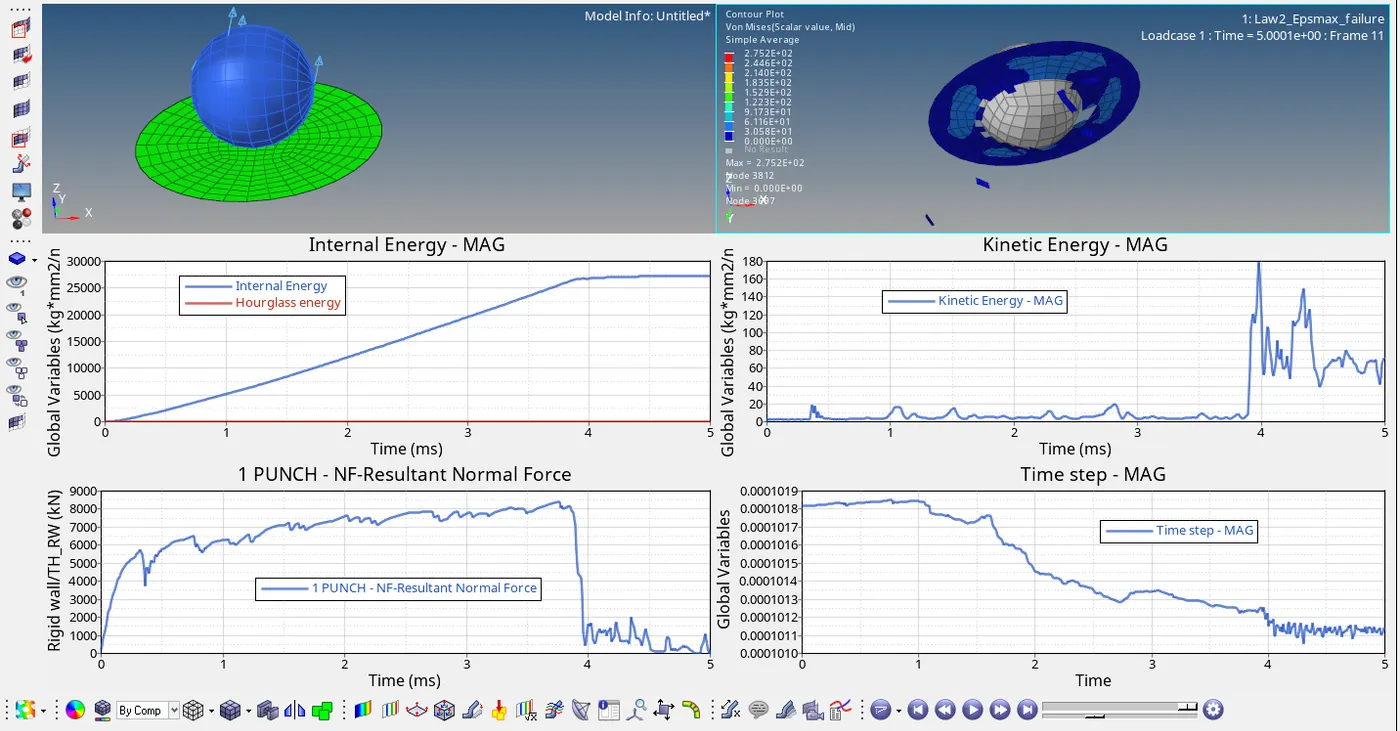
Fig 8: Simulated results for Case_3
In this case, The simulation shows upto 3.8 ms the deformation of the plate is smooth after that elements are cracked and deleted at the critical point. At that point, the time step as suddenly increases and also the normal force of the punch reaches the max point. The max von moses stress is 275 N/mm2 and the energy error is 3% means the model is not consistent for this case. The energy dissipation is almost linear upto 3.8ms and varies randomly because of the element crack and deletion. The Kinetic energy is varied peak at the time 3.8 ms in which the element deletion is occured, due to element in the edge the energy dissipation is remain constant and some variation in the kinetic energy.
Case_4:
LAW2_EPSMAX_Crack:
Here, the Failure johnson is included which defines the damage factor (D1 , D2, D3, D4, D5), Dadv and Ixfem which defines the crack advancement. The material card image is used as Law2_Plast_Johns_Zeril. the material as yield stress, max stress, eps_p_max are defined.
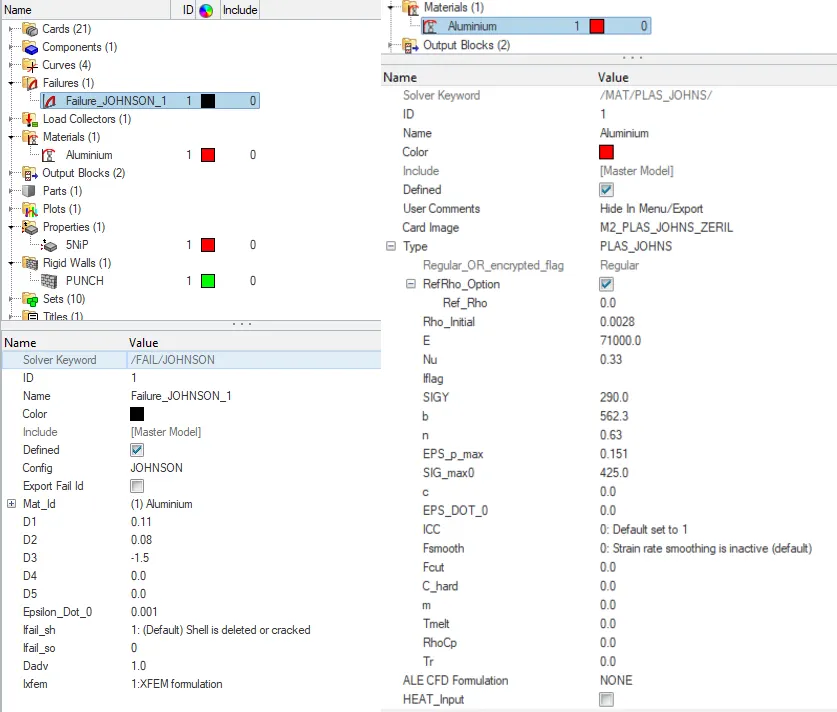
Fig 9: Material property and Failure johnson card
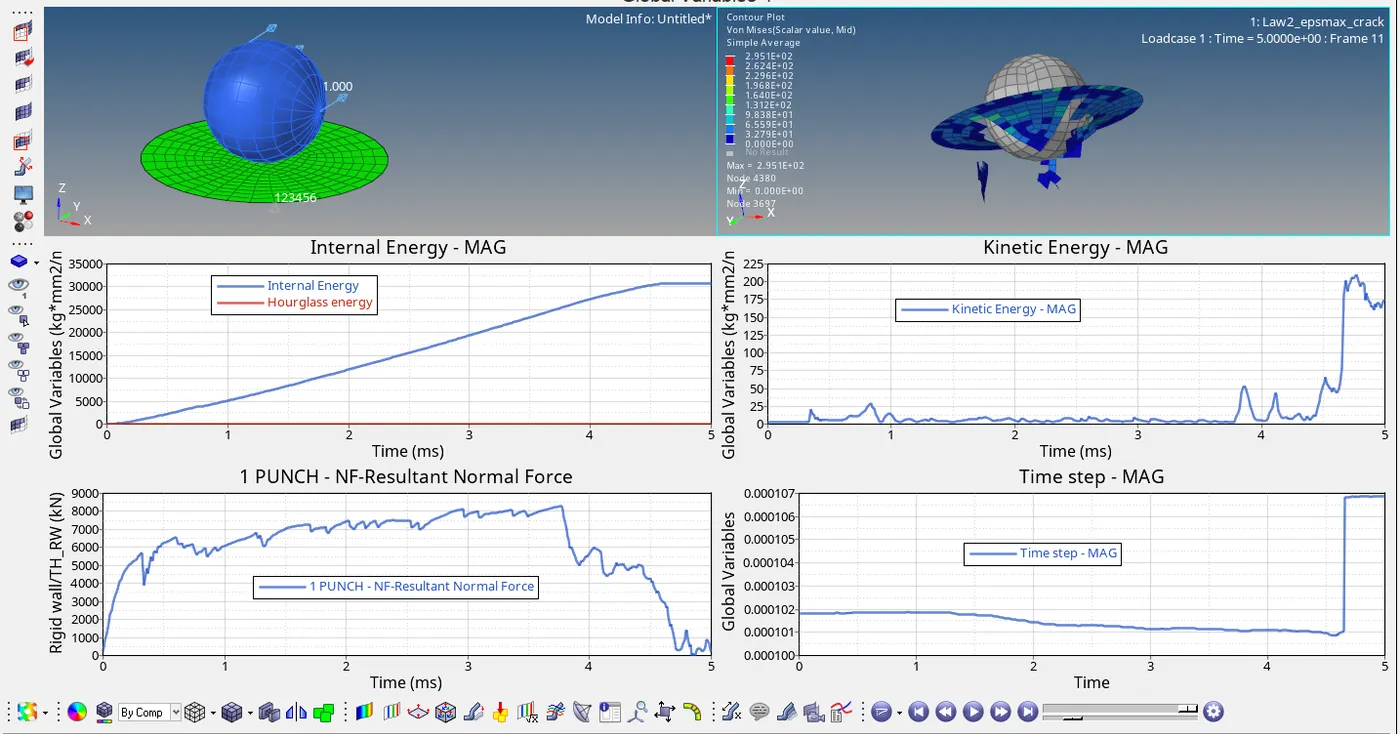
Fig 10: Simulated results for Case_4
In this case, The simulation shows upto 4.5 ms the deformation of the plate is smooth after that elements are cracked and deleted at the critical point. At that point, the time step as suddenly increases and also the normal force of the punch reaches the max point. The max von moses stress is 295 N/mm2 which exceeds the yield stress and the energy error is 4% means the model is not consistent for this case. The energy dissipation is almost linear upto 4.5ms and remains constant because of the element crack and deletion. The Kinetic energy is varied peak at the time 4.5 ms in which the element deletion is occured, due to element in the edge the energy dissipation is remain constant and some variation in the kinetic energy.
Case_5:
LAW2_EPSMAX_No_Fail:
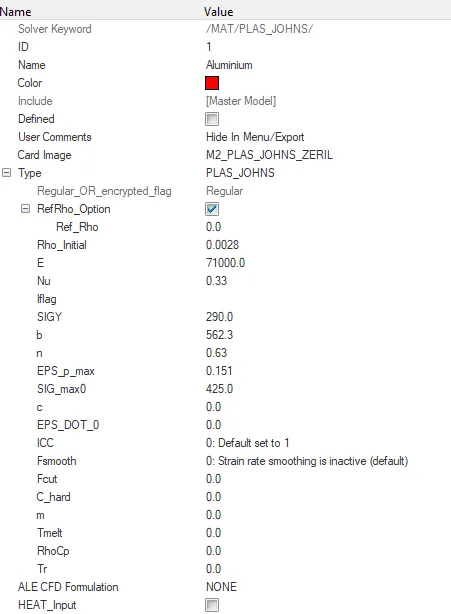
Fig 11: Material property
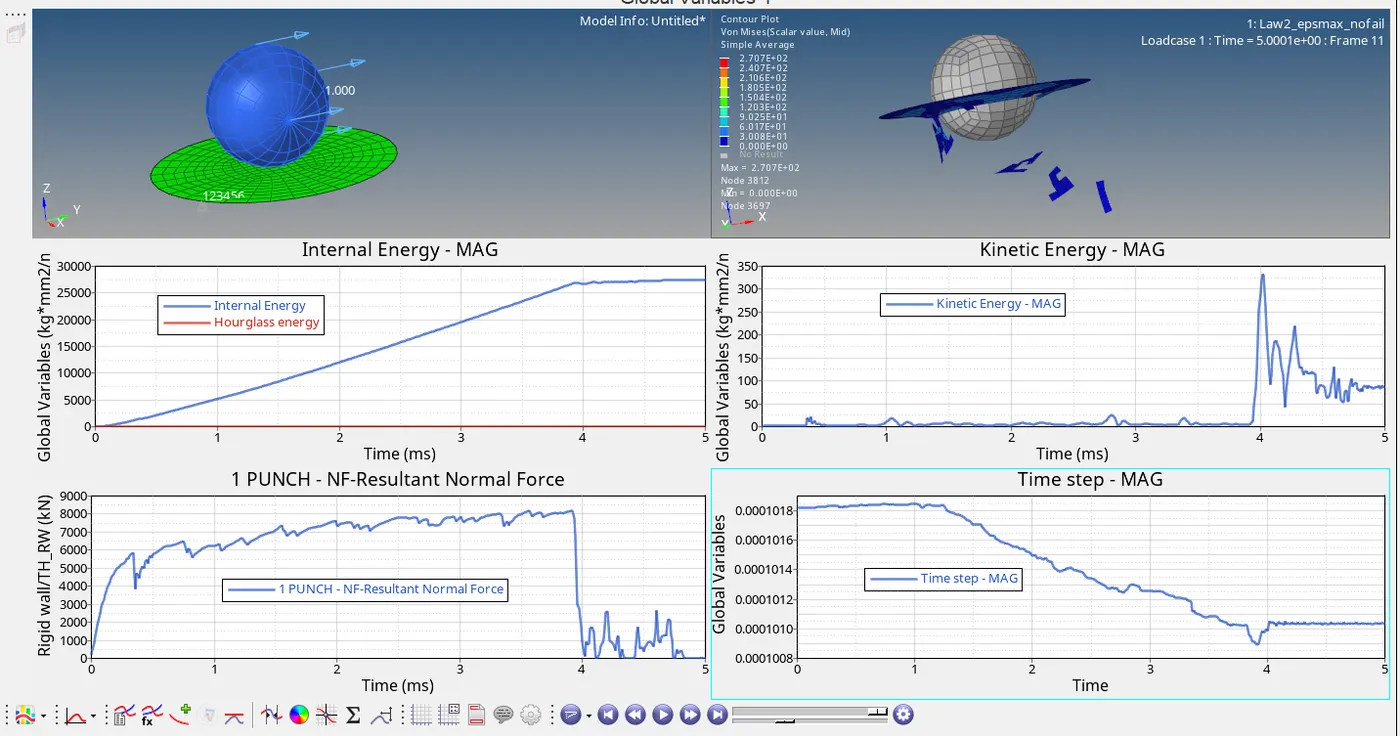
Fig 12: Simulated results for Case_5
In this case, The simulation shows upto 4 ms the deformation of the plate is smooth after that elements are cracked and deleted at the critical point. At that point, the time step as suddenly increases and also the normal force of the punch reaches the max point. The max von moses stress is 270 N/mm2 and the energy error is 0.8% means the model is consistent for this case. The energy dissipation is almost linear upto 4ms and remains constant because of the element crack and deletion. The Kinetic energy is varied peak at the time 4 ms in which the element deletion is occured, due to element in the edge the energy dissipation is remain constant and some variation in the kinetic energy.
Case_6:
LAW2_Johnson_Cook:
This law represents an isotropic elasto-plastic material using the Johnson-Cook material model. This model expresses material stress as a function of strain, strain rate and temperature. A built-in failure criterion based on the maximum plastic strain is available.
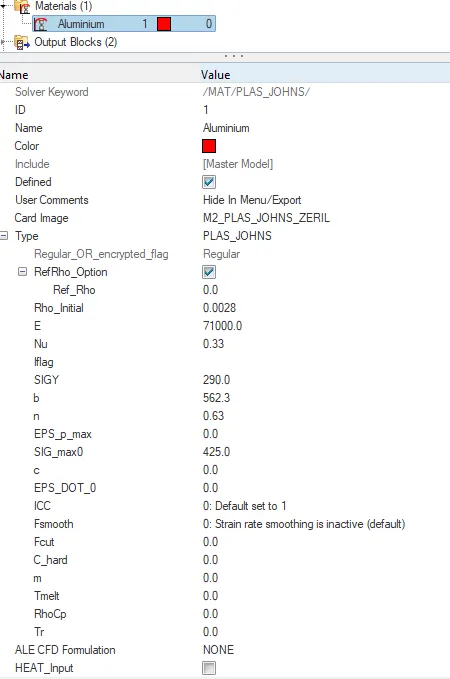
Fig 13: Material property
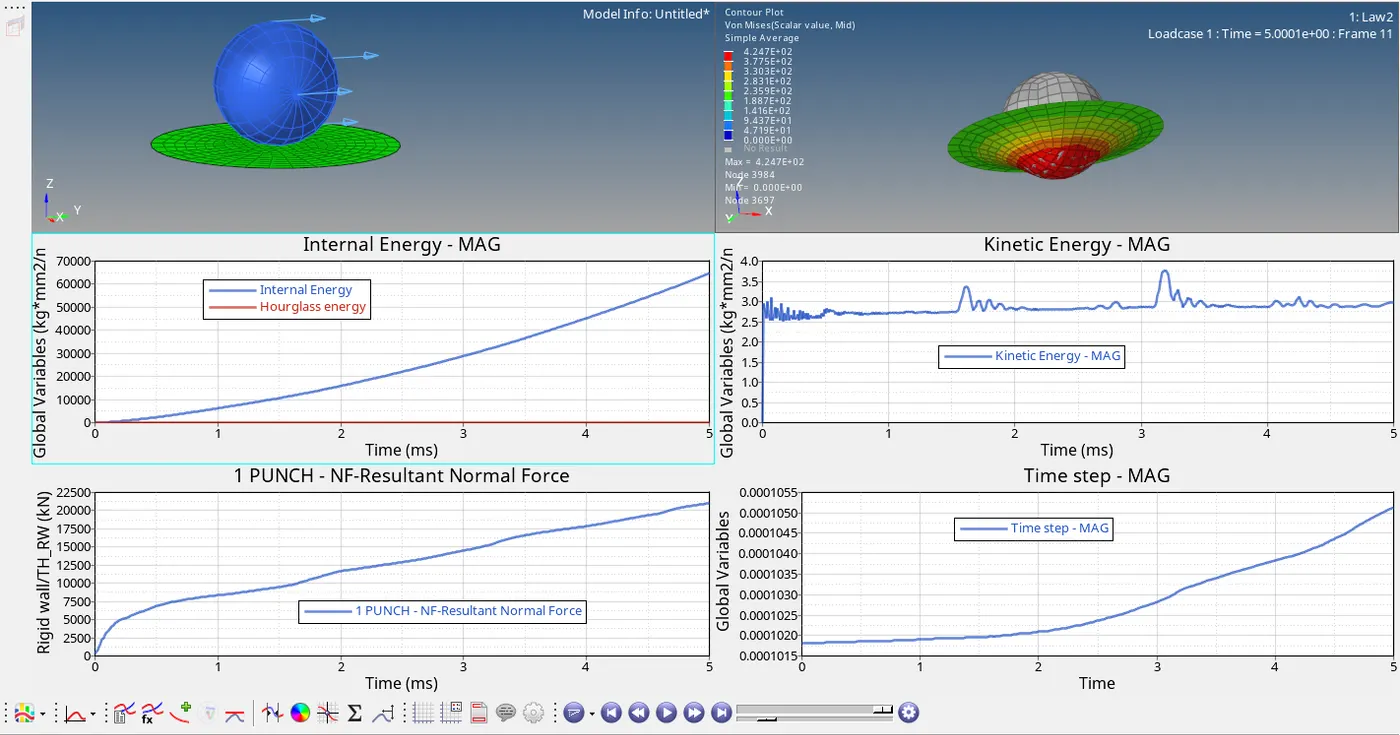
Fig 14: Simulated results for Case_6
In this case, The simulation shows the deformation of the plate which exceeds the yield stress means the deformation is permanent and form fracture. The time step varies smoothly increases and also the normal force of the punch reaches the max point. The max von moses stress is 424.7 N/mm2 which is near to max stress and the energy error is 0.8% means the model is consistent for this case. The energy dissipation is almost linear overall simulation.
Case_7:
LAW27_Elasto_Plastic_Brittle:
This law combines an isotropic elasto-plastic Johnson-Cook material model with an orthotropic brittle failure model. Material damage is accounted for prior to failure. Failure and damage occur only in tension. This law is applicable only for shells.
In this model, the material behaves as a linear-elastic material when the equivalent stress is lower than the plastic yield stress. For higher stress values, the material behavior is plastic and the stress is calculated as,
The plasticity hardening exponent, n must be less than 1.
Damage and rupture defined with 4 parameters for each principal direction:
1. et = Strain at the beginning of tensile failure
2. em = Maximum tensile strain at which the stress in the element is set to a value dependent on dmax1
3. dmax = Maximum tensile damage factor
4. ef = Maximum tensile strain for element deletion
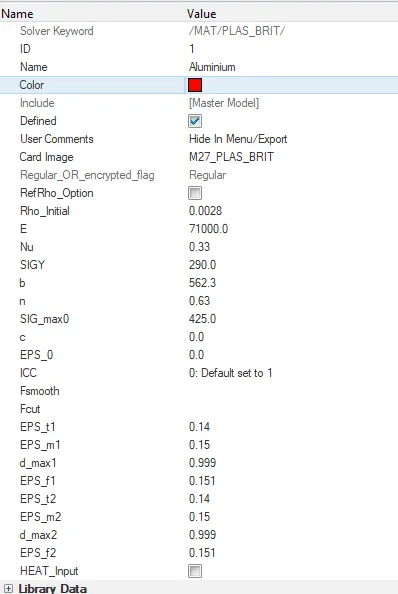
Fig 15: Material property
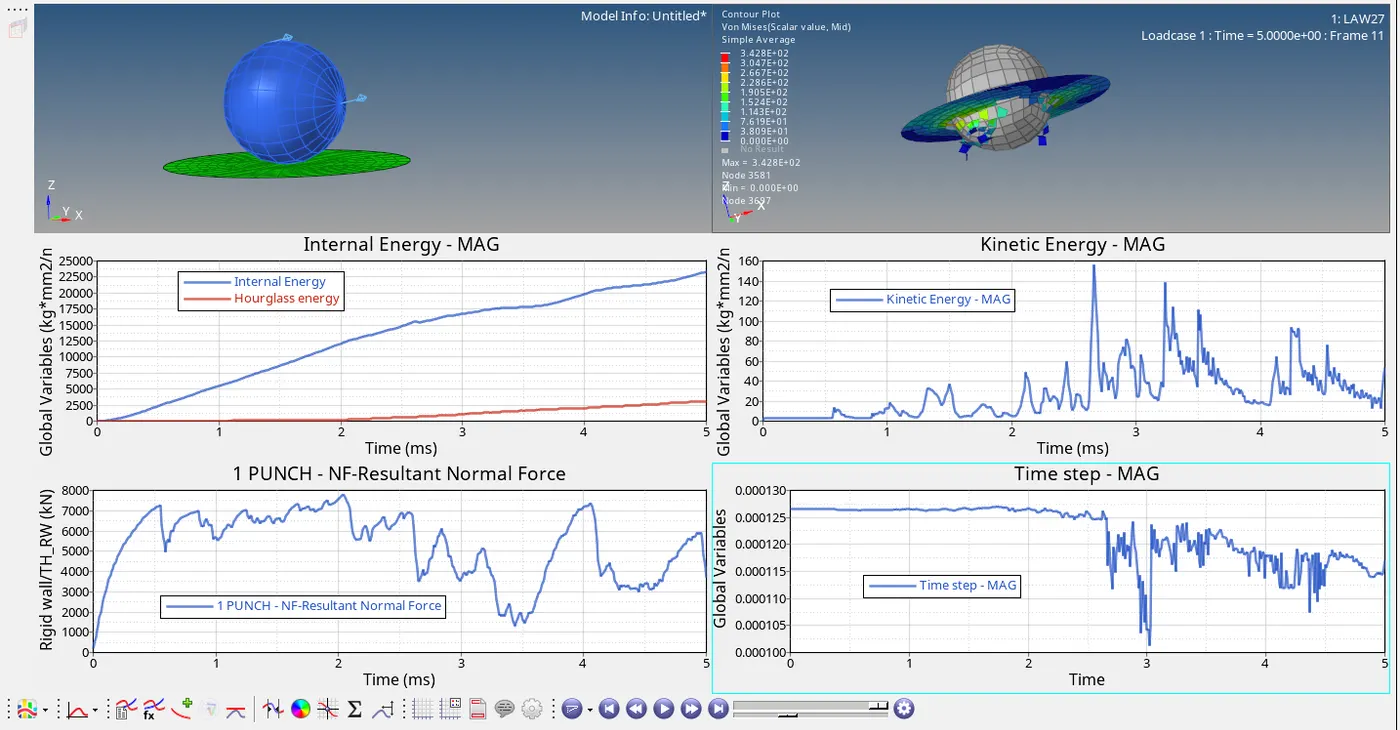
Fig 16: Simulated results for Case_7
In this case, The simulation shows upto 2 ms the deformation of the plate is smooth after that elements are cracked and deleted at the critical point because of brittle material. At that point, the time step varies rapidly and also the normal force of the punch reaches the max point. The max von moses stress is 342 N/mm2 which exceeds the yield stress and the energy error is -7.1% means the model is not consistent for this case. The energy dissipation is more and varies almost linear overall the simulation. The hourglass is varying after the elements crack therefore the energy error is maximum. The Kinetic energy is varied peak at the time 2.5 ms because the object fail (element deletion) at a short time because of Brittle material when reaches to yield point.
RESULT:
( i ) Comparison Chart:
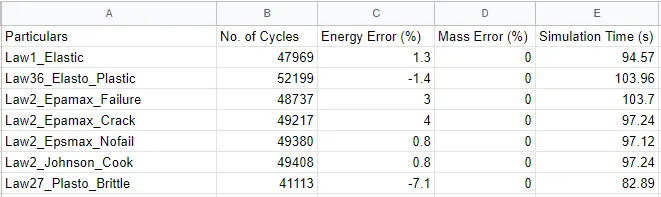
Fig 17: Comparision chart
The above chart shows the energy error, No. of cycle, Mass Error and Simulation time. By comparing all the 7 cases, we can notice Law2_Johnson_cook and Law36_ Elasto_ Plastic which as 0.8 % and -1.4 % of energy error accordingly which is accepted and considered as consistent. The No. of cycle for this simulation is 49408 and 52199 and time taken as 97.24 and 103.96 to complete the simulation accordingly. This case is feasible when compare to other case.
( ii ) Comparison of Internal Energy:
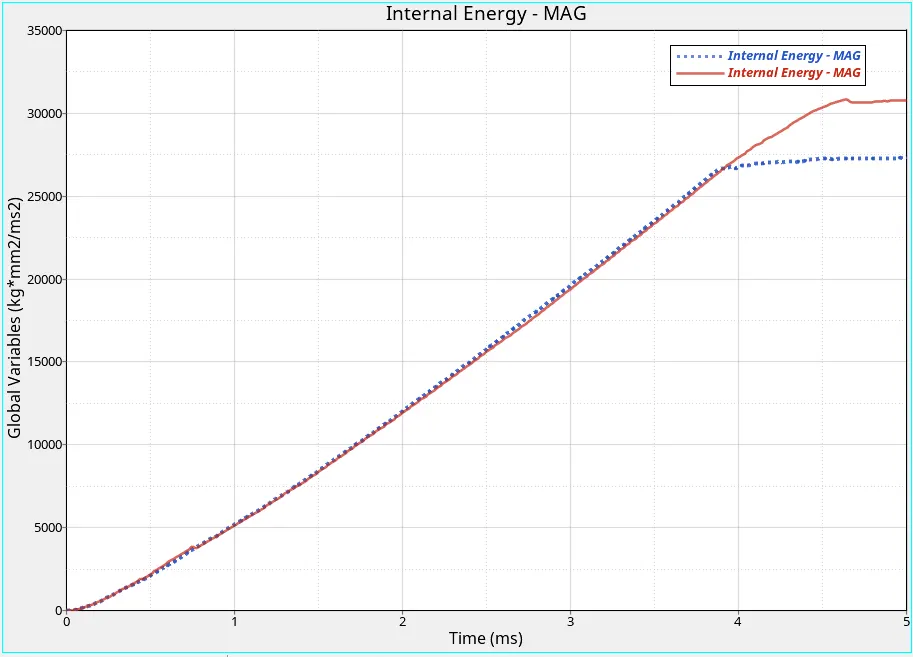
Fig 18: Internal Energy of Epsmax_failure and Epsmax_crack
The above graphs shows that, variation of internal energy of epsmax_failure (dotted line) and epsmax_ crack (straight line). The internal energy of Epsmax_failure defines that the energy dissipation and element deletion at the time of 4ms and maintained constant further. Whereas in Epsmax_crack, the internal energy can sustain to a long time that means still the elements are get in touch with the rigid punch till 4.5 ms and element deletion are occured.
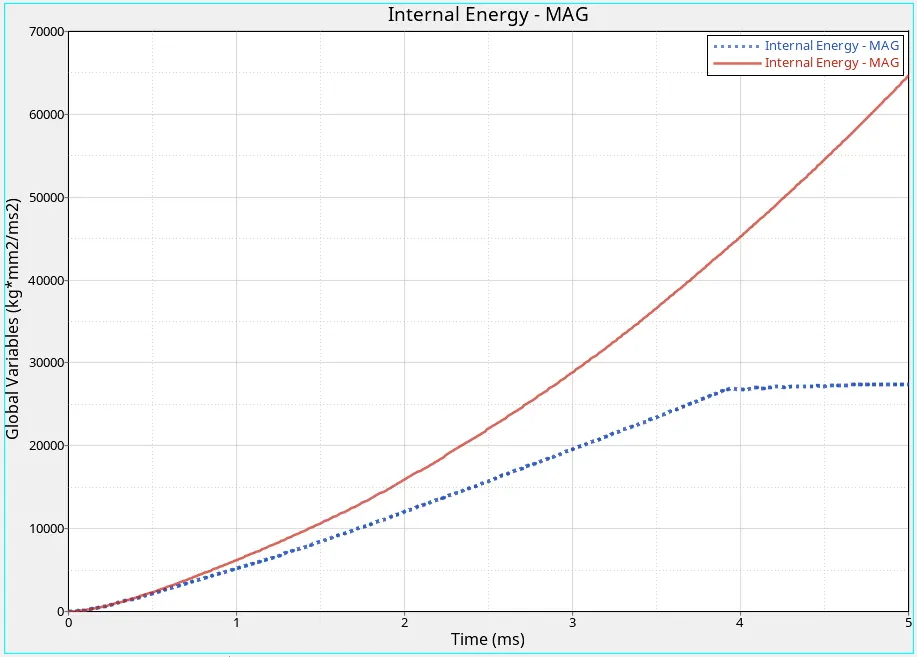
Fig 19: Internal Energy of Epsmax_nofail and Law2
The above graphs shows that, variation of internal energy of epsmax_Nofail (dotted line) and Law2 (straight line). The internal energy of Epsmax_Nofail defines that the energy dissipation and element deletion at the time around 4ms and maintained constant further. Whereas in Law2, the internal energy can sustain to a long time that means still the elements are get in touch with the rigid punch and there is no element deletion are occured.
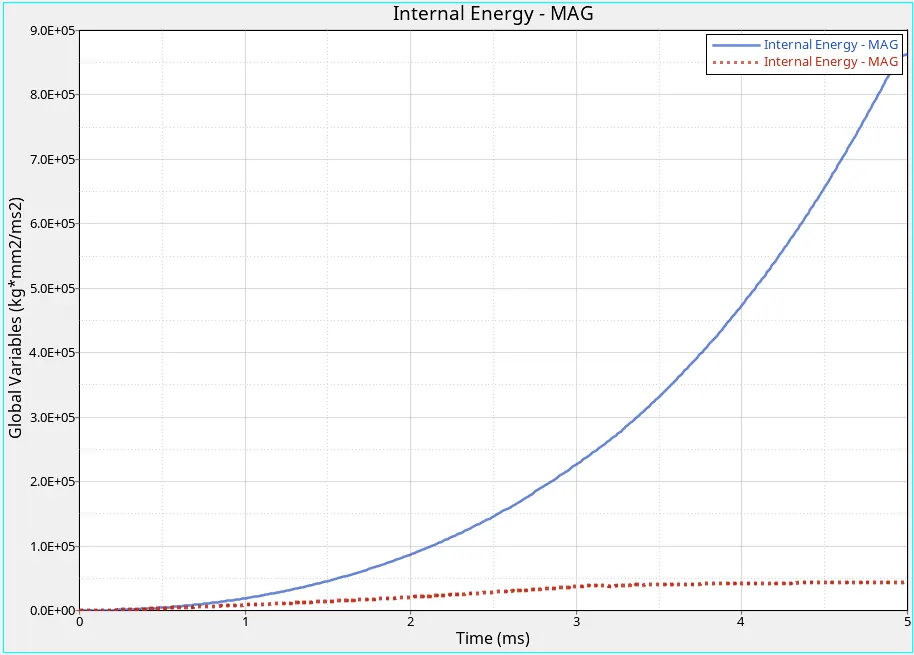
Fig 20: Internal Energy of Law1 and Law36
The above graphs shows that, variation of internal energy of Law36_Elasto_Plastic (dotted line) and Law1_Elastic (straight line). The internal energy of Law36_Elasto_Plastic defines that the energy dissipation and element deletion at the time of 3ms . Whereas in Law1_Elastic, the internal energy can sustain to a long time that means still the elements are get in touch with the rigid punch overall the simulation and there is no element deletions are occured.
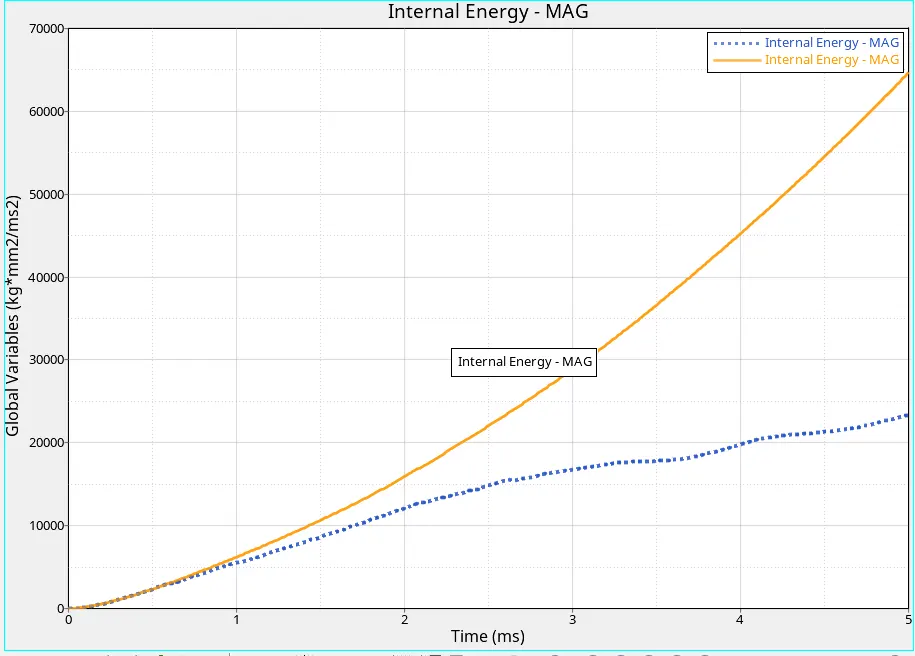
Fig 21: Internal Energy of Law2 and Law27
The above graphs shows that, variation of internal energy of Law27_Plast_Brittle (dotted line) and Law2 (straight line). The internal energy of Law27_Plast_Brittle defines that the energy dissipation and element deletion can occur in a short time. Whereas in Law2, the internal energy can sustain to a long time that means still the elements are get in touch with the rigid punch and there is no element deletion are occured.
CONCLUSION:
1. All the simulation as been done based on the properties,
- LAW1_Elastic
- LAW36_Elasto_plastic
- LAW2_EPSMAX_Failure
- LAW2_EPSMAX_Crack
- LAW2_EPSMAX_No_Fail
- LAW2_Johnson_Cook
- LAW27_Elasto_Plastic_Brittle
2. After all the simulation, Energy error and No. of cycle and Simulation time is compared and justified the feasible one.
3. Comparison of Internal energy for all 7 cases.
Drive_Link:
https://drive.google.com/drive/folders/1c3SDWKc6Ffo0QFhrhes7Er_rZnolWLgJ?usp=sharing