Week 1 Understanding Different Battery Chemistry
AIM: To study the different types of Lithium-ion batteries and their characteristics.
KEYWORD: LCO, LMO, NCA, NMC, LFP, LTO, Battery capacity, Electrolyte, etc.,
INTRODUCTION:
Lithium is the lightest of all metals, has the greatest electrochemical potential, and provides the largest specific energy per weight. Rechargeable batteries with lithium metal on the anode could provide extraordinarily high energy densities; however, it was discovered in the mid-1980s that cycling produced unwanted dendrites on the anode. Lithium-ion uses a cathode (positive electrode), an anode (negative electrode), and an electrolyte as a conductor. (The anode of a discharging battery is negative and the cathode positive. The cathode is a metal oxide and the anode consists of porous carbon. During discharge, the ions flow from the anode to the cathode through the electrolyte and separator; the charge reverses the direction and the ions flow from the cathode to the anode.
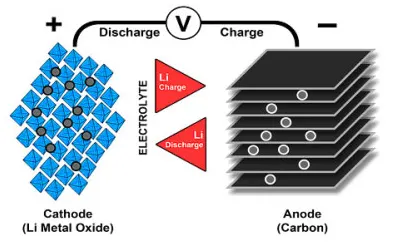
Fig1: Ion flow in lithium-ion battery.
When the cell charges and discharges, ions shuttle between the cathode (positive electrode) and anode (negative electrode). On discharge, the anode undergoes oxidation or loss of electrons, and the cathode sees a reduction or a gain of electrons. Charge reverses the movement.
TYPES OF LITHIUM-ION BATTERIES:
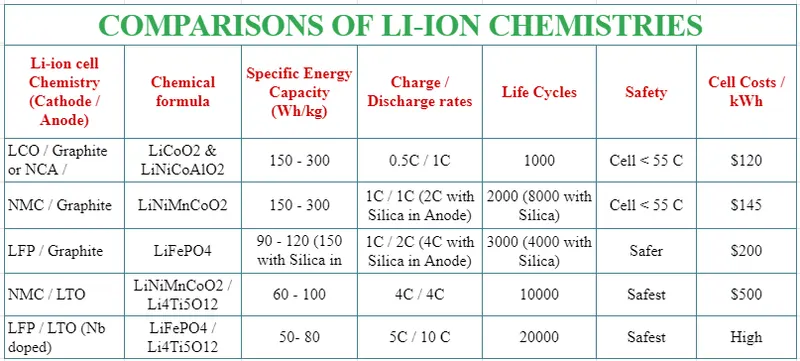
1. Lithium Cobalt Oxide(LiCoO2) — LCO
2. Lithium Manganese Oxide (LiMn2O4) — LMO
3. Lithium Nickel Manganese Cobalt Oxide (LiNiMnCoO2) — NMC
4. Lithium Iron Phosphate(LiFePO4) — LFP
5. Lithium Nickel Cobalt Aluminum Oxide (LiNiCoAlO2) — NCA
6. Lithium Titanate (Li2TiO3) — LTO
PERFORMANCE OF BATTERIES:
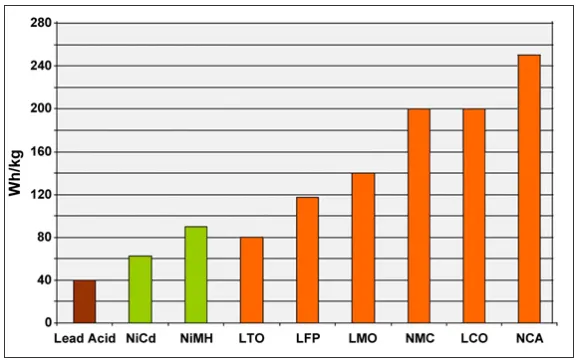
By comparing the specific energy of lead-, nickel- and lithium-based systems. While Li-aluminum (NCA) is the clear winner by storing more capacity than other systems, this only applies to specific energy. Li-manganese (LMO) and Li-phosphate (LFP) are superior in terms of specific power and thermal stability. Li-titanate (LTO) may have low capacity but this chemistry outlives most other batteries in terms of life span and also has the best cold temperature performance. Moving towards the electric powertrain, safety, and cycle life will gain dominance overcapacity. (LCO stands for Li-cobalt, the original Li-ion.)
ADVANTAGES & LIMITATION OF LI-ION:
CHARACTERISTICS OF LI-ION: