Planetary Gear
AIM :-
To design a planetary gear and perform motion analysis in Solidworks.
THEORY :-
Gears are mechanical components that transmit rotation and power from one shaft to another, if each shaft possesses appropriately shaped projections (teeth) equally spaced around its circumference such that as it rotates, the successive tooth goes into the space between the teeth of the other shaft. Thus, it is a machine component in which the rotary power is transmitted by the prime mover’s tooth surface pushing the tooth surface of the driven shaft.
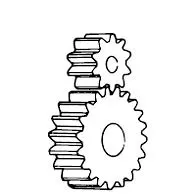
Gears are designed using certain definitions or teminology as shown below.
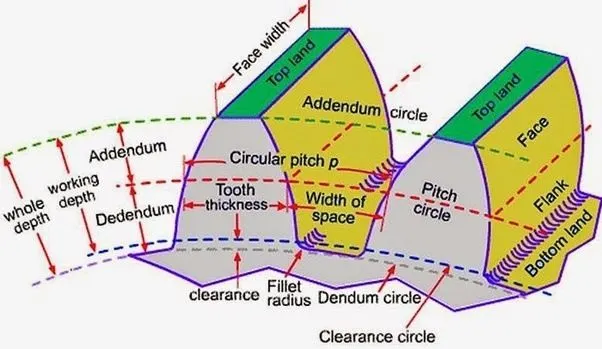
In order to design the planetary gear assembly, three terminologies are considered.
- Pitch Circle: It is an imaginary circle drawn on gear profile in such a way that a pure rolling motion on this circle gives the motion which is exactly similar to the gear motion.
- Pressure Angle: It is the angle between common normal at the point of contact at a pitch point. In gear terminology, pressure angle plays a crucial part in gear design. The standard value of pressure angles are 14 1/2, 20 and 25.
- Module: The module is defined as the ration of pitch circle diameter in mm to the number of teeth.
Planetary Gears,
A planetary gear set is made up of three types of gears; a sun gear, planet gears, and a ring gear. The sun gear is located at the center and transmits torque to the planet gears which are typically mounted on a moveable carrier. The planet gears orbit around the sun gear and mesh with an outer ring gear. Planetary gear systems can vary in complexity from very simple to intricate compound systems, depending on the application.
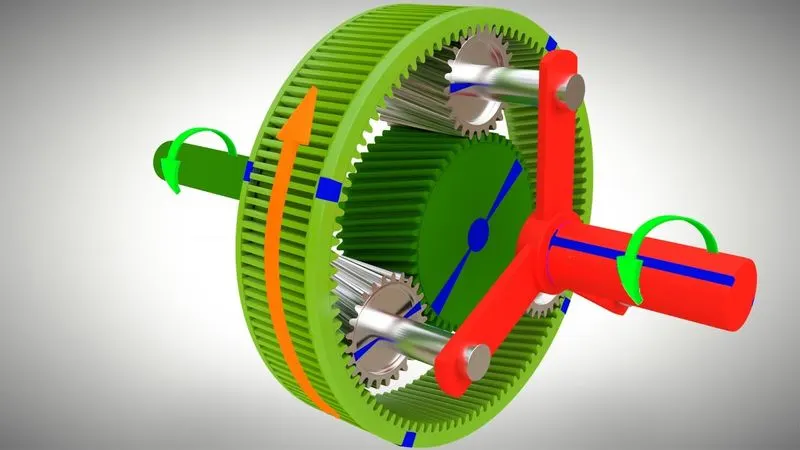
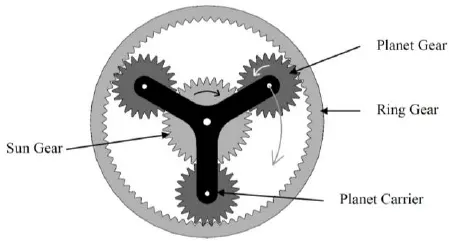
Planetary gear systems are able to produce a lot of torque because the load is shared among multiple planet gears. This arrangement also creates more contact surfaces and a larger contact area between the gears than a traditional parallel axis gear system. Because of this, in the load is more evenly distributed and therefore the gears are more resistant to damage.
CALCULATIONS :-
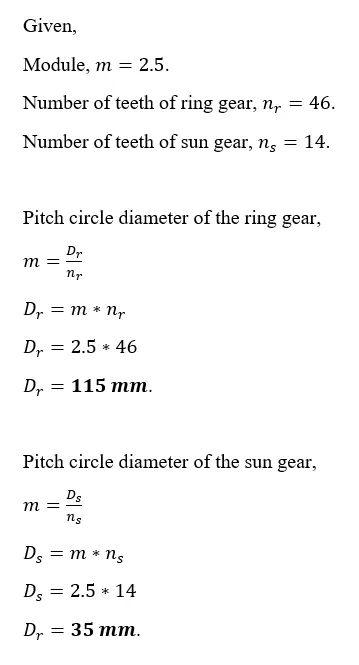
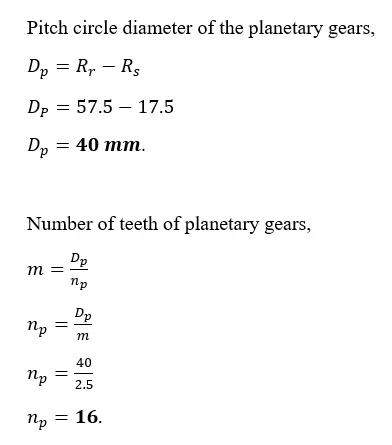
SOLIDWORKS MODEL :-
1. Design of the Carrier,
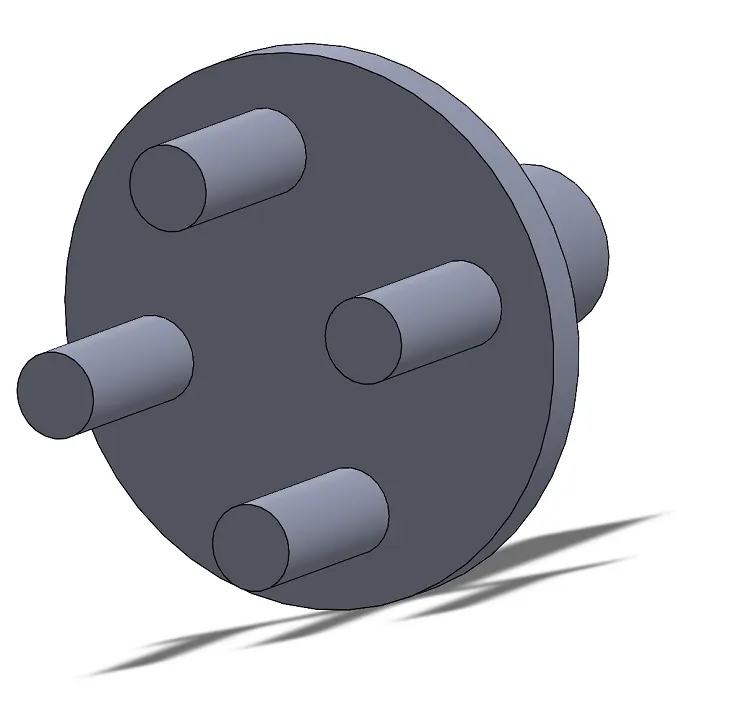
- First, a circle with a diameter of the pitch circle diameter of the ring gear is sketched and the dimension is added. The sketch is then extruded by 10 mm.
- The rear surface of the carrier is selected and a circle is skected and the dimensions are added. It is then extruded by 80 mm. This part is the output shaft of the carrier.
- To design the holders for the planetary gear, a circle having a diameter same as the PCD of the planetary gear is created as a construction geometry and is made tangent to the carrier base. Then a circle having a diameter of 18 mm which is the nominal shaft diameter is created.
- Circular sketch pattern is selected to create 3 more circle of the same dimensions as the holder's. The circle are then extruded by 40 mm which is the distance of the planetary gear hub.
2. Design of the Ring Gear,
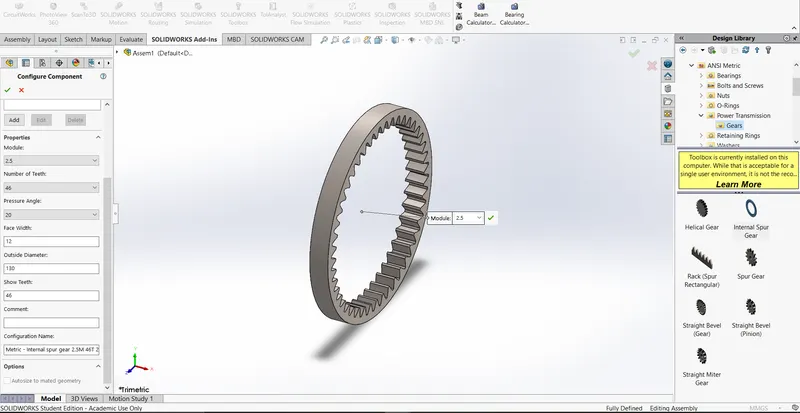
In order to add gears to the assembly, the toolbox add-in is loaded and selected under design library. ANSI metric is selected and under power transmissions gears folder is selected. An internal spur gear is chosen for the ring gear. Once the gear is dragged and dropped, the parameters can be configured. Here the module, number of teeth, face width and outside diameter are configured.
3. Design of the Sun Gear,
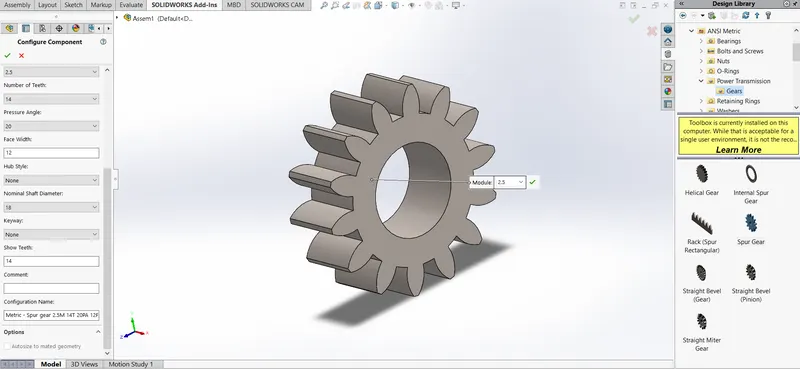
For the sun gear, a spur gear is selected where the module, number of teeth, face width and nominal shaft diameter are configured.
4. Design of the Planetary Gear,
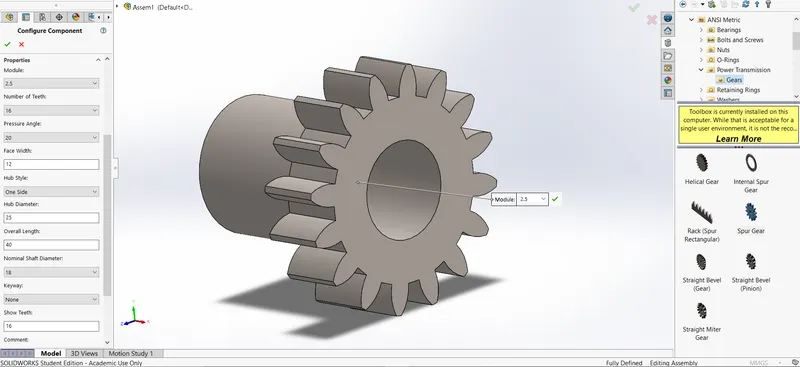
For the planetary gear, a spur gear is selected where the module, number of teeth, face width and nominal shaft diameter are configured. The difference between the model of the planetary gear and sun gear is the addition of a hub.
Assembly of the Parts,
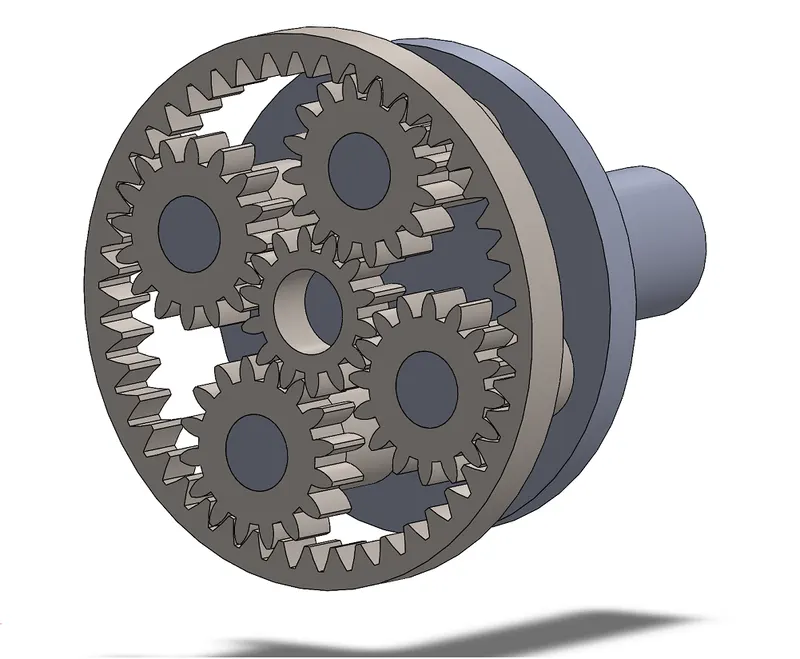
First the carrier is imported to the assembly, then the planetary gears are imported and the respective mates with respect to the carrier are created to constrain the carrier and the planetary gears. Once the planetary gears are constrained, the sun gear is imported and constrained using the required mates. At the end the ring gear is imported and constrained thereby completed the assembly. The final assembly is shown below.
OUTPUT :-
Motion study analysis is conducted for 3 conditions and the plots are obtained.
Case 1: Ring Gear is Fixed,
The ring gear is fixed and the planetary gears, sun gear and carrier are in float condition. The rotor input is provided to the sun gear at a constant speed of 200 RPM in clockwise direction. The motion analysis is calculated and the angular velocity of the carrier is plotted.
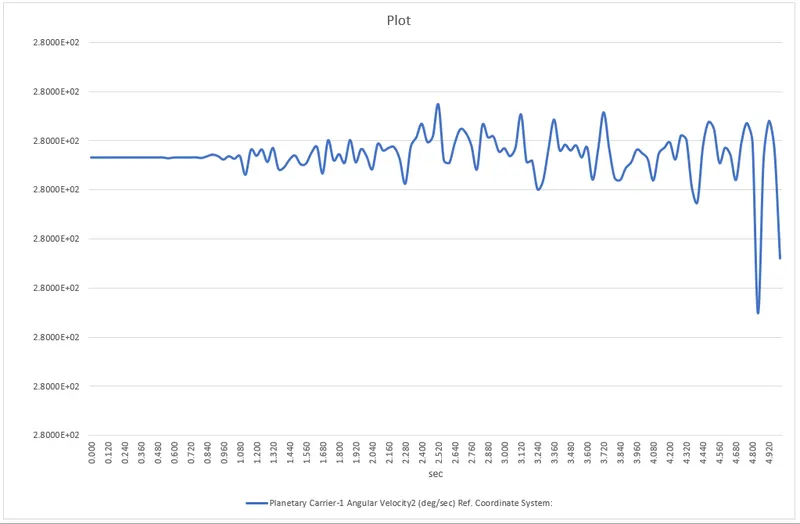
The angular velocity of the carrier when the ring gear is fixed is 280 degrees/second or 4.9 rad/s.
Case 2: Sun Gear is Fixed,
The sun gear is fixed and the planetary gears, ring gear and carrier are in float condition. The rotor input is provided to the ring gear at a constant speed of 200 rpm in clockwise direction. The motion analysis is calculated and the angular velocity of the carrier is plotted.
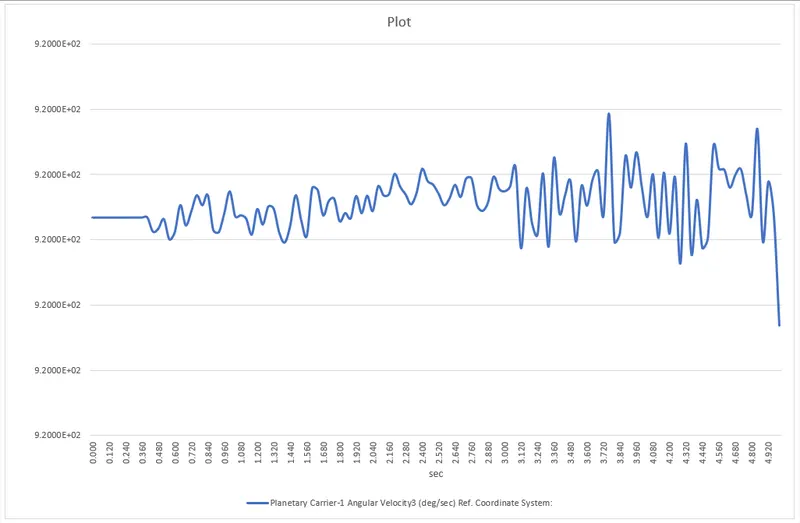
The angular velocity of the carrier is 920 degrees/second or 16.1 rad/s.
Case 3: Carrier is Fixed,
The carrier is fixed and the planetary gears, sun gear and ring gear are in float condition. The rotor input is provided to the sun gear at a constant speed of 200 RPM in clockwise direction. The motion analysis is calculated and the angular velocity of the ring gear is plotted.
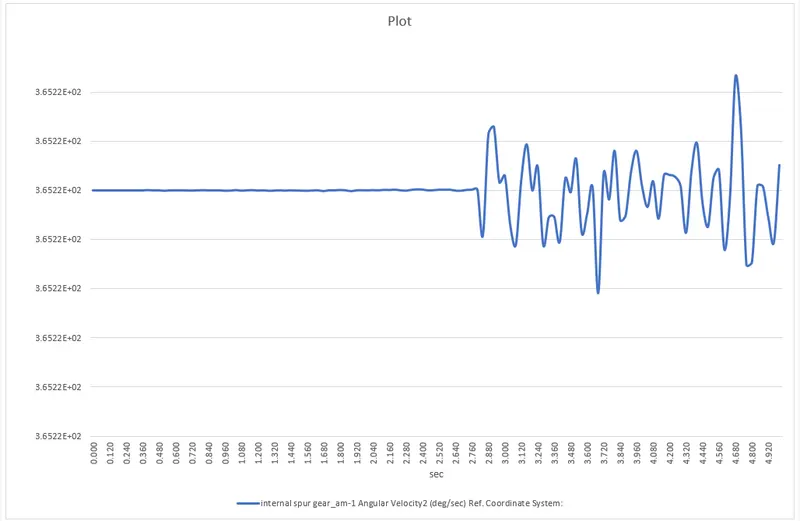
The angular velocity of the ring gear is 365 degrees/second or 6.4 rad/s.
CONCLUSION :-
A planetary gear arrangement is modelled using solidworks and the motion study analysis is conducted where the angular velocity is plotted based on different conditions.