ADAMS - Project - Hardpoint tuning to achieve pitch gradient targets using suspension “anti” characteristics
AIM :-
To tune the hardpoints of the front double wishbone suspension and rear multi link suspension to achieve pitch gradient targets using anti characteristics.
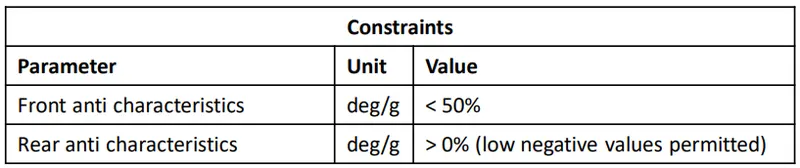
GIVEN DATA :-
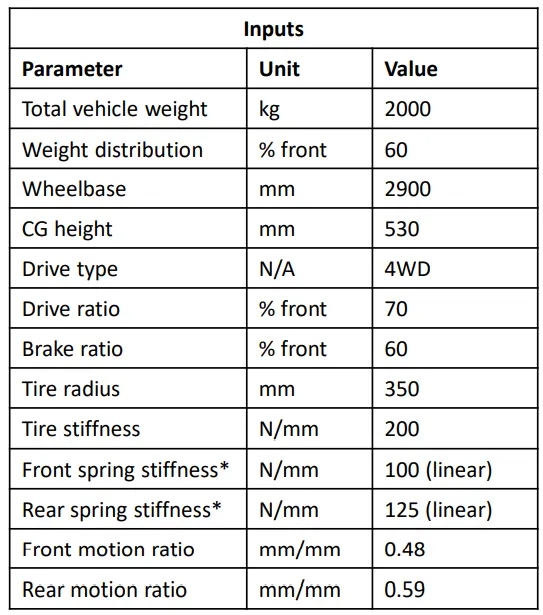
TARGET :-
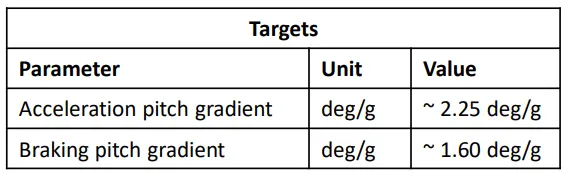
CONSTRAINTS :-
SUSPENSION MODELS :-
Front Double Wishbone Setup,
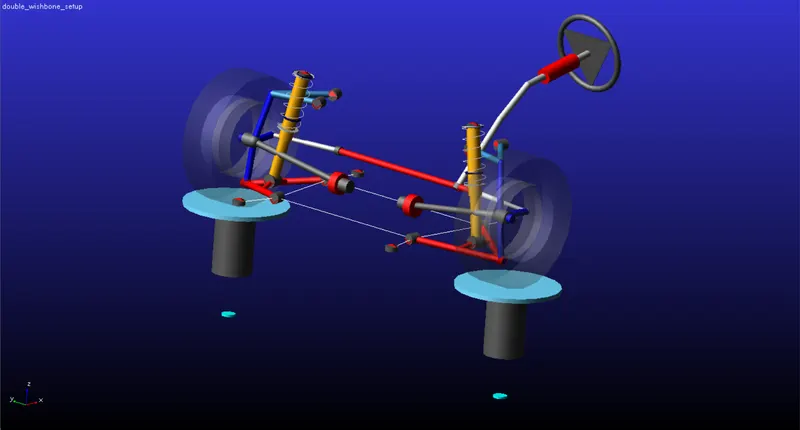
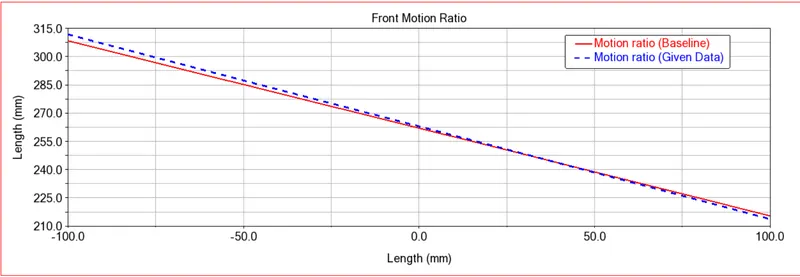
After the double wishbone assembly is loaded, it's parameters are modified to match the given data. For the spring stiffness, the property file is modified where the force values are changed to achieve a stiffness of 100 N/mm. To achieve a motion ratio of 0.48, the lower strut mount hardpoint is varied and the plot of the baseline and given data motion ratio is shown below.
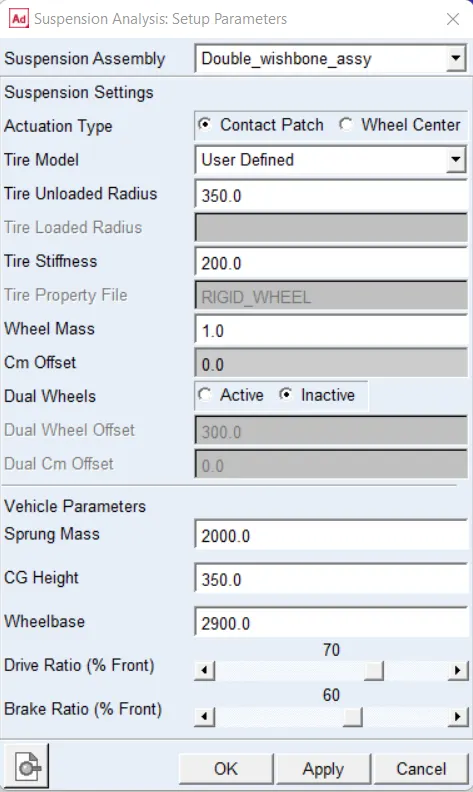
The suspension parameters are changed according to the given data as shown below.
Rear Multi Link Setup,
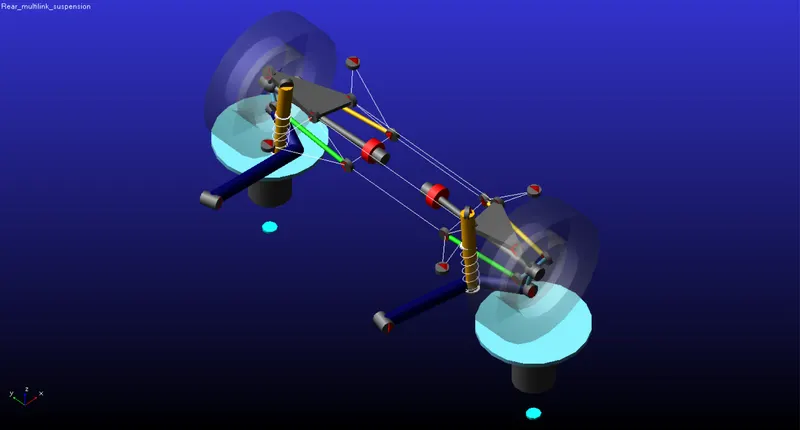
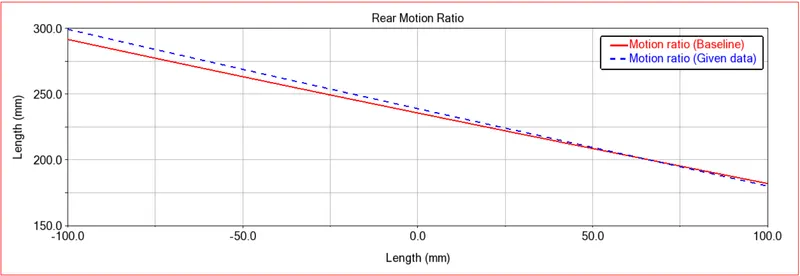
After the rear multi link assembly is loaded, it's parameters are modified to match the given data. For the spring stiffness, the property file is modified where the force values are changed to achieve a stiffness of 125 N/mm. To achieve a motion ratio of 0.59, the lower strut mount hardpoint is varied and the plot of the baseline and given data motion ratio is shown below.
The suspension parameters are changed according to the given data as shown below.
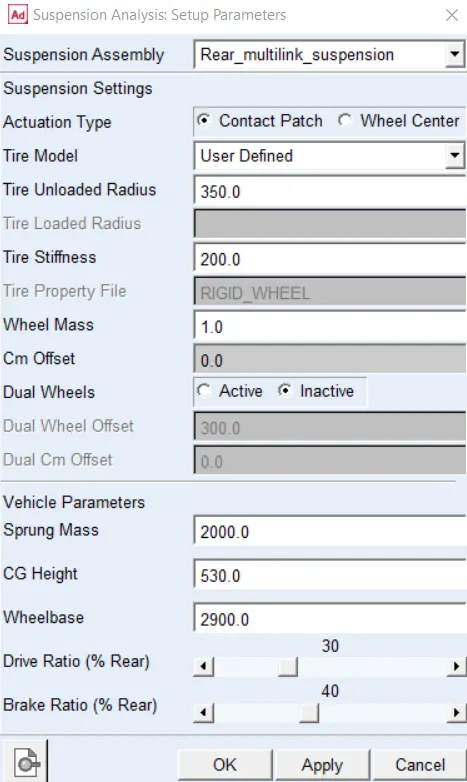
After the changes are made to both the assembly models, the simulations are run and hardpoint tuning is performed to reach the pitch gradient targets.
SIMULATION AND OPTIMIZATION :-
Parallel wheel travel simulation is conducted for both the setups with 250 steps and 100 mm of suspension travel. After the simulation the following, parameters are plotted in the post processor,
- Ride rate.
- Side view swing arm length.
- Side view swing arm angle.
- Front anti dive.
- Rear anti lift.
- Front anti lift.
- Rear anti squat.
- Front end deflection under load with compensation during braking and acceleration.
- Rear end deflection under load with compensation during braking and acceleration.
These represent the baseline values. The data are entered in a spreadsheet which is given below.
https://docs.google.com/spreadsheets/d/1wgwnzm13knD031Ld9DUbKq5ZvGRswhbKnehhRyjlQhA/edit?usp=sharing
Hand calculations are done for the anti characterstics to compare between the theoritical values and the simulation values.
Tuning the Hardpoints to Achieve the Targets,
The baseline pitch gradients are,
- Braking pitch gradient = 1.92 deg/g.
- Acceleration pitch gradient = 2.18 deg/g.
By varying the hardpoints of the ball joints, the anti characteristics can be modified. The modified hardpoints table are given below.
Front double wishbone setup,
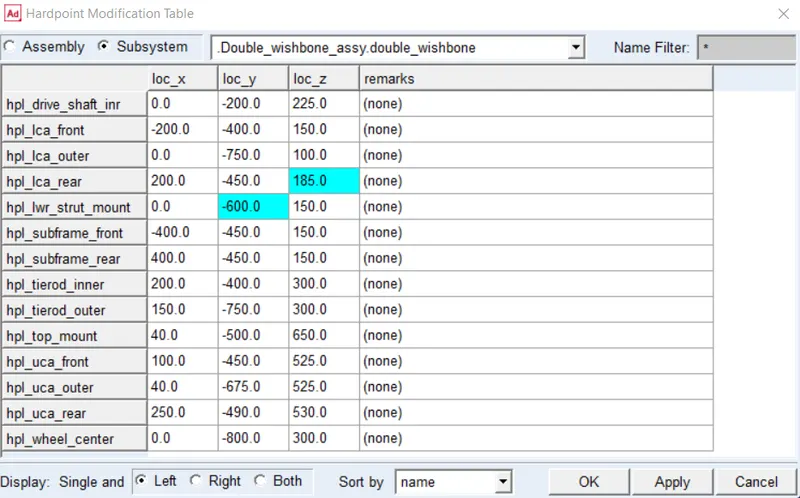
The y-coordinate of the lower strut mount and z-coordinate of the rear lower control arm are modified.
Rear multi link setup,
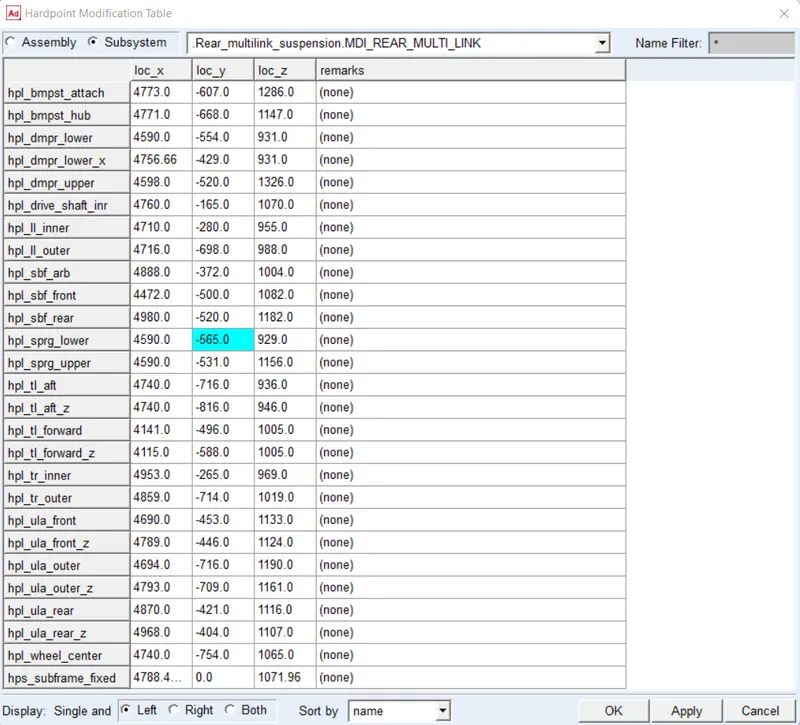
The y-coordinate of the lower spring is modified.
After the hardpoints are modified, the parallel wheel travel simulation is again run with the same inputs. After the simulation, the parameters are plotted and the targets are achieved.
OUTPUT AND PLOTS :-
Front Ride Rate,
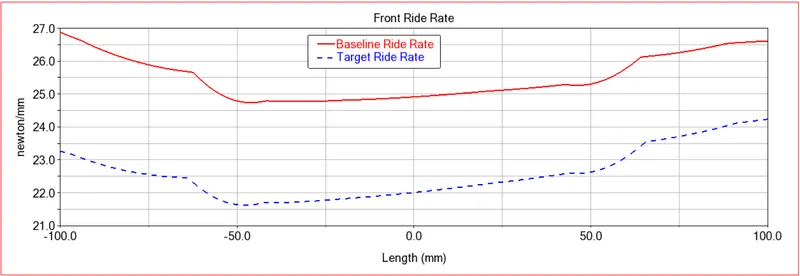
The values are,
- Before hardpoint tuning (Baseline) = 24.92 N/mm.
- After harpoint tuning (target) = 22 N/mm.
Rear Ride Rate,
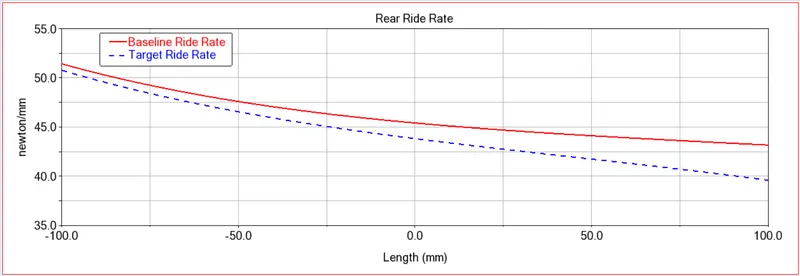
The values are,
- Before hardpoint tuning (Baseline) = 42.77 N/mm.
- After harpoint tuning (target) = 43.81 N/mm.
Front Side View Swing Arm Length,
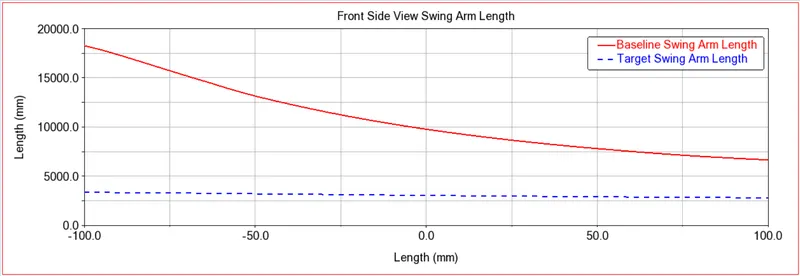
The values are,
- Before hardpoint tuning (Baseline) = 9771.94 mm.
- After harpoint tuning (target) = 3042.56 mm.
Rear Side View Swing Arm Length,
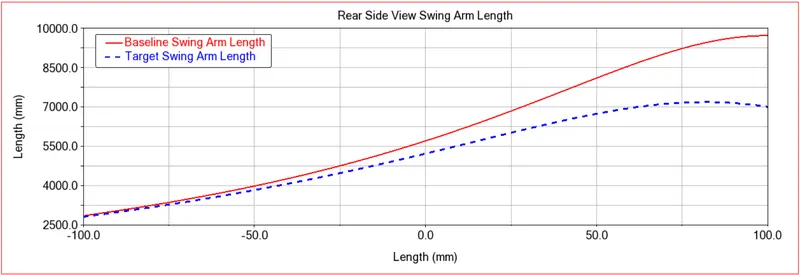
The values are,
- Before hardpoint tuning (Baseline) = 5023.13 mm.
- After harpoint tuning (target) = 5216.08 mm.
Front Side View Swing Arm Angle,
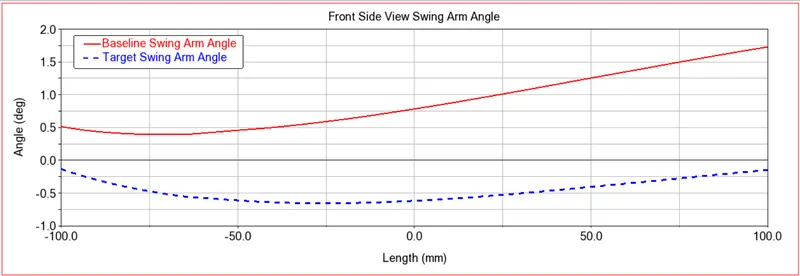
The values are,
- Before hardpoint tuning (Baseline) = 0.79 deg.
- After harpoint tuning (target) = -0.61 deg.
Rear Side View Swing Arm Angle,
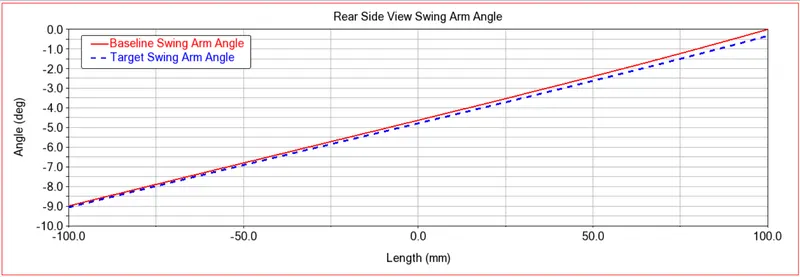
The values are,
- Before hardpoint tuning (Baseline) = -4.84 deg.
- After harpoint tuning (target) = -4.78 deg.
Front Anti Dive,
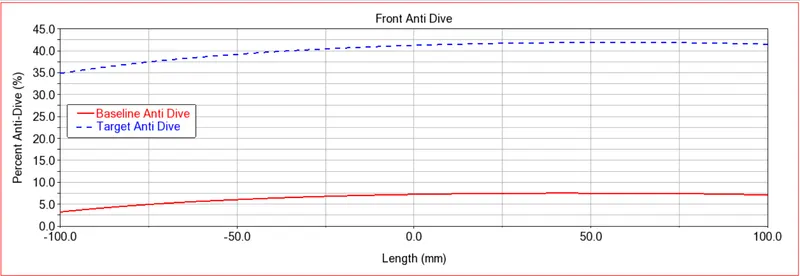
The values are,
- Before hardpoint tuning (Baseline) = 7.23%.
- After harpoint tuning (target) = 41.22%.
Rear Anti Lift,
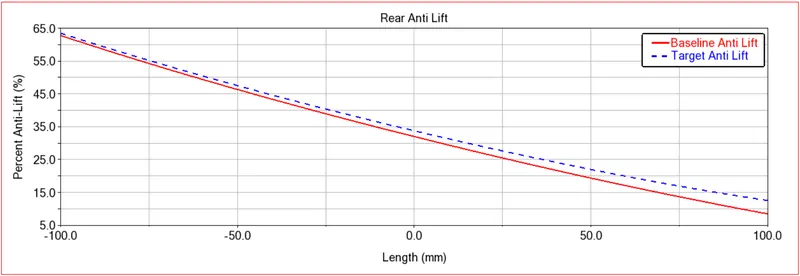
The values are,
- Before hardpoint tuning (Baseline) = 34.54%.
- After harpoint tuning (target) = 33.76%.
Front Anti Lift,
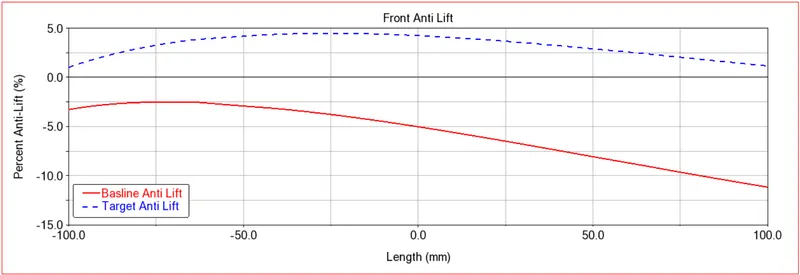
The values are,
- Before hardpoint tuning (Baseline) = -5.02%.
- After harpoint tuning (target) = 4.24%.
Rear Anti Squat,
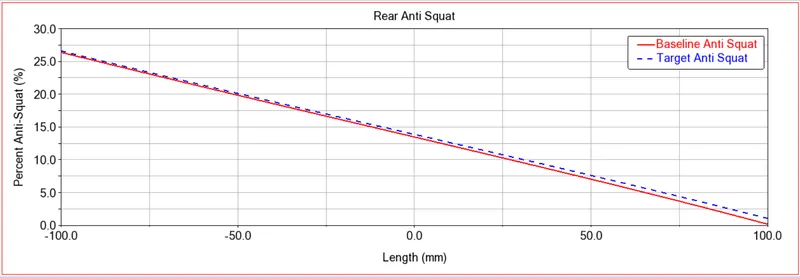
The values are,
- Before hardpoint tuning (Baseline) = 13.47%.
- After harpoint tuning (target) = 13.86%.
Front End Deflection Under Load During Braking,
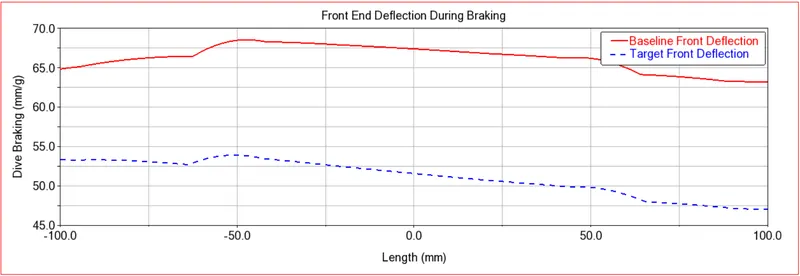
The values are,
- Before hardpoint tuning (Baseline) = 67.37 mm/g.
- After harpoint tuning (target) = 51.55 mm/g.
Front End Deflection Under Load During Acceleration,
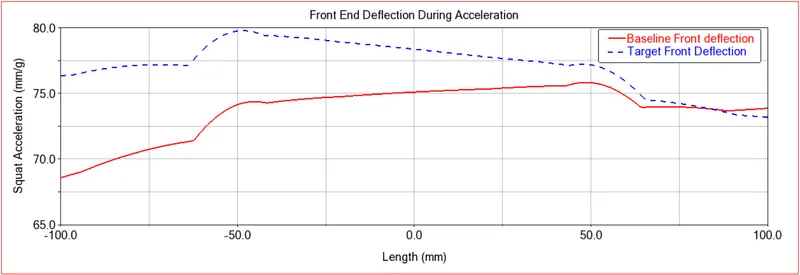
The values are,
- Before hardpoint tuning (Baseline) = 75.10 mm/g.
- After harpoint tuning (target) = 78.36 mm/g.
Rear End Deflection Under Load During Braking,
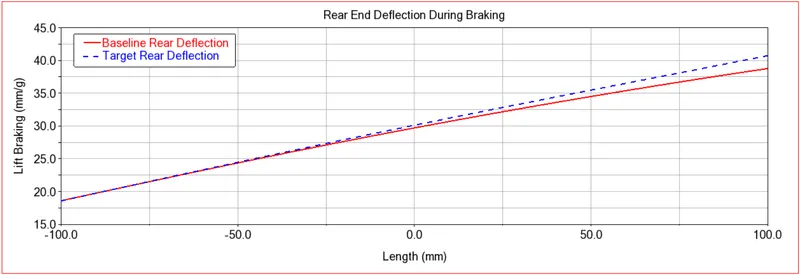
The values are,
- Before hardpoint tuning (Baseline) = 29.70 mm/g.
- After harpoint tuning (target) = 30.11 mm/g.
Rear End Deflection Under Load During Acceleration,
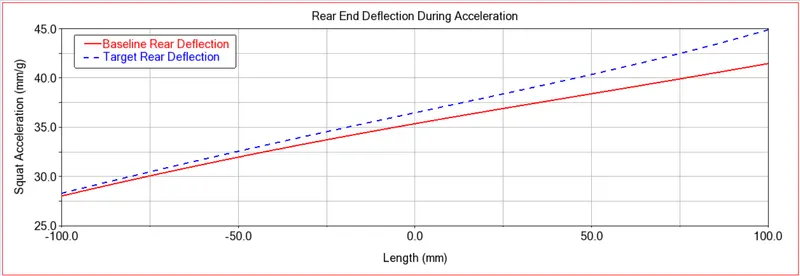
The values are,
- Before hardpoint tuning (Baseline) = 35.36 mm/g.
- After harpoint tuning (target) = 36.41 mm/g.
Pitch Gradients,
From the deflection under load the pitch gradients are calculated and they are,
Braking pitch gradient = 1.61 deg/g.
Acceleration pitch gradient = 2.27 deg/g.
Both the values satisfy the targets.
CONCLUSION :-
Simulations of the front double wishbone and the rear multi link suspension assemblies are run and the hardpoints are tuned to achieve the pitch gradient targets.