Week-3 Challenge: ADVISOR Tool
AIM :-
- To check if an electric vehicle with 500 Kg of cargo mass can cover 45 Km with the FTP drive cycle using the ADVISOR tool. If not how to make the necessary changes to reach the desired range.
- To perform and analyse a gradeability test of a Toyota Prius using the ADVISOR tool.
THEORY :-
ADVISOR, NREL’s ADvanced VehIcle SimulatOR, is a set of model, data, and script text files for use with Matlab and Simulink. It is designed for rapid analysis of the performance and fuel economy of conventional, electric, and hybrid vehicles. ADVISOR also provides a backbone for the detailed simulation and analysis of user defined drivetrain components, a starting point of verified vehicle data and algorithms from which to take full advantage of the modeling flexibility of Simulink and analytic power of MATLAB.
ADVISOR is used to estimate the fuel economy of vehicles that have not yet been built. Learn about how conventional, hybrid, or electric vehicles use (and lose) energy throughout their drivetrains. Compare relative tailpipe emissions produced on a number of cycles. Evaluate an energy management strategy for your hybrid vehicle’s fuel converter. Optimize the gear ratios in your transmission to minimize fuel use or maximize performance, etc.
The models in ADVISOR are mostly empirical, relying on drivetrain component input/output relationships measured in the laboratory, and quasi-static, using data collected in steady state (for example, constant torque and speed) tests and correcting them for transient effects such as the rotational inertia of drivetrain components.
EXPLANATION OF THE SOLUTION :-
1. To Analyse the Range of an Electric Vehicle with a Payload using the FTP Drive Cycle.
The given mass of the payload is 500 Kg. We need to check if the EV model can travel 45 Km with the given payload using the FTP drive cycle.
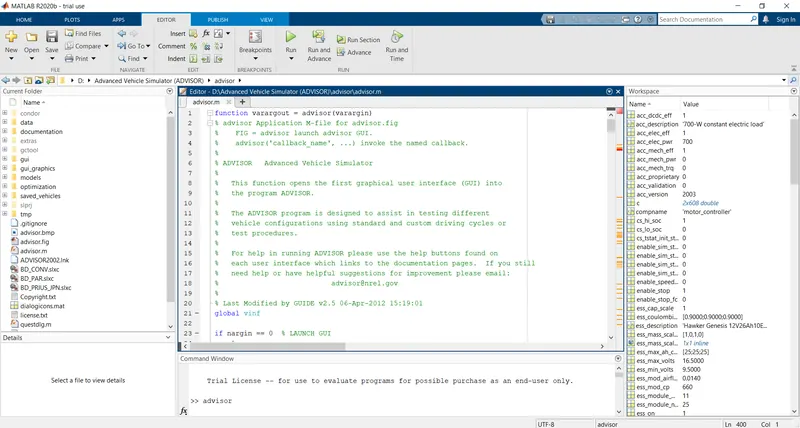
First MATLAB is opened and the advisor.m file is opened. Once the file is opened we type advisor in the command window to open the tool.
Once the advisor tool is launched we select the vehicle file, in this case the file being EV_defaults_in. This will load the standard data of an Electric Vehicle. After the file is loaded we change the value of the cargo mass to 500 Kg.
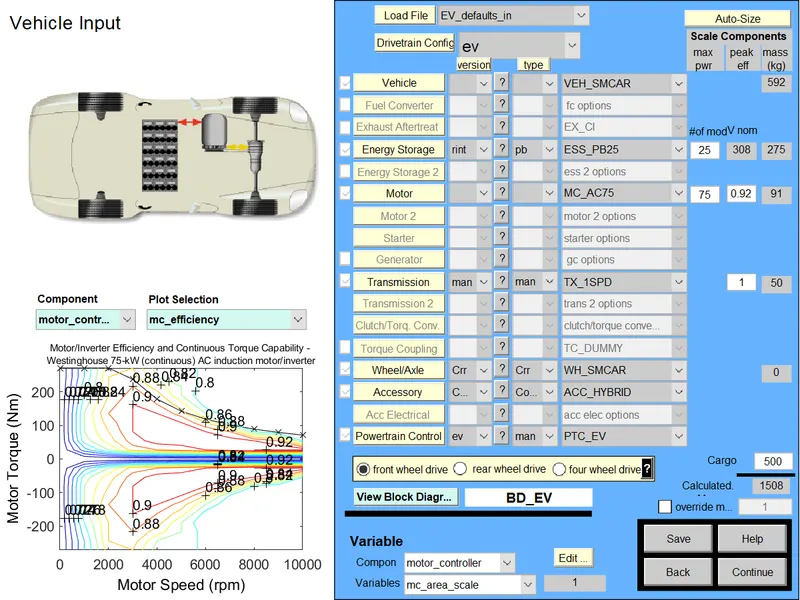
Once the cargo mass is added, we click on continue to go to the next setup.
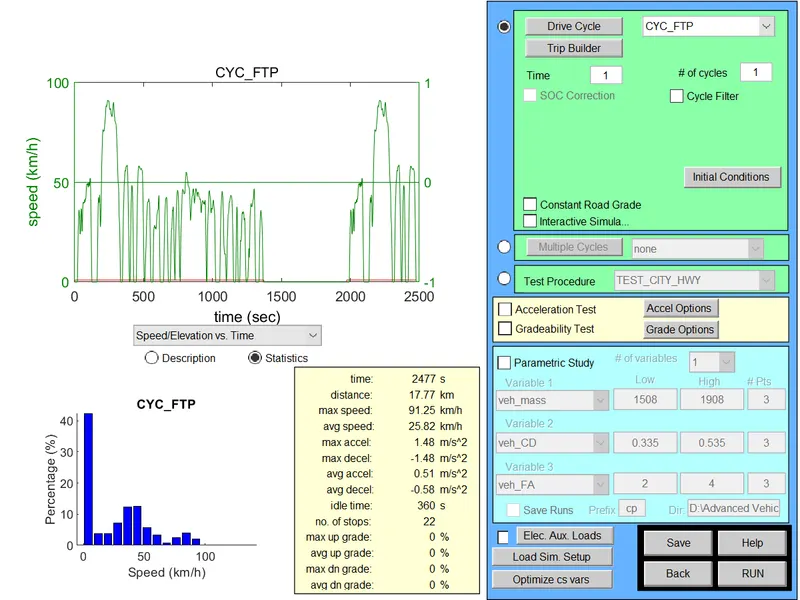
The next setup shows us the data of the drive cycle. We have selected the FTP Drive Cycle which stands for Federal Test Procedure which is defined by the US Environment Protection Agency (EPA).
We also have data such as time taken for one drive cycle, the total distance covered, speed, acceleration and gradeability.
It is observed that one drive cycle covers 17.77 Km. In order to run the simulation for 45 Km we must add 3 driving cycles, which would bring the total distance covered to 53.31 Km.
Once the number of drive cycles is changed to 3, we run the simulation and the result is as follows.
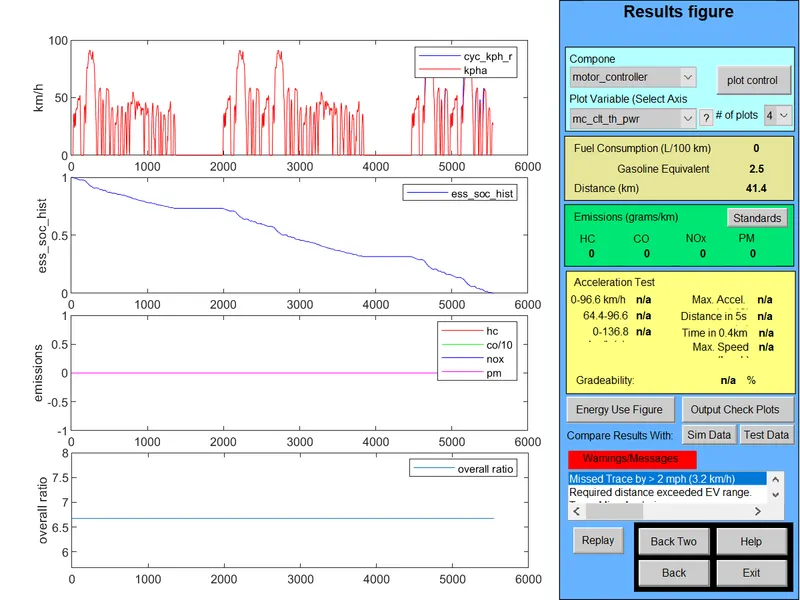
From the second graph we can see that the battery's State of Charge (SOC) reaches 50% just as the first drive cycle is completed and the second drive cycle starts and the battery's charge gets completely depleted by the end of the second drive cycle.
Therefore the range of the EV is only 41.4 Km with the given payload. And this less than the target required.
In order to meet the target range we start to increase the number of battery modules. We first started with 25 battery modules. But that was not enough to obtain the target range. In order to obtain the range we add a module to the previous setup and run the simulation.
First we increase the number of modules to 26. After that we run the simulation.
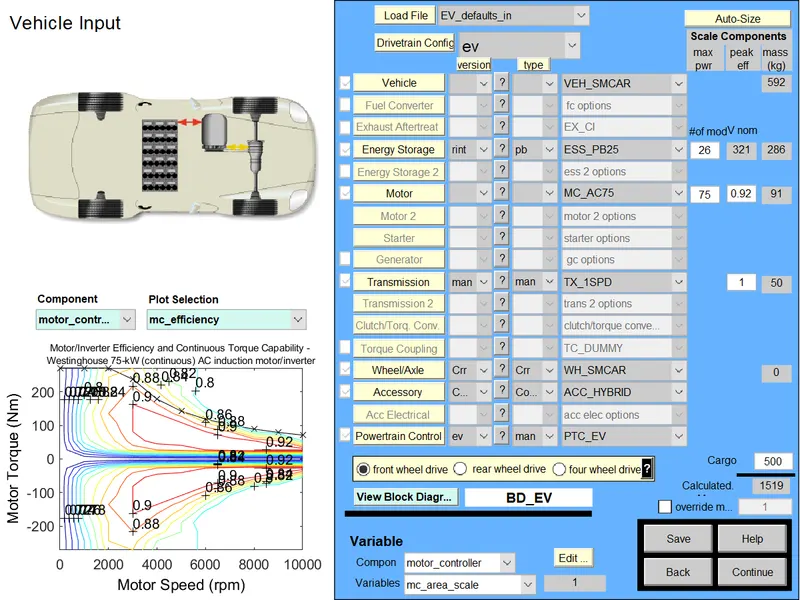
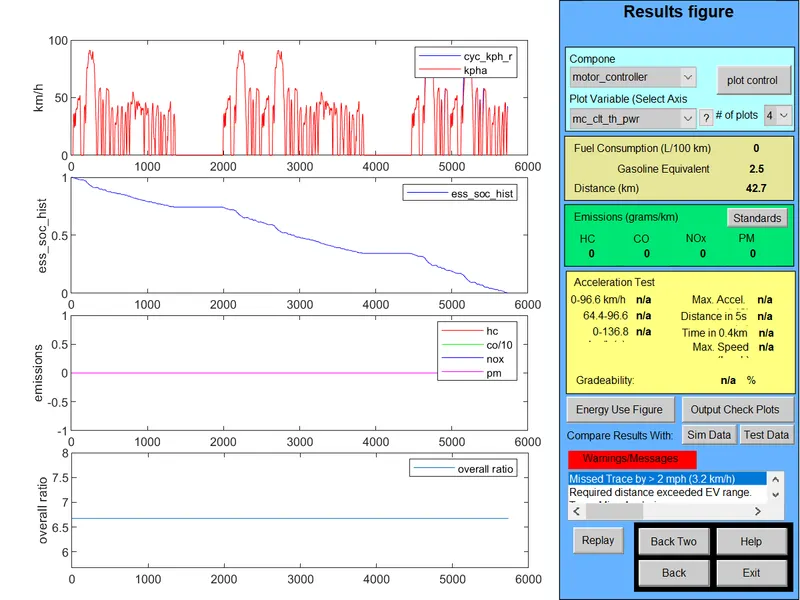
After increasing the number to 26 we can see that the range has increaseb by 1.3 Km to 42.7 Km.
We then increase the number of modules again by 1 to 27.
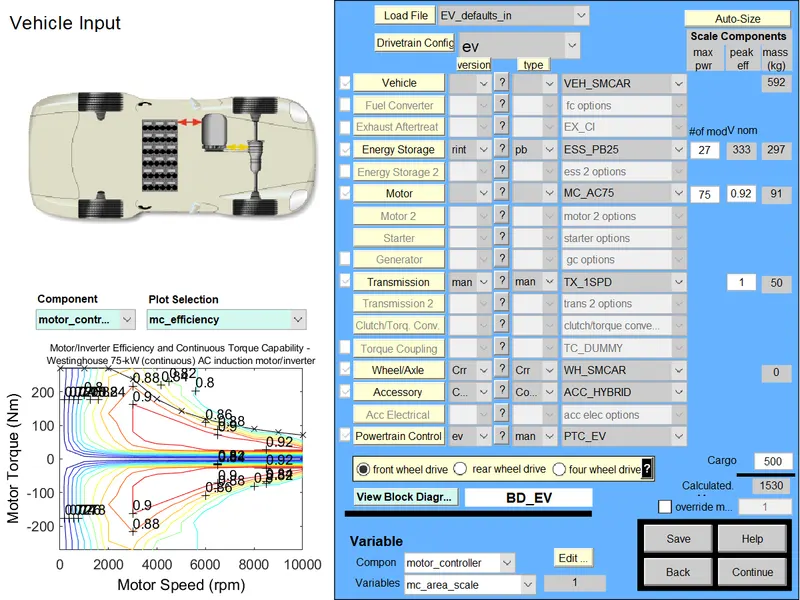
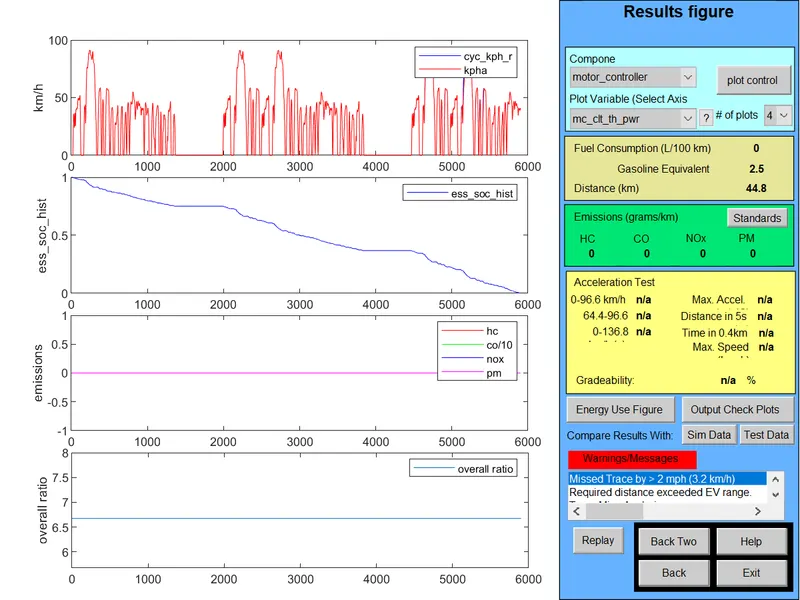
The range then increase by 2.1 Km to 44.8 Km. Since we are very close to the target range by 0.2 Km, we can finally obtain it by adding another battery module.
The number of battery modules is increased by 1 to 28.
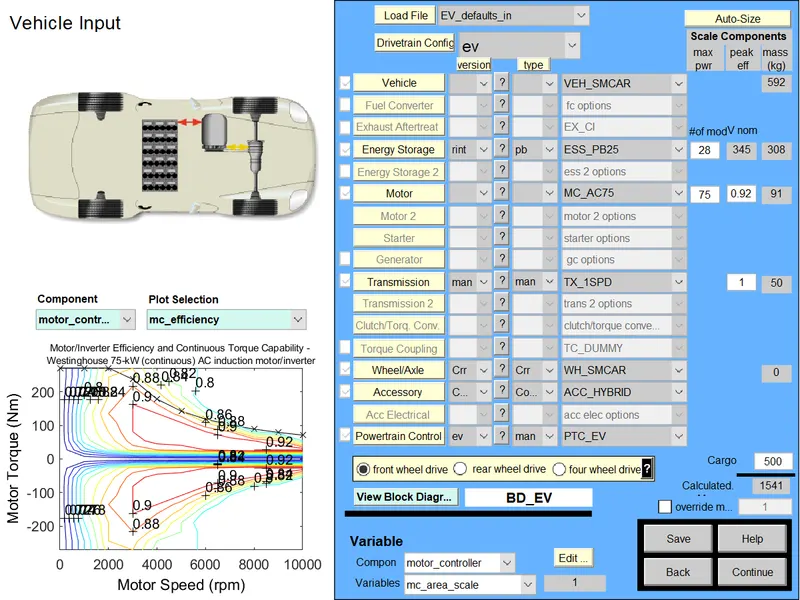
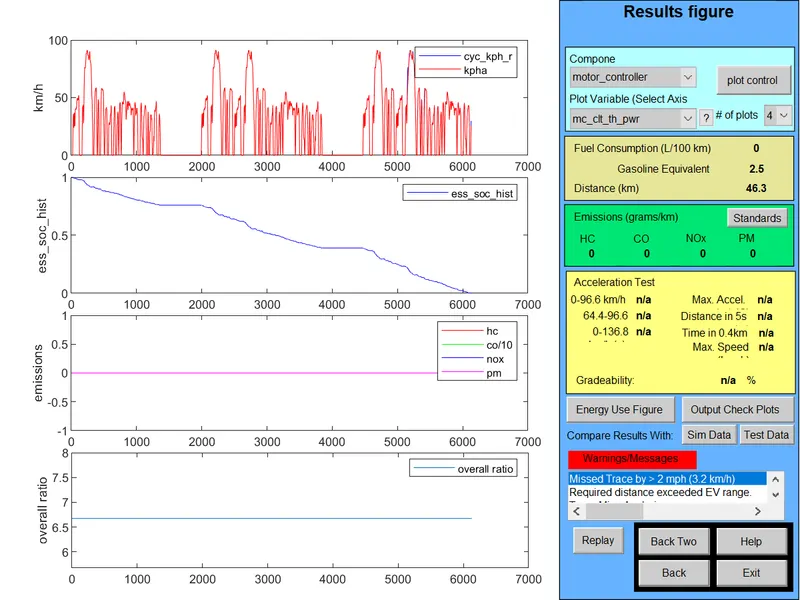
With 28 battery modules the range increases by 1.5 Km to 46.3 Km.
This increases the range of the EV to a little more than the target range. The table of the change in battery module and it's corresponding increase in range is given below.
Number of Battery Modules Vehicle Range (Km)
26 42.7
27 44.8
28 46.3
2. Gradeability Test of a Prius.
First we load the PRIUS_JPN_defaults_in in the advisor tool. We retain the default values of the prius model.
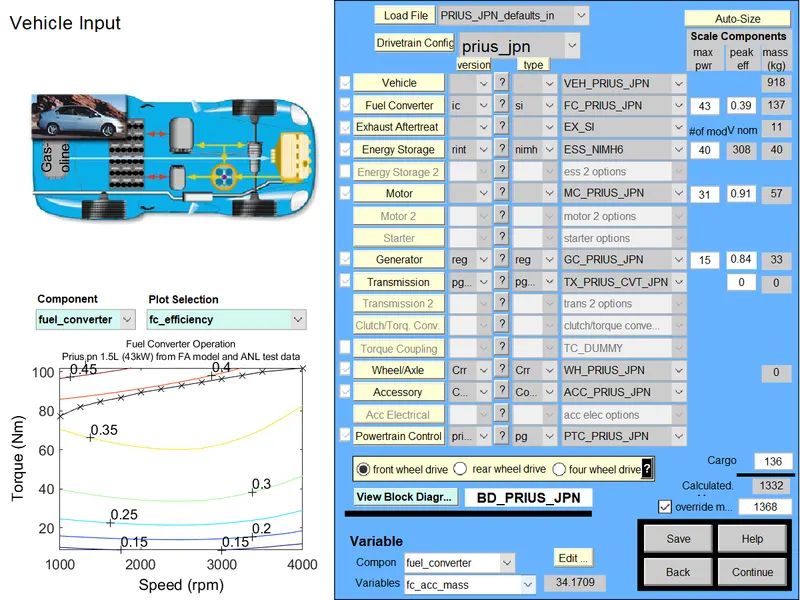
In order to perform the gradeability test we go to the next setup figure which consists of the drive cycle data.
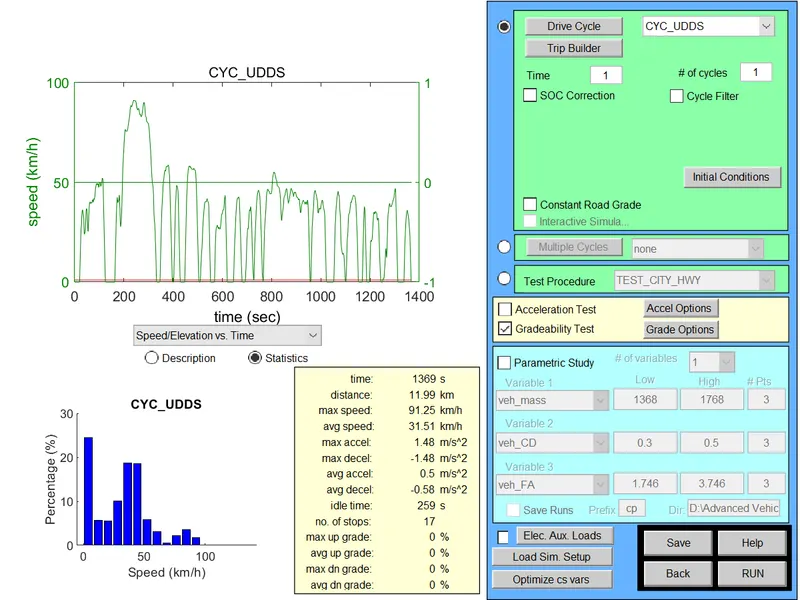
Here we use the default UDDS drive cycle data. We also select the Gradeability Test option and click on grade options to vary out input parameters.
The gradeability test will be conducted at 5 different speed intervals. Where the run time of the simulation will be kept at its default which is 10s.
a). When the speed is at 20 Miles/hr or 32.2 Km/hr.
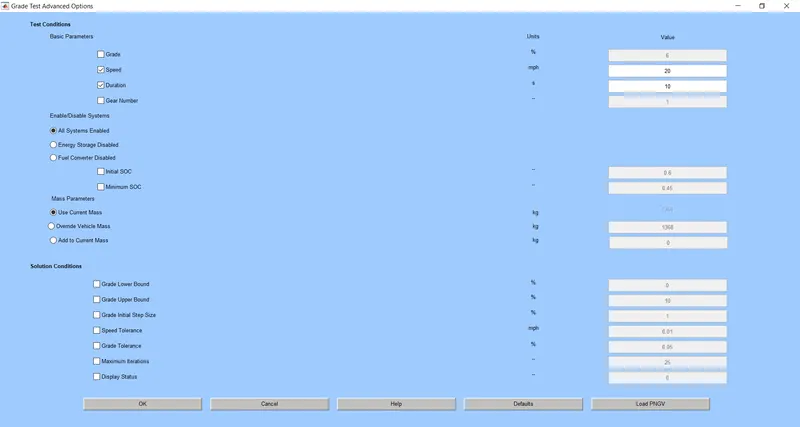
First the advanced grade options is opened. Then the speed and duration is selected. By default the speed input is provided in miles per hour, but once the simulation is run it changes to kilometers per hour. The run time duration is set constant at 10s. We also select the All Systems Enabled option.
Once the speed is entered we click on OK and close the window. After that the simulation is run.
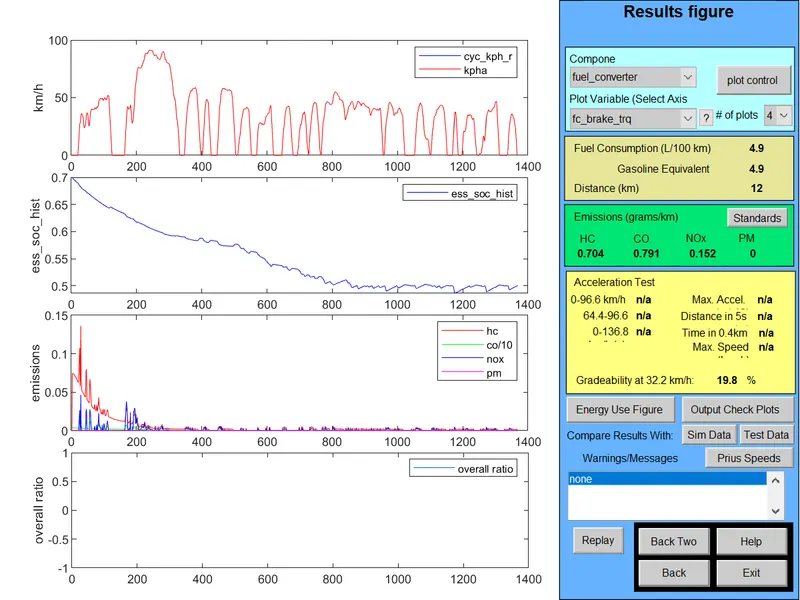
From the simulation it is observed that the gradeability is 19.8% at 32.2 Km/hr.
b). When the speed is at 40 Miles/hr or 64.4 Km/hr.
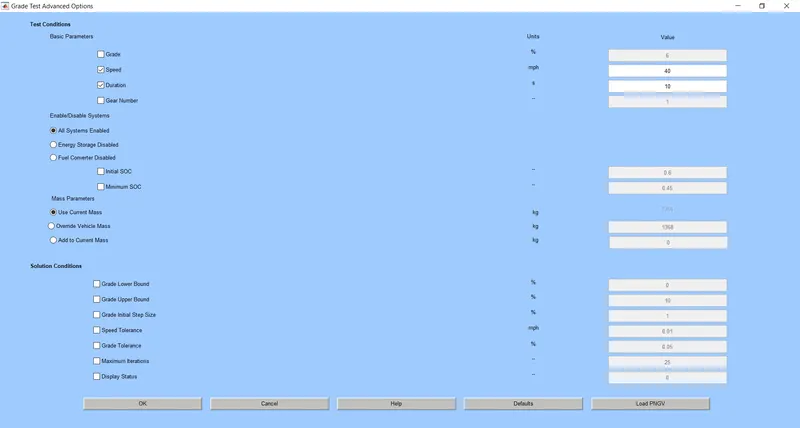
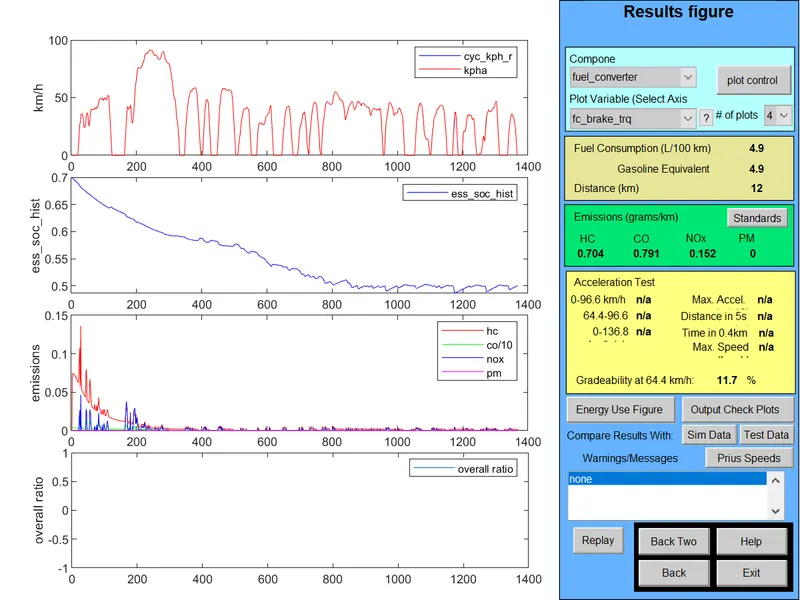
At speed of 64.4 Km/hr the gradeability is 11.7%.
c). When the speed is 60 Miles/hr or 96.6 Km/hr.
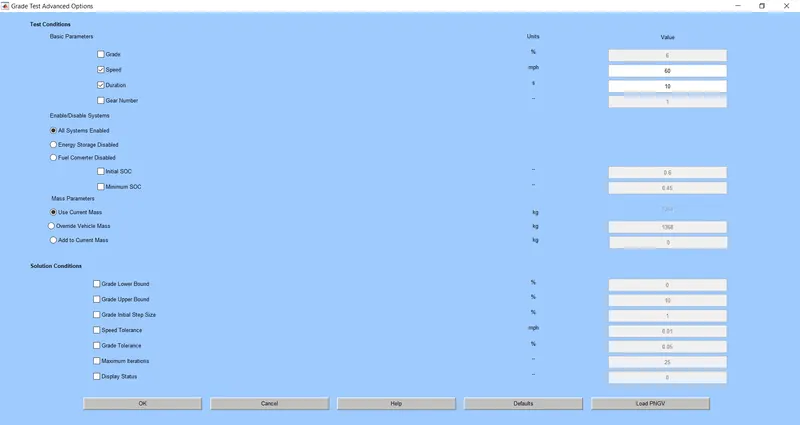
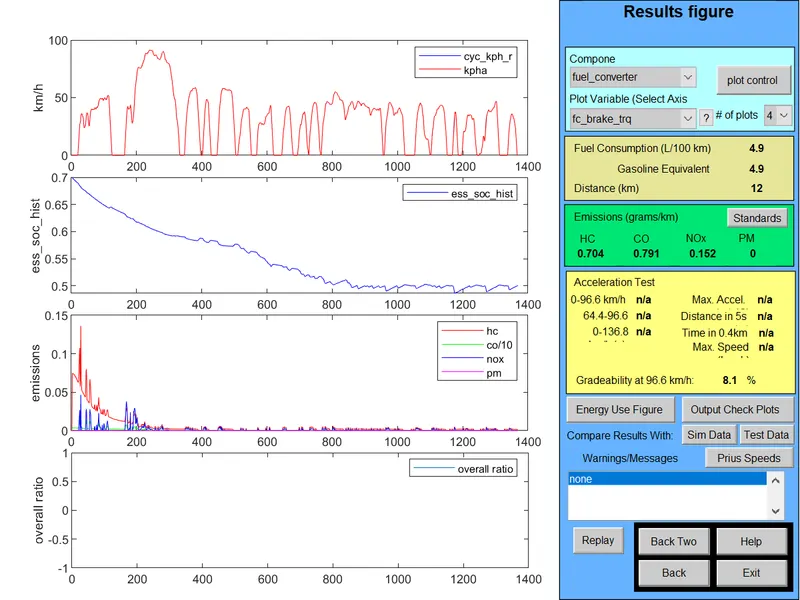
At speed of 96.6 Km/hr the gradeability is 8.1%.
d). When the speed is 80 Miles/hr or 128.7 Km/hr.
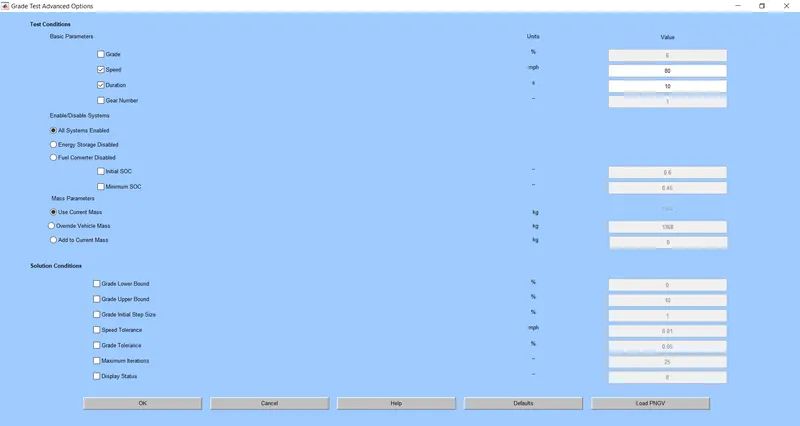
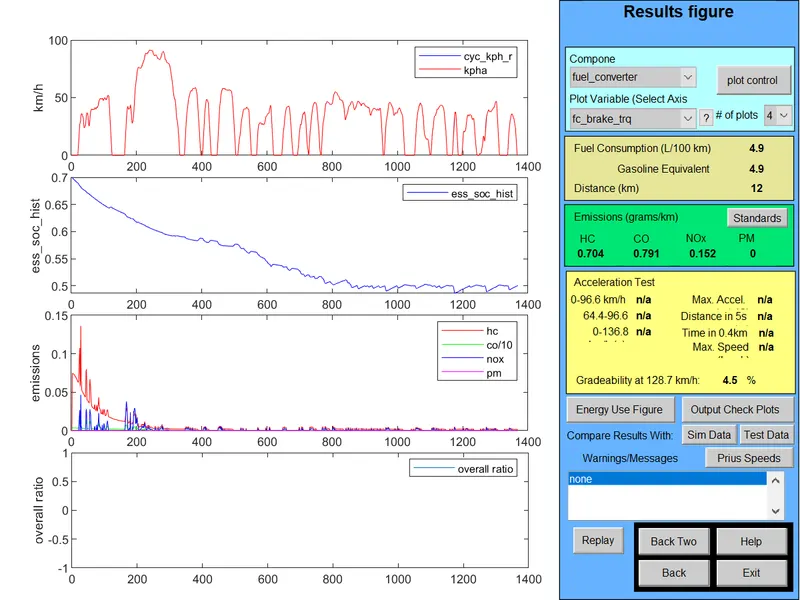
At speed of 128.7 Km/hr the gradeability is 4.5%.
The speed and gradeability is tabulated below.
Speed (Km/hr) Gradeability (%)
32.2 19.8
64.4 11.7
96.6 8.1
128.7 4.5
From the table we can observe that as the gradeability decreases, the speed of the Prius increases with the same duration of time.
CONCLUSION :-
- Using the ADVISOR tool we were able to simulate the target range the electric vehicle can travel with a given cargo mass by altering the number of battery modules.
- Using the ADVISOR tool we were able to perform a gradeability test of a Toyota Prius.