Project 1 Mechanical design of battery pack
AIM :-
To prepare a battery pack having an energy of 18 KWh using the ANR26650M1-B Lithium-ion cell.
THEORY :-
The ANR26650M1-B is a high performance lithium-ion phosphate battery developed by A123 systems.
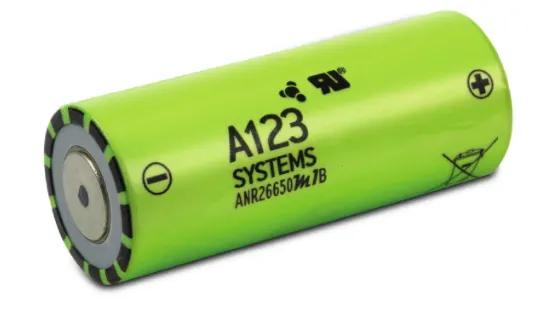
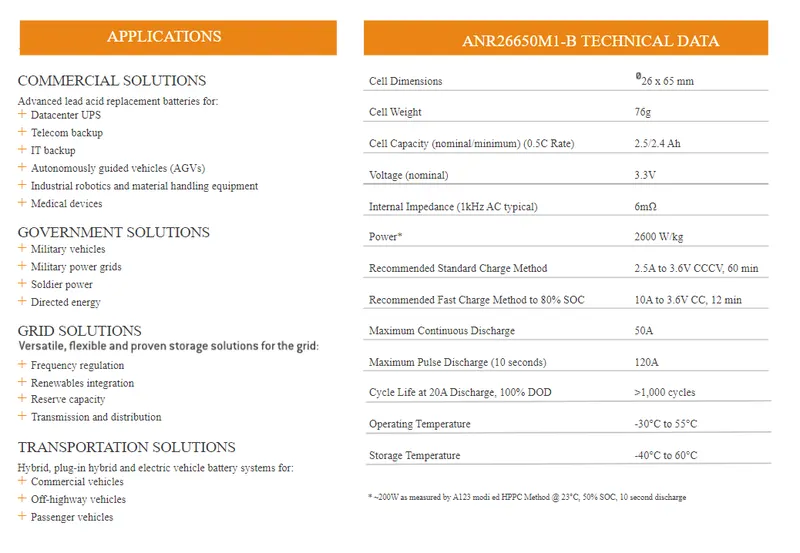
The battery delivers high power and energy density combined with excellent safety performance and extensive life cycle. They have low capacity loss and impedance growth over time as well as high usable energy over a wide state of charge (SOC) range. The datasheet of the battery is given below.
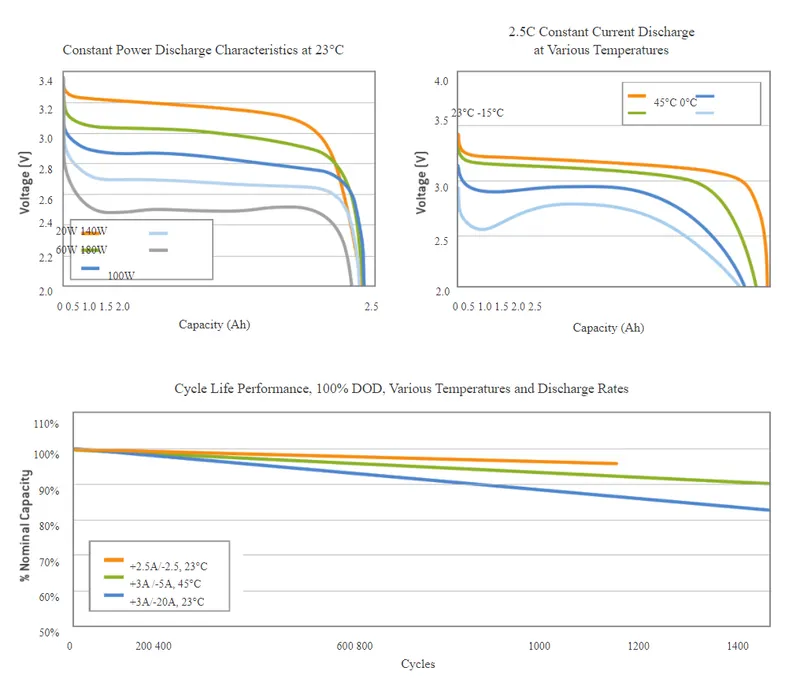
The discharge characteristics of the battery is given below.
DESIGNING THE BATTERY PACK CELL ARRANGEMENT :-
The Li-ion cells are connected in a series-parallel arrangment where the series connection is used to obtain the desired voltage and the parallel connection is used to obtain the desired energy capacity.
Given that,
Cell Capacicty Cc = 2.5 Ah.
Cell voltage Vc = 3.3 V.
The arrangement has to be designed in a way that the battery's energy capacity must be 18 KWh.
The equations to calculate the cell arrangement are,
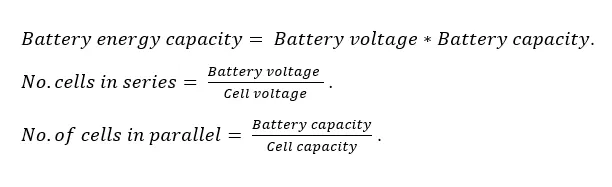
Let us assume that the voltage of the battery pack is 350V.
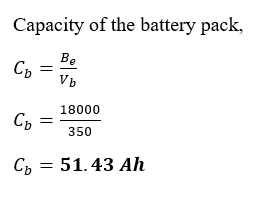
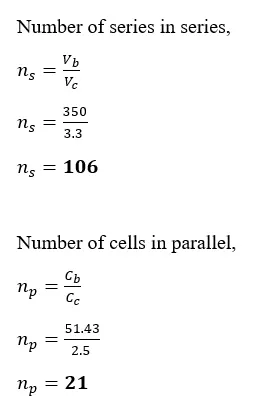
Therefore, the arrangement of Li-ion cells to create the battery pack is 106s21p, where 106 cells are connected in series and 21 cells are connected in parallel. The total number of cells are 2226 cells.
DESIGNING THE CELL CONNECTIONS :-
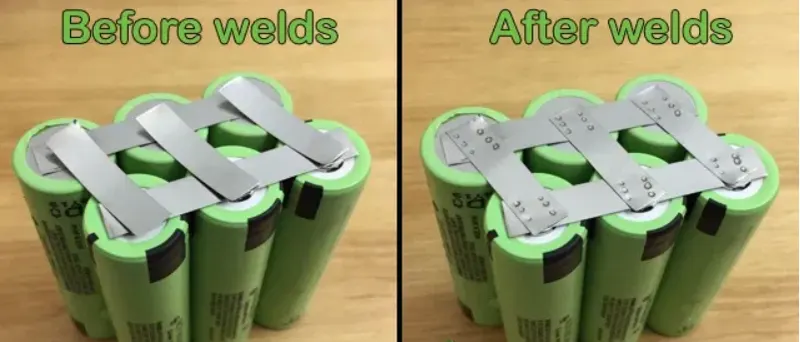
In order to connect the Li-ion cells together, Nickel strips are used. These strips low resistance which leads to lesser build up of heat between the cells. The dimensions of the strips must be between 0.1 to 0.15 mm thick and width of 7 to 8 mm. Either single rolls of nickel strips can be purchased or preset strips for 22650 li-ion can be used. An exampled of preset strips are shown below.
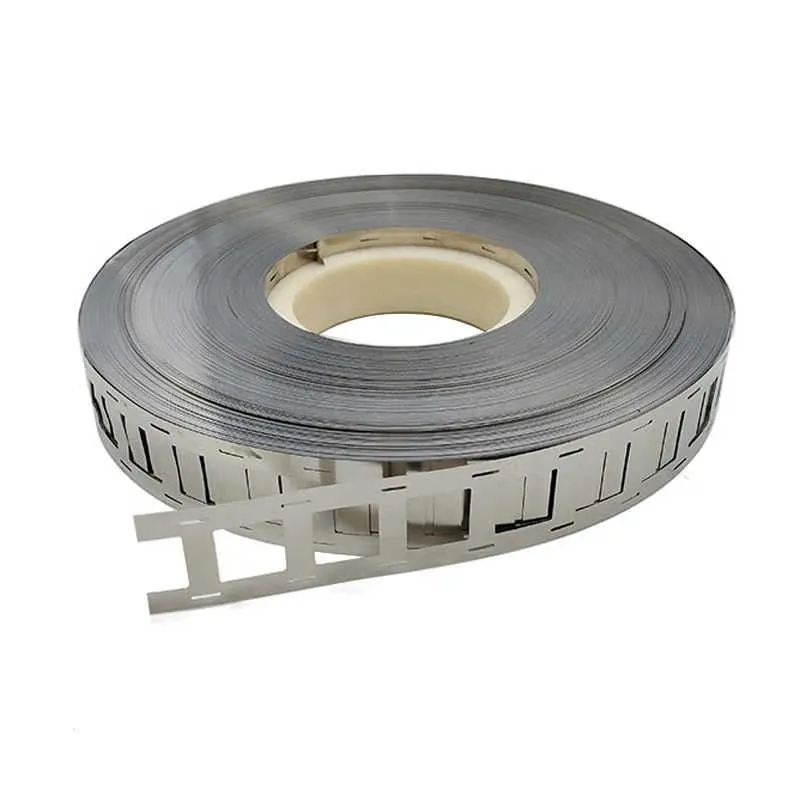
When the strips are connected they appear as shown below.
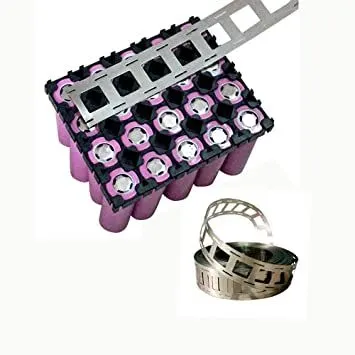
The nickel strips are then joined to the electrical contacts using spot welding. Since Li-ion cells are sensistive to heat, connecting the nickel strips to the electrical contacts by soldering will generate a lot of heat and it does not dissipate fast which will permanently damage the cell. Hence, spot welding is used to connect the nickel strips and electrical contacts where the heat generate at the welded spot is very less and dissipates very fast thereby not damaging the cell. Specific spot welders are used to join the connections and an example of one is shown below.
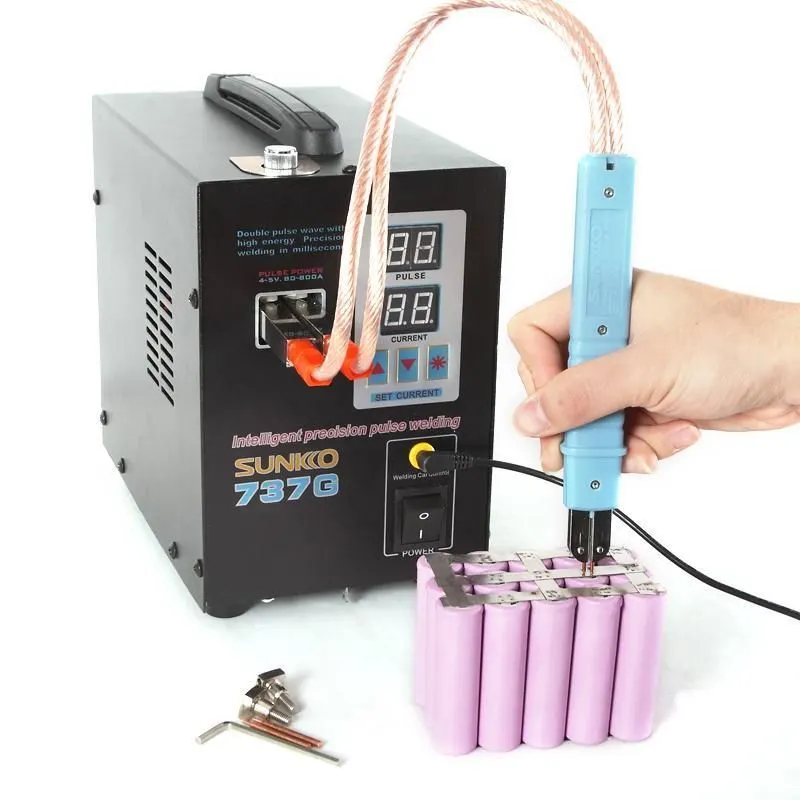
These type of specialised welders allow for two spots to be created at a time. The electrodes used are made of copper and are spaced apart by a few millimeters using two arms which ensure even spacing between the welded spots for all cells. Ideally 4 to 6 spots are welded to ensure that the nickel strip is secured to the electrical contact. Too little spots and the strip will come off and too many spots and the cell will get heated up.
The cells can be further secured using battery holders which are shown below.
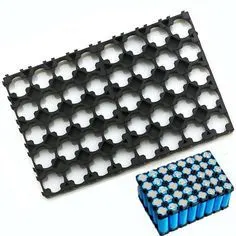
These holders are available as a single piece or a set based on the cell arrangement. These holders help in ensuring that the cells stay rigid when connected.
DESIGNING THE BATTERY PACK CASING :-
Lithium-ion batteries are very sensitive to atmospheric effects like the presence of moisture and interaction with oxygen. Moisture and oxygen render the electrolyte useless and may also induce effects (like increasing flammability) which are unwanted. Also, the battery has to maintain a pressure which will prevent its collapse in environmental conditions.
The dimensions of the ANR26650M1-B Li-ion cell is given below. Based on these dimensions the size of the battery pack casing is calculated.
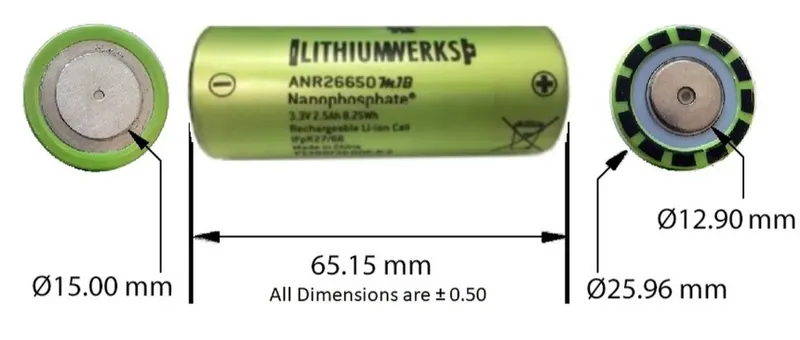
The cells are arranged in a cubic arrangement and the size of the pack is calculated using the given formula,
Pack Size = nD*mD*H
Where,
n = Number of cells in a row = 106.
D = Diameter of a cell = 25.96 mm.
m = Number of rows = 21.
H = Cell height = 65.15 mm.
Length of the pack = n*D
= 106*25.96
= 2751.76 mm or 2.75 m.
Width of the pack = m*D
= 21*25.96
= 545.16 mm or 0.54 m.
Height of the pack = 65.15 mm or 0.065 m.
Therefore the dimensions of the battery pack is 2.75 m x 0.54 m x 0.065 m.
One method to create a pack casing is to use shrink wrapping. Shrink wrap is a plastic film that can be wrapped around the battery pack, regardless of size or shape. Heat is then applied to the surface, which causes the plastic to shrink. As it shrinks, it conforms to the shape of the pack and seals itself. Since there is no restriction on size to shrink wrapping, it can be used to protect even the bulkiest of battery packs. Shrink wrap plastic is recyclable.
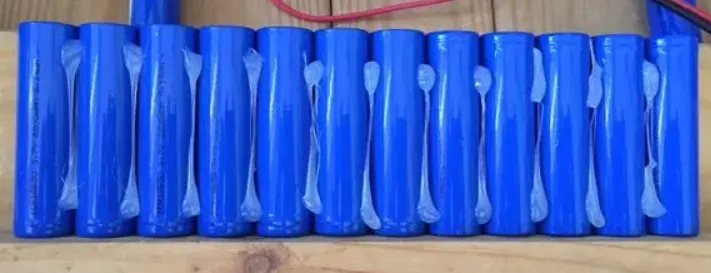
Advantges of shrink wrapping are,
- Ensures Protection: When heat is applied to shrink wrap, it creates a very tight seal which fully protects the battery pack. Once sealed, the items are protected from damages which can be caused by dust, dirt or moisture. Some types of shrink wrap even come with a UV protection feature, to keep products safe from the sun’s harmful rays.
- Durable: Shrink wrap is made from a very sturdy, durable plastic. It is difficult to tear or puncture. Unlike other materials, shrink wrap does not become brittle or weaken when it is under extreme weather conditions and it does not loosen nor sag, ensuring more security.
- Affordable: Shrink wrapping is an affordable option for it only requires two things, as mentioned – heat and plastic. The price may vary on the type of plastic used, but even considering such the process is cheaper than the value it delivers.
But for a battery pack with large arrangement of cells shrink wrapping is not the suitable option. In order to protect the battery pack metal or plastic housings are used. The most commonly used material to create pack housings are aluminium and high strength steel. An efficient battery housing has many attributes that aid passenger and battery safety, assist in thermal management, while protecting the battery from the harsh environment under the vehicle and in an accident. The system must be produced within the financial and weight constraints of the vehicle. The battery box consists of four primary structural pieces: top cover, bottom cover, internal structure, and side impact crash protection structure. The image shown below is the battery housing of the Audi e-tron.
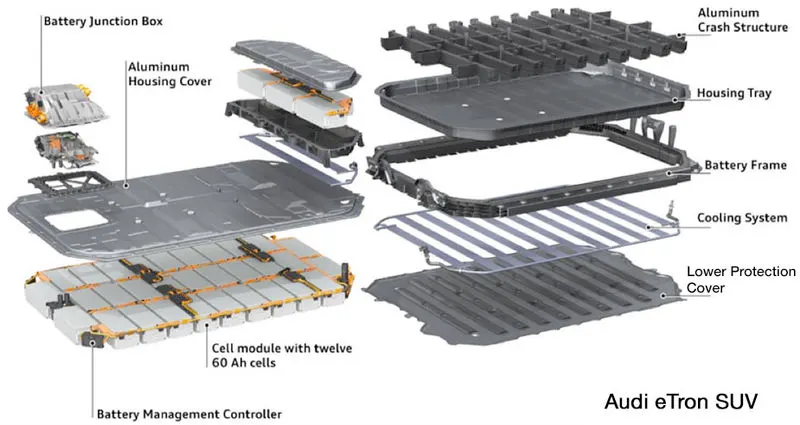
Aluminium housings were widely used in electric vehicles but high strength steel housings are now being preffered. The advantages of high strength steel over aluminium are,
- 50% reduction in manfucturing cost over an aluminium housing of the same dimensions.
- Up to two thirds less greenhouse gas emissions arise in the production of a steel battery housing compared with an aluminum design.
- The melting point of steel (0.8 mm) is 1,410° C. In fire tests, the temperature of the steel battery housing cover barely exceeds 1,000° C even after 20 minutes, demonstrating the impressive safety reserves of steel. By contrast, aluminum (1.1 mm) reaches its melting point of 610°C after just 15 seconds in the fire test due to low thermal inertia.
- High-strength steels can be used to make very slim and thin-walled crash structures, saving packaging space and freeing up room for large batteries.
- Battery housing with multi chamber profiles made from high strength steel supports very high loads in the event of side collision and prevents contact between the housing and modules.
- A high strength steel plate of a minimum thickness of 1.2 mm can even proctect the pack in case of an impact with foreign objects under the vehicle.
CONCLUSION :-
Using the ANR26650M1-B lithium ion cell, a battery pack is constructed with the following results,
- Cell arrangement of the pack is 106s21p.
- Total number of cells used are 2226.
- Dimensions of pure nickel strip for connecting the cells are 0.8 mm thickness and 7 mm width.
- Number of spot welds for each cell is 4 or 6.
- Dimensions of the battery pack is 2.75 m x 0.54 m x 0.065 m.
- High strength steel is considered to create the pack housing.