Vehicle Ride 2
AIM :-
- To calculate the parameters for front and rear suspension based on the given data.
- To plot force vs velocity shock curve using MATLAB based on the calculated parameters.
1. CALCULATE THE FOLLOWING PARAMETERS FOR FRONT AND REAR SUSPENSION :-
- Sprung mass critical damping.
- Unsprung mass critical damping.
- Sprung mass initial damping co-efficient.
- Unsprung mass initial damping co-efficient.
- Low speed compression damping co-efficient.
- High speed compression damping co-efficient.
- Low speed rebound damping co-efficient.
- High speed rebound damping co-efficient.
Given data,
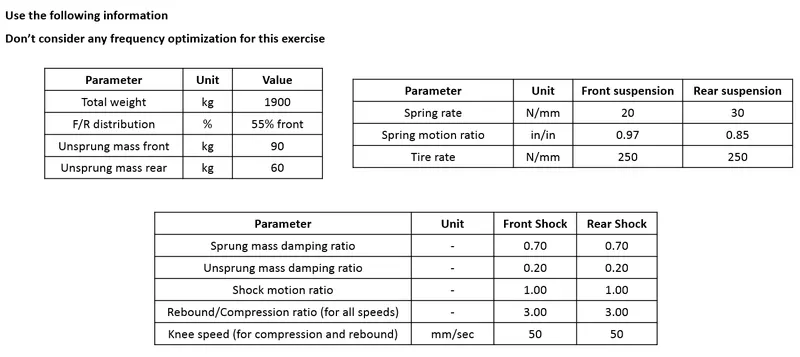
a). Sprung Mass Critical Damping,
The formula to calculate the critical damping of sprung mass is given as,
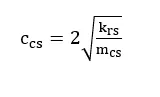
Where,
Krs = Ride rate of sprung mass in N/mm.
Mcs = Corner sprung mass in.
For front suspension,
Corner sprung mass, Mcsf = 477.5 Kg.
To calculate the ride rate the wheel rate must be known.
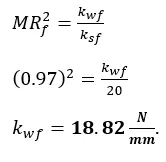
The ride rate is calculated as,
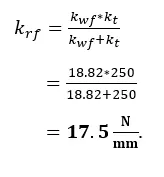
The sprung mass for critical damping of front suspension is,
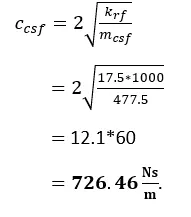
For rear suspension,
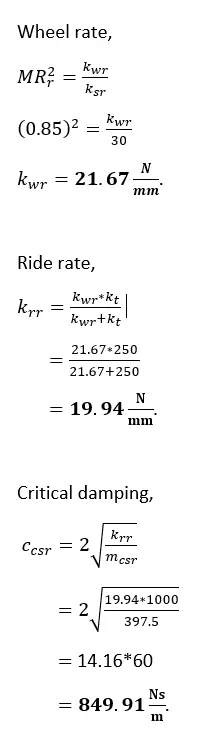
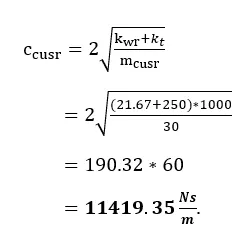
b). Unsprung Mass Critical Damping,
The formula to calculate the critical damping is given as,
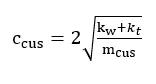
Where,
Kw = Wheel rate in N/mm.
Kt = Tire rate in N/mm.
Mcus = Corner unsprung mass in Kg.
For front suspension,
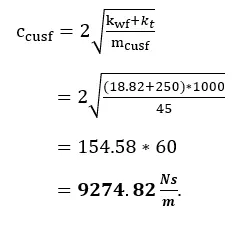
For rear suspension,
c). Sprung Mass Initial Damping Co-efficient,
Sprung mass damping coefficient is given as,
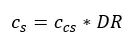
Where,
Ccs = Sprung mass critical damping co-efficient.
DR = Sprung mass damping ratio.
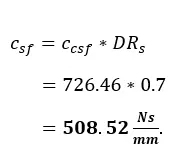
For front suspension,
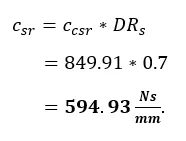
For rear suspension,
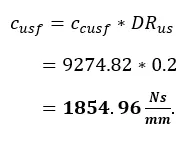
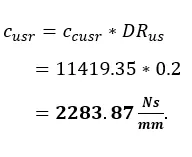
d). Unsprung Mass Initial Damping Co-efficient,
The unsprung mass damping coefficient is given as,
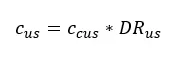
Where,
Ccus = Unsprung mass critical damping coefficient.
DRus = Unsprung mass damping ratio.
For front suspension,
For rear suspension,
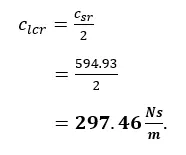
e). Low Speed Compression Damping Co-efficient,
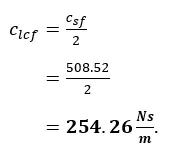
The formula for low speed compression damping co-efficient is given as,

Where,
Cs = Sprung mass initial damping coefficient.
For front suspension,
For rear suspension,
f). High Speed Compression Damping Co-efficient,
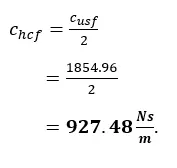
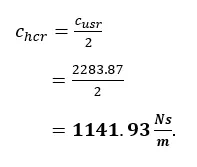
The formula for high speed compression damping co-efficient is given as,
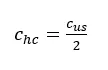
Where, Cus = Unsprung mass initial damping co-efficient.
For front suspension,
For rear suspension,
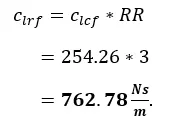
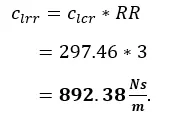
g). Low Speed Rebound Damping Coefficient,
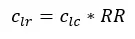
The formula for low speed rebound damping coefficient is given as,
Where,
Clc = Low speed compression damping coefficient.
RR = Rebound ratio.
For front suspension,
For rear suspension,
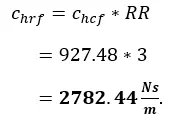
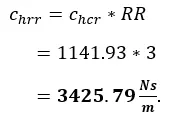
h). High Speed Rebound Damping Coefficient,
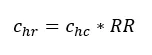
The formula for high speed rebound damping coefficient is given as,
Where,
Chc = High speed compression damping coefficient.
RR = Rebound ratio.
For front suspension,
For rear suspension,
The parameters are calculated and tabulated in a spreadsheet and the link is given below.
https://docs.google.com/spreadsheets/d/1yRjIV8gFLqk4cSUBdXIKwKgCtwdeiWEZ6kK9-bn4tvU/edit?usp=sharing
2.PLOT THE FORCE VS VELOCITY SHOCK CURVE FOR FRONT AND REAR SUSPENSIONS BASED ON THE ABOVE PARAMETERS USING MATLAB :-
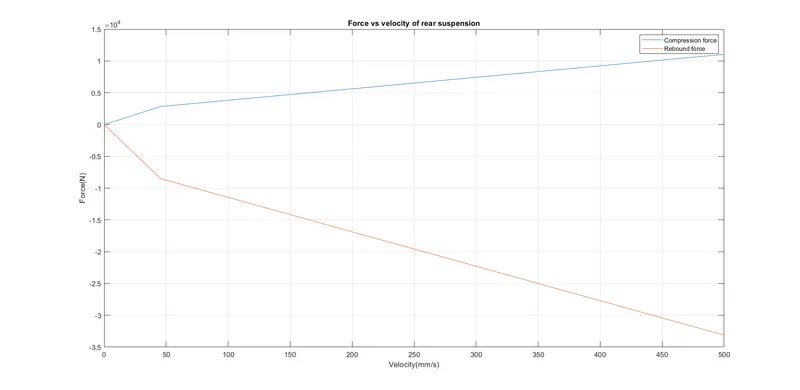
The above parameters calculated are entered in MATLAB and the compression and rebound forces above and below knee speed are calculated using a for loop with an if-else condition. The program is then run and the force vs velocity plots for front and rear suspension are plotted.
The MATLAB program is given below,
% Damper optimization
clear all
close all
clc

% Corner sprung and unsprung mass of the vehicle.
Ms_front = 477.5; % Front corner sprung mass in Kg.
Ms_rear = 397.5;  % Rear corner sprung mass in Kg.
Mus_front = 45;   % Front corner unsprung mass in Kg.
Mus_rear = 30;    % Rear corner unsprung mass in Kg.

% Spring parameters
Ks_front = 20;   % Front spring rate in N/mm.
Ks_rear = 30;    % Rear spring rate in N/mm.
Kt = 250;        % Tire rate for front and rear in N/mm.
MR_front = 0.97; % Motion ratio for front suspension.
MR_rear = 0.85;  % Motion ratio for rear suspension.

% Damper parameters
DR_s = 0.7;  % Sprung mass damping ratio.
DR_us = 0.2; % Unsprung mass damping ratio.
RR = 3;      % Rebound ratio.

% Wheel rate calculations
Kw_front = (MR_front)^2*Ks_front; % Front wheel rate in N/mm.
Kw_rear = (MR_rear)^2*Ks_rear;    % Rear wheel rate in N/mm.

% Ride rate calculations
Kr_front = (Kw_front*Kt)/(Kw_front+Kt); % Front ride rate in N/mm.
Kr_rear = (Kw_rear*Kt)/(Kw_rear+Kt);    % Rear ride rate in N/mm.

% Damping coefficients calculations.

% Sprung mass critical damping.
Cc_sf = (2*((Kr_front)*Ms_front)^0.5); % Front suspension in Ns/m.
Cc_sr = (2*((Kr_rear)*Ms_rear)^0.5);   % Rear suspension in Ns/m.

% Unsprung mass critical damping.
Cc_usf = (2*(((Kw_front+Kt))*Mus_front)^0.5); % Front suspension in Ns/m.
Cc_usr = (2*(((Kw_rear+Kt))*Mus_rear)^0.5);   % Rear suspension in Ns/m.

% Sprung mass initial damping.
Ci_sf = Cc_sf*DR_s; % Front suspension in Ns/m.
Ci_sr = Cc_sr*DR_s; % Rear suspension in Ns/m.

% Unsprung mass initial damping.
Ci_usf = Cc_usf*DR_us; % Front suspension in Ns/m.
Ci_usr = Cc_usr*DR_us; % Rear suspension in Ns/m.

% Low speed compression damping.
Ccr_lsf = Ci_sf/2; % Front suspension in Ns/m.
Ccr_lsr = Ci_sr/2; % Rear suspension in Ns/m.

% High speed compression damping.
Ccr_hsf = Ci_usf/2; % Front suspension in Ns/m.
Ccr_hsr = Ci_usr/2; % Rear suspension in Ns/m.

% Low speed rebound damping.
Cr_lsf = Ccr_lsf*RR; % Front suspension in Ns/m.
Cr_lsr = Ccr_lsr*RR; % Rear suspension in Ns/m.

% High speed rebound damping.
Cr_hsf = Ccr_hsf*RR; %Front suspension in Ns/m.
Cr_hsr = Ccr_hsr*RR; % Rear suspension in Ns/m.

% Speed range
v = linspace(0,500,100); %In mm/s.

% For front suspension
for i = 1:length(v)
    if v(i) <= 50 % Knee speed in mm/s.
        FC_f(i) = Ccr_lsf*v(i); % Compression force below knee speed in N.
        FR_f(i) = Cr_lsf*v(i);  % Rebound force below knee speed in N.
    else
        FC_f(i) = FC_f(i-1)+(v(i)-v(i-1))*Ccr_hsf; % Compression force above knee speed in N.
        FR_f(i) = (FR_f(i-1)+(v(i)-v(i-1))*Cr_hsf);  % Rebound force above knee speed in N.
    end
end

% For rear suspension
for j = 1:length(v)
    if v(j) <= 50 % Knee speed in mm/s.
        FC_r(j) = Ccr_lsr*v(j); % Compression force below knee speed in N.
        FR_r(j) = Cr_lsr*v(j);  % Rebound force below knee speed in N.
    else
        FC_r(j) = FC_r(j-1)+(v(j)-v(j-1))*Ccr_hsr; % Compression force above knee speed in N.
        FR_r(j) = (FR_r(j-1)+(v(j)-v(j-1))*Cr_hsr);  % Rebound force above knee speed in N.
    end
end

% Plotting the graphs
figure(1)
plot(v,FC_f);
hold on;
plot(v,-FR_f);
grid on;
xlabel("Velocity(mm/s)");
ylabel("Force(N)");
title("Force vs velocity of front suspension");
legend("Compression force","Rebound force");

figure(2)
plot(v,FC_r);
hold on;
plot(v,-FR_r);
grid on;
xlabel("Velocity(mm/s)");
ylabel("Force(N)");
title("Force vs velocity of rear suspension");
legend("Compression force","Rebound force");
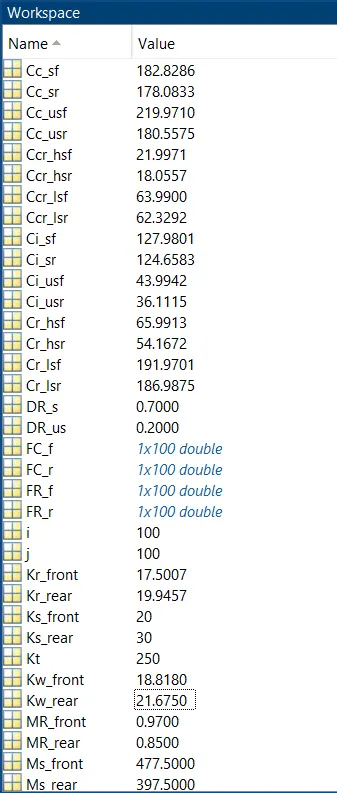
The calculated parameters are displayed in the workspace window which is shown below.
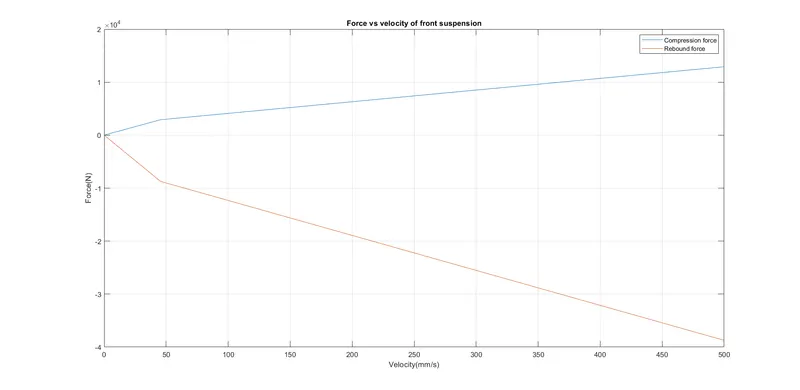
The plots of the front and rear suspension are given below.
Front force vs velocity plot,
Rear force vs velocity plot,
Result,
Both the plots show the variation between the compression and rebound forces. The increase in force above the knee speed is observed. The rebound force too is thrice as high as the compression force due to the rebound ratio.
CONCLUSION :-
- The damping coefficients of the front and rear suspension are calculated.
- The force vs velocity plot of the front and rear suspension based on the calculated parameters are plotted using MATLAB.