Problem Set-1b Week 11Challenge : Basic Handling parameters
AIM :-
To calculate the following parameters based on the given data,
- Ackermann steer angles for 500, 200 and 50 ft radius.
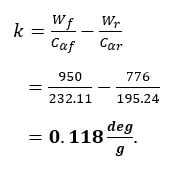
- Understeer gradient.
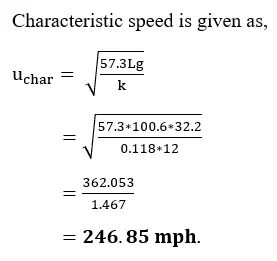
- Charactersitic speed.
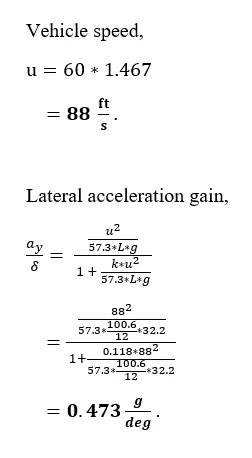
- Lateral acceleration gain at 60 mph.
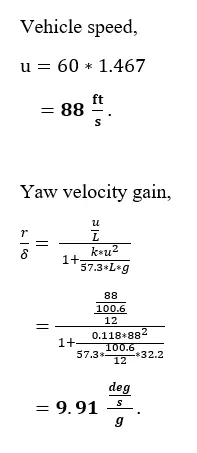
- Yaw velocity gain at 60 mph.
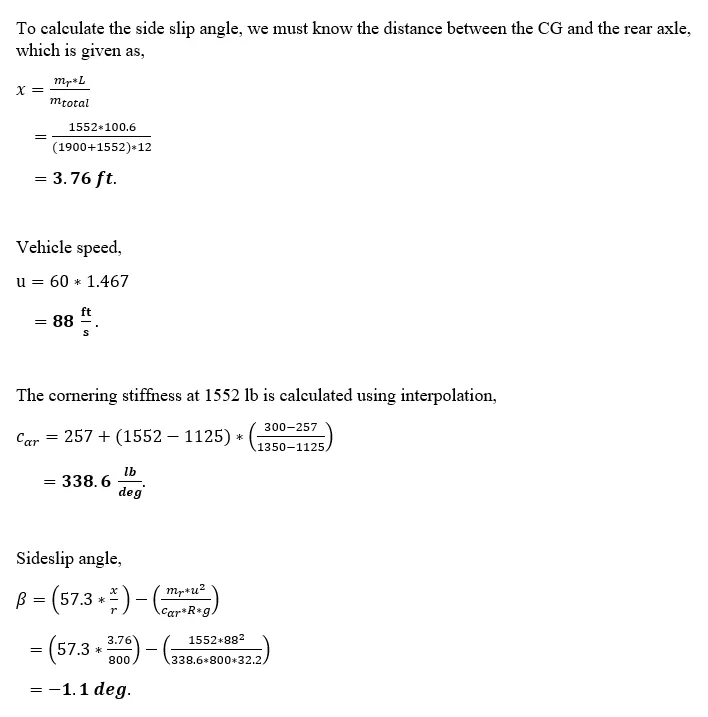
- Slide slip angle at CG on an 800 ft radius turn at 60 mph.
- Why is the calculated understeer gradient low?
GIVEN DATA :-
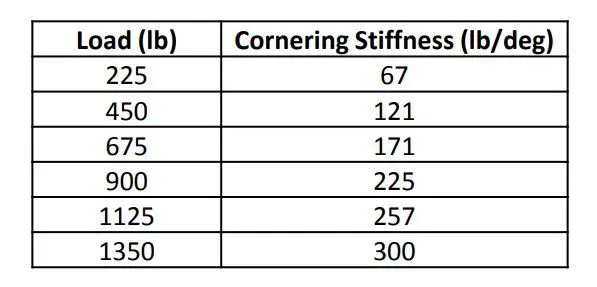
Weight of the front axle, Mf = 1900 lbs.
Weight of the rear axle, Mr = 1552 lbs.
Wheelbase, l = 100.6 in.
NUMERICAL SOLUTION :-
1. Ackermann Steer Angles for 500, 200 and 50 ft radius.
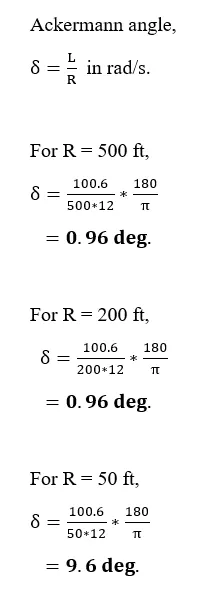
2. Understeer gradient.
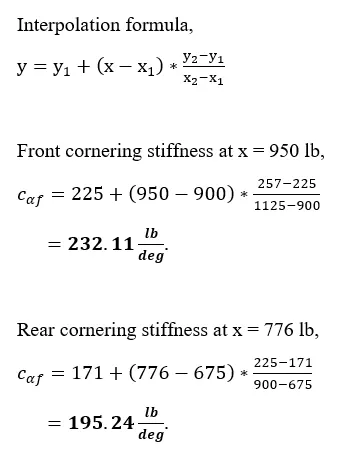
The weight on one front tire is, Wf = 1900/2 = 950 lb.
The weight on one rear tire is, Wr = 1552/2 = 776 lb.
The cornering stiffness can then be obtained using interpolation,
The understeer gradient is,
3. Characteristic Speed.
4. Lateral acceleration gain at 60 mph.
5. Yaw velocity gain at 60 mph,
6. Sideslip angle at the CG on an 800ft radius turn at 60 mph.
7. Why is the understeer gradient quite low?
The understeer gradient is quite low because only cornering stiffness is taken into consideration for calculation. Whereas in the real world the suspension and steering also affect understeer gradient.