Week 1 Understanding Different Battery Chemistry
AIM :-
- To prepare a table on the materials and chemical reactions that occur in the anode and cathode of different types of lithium ion cells.
- To compare the differences between the lithium ion batteries based on their characteristics.
1. TABLE ON MATERIALS AND CHEMICAL REACTIONS IN THE CATHODE AND ANODE OF LITHIUM ION CELLS :-
A battery is a device that is used to store electrical energy. They are a collection of one or more cells whose chemical reactions create a flow of electrons in a circuit. All batteries are made up of three basic components anode, cathode and electrolyte which chemically reacts with the anode and cathode. A separator is often used to prevent the anode and cathode from touching, if the electrolyte is not sufficient. In order to store these components, batteries usually have some kind of casing.
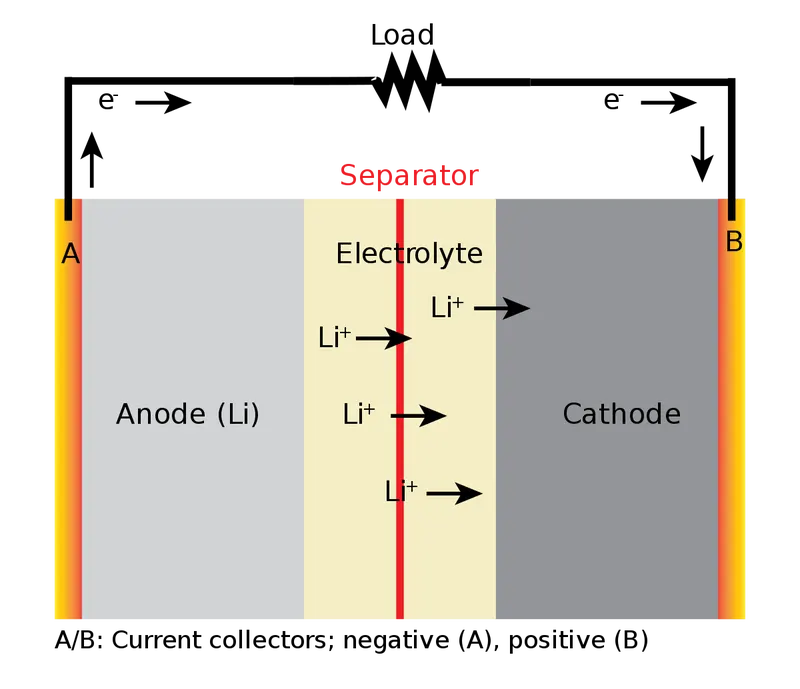
Anode: Electrons flow out from the anode in a device connected to a circuit. This means that conventional current flows into an anode. In a battery, the chemical reaction between the anode and electrolyte causes a build up of electrons in the anode. These electrons want to move to the cathode, but cannot pass through the electrolyte or separator.
Cathode: Electrons flow into the cathode in a device connected to a circuit. This means that conventional current flows out from a cathode. In batteries, the chemical reaction in or around the cathode uses the electrons produced in the anode. The only way for the electrons to get to the cathode is through a circuit, external to the battery.
Electrolyte: The electrolyte is the substance, often a liquid or gel, that is capable of transporting ions between the chemical reactions that happen at the anode and cathode. The electrolyte also inhibits the flow of electrons between the anode and cathode so that the electrons more easily flow through the external circuit rather than through the electrolyte.
Separators: Separators are porous materials that prevent the anode and cathode from touching, which would cause a short circuit in the battery. Separators can be made from a variety of materials, including cotton, nylon, polyester, cardboard, and synthetic polymer films. Separators do not chemically react with either the anode, cathode, or electrolyte.
Casing: Most batteries need a way to contain their chemical components. Casings, otherwise known as housings or shells, are simply mechanical structures meant to hold the battery's internals. Battery casings can be made of almost anything: plastic, steel, soft polymer laminate pouches, and so on. Some batteries use a conducting steel casing that is electrically connected to one of the electrodes.
In electric vehicles Lithium-Ion batteries are used. It is a type of rechargeable battery. In these batteries, lithium ions move from the negative electrode through an electrolyte to the positive electrode during discharge, and back when charging. Li-ion batteries use an intercalcated lithium compound as the material at the positive electrode and typically graphite at the negative electrode. The batteries have a high energy density, no memory effect and low self discharge. They can however be a safety hazard since they contain flammable electrolytes, and if damaged or incorrectly charged can lead to explosions and fires.
There are six types of Lithium-Ion batteries used in the industry and they are,
- Lithium Cobalt Oxide (LiCoO2) or LCO.
- Lithium Manganese Oxide (liMn2O4) or LMO.
- Lithium Nickel Manganese Cobalt Oxide (LiNiMnCoO2) or NMC.
- Lithium Ion Phosphate (LiFePO4) or LFP.
- Lithium Nickel Cobalt Aluminium Oxide (LiNiCoAlO2) or NCA.
- Lithium Titanate (Li2TiO3) or LTO.
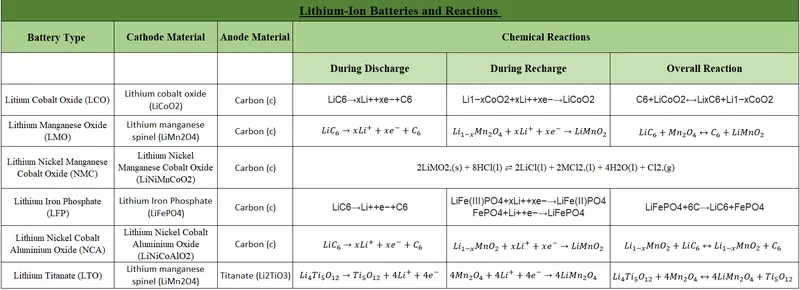
A table on the 6 batteries about the materials used and chemical reactions are provided below.
2. DIFFERENT TYPES OF LITHIUM ION BATTERIES BASED ON THEIR CHARACTERISTICS :-
The lithium ion batteries are classified based on 6 parameters and they are,
- Specific energy which is the amount of energy stored per unit mass.
- Cost.
- Specific power.
- Safety.
- Performance.
- Life span.
The charts below show the strengths of each battery type based on the above 6 parameters.
Lithium Cobalt Oxide (LCO): It has high specific energy and performance but are expensive and have low life span, specific power and safety. This type of battery is used to power long time portable devices such as mobile phones, tablets, laptops and cameras.
Lithium Manganese Oxide (LMO): It has fairly high specific energy, power and safety but low life span and cost. This type of battery is used to power security devices, fire alarms and electricity/water meters.
Lithium Nickel Manganese Cobalt Oxide (NMC): It has very high specific energy and fairly high cost, life span, safety and specific power. It is the most balanced battery parameter-wise among the 6. This type of battery is ideal to power electric vehicles due to it's balanced characteristics.
Lithium Iron Phosphate (LFP): It has very high life span, specific power and safety but very low specific energy and moderate performance. This type of battery is used for electric vehicles and solar energy installations.
Lithium Nickel Cobalt Aluminium Oxide (NCA): It has very high specific energy, high performance, long life span and low cost. But it is not safe compared to other batteries. This type of battery is used to power electrical appliances and small electric vehicles.
Lithium Titanate (LTO): It has very high performance, a very long life span and it is very safe. It is very cheap in terms of cost and has moderate specific power but has very low specific energy. This type of battery is used in electric vehicles, military applications, solar energy appliances.
CONCLUSION :-
- The materials used and chemical reactions at the anode and cathode of different types of lithium ion battery are tabulated.
- The applications of different types of lithium ion batteries based on their characteristics are explained.