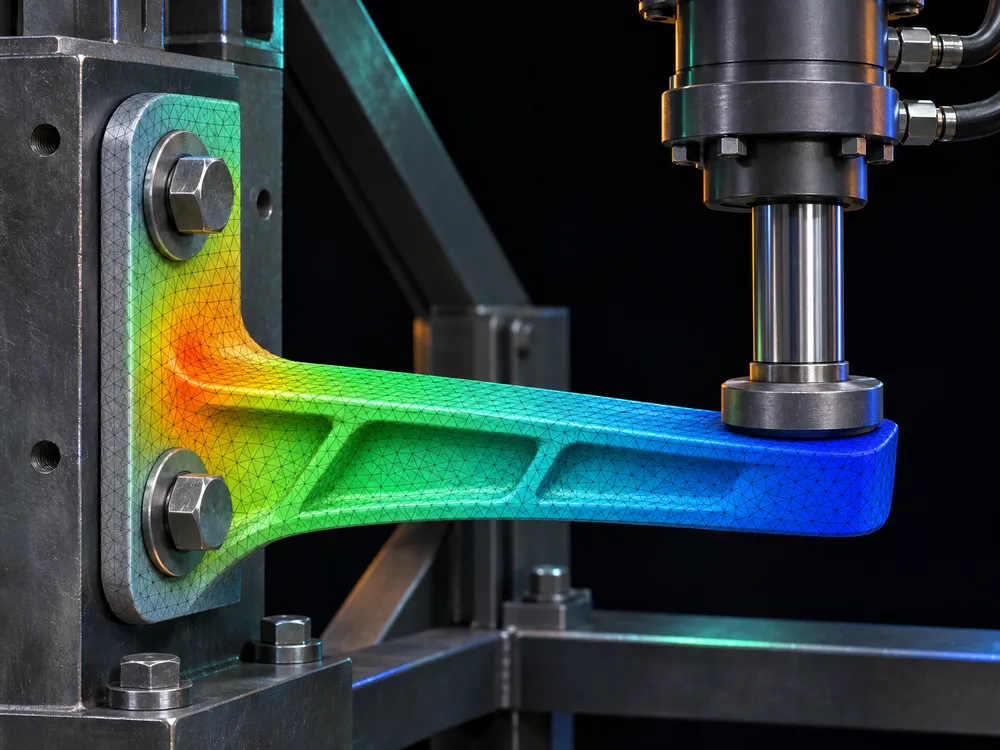
FEA (finite element analysis) courses online
Every Skill-Lync FEA course in ANSYS, HyperMesh, ANSA, LS-DYNA and more, with fees, hours, projects and what our FEA learners went on to earn.
- 15
- courses and programs
- ₹40,000
- per short course
- 4 to 24
- weeks per short course
- 6
- programs, from ₹1,50,000
As of 16 Nov 2026 · Fees are the list price on each course page, inclusive of all charges
Skill-Lync teaches FEA in 15 online courses: 9 short courses in ANSYS Workbench, HyperMesh, ANSA, LS-DYNA, Radioss, SOLIDWORKS and STAAD.Pro, and 6 programs that combine them. Here they all are with fees, duration and projects, which one fits the job you want, and what our FEA learners went on to earn.
Every Skill-Lync course that teaches FEA
Projects is the number of industry projects listed on the course page. Programs also include the courses' smaller assignments. EMI figures are the lowest monthly plan shown on the course page.
How much does an FEA course cost in India?
As of 19 Nov 2026, other providers' FEA courses range from free lessons (NPTEL) to ₹1,00,000 (NICE Bengaluru) among those priced in rupees; the cheapest paid one is Coursera at ₹7,499. Skill-Lync's options in this table cost ₹40,000 to ₹2,75,000, inclusive of all charges, with graded projects and doubt support; the programs add placement support.
| Provider and course | Fee | Duration | Format |
|---|---|---|---|
| NPTEL (IIT Kanpur) Basics of Finite Element Analysis - I (Prof. Nachiketa Tiwari) | Free to watch and learn | 8 weeks (the last run's exam was on 20 Sep 2026; videos stay online, check NPTEL for the next run) | Recorded video lectures with weekly assignments |
| NPTEL (IIT Roorkee) Finite Element Method and Computational Structural Dynamics (Prof. Manish Shrikhande) | Free to watch and learn | 12 weeks (the last run's exam was on 16 Oct 2026; videos stay online) | Recorded video lectures with weekly assignments |
| Coursera (University of Michigan) The Finite Element Method for Problems in Physics (Prof. Krishna Garikipati) | Included with Coursera Plus, shown at ₹7,499 for a year on an offer banner | 6 weeks at 10 hours a week, 13 modules, self-paced | Recorded lectures with 12 graded assignments, including coding assignments |
| Skill-Lync Basics of FEA - Explicit and Implicit FEA | ₹40,000 incl. all charges | 12 weeks | Online: recorded lessons, live doubt sessions, graded projects |
| Skill-Lync Structural Analysis using Ansys Workbench | ₹40,000 incl. all charges | 7 weeks | Online: recorded lessons, live doubt sessions, graded projects |
| Skill-Lync FEA using SOLIDWORKS | ₹40,000 incl. all charges | 4 weeks | Online: recorded lessons, live doubt sessions, graded projects |
| NICE Bengaluru (Niharika Institute of Computational Engineering) Advanced Programme in FEM analysis (Ansys) | ₹1,00,000 | 3 months | Classroom in Rajajinagar, Bengaluru |
| Skill-Lync Pre-Graduate Program in Finite Element Analysis | ₹1,50,000 incl. all charges | 16 weeks | Online: recorded lessons, live doubt sessions, graded projects |
| Skill-Lync Post Graduate Program in CAE | ₹2,75,000 incl. all charges | 48 weeks | Online: recorded lessons, live doubt sessions, graded projects |
| LearnFEA (Renato Carvalho) The Finite Element Method for Linear Structural Analysis | USD 50, shown reduced from USD 95 | 60 hours of recorded video, 12 modules | Recorded, self-paced |
| eCornell (Cornell University) Finite Element Analysis Certificate Program (5 courses) | USD 3,900 | Up to 6 months to complete the 5 courses | Online, self-scheduled, with a facilitator who gives feedback |
| Enterfea (Łukasz Skotny) The Breakthrough FEA Course | 527 EUR for a single user | Over 24 hours of video plus about 500 pages of written lessons | Recorded, self-paced, 8 modules and 5 worked examples, with a learner community |
Read from each provider's own course page on 19 Nov 2026, sorted by fee: free first, then rupee fees, then fees in US dollars, then pages that show no fee. Some providers include GST and many don't say. Free courses usually charge for the certificate. For certificates, placement support and how to choose, see the full comparison: Best FEA course in India (2026).
Which one should you pick?
- You are new to FEA and want one course first. Take Basics of FEA: Explicit and Implicit FEA (12 weeks, ₹40,000, 23 h of video) if you want the theory and the solver choice explained before any software. Take Structural Analysis using Ansys Workbench (7 weeks, 14 h) if you want to run static, modal and impact analyses quickly. If you already design in SOLIDWORKS, FEA using SOLIDWORKS (4 weeks, 4 h) is the shortest start.
- You want a CAE job and can commit 4 months to a year. The Pre-Graduate Program in Finite Element Analysis (16 weeks, ₹1,50,000, EMI from ₹7,841 a month) is four courses: Basics of FEA, HyperMesh, ANSA and Ansys Workbench, 73 h of video. The Post Graduate Program in CAE (48 weeks, ₹2,75,000, EMI from ₹14,375) adds LS-DYNA, crashworthiness with Radioss and automotive safety standards, 149 h and 17 projects. 270 of the 489 FEA placements in our records came from PG CAE.
- You want a meshing (pre-processing) role. Many entry CAE roles start with meshing for an analysis team. HyperMesh for FEA Plastic and Sheet Metal Applications (24 weeks, 19 h) and Preprocessor for Structural Analysis using ANSA (8 weeks, 18 h) are the two meshing courses. The Post Graduate Program in Automation & Pre-Processing for FEA & CFD Analysis (24 weeks, ₹2,75,000) adds TCL/TK automation for HyperMesh, MATLAB, Python and ANSA CFD meshing to both.
- You want crash and safety. Crashworthiness Analysis using HyperMesh and Radioss (12 weeks, 25 h: frontal, side pole and roof crush of a full car) and LS-DYNA for Structural Mechanics (12 weeks, 19 h: pedestrian head impact, bird strike). PG CAE has both plus automotive safety standards; the Post Graduate Program in Computational Design and Pre-processing (32 weeks) has both plus SOLIDWORKS surface modelling (see Before you pay).
- You want EV or automotive breadth. The Post Graduate Program in Hybrid Electric Vehicle Design and Analysis (48 weeks, ₹2,75,000) lets you choose one of four tracks; its FEA track teaches the same ANSA, HyperMesh, crash, LS-DYNA and Workbench courses with MATLAB, Python and an electrical-architecture course. 175 of our FEA placements came from this program.
- You want an IIT certificate. The Post Graduate Certification Program in Automotive Design & Analysis with IIT Jammu (12 months, ₹2,00,000) is mainly a design program (CATIA, NX, BIW, GD&T) with a mandatory FEA track of ANSA and LS-DYNA and optional HyperMesh, crash and Workbench courses. Pick it if you want design and analysis together.
- You are a civil engineer. Design of Tanks by Finite Element Analysis (12 weeks, 21 h) uses plate FEA in STAAD.Pro for an underground water tank. For building and bridge analysis, see the STAAD.Pro and ETABS course pages linked under Tools.
What is FEA?
FEA (finite element analysis) predicts how a part or structure responds to loads on a computer instead of on a test rig. You split the part into many small elements joined at nodes, give each element a simple way to deform, and assemble the elements into one large set of equations, stiffness times displacement equals force. Solving it gives the displacement of every node, and from that the strain and stress in every element.
In industry FEA answers questions like: will this bracket yield under the worst load, at what frequency does this door panel vibrate, how far does the steering column move in a frontal crash, how many cycles before this weld cracks. The work splits into three parts. Pre-processing: clean the CAD, extract mid-surfaces of thin parts, mesh with 1D, 2D or 3D elements, model spot welds and bolts, assign materials and loads (HyperMesh and ANSA are the usual tools). Solving: an implicit solver for static, modal and fatigue problems (ANSYS Mechanical, Nastran, OptiStruct, Abaqus), an explicit solver for crash, drop and impact (LS-DYNA, Radioss). Post-processing: read the stresses, check them against the material limits and against test data.
Here is a calculation every crash engineer knows. An explicit solver marches through time in tiny steps, and a step may not be longer than the time a stress wave takes to cross the smallest element. In steel (E = 210 GPa, density 7,850 kg/m³, Poisson's ratio 0.3) a wave in a thin shell travels at √(E / (ρ(1 − ν²))) ≈ 5,422 m/s. For a 5 mm shell element, with the 0.9 safety factor LS-DYNA and Radioss use by default, the step is 0.9 × 5 mm ÷ 5,422 m/s ≈ 0.83 microseconds. A frontal crash lasts about 100 ms, so the solver takes about 1,20,000 steps, each one updating every element in the car.
Halve the element size to 2.5 mm and the step halves (0.41 µs, about 2,41,000 steps) while a shell model gets four times as many elements, so the run costs roughly eight times as much. Worse, one 2 mm element left in a 5 mm mesh sets the step for the whole model: 0.33 µs and about 3,01,000 steps. That is why crash meshing specs set a minimum element length, and why solvers offer mass scaling: making that small element 6.25 times denser restores the 5 mm step, which is fine for a handful of elements and wrong for thousands, so engineers check the added mass in the solver output. An implicit static run has no such limit, but each step solves the full stiffness matrix; choosing explicit or implicit is one of the first things FEA courses teach.
What a FEA course covers
- FEM foundations. Weighted residual and Petrov-Galerkin methods, the potential energy approach, shape functions, and stiffness matrices derived by hand for 1D bar, CST and LST triangles and 3D elements; plane stress and plane strain; equations of motion, the mass matrix and what separates explicit from implicit solvers.
- Strength of materials for FEA. Stress-strain behaviour, Hooke's law, bending, Mohr's circle and theories of failure: the hand checks you need to judge whether a stress plot is believable.
- Pre-processing (meshing). Geometry cleanup and free edges, manual and automatic mid-surfacing of sheet-metal and variable-thickness plastic parts, 1D, 2D and 3D (tetra and hexa) meshing to quality criteria, connections for doors and seats, batch meshing and morphing, in both HyperMesh and ANSA.
- Implicit structural analysis. ANSYS Workbench: static and contact analysis (a backhoe bucket, a differential housing), modal and frequency-response analysis, transient analysis of a rack and pinion, rigid-body dynamics and bolt pre-tension. SOLIDWORKS Simulation: linear and nonlinear static, parametric studies, buckling, fatigue with S-N curves, a PCB drop test and frequency analysis.
- Explicit dynamics and crash. LS-DYNA keywords, hourglass energy, time-step control, weld modelling, implicit runs in LS-DYNA and material cards built from raw test data; Radioss element formulations, material laws, contact interfaces, debugging, airbag models, occupant injury criteria and the FMVSS and NCAP test standards.
- Full-vehicle and industry projects. Frontal crash, side pole impact and roof crush of a full car model under FMVSS, pedestrian head impact on a hood, bird strike on an aircraft engine, a door-panel and spare-wheel-well mesh, an instrument-panel trim and a suspension assembly.
- Civil FEA. Plate finite element analysis of an underground water tank in STAAD.Pro, Wood-Armer moments, design of plate elements from the results and crack-width checks to the IS code.
The courses in detail
FEA using SOLIDWORKS
4-week online course using SOLIDWORKS, with 1 industry project. A 4-week Solidworks course that trains engineers in the fundamentals of FEA analysis.
Projects include: Buckling Analysis.
Tools: SOLIDWORKS
Basics of FEA - Explicit and Implicit FEA
12-week finite element analysis course in ANSYS Workbench: implicit and explicit solvers, meshing, boundary conditions and 3 hands-on projects.
Projects include: Study of cantilever beam; Study of crushing of square steel tube; Study of impact of steel ball on aluminum plate of 5 mm thickness.
Tools: ANSYS Workbench
LS-DYNA for Structural Mechanics/FEA
12-week LS-DYNA course for structural mechanics and explicit FEA: material models, contacts, impact problems and post-processing in LS-PrePost.
Projects include: Pedestrian Head Impact Simulation on a Hood; Bird Strike on an Aircraft Engine using Shell Elements.
Tools: LS-DYNA, LS-PREPOST
HyperMesh for FEA Plastic and Sheet Metal Applications
Learn more about how FEA is used in Hypermesh & Sheet Metal Applications With Skill-Lync's HyperMesh for FEA Plastic and Sheet Metal Applications Course
Projects include: Meshing of Door Panel; Meshing of Car Spare Tyre Floor Panel.
Tools: HyperMesh
Structural Analysis using Ansys Workbench
7-week course on structural analysis in ANSYS Workbench Mechanical: static, modal and contact problems, meshing and results checks, with 2 projects.
Projects include: Pre-Tension Analysis using Ansys Workbench; Side Impact Analysis on Two Cars.
Tools: ANSYS Workbench
Preprocessor for Structural Analysis using ANSA
8-week ANSA course for structural analysis: geometry clean-up, shell and solid meshing and model set-up for FEA, with 2 projects.
Projects include: Modeling of an Automotive IP Trim Component; Modeling of an Automotive Suspension Assembly.
Tools: ANSA
CAE Simulation using SolidWorks
12-week online course.
Crashworthiness Analysis using HyperMesh and Radioss
12-week crashworthiness course: vehicle crash models in HyperMesh, Radioss solver set-up and results, with 3 crash simulation projects.
Projects include: Frontal Crash of a NEON Dodge Model in FMVSS Regulation; Side Pole Impact Analysis of NEON Dodge Model in FMVSS Regulation; Roof Crush Analysis of a NEON Doge Model in FMVSS Regulation.
Tools: HyperMesh, Radioss
Design of Tanks by Finite Element Analysis
12-week online course using STAAD.Pro, AutoCAD, with 2 industry projects. Design of Tanks by Finite Element Analysis using Ansys.
Projects include: Analysis and design of an underground water tank using STAAD.Pro; Post processing of results from analysis and design of an underground water tank using STAAD.Pro.
Tools: STAAD.Pro, AutoCAD
Pre-Graduate Program in Finite Element Analysis
16-week online course using ANSA, HyperMesh, ANSYS Workbench, with 9 industry projects. A comprehensive program covering the basics of finite element analysis…
Projects include: Study of cantilever beam; Study of crushing of square steel tube; Study of impact of steel ball on aluminum plate of 5 mm thickness; Meshing of Door Panel.
Tools: ANSA, HyperMesh, ANSYS Workbench
Post Graduate Program in Automation & Pre-Processing for FEA & CFD Analysis
24-week online PG program using MATLAB, ANSA, Python, HyperMesh, with 11 industry projects.
Projects include: Extracting Data from NASA Thermo.dat File; Extracting Steam Properties using Rankine Cycle Simulator; Breaking Ice with Air-Cushion Vehicle; Data Analysis.
Tools: MATLAB, ANSA, Python, HyperMesh
Post Graduate Program in Computational Design and Pre-processing
32-week online PG program using SOLIDWORKS, LS-DYNA, LS-PREPOST, HyperMesh, Radioss, ANSA, with 10 industry projects.
Projects include: Modeling of an Automotive IP Trim Component; Modeling of an Automotive Suspension Assembly; Pedestrian Head Impact Simulation on a Hood; Bird Strike on an Aircraft Engine using Shell Elements.
Tools: SOLIDWORKS, LS-DYNA, LS-PREPOST, HyperMesh, Radioss, ANSA
Post Graduate Program in CAE
48-week PG program in computer-aided engineering: HyperMesh, ANSA, LS-DYNA and Radioss for meshing, crash and FEA, 17 industry projects, placement support.
Projects include: Modeling of an Automotive IP Trim Component; Modeling of an Automotive Suspension Assembly; Pedestrian Head Impact Simulation on a Hood; Bird Strike on an Aircraft Engine using Shell Elements.
Tools: LS-DYNA, LS-PREPOST, HyperMesh, Radioss, ANSA, MATLAB, MASTAN, ANSYS Workbench
Post Graduate Program in Hybrid Electric Vehicle Design and Analysis
48-week PG program in hybrid and electric vehicle design and analysis: MATLAB, LS-DYNA and ANSYS Fluent, 48 projects, mentor reviews and placement support.
Projects include: Breaking Ice with Air-Cushion Vehicle; Data Analysis; Modeling of an Automotive IP Trim Component; Modeling of an Automotive Suspension Assembly.
Tools: MATLAB, LS-DYNA, LS-PREPOST, ANSYS Fluent, SpaceClaim, CFD Post, HyperMesh, Radioss, ANSA, Simulink, CONVERGE, Paraview, OpenFOAM, Octave, CATIA V5, Python, Siemens NX CAD, Simscape, ANSYS Workbench
Post Graduate Certification Program in Automotive Design & Analysis (IIT Jammu)
A comprehensive program that covers both the basics and advanced concepts in Automotive Design and CAE.
Tools: CATIA V5, NX CAD, ANSA, LS-DYNA, HyperMesh
Jobs after a FEA course
Typical job titles: FEA engineer, CAE engineer or analyst, meshing or pre-processing engineer (often named after the tool, as in ANSA engineer), crash and safety engineer, durability or NVH engineer. Most FEA jobs in India sit with engineering services companies that run analysis for global carmakers and aerospace firms, with automotive testing bodies such as ARAI, and with simulation consultancies and software resellers.
From Skill-Lync's own placement records (as of 16 Nov 2026): 489 placements in the CAE (structural FEA) domain, 456 with a salary, recorded 2019 to 2026. Median salary 3.2 LPA, middle half 2.8 to 4 LPA; for freshers alone the median is 3 LPA (n = 285). 191 of the job titles or roles contain "FEA"; 127 more say CAE, analysis or analyst. 270 came from PG CAE and 175 from the PG HEV program. Full breakdown by employer and city: CAE engineer salaries.
Employers with the most placements: Cyient (38), Xitadel (30), ARAI (18), Tata Elxsi (16), Expleo (15), Analyzer CAE (12), ALTEN (11), Tata Technologies (10); 4 joined Skill-Lync itself. Most of these are engineering services companies, not carmakers. Hiring in your city: Pune, Chennai, Bangalore and Hyderabad; who hires freshers: companies hiring mechanical engineering freshers.
Timing matters: 452 of the 489 placements were in 2021 to 2023 (248 in 2022 alone) and only 17 in 2024 or later. These are learners who told us they were placed, so treat the numbers as a starting point, not as today's market rate.
Projects students built
Skill-Lync learners have published at least 3,439 FEA project reports (773 students, as of 16 Nov 2026). We count only reports tagged with an FEA tool whose title names an analysis or meshing task, so the true number is higher. The most common:
2D shell meshing and mid-surfacing of sheet-metal and plastic parts (969), connections (spot welds, seams, bolts) on doors and seats (400), 3D tetra and hexa solid meshing (390), mesh morphing (192), element formulation studies (145), frontal crash of a full car (98), material modelling from test data (94), side pole and side impact (70), drop tests (66), pedestrian head impact on a hood (56), bird strike on an aircraft engine (42).
Browse them at FEA student projects. For your own project, start from HyperMesh and ANSA project ideas, LS-DYNA project ideas or ANSYS project ideas; FEA and crash analysis expert answers covers the questions learners ask most.
FEA software, course by course
Each tool has its own page listing every Skill-Lync course that uses it, with fees and syllabus notes:
- HyperMesh courses (meshing, Radioss crash, TCL automation)
- ANSA courses (FEA and CFD meshing)
- LS-DYNA courses (explicit crash and impact)
- ANSYS courses (Workbench Mechanical)
- SOLIDWORKS courses (SOLIDWORKS Simulation)
- STAAD.Pro courses (civil structural analysis)
- ETABS courses (building analysis and design)
Free FEA lessons before you pay
Strength of materials and mechanics are the base of every FEA course. These are free:
- Structural analysis using Ansys Workbench, free lessons
- Introduction to FEA, free 1-hour course (YouTube, chapter guide)
- Introduction to CAE: meshing, boundary conditions, contacts and a HyperMesh frontal crash demo, free 65-minute webinar (YouTube, chapter guide)
- FEA fundamentals, free course (resources.skill-lync.com)
- Strength of materials, free course
- GATE strength of materials questions, solved
- GATE machine design questions, solved
- GATE engineering mechanics questions, solved
- Weld strength calculator (hand check for weld FEA)
- Beam calculator: shear force, bending moment, slope and deflection, with a check of a beam FEA result (hand check for a static analysis)
- Beam natural frequency calculator (hand check for a modal analysis)
- Shell element formulation calculator: hourglass modes, reduced vs full integration and shear locking (hand check for an element choice)
- Tet mesh quality calculator: tet collapse, volume skew and TET4 vs TET10 stiffness in bending (hand check for a solid mesh)
- 1D element calculator: RBE2 vs RBE3, rod vs bar vs beam and PBARL section properties (hand check for rigid links and 1D elements)
- Fatigue life calculator: S-N curve, Goodman and Gerber, rainflow counting and Miner's rule (hand check for a durability analysis)
- Gear design calculator: Lewis and Hertz stresses, contact ratio, worm efficiency (hand check for a gear contact analysis)
- Bird strike calculator: impact pressure, force and energy of a bird, fan blade slicing and the LS-DYNA set-up (hand check for a bird strike analysis)
- Torsion calculator: τ = Tr/J, twist and plastic torque, G and Nadai's curve from a torsion test (hand check for an Explicit Dynamics torsion run)
- Bullet penetration calculator: bullet energy, ballistic limit and residual speed of a thin plate, Ansys Explicit time step and erosion (hand check for a projectile impact run)
Free FEA tutorials
Start here before you pay for anything. These are written by Skill-Lync learners and engineers:
- Deriving the Finite Element Equations: Stepped Bar Example Using Minimum Potential Energy
- What is FEA? A Beginner's Guide to Finite Element Analysis, with a Worked Example
- Understanding Elements In Finite Element Analysis
- All About Higher Order Elements In FEA
- All You Need to Know About Tria Elements
- Linear vs Nonlinear Analysis in FEA: Types, Newton-Raphson, Worked Examples
- Analysis vs Simulation: Key Differences, with a Worked Example
- Comparing the Explicit and Implicit Methods in FEA
- All About Time-Step in LS Dyna
- Structural Analysis in ANSYS: Guide to Choosing the Right Simulation Method
- Contact Sizing and Refinement In Ansys Workbench
- Linearised Stress Results in Ansys Workbench
- Geometry Cleanup in HyperMesh: Tools for Fixing the Free Edges
- Realizing Connectors In HyperMesh
- How Is Hexa Mesh Used in ANSA
- 1D vs 2D vs 3D FEA: Beam, Shell and Solid Elements in SolidWorks
- Mastering Buckling Analysis in SolidWorks: A Complete Guide
- How to Start Your Career as a CAE or FEA Engineer
- Ace Your Next Job Interview with the Top 35 FEA Interview Questions and Answers
Before you pay
PG Computational Design costs as much as PG CAE and has less in it. The Post Graduate Program in Computational Design and Pre-processing (110 h of video) and the Post Graduate Program in CAE (149 h) are both ₹2,75,000. PG CAE contains all four FEA courses of Computational Design (ANSA, HyperMesh, LS-DYNA, crashworthiness) plus Basics of FEA, Ansys Workbench and safety standards; Computational Design adds only SOLIDWORKS surface modelling. Pick it if you want that design course or a shorter program (32 weeks against 48).
The Pre-Graduate program saves ₹10,000. Its four courses cost ₹1,60,000 bought one by one and ₹1,50,000 as the program. If you need only one or two of them, buy those at ₹40,000 each.
In the PG HEV program, check that you are on the FEA track. Learners choose one of four tracks (CFD, FEA, design, EV/HEV design). The fee is the same as PG CAE; the FEA track adds MATLAB, Python and an electrical-architecture course but has no Basics of FEA theory course.
Check the software licence before you start. Ansys gives free student licences (Ansys Student with Mechanical, and LS-DYNA Student) with a model-size cap, and Altair has long offered a free Student Edition that includes HyperMesh. There is no free personal ANSA edition. Ask the counsellor which licences the course provides and for how long.
A short course will not get you an FEA job on its own. Employers test strength of materials, element types and mesh quality, one pre-processor, one solver, and projects you can explain, including how you checked the result against a hand calculation or a test. Plan for two or three courses or a program plus your own projects.
Hiring has slowed since 2022. In our records FEA placements peaked in 2022 (248) and fell to 12 in 2024. Ask the counsellor for recent placements in FEA specifically before you pay, and look at recent placements yourself.
FEA course FAQs
What is the fee for an FEA course at Skill-Lync?
As of 16 Nov 2026: each of the 9 FEA short courses is ₹40,000. The Pre-Graduate Program in FEA is ₹1,50,000 (EMI from ₹7,841 a month). PG CAE, PG Computational Design and Pre-processing, PG Automation and Pre-Processing, and PG HEV are ₹2,75,000 each (EMI from ₹14,375), and the IIT Jammu Automotive Design and Analysis program is ₹2,00,000. Fees are inclusive of all charges.
Which software is used for FEA?
HyperMesh and ANSA for meshing and model setup; ANSYS Mechanical, Nastran, OptiStruct and Abaqus for implicit analysis (static, modal, fatigue); LS-DYNA and Radioss for explicit analysis (crash, drop, impact); SOLIDWORKS Simulation for design-stage checks; and STAAD.Pro or ETABS for civil structures. Skill-Lync's FEA courses use HyperMesh, ANSA, ANSYS Workbench, LS-DYNA, Radioss, SOLIDWORKS and STAAD.Pro.
What is the difference between FEA and CAE?
CAE (computer-aided engineering) is the umbrella term for simulation: FEA for structures, CFD for fluids, and multibody dynamics for mechanisms. In job posts, "CAE engineer" often means structural FEA. In Skill-Lync's records for the structural domain, 191 job titles or roles contain "FEA" and 127 more say CAE or analysis.
Can I learn FEA on my own?
You can learn the basics free: strength of materials, then the stiffness method for a bar and a beam by hand, then a free student version of ANSYS or Altair and a few problems with a known answer, such as a cantilever beam or a plate with a hole. What is hard alone is judging mesh quality and whether a result is right; that is where reviewed course projects help.
What is the salary of an FEA engineer in India?
In Skill-Lync's placement records (CAE domain, 2019 to 2026, as of 16 Nov 2026), the median salary is 3.2 LPA (n = 456) and the fresher median 3 LPA (n = 285); the middle half earned 2.8 to 4 LPA. Experienced engineers and those at product companies earn more. Most of these placements are from 2021 to 2023.
What should I know before an FEA course?
Strength of materials (stress, strain, bending, failure theories), engineering mechanics, and enough matrix algebra to follow a stiffness matrix. You do not need to code for the meshing and solver courses; TCL, Python or MATLAB help later for automation.
Which is better, an FEA course or a CFD course?
Pick by the problems you like. FEA is structures: stress, vibration, crash, fatigue. CFD is fluids and heat: aerodynamics, cooling, pumps, combustion. In Skill-Lync's records structural CAE placements outnumber CFD placements, which suggests more FEA openings. Compare the CFD options on the CFD courses page.