Week 1 Stress Concentration on a Plate with hole
Aim:
To perform a static structural analysis onaplate with a single hole and three holes and determine and compair the maximum deformation and stress developed in the model.
Objective:
The objective is split into two cases;
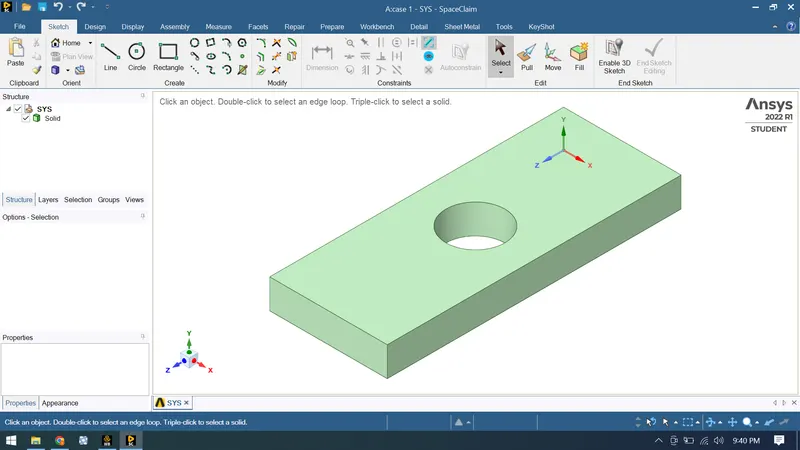
Case 1: Design a plate with single hole of dimesion 300*120*30mm and a centre hole of 60mm diameter at the centre of the job and perform a static structural analysis to determine the maximum deformation and stress developed.
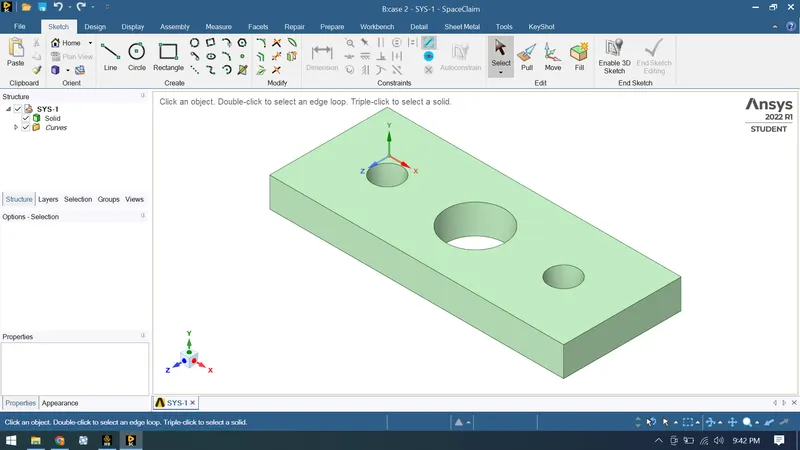
Case 2: Design a plate with three hole of dimesion 300*120*30mm, a centre hole of 60mm diameter at the centre of the job and smaller holes of diameter 30mm, 90mm away from the center and perform a static structural analysis to determine the maximum deformation and stress developed.
Procedure:
1. For the given cases static structural is the mode of analysis used for simulation.
2. To move further with the analysis part the prior step to be worked on is development of geometry.
3. Spaceclaim is the tool to generate the geometry for both the cases.
Geometry for Case 1:
Geometry for Case 2:
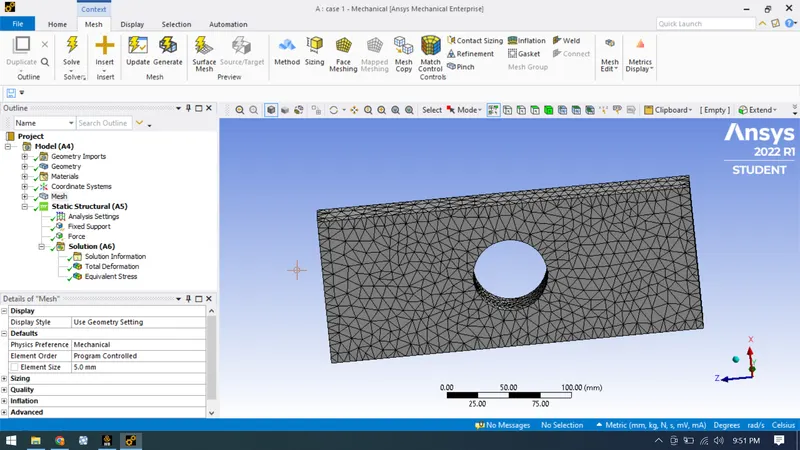
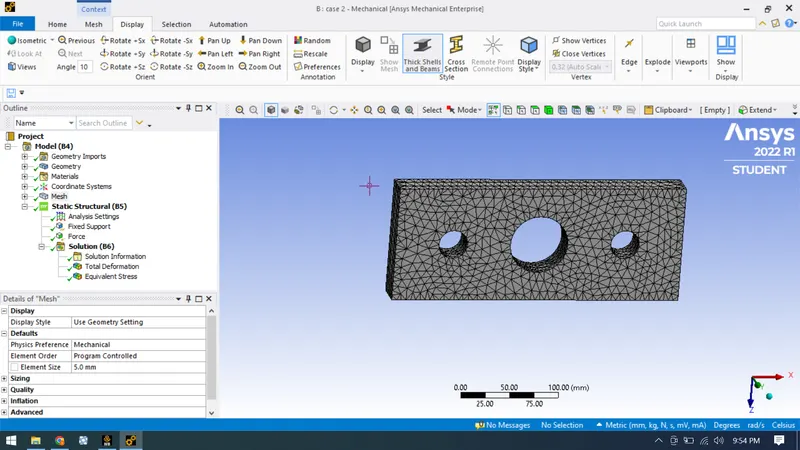
4. After geometry is generated we move further with model tab. Here material is assigned to the geometry , after assigning the material the next step is to generate a refined mesh
5. In the below models the chosen element size is 5mm and the method is tetrahedron.
case 1:
case 2:
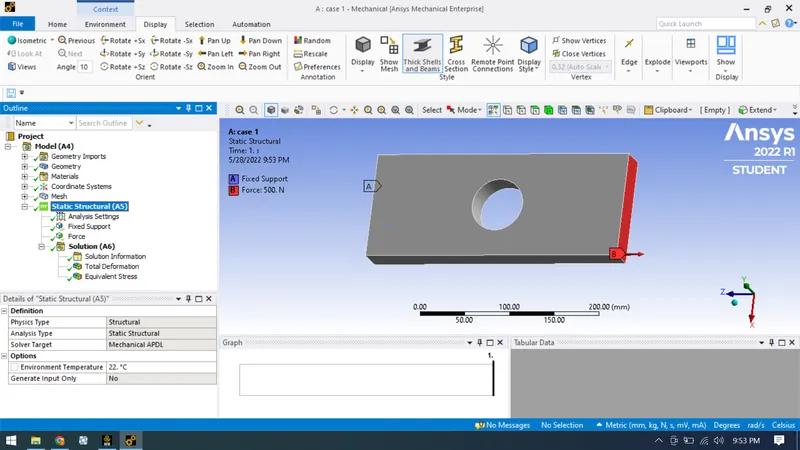
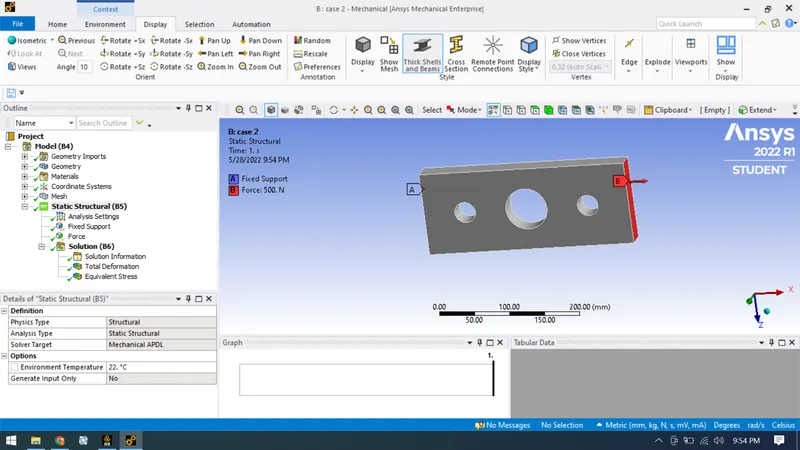
6. After meshing boundary conditions are provided accoeding to the problem statement;
Left side flat face of the geometry is to be fixed and on the other end,a force of 500N is to be applied , following are the graphical representation for fixed support and force for respective cases ,
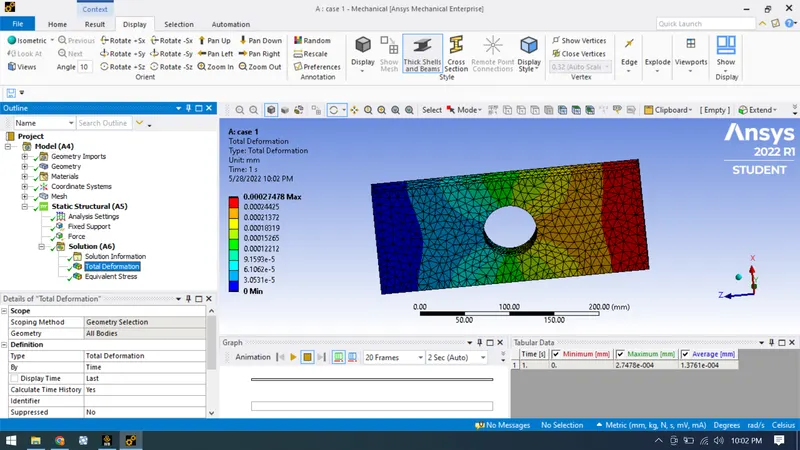
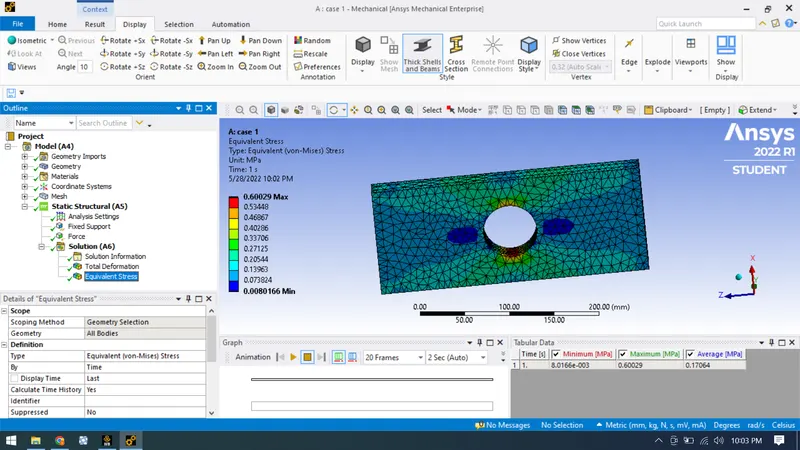
7. According to problem statement, the solutions to be found are Total deformation and Equivalent stress.
For Case 1;
Total Deformation:
Equivalent stress:
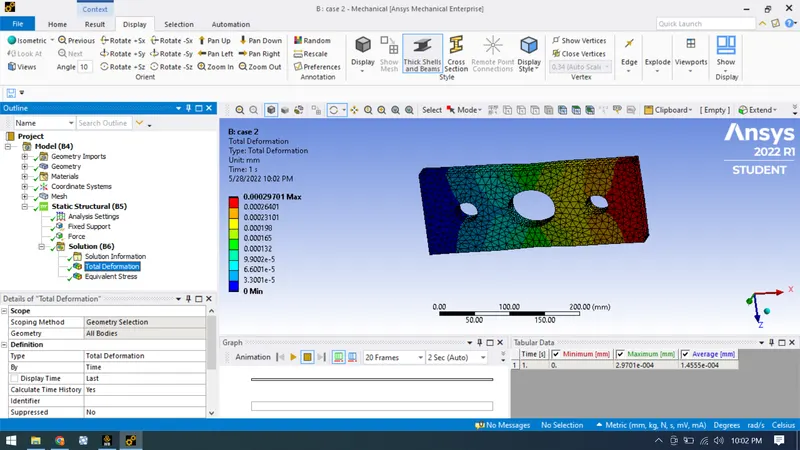
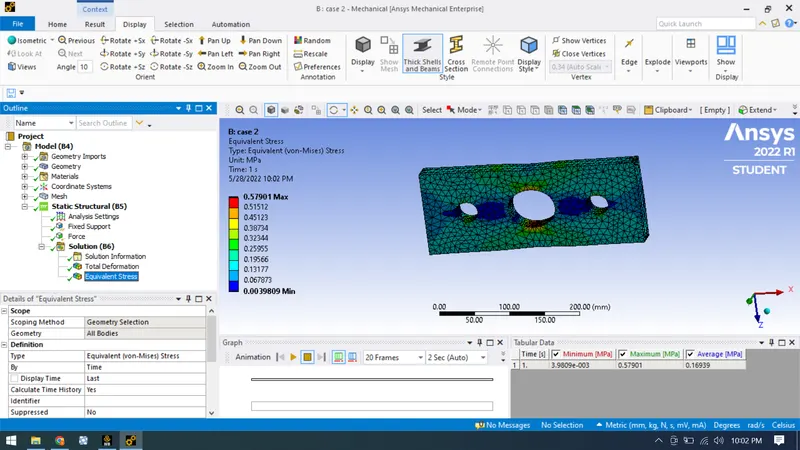
For Case 2;
Total Deformation:
Equivalent stress:
Tabular comparison for Case 1 and Case 2:
| Sr no | Solution | Case 1 | Case 2 |
| 1 | Minimum Total Deformation | 0 | 0 |
| 2 | Maximum Total Deformation | 2.7478e-004 | 2.9701e-004 |
| 3 | Avg Total Deformation | 1.3761e-004 | 1.4555e-004 |
| 4 | Minimum Equivalent stress | 8.0166e-003 | 3.9809e-003 |
| 5 | Maximum Equivalent stress | 0.60029 | 0.57901 |
| 6 | Avg Equivalent stresss | 0.17064 | 0.16939 |
Conclusion:
1. From the results above, we can conlcude that the plate with one hole has less deformation than the plate with three
hole.
2. Stress level in plate with one hole has is higher than the plate with three holes and the stress is distrubuted in plate with 3 hole.
3. From analysis point of view, we can say that choosing plate with one hole because if we compare the stresses for
both cases its minimal level. We can also choose plate with three holes, which is computationally inexpensive at the
cost of result which we produced.
4. From manufacturing point of view, we can choose plate with one hole because less number of holes leads to less work on the job and more cost effective, thus resulting in saving total production cost.
5. Where as it depends on the manufacturers problem statement for the component depending on required properties of the component and the investment which can be afforded to the development of the job.
NOTE: Please find the "C_11.rar" file attached.