Assignment 5-RADIOSS Interfaces & Study of Effect of Notches Challenge
Aim: To study interfaces and study the effect of notches challenges.
Objective: Create the mesh for bumper assembly,mesh size should be 6mm.
- Run the crash tube model as it is.
- Change the Inacti=6 and run.
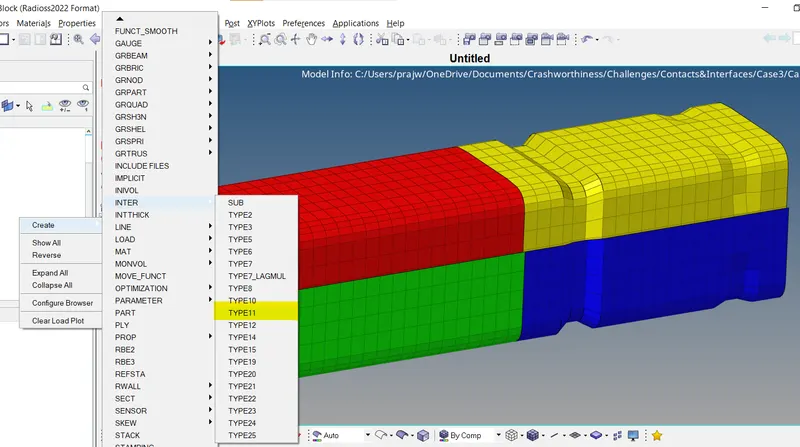
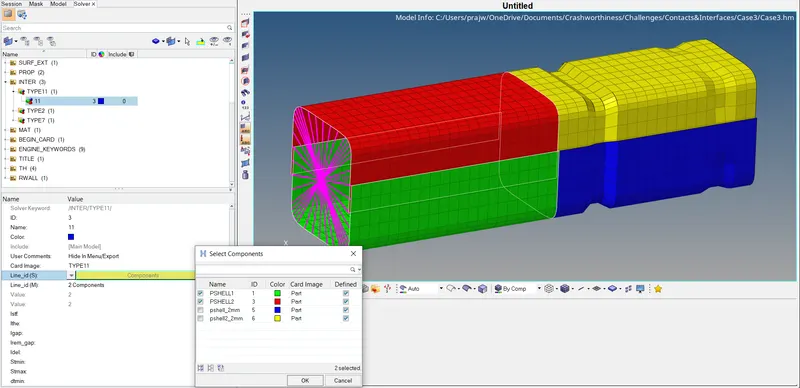
- Create the type 11 contact and run.
- Remove both notches and remove boundary condition on rigid body node then run.
- Create a new notch in the middle ,select the whole section and run.
- Create a new notch with nodes only from opposing 2 faces and run.
Note:
- Plot RWALL forces ,contact forces,internal energy and Create TH/PART for all parts and compare results for all cases.
- Comment your thought on why there is a change in the internal energies.
- How does the notch affect the results?
- Plot energies and note any difference.
Procedure:
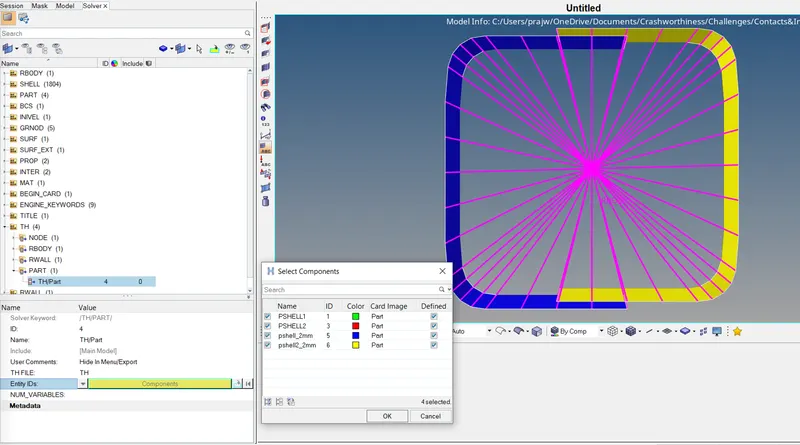
NOTE: For all the cases import the given .rad files using import solver deck; after importing create TH/PART for the 4 components for obtaining the results on them as shown below; and run the analysis using analysis > radioss > saveas > radioss.

_____________________________________________________________________________________________________
- Following was performed for the cases mentioned below
Case1:
Running analysis for the given model.
Case2:
Changing the Inacti=6.
From: 0/default TO: 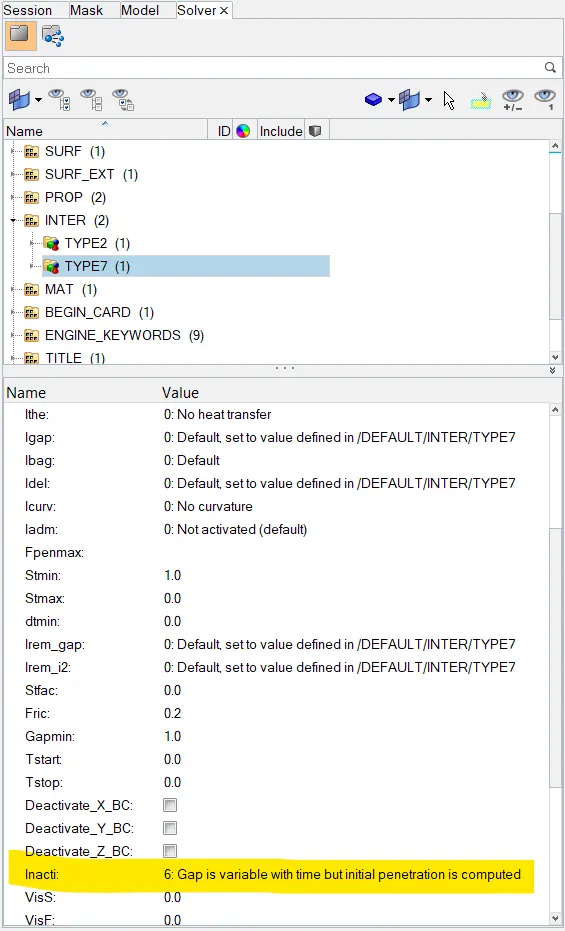
Case3:
Creating a new type 11 contact and assigning lineID for slave and master for for the following components as shown:
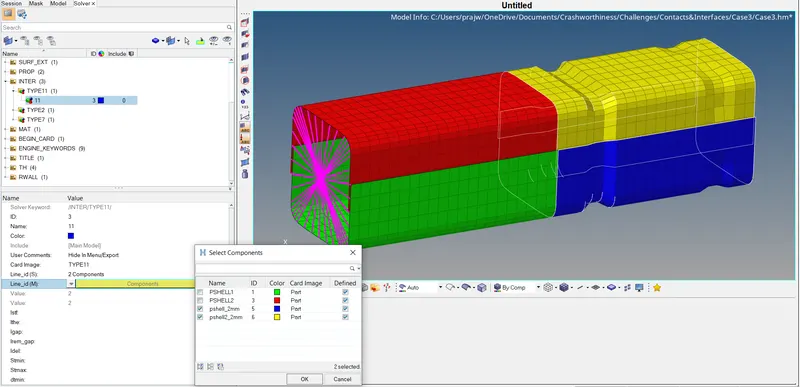
Case4:
Deleting/removing the boundary conditions. And also removing the notches present by using align node option(F7).
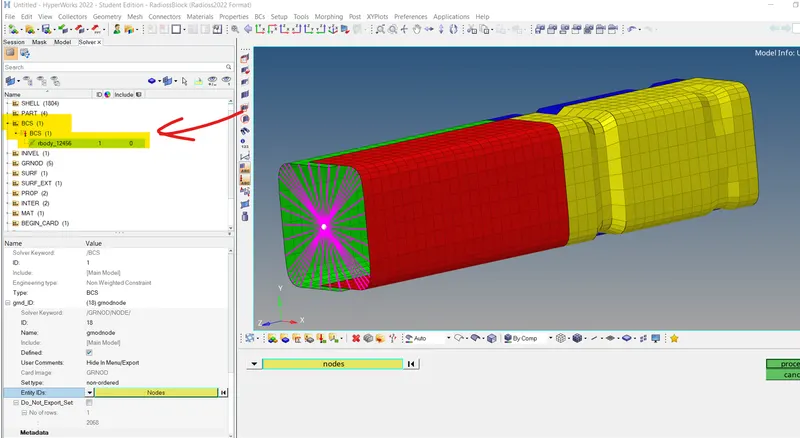
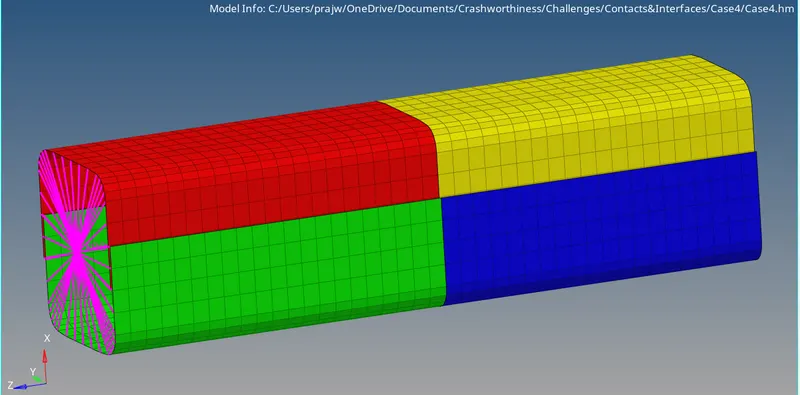
Case5:
Removing the pre existing notches and creating a notch in the middle throughout the component as shown below.
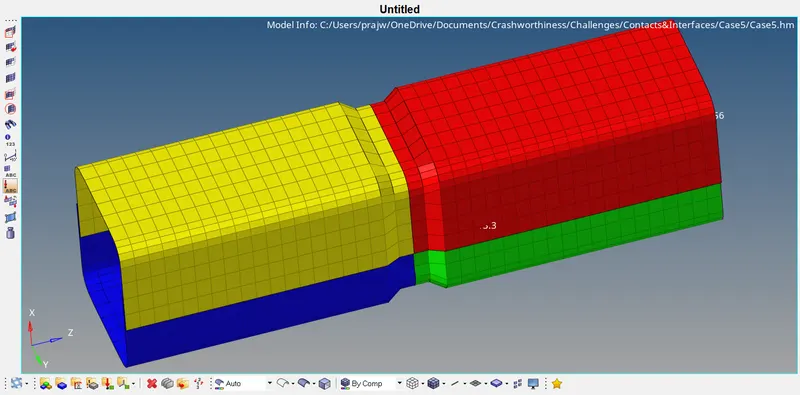
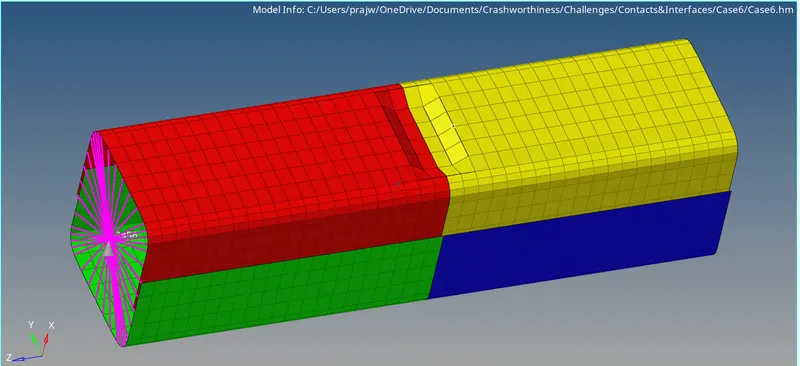
Case6:
Removing the pre existing notches and creating a notch on the opposite faces in the middle as shown below.
_____________________________________________________________________________________________________
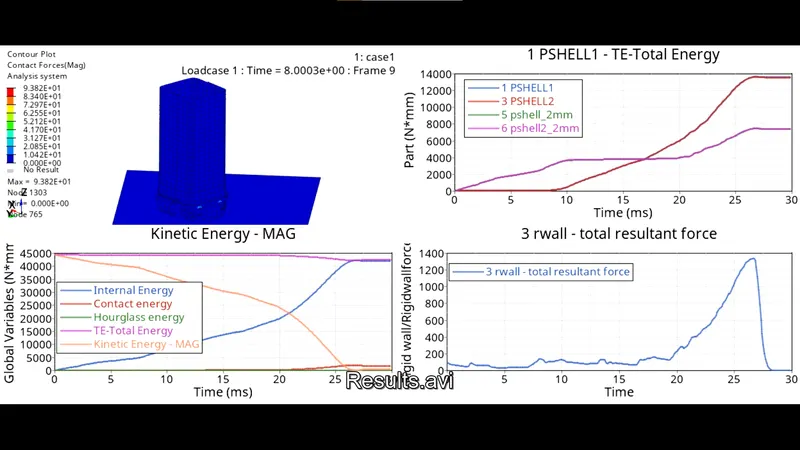
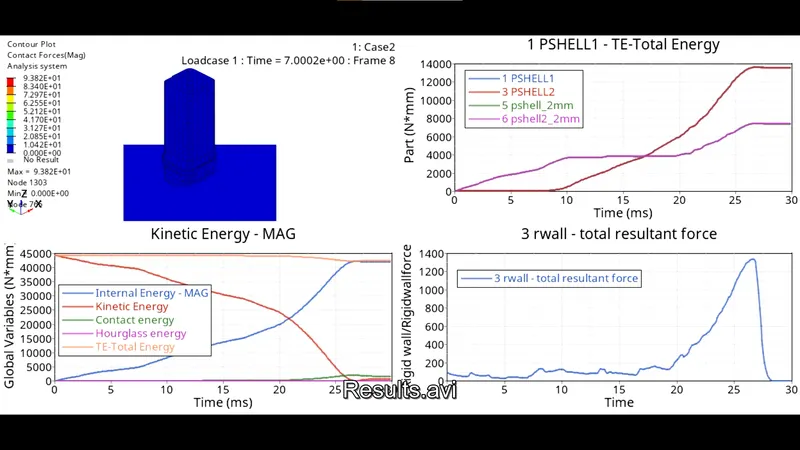
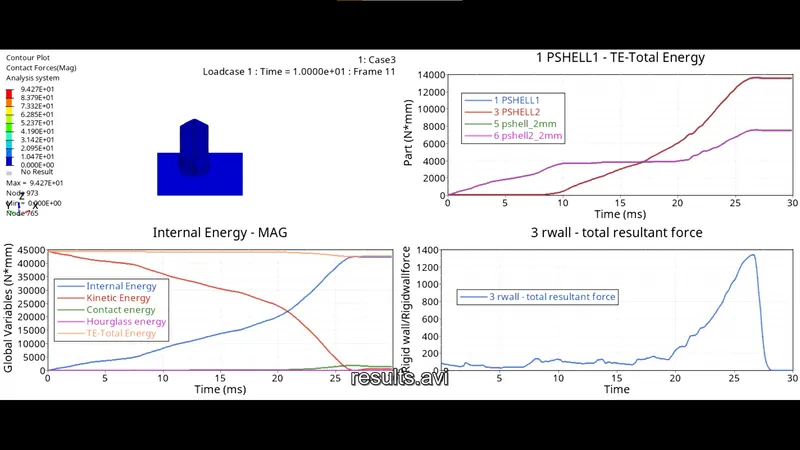
- After running the analysis, divide the graphics window into 4 parts and plot RWALL forces, contact forces, internal energy and part forces.
Case1:
Case2:
Case3:
Case4:
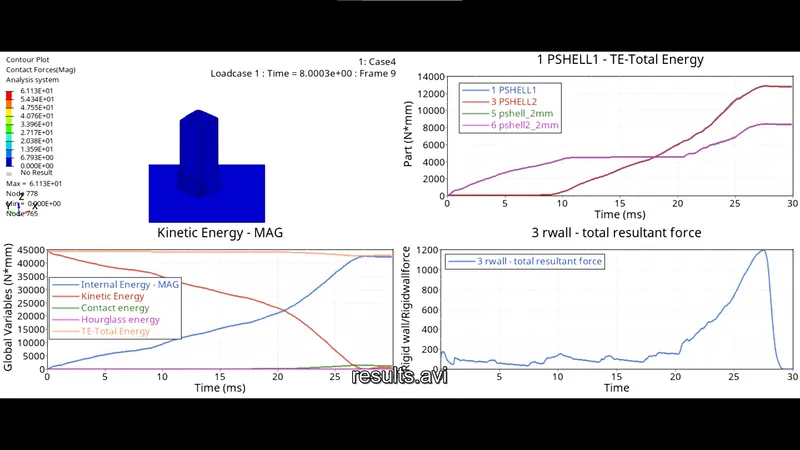
Case5:
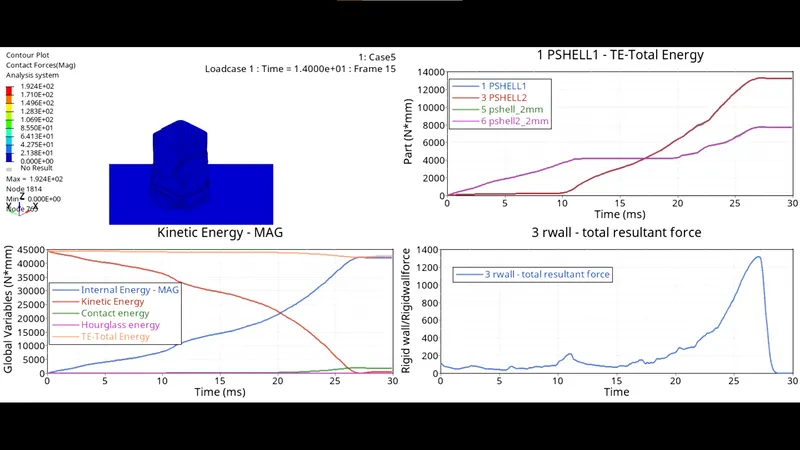
Case6:
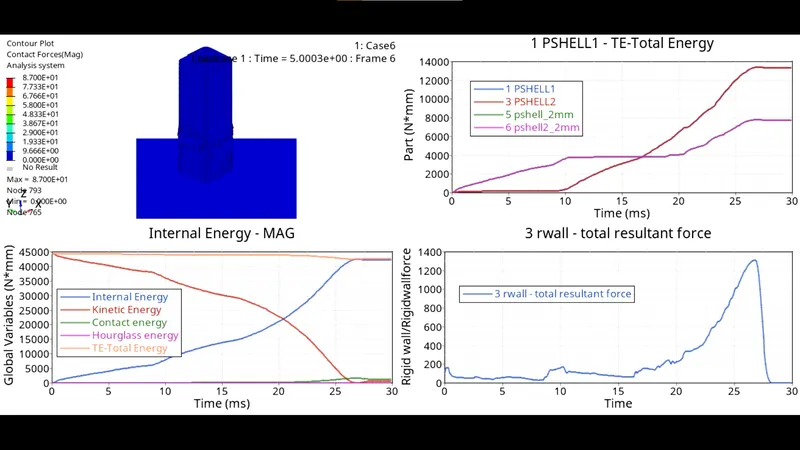
_____________________________________________________________________________________________________
For Case 1: Checkout for 0001.out for the results

Similarily after checking for all the results we get the following results.
OBSERVATION & CONCLUSION:
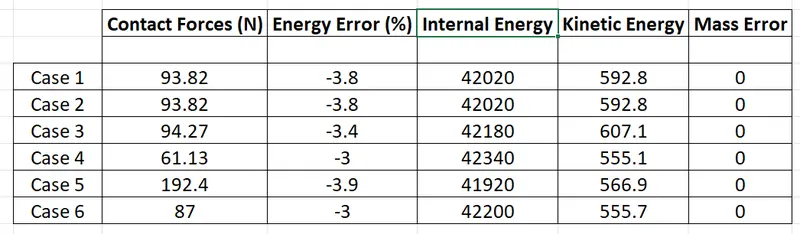
- In all the cases the hourglass energy is below the internal energy.
- The energy error is also within the acceptable range.
- It is observed that in case 4 where the notch is removed, the stress induced in the crush tube is the least compared to other cases. The crush tube with notches undergo stress concentration and these areas are the first to undergo deformation.
- The deformations are predictable in case of notched components. No initial penetration is observed in case 1 where Inacti = 0. If initial penetration existed,it could have been indicated by the graph of contact energy which could have piked up at the start itself before any impact.
- Energy error for all cases is between -3.8% to -2.3% which is acceptable.
The interface means how the elements behave with each other when they are in contact. The explicit analysis method efficiently
solves complex dynamic contact problems (boundary condition nonlinearity). Accurate modeling of contact interfaces is essential to
correctly capture contact interaction between bodies. RADIOSS has a large number of contact types suitable for many applications.
In RADIOSS an interface is created by defining the master segment and slave node-set. The master segment can be parts of
components, elements, contact surface, node surface sets, and slave entities that can be parts of components and node sets. The
contact algorithm will check every time step for potential penetration of a slave node through a master segment. If penetration is
detected the contact is treated with either a Penalty or Lagrange multiplier method.In this project we will learn about:
TYPE7, variable stiffness, node to surface contact
TYPE11, variable stiffness, edge to edge contac