Week 7-Long Piston With Cam
Long Piston With Cam Analysis
Objective: To perform a transient analysis on a piston and cam mechanism model.
To run the analysis with below mentioned setups:
- Frictionless contact
- Frictional contact with coefficient of 0.1
- Frictional contact with coefficient of 0.2
Aim is to solve for Equivalent Stress, Directional Deformation and Equivalent Elastic Strain for all the three cases.
Procedure:
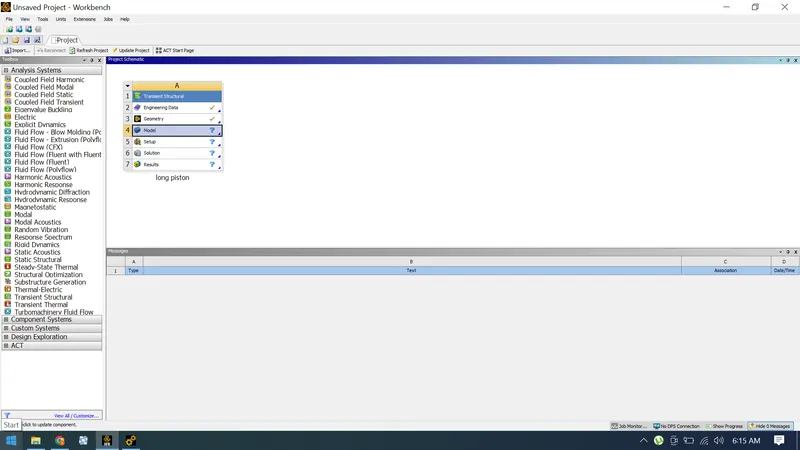
The model is imported using geometry tab in Transient Structural Analysis
Material:
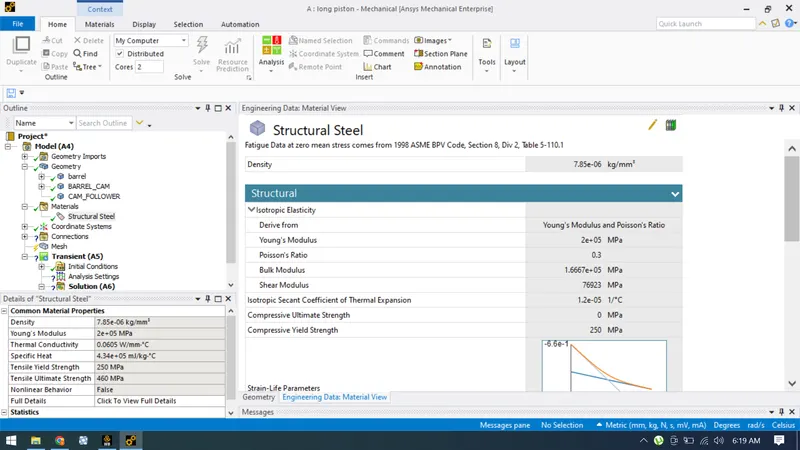
Structural steel is the chosen material for all the components in the model.
Meshing:
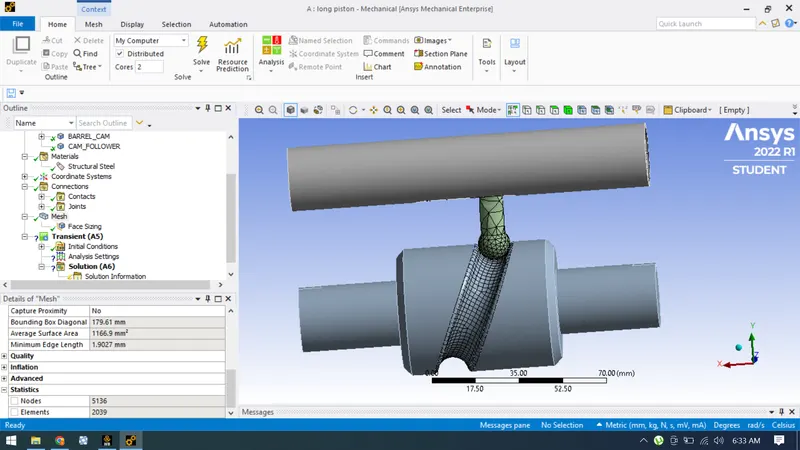
Model is meshed with program-controlled mesh with mesh element size of 6 mm. Where as
regions of particular interest i.e. contact surfaces between follower and cam is meshed using
face sizing with mesh element size of 2 mm
Total No. of Nodes:5136
Total No. of Elements: 2039
Analysis Setup:
Contacts;
Case1:
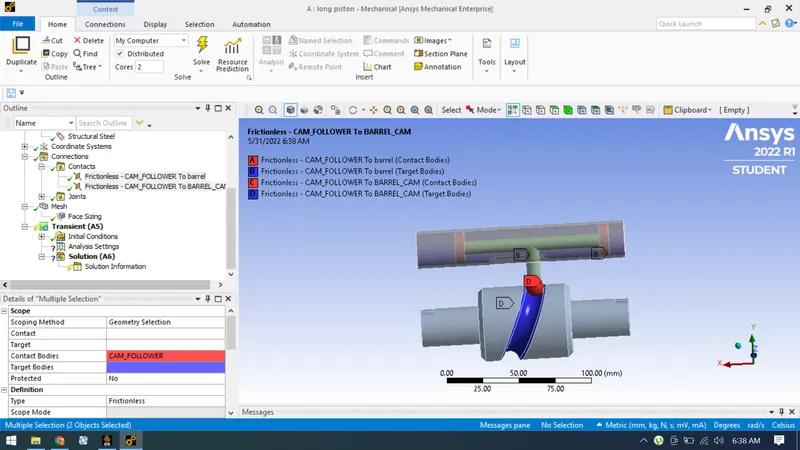
Here, as per the problem statement for case1, frictionless contact is provided.
Case2:
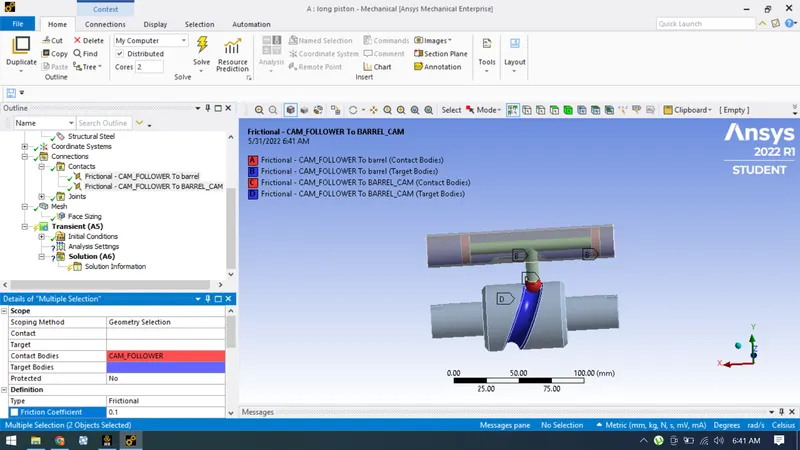
Here, as per the problem statement for case2, frictional contact is provided of coefficient 0.1 .
Case3:
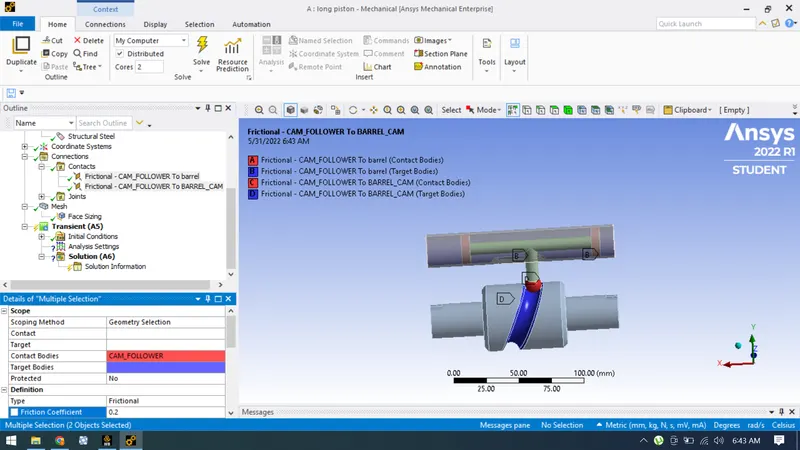
Here, as per the problem statement for case3, frictional contact is provided of coefficient 0.2 .
Joints:
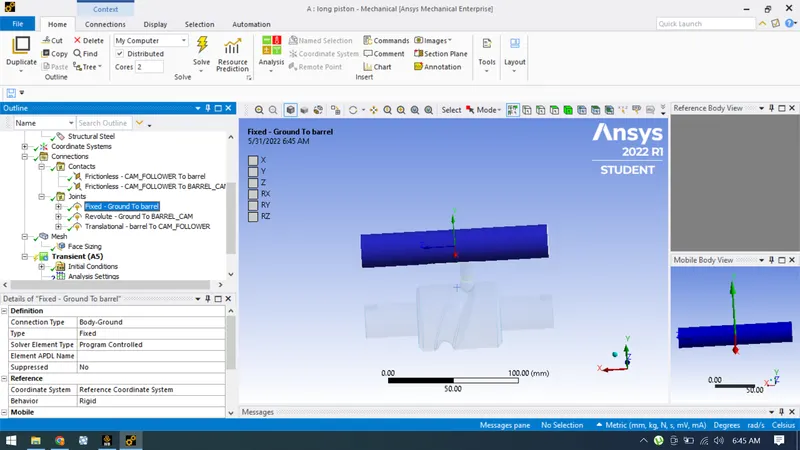
Fixed joint is assigned to barrel with relative to ground in order to hold the barrel fix and stady at its position during the process of simulation.
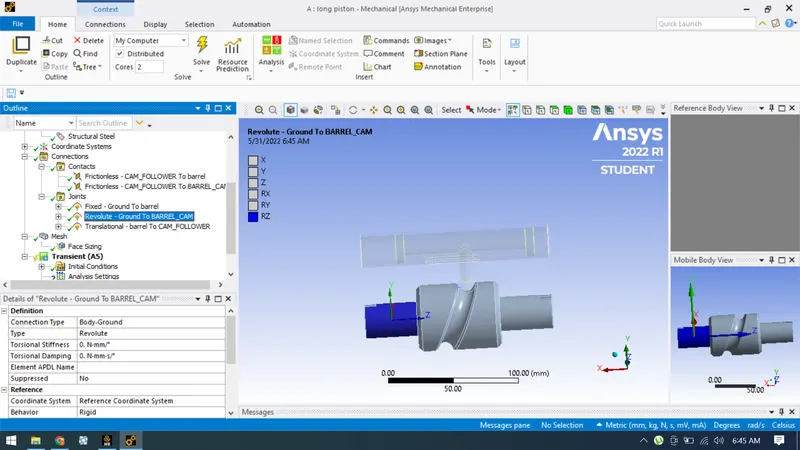
Revolute joint is provided to BARREL_CAM relative to ground to provide it with axis of rotation along Z axis.
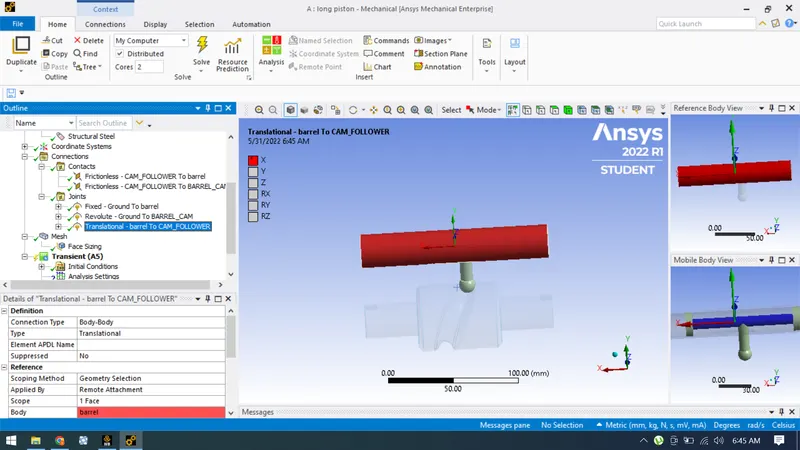
A Translation joint is assigned to CAM_FOLLOWER with relation to Barrel so that the follower can move axially in the barrel in the direction of X-axis.
Boundary Conditions:
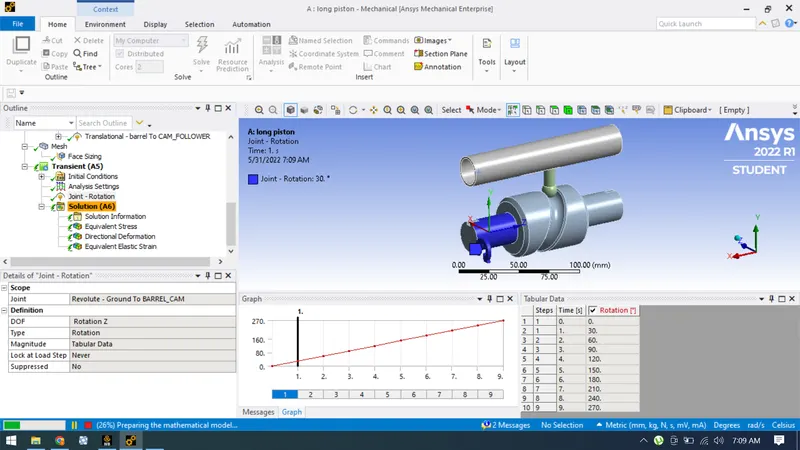
Boundary condition of time dependant rotation is provided to Barrel_cam of an angle of 270 degree with an increment of 30 degree.
Analysis Settings:
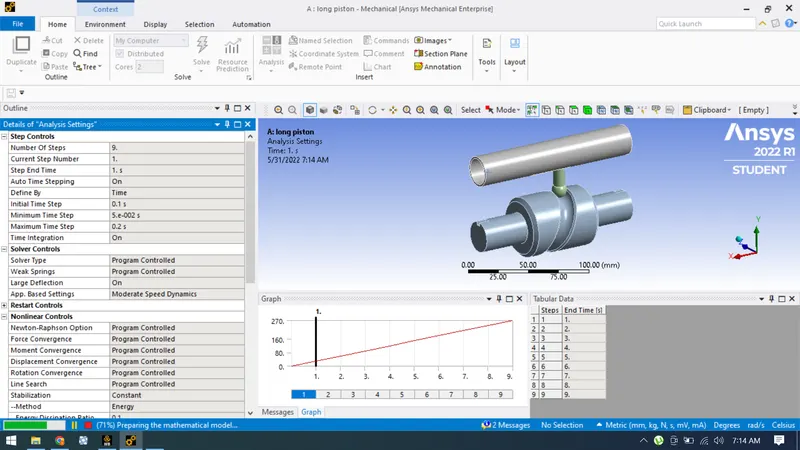
In Analysis setting no of Steps carried is set as 9 with initial time step at 0.1sec ,minimum time step as 5.e-002 sec and 0.2sec of minimum time step. Here, auto time stepping is enabled weak springs and large diflections is kept on and stabilization is kept on with energy dissipation factor as 0.1 .
Results;
Case 1: Frictionless contact
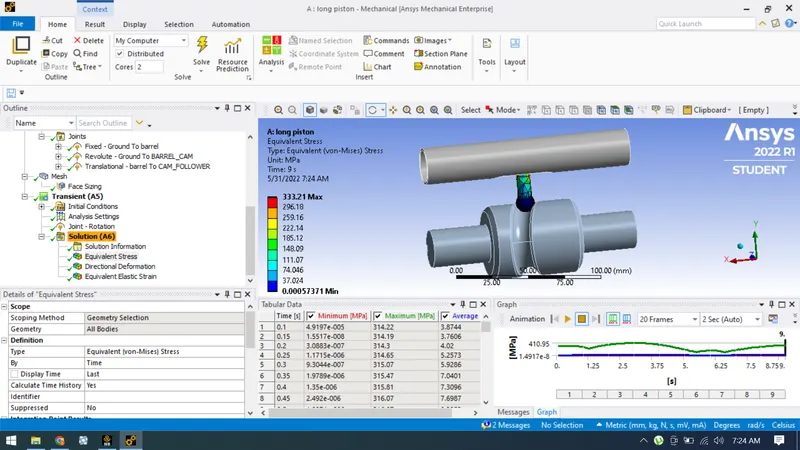
Equivalent Stress:
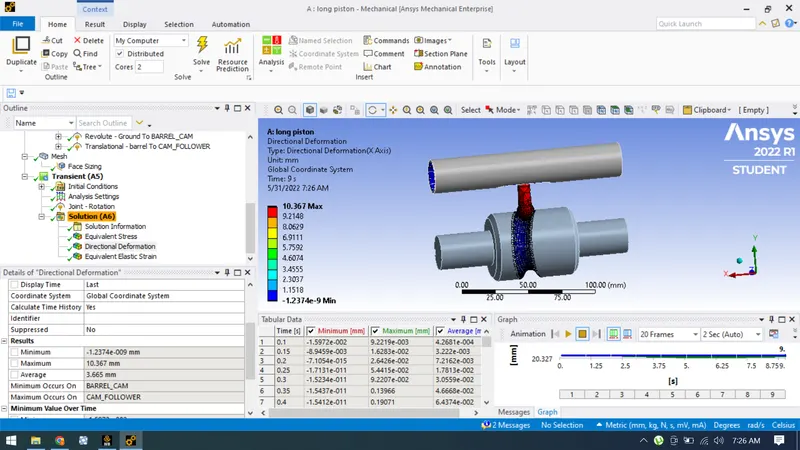
Directional Deformation:
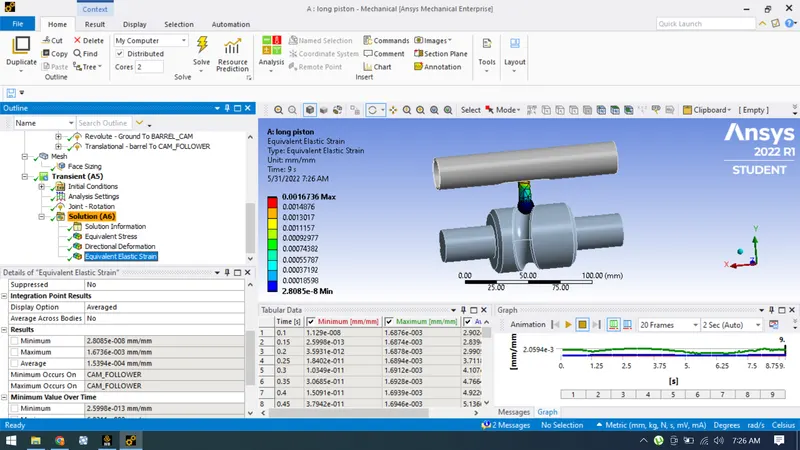
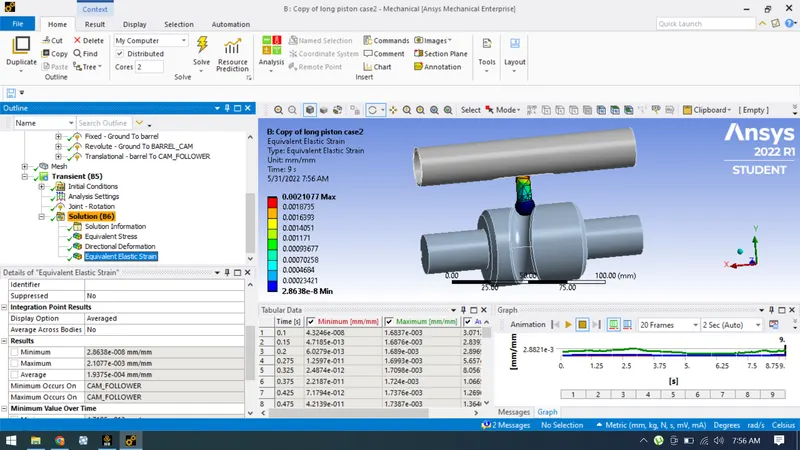
Equivalent Elastic Strain:
Case 2: Frictional contact of 0.1
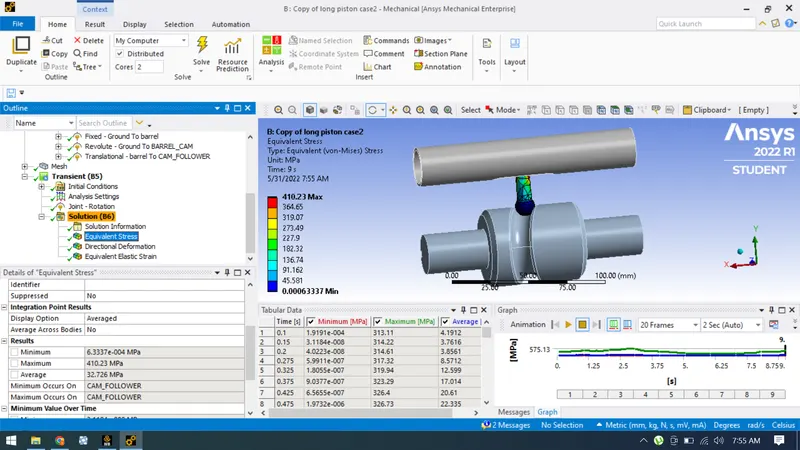
Equivalent Stress:
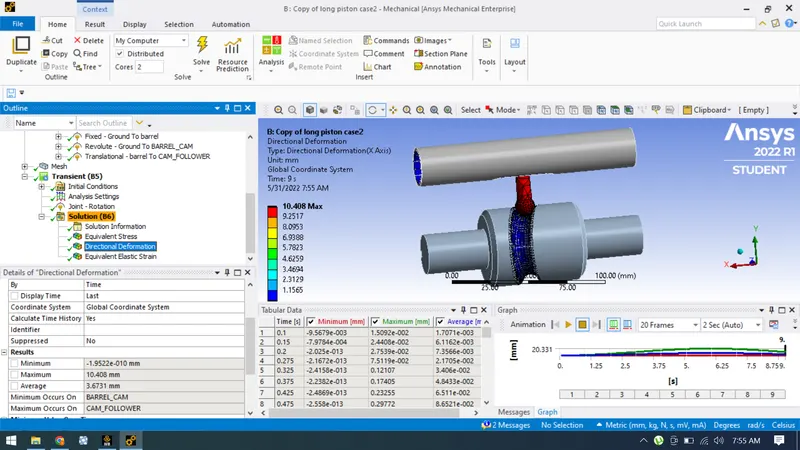
Directional Deformation:
Equivalent Elastic Strain:
Case 3: Frictional contact of 0.2
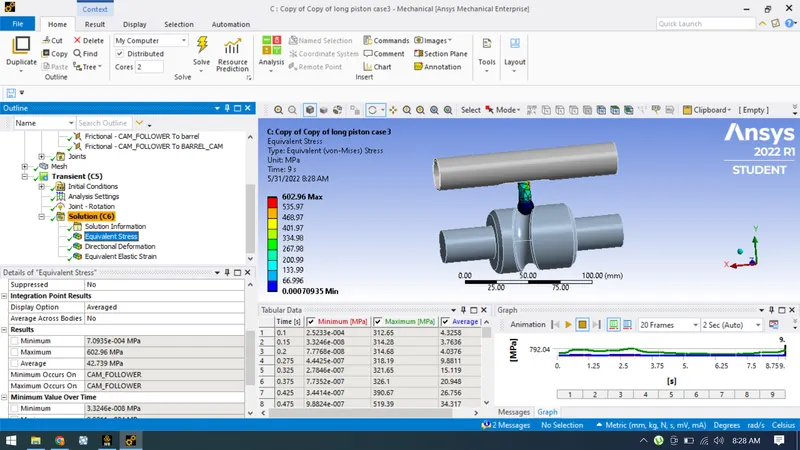
Equivalent Stress:
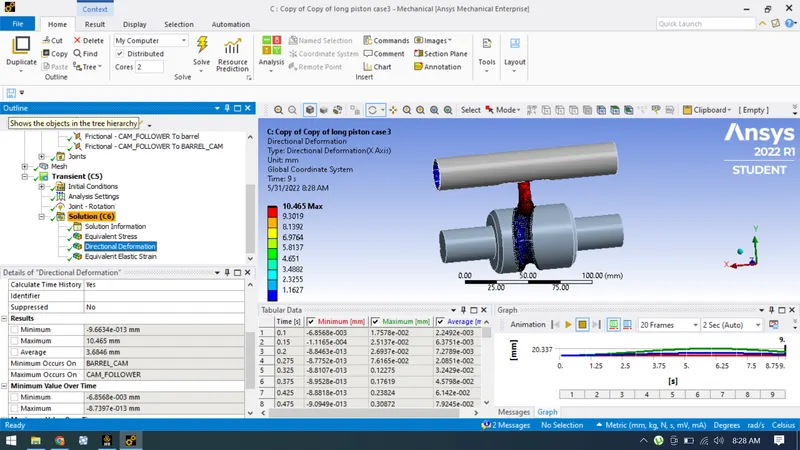
Directional Deformation:
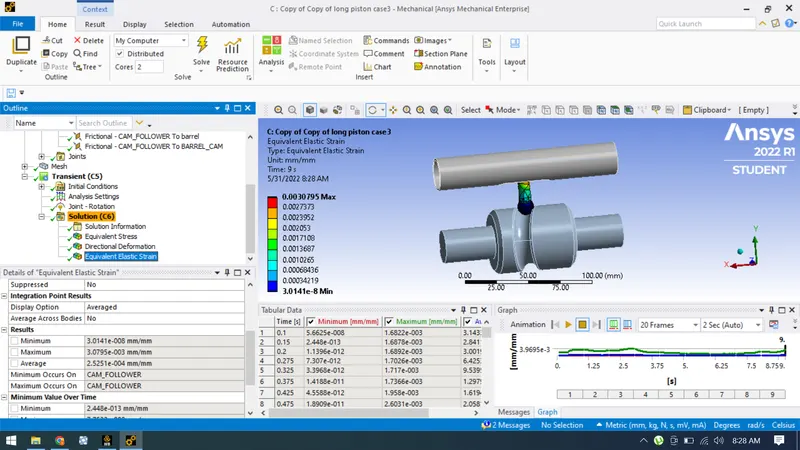
Equivalent Elastic Strain:
Following is the tabular comparison for all the three cases;
| Analysis | Case 1: Frictionless contact | Case 2: Frictional contact of 0.1 | Case 3: Frictional contact of 0.2 |
| Max Equivalent Stress | 333.21 MPa | 410.23 MPa | 602.96MPa |
| Max Directional Deformation | 10.367mm | 10.408mm | 10.465mm |
| Max Equivalent Elastic Strain | 0.0016736 | 0.0021077 | 0.0030795 |
Conclusion:
- After comparing the three cases for equivalent stress it implies that as the frictional coefficient is changed from zero in frictionless contact case to a value of 0.2 in third case, magnitude of Equivalent Stress developed is increasing. This variation is due to increase in frictional coefficient between surfaces which leads to resistance development during the motion of follower and so force is acting on follower, which causes development of higher stresses. Which leads to increase in maximum equivalent stress value with respect to cases.
- Since there’s no change in path of follower , deformation is similar in all the three results.
- In the case of equivalent plastic strain the strain value is varying with respect to time and with increase in frictional coefficient between the contact reason which leads to increase in strain development.