Week 2 Bevel Gear Challenge
STATIC STRUCTURAL ANALYSIS ON BEVEL GEAR
Objective: To carry out a Static Structural analysis on bevel ear for Equivalent stress, Total deformation and Stress intensity using below mentioned mesh size;
Case 1:4mm
Case 2:5mm
Case 3:6mm
The aimis to perform grid dependency test for different mesh size of 4mm, 5mm, 6mm and comeup with the best suitable mesh size for better reports.
Setup For Simulation:
Geometry:
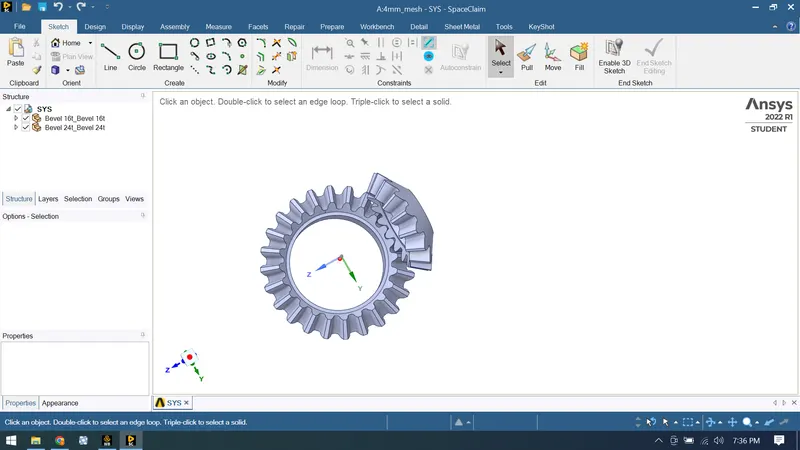
The geometry is imported in static structural panal using import geometry feature present in geometry tab, the model is imported for static structural analysis.
The geometry imported is a pair of bevel gear named as big gear and small gear with 24 teeth and 16 teeth respectively.
To simplify the geometry we remove the unwanted material from the model to reduce computational time for meshing;
Material Property:
Case 1: 4mm mesh
Case 2: 5mm mesh
Case 3: 6mm mesh
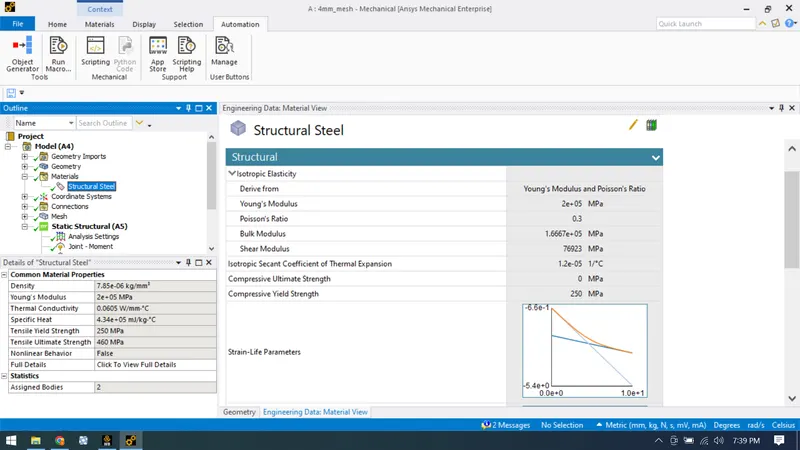
Analysis is carried out individuall for each case.
Connection details:
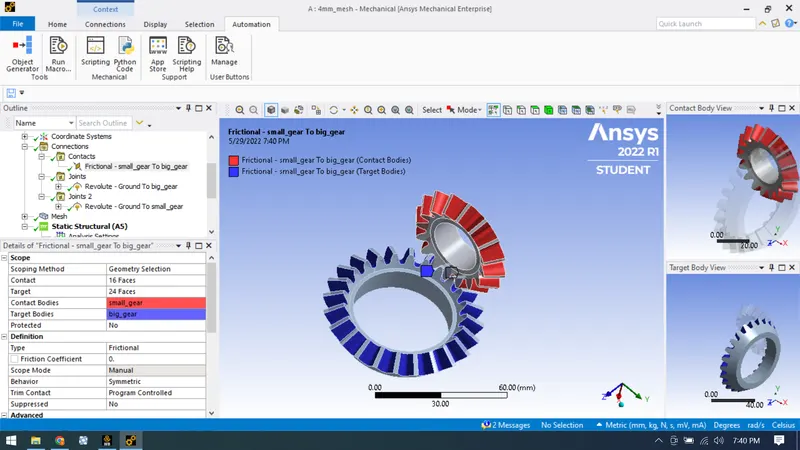
The type of contact chosen for the given gear drive for driver and driven gear is considered as frictional contact and formulation is chossed as augmented lagrange to minimise the interference . To avoid penetration interference treatment is chosen asadjust to touch.
Joint details:
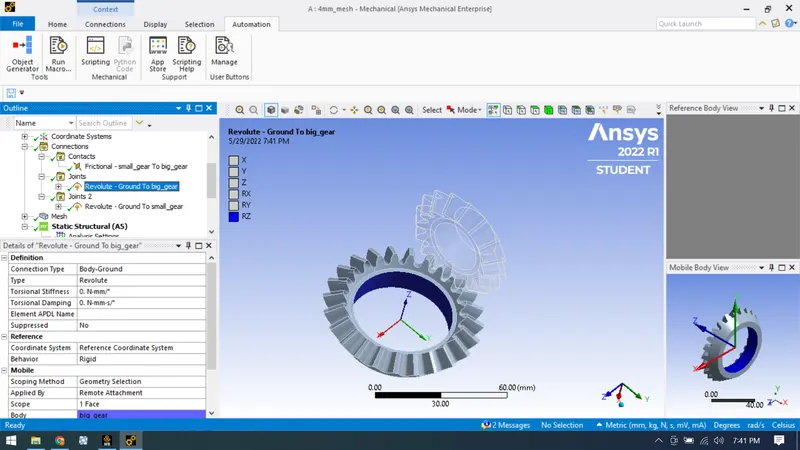
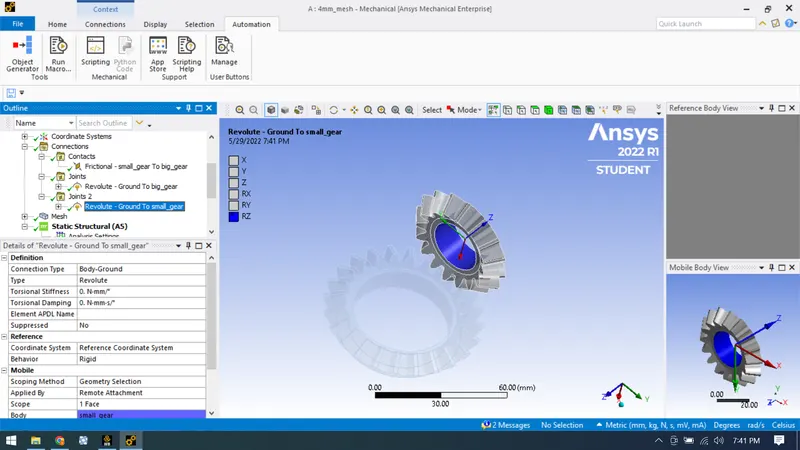
Here, both the gear are provided with revolute joint with ground to gear contact , small gear is provided with DOF of rotation along Z azis with type as rotation and increment of 20 degree and big is provided with DOF of rotation along Z axis with type as moment of 100 N-mm.
Meshing:
Case 1 : 4 mm
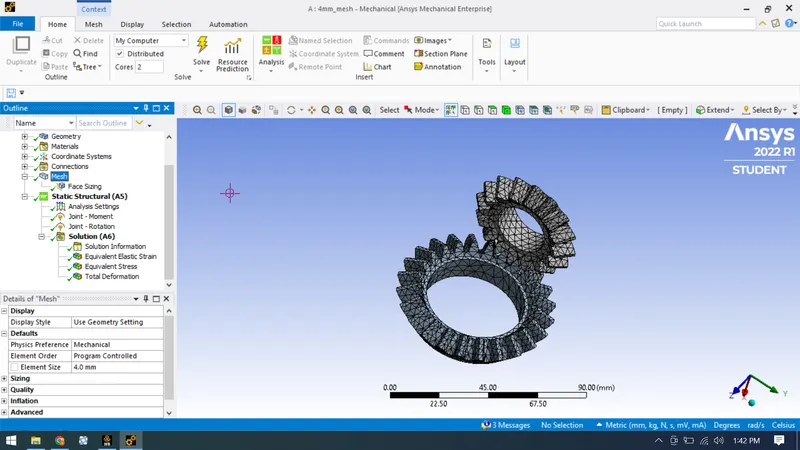
The general mesh size is provided to be 4mm and the type of mesh is TETRA. The no of nodes in the mesh are 14001 and no of elements are 7173 .
Case 2 : 5 mm
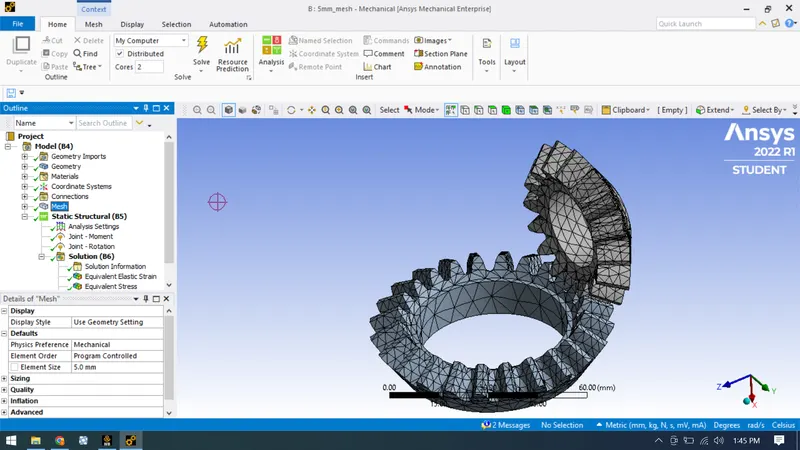
The general mesh size is provided to be 5mm and the type of mesh is TETRA. The no of nodes in the mesh are 13220 and no of elements are 6760 .
Case 3 : 6 mm
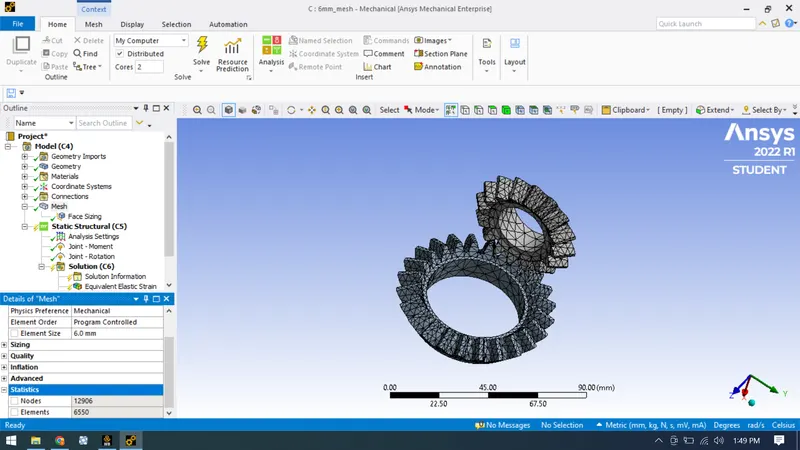
The general mesh size is provided to be 6mm and the type of mesh is TETRA. The no of nodes is the mesh are 12906 and no of elements are 6550 .
Joint load details:
Small Gear is considered as driven gear hence, rotation of 120 degree is considered at an increment of 20 degree, therefore Big gear has to be driving gear since the moment of 100N-mm is provided
Results:
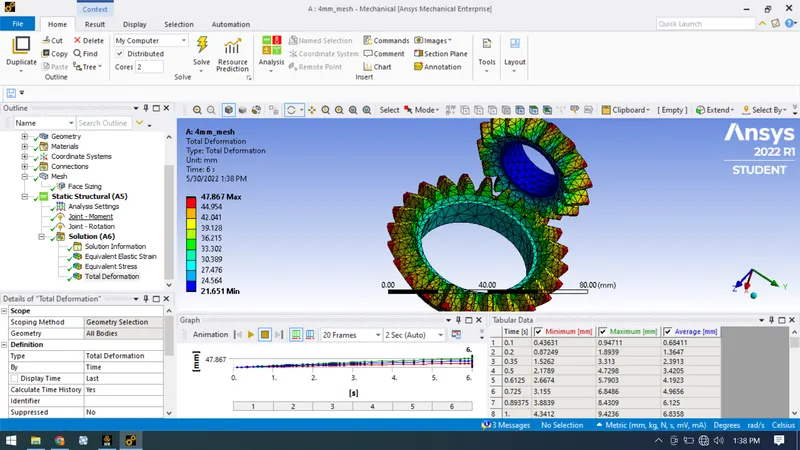
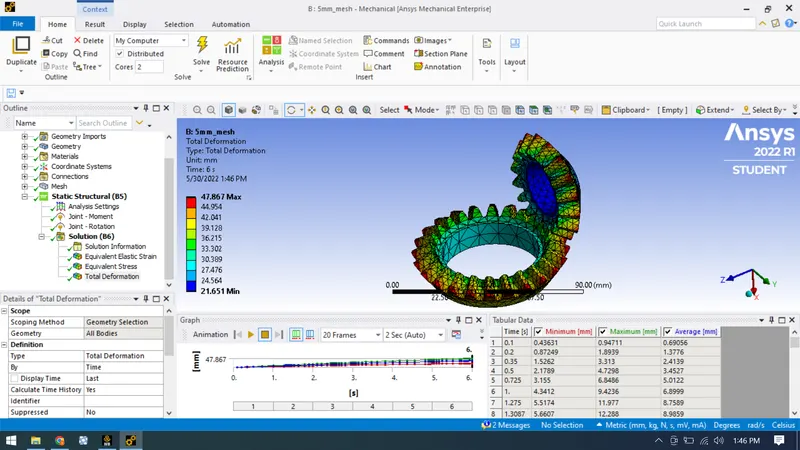
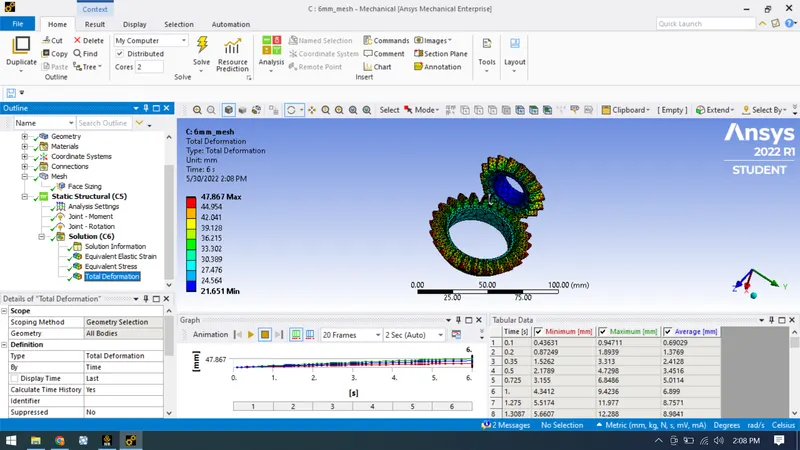
Total deformation:
Case 1:4mm
Case 2:5mm
Case 3:6mm
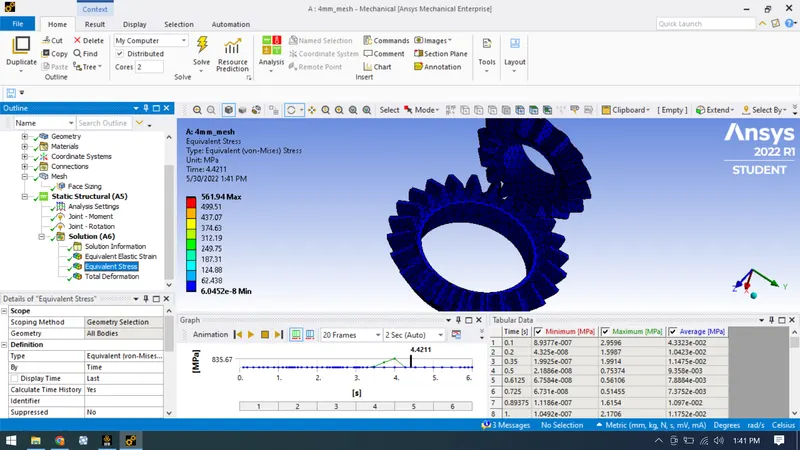
Equivalent Stress:
Case 1:4mm
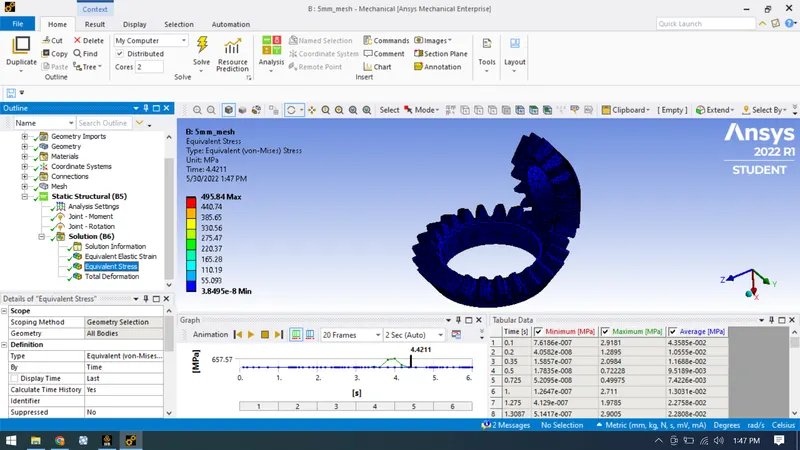
Case 2:5mm
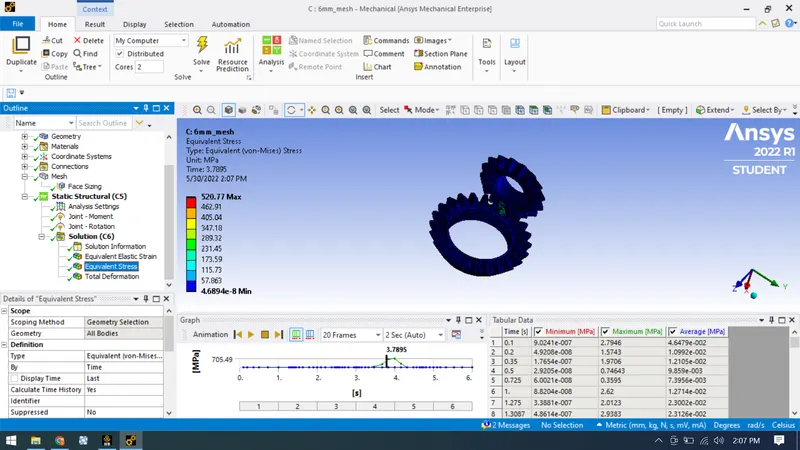
Case 3:6mm
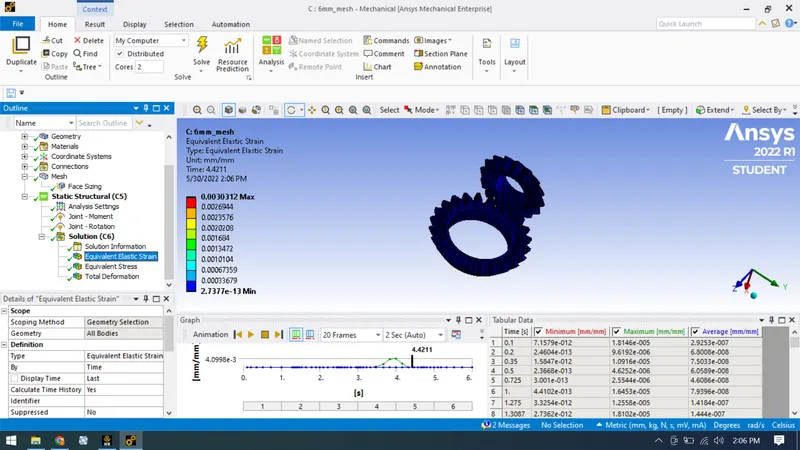
Equivalent elastic strain:
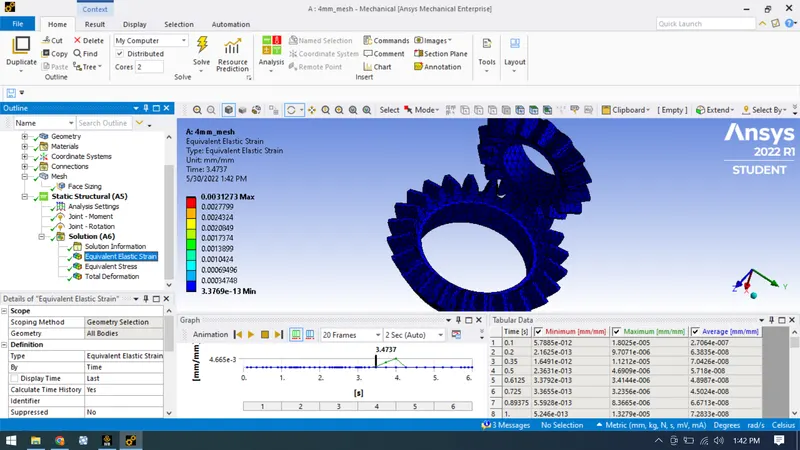
Case 1:4mm
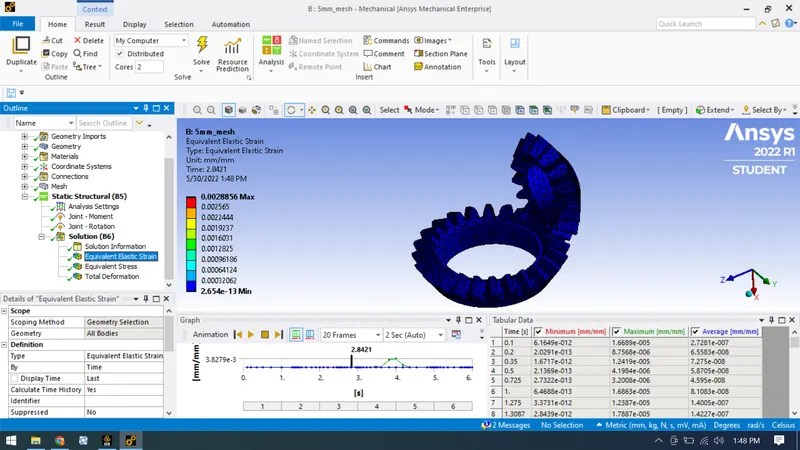
Case 2:5mm
Case 3:6mm
Tabular Report Comparison For All The Three Cases:
| Analysis | Case 1 (4mm) | Case 2 (5mm) | Case 3 (6mm) |
| Max Total deformation | 47.867mm | 47.867mm | 47.867mm |
| Max Equivalent Stress | 561.94MPa | 495.84MPa | 520.77MPa |
| Max Equivalent elastic strain | 0.0031273 | 0.0028856 | 0.0030312 |
Conclusion:
• Total deformation (47.867) is same all 3 cases, i.e, mesh size won't affect total deformation.
• Average change of Equalent elastic strain is almost similar in all 3 cases
• Equivalent stress value changes with element size reduction in mesh which leads to accurate
simulation results.
• Selection of mesh size depends on factors like, computational time, accuracy of result,
type of application and so on..
• Before selecting the mesh size consider the above mentioned factors.
NOTE: Please access text file attached for drive link for .wbpj and .wbpz files for analysis.