Week 1 Spur Gear Challenge
objective: For the given materials applied for the spur gear and then run the simulation and compare the results and decide which material is recommended based on the results.
Spur gears or straight-cut gears are the simplest type of gear. These gears mesh together correctly only if fitted to parallel shafts. No axial thrust is created by the tooth loads. Spur gears are excellent at moderate speeds but tend to be noisy at high speeds.
The spur gears can be classified into two main categories: External and Internal. The gears with teeth cut outside of the cylinder are known as external gears. The gears with teeth cut on the internal side of the cylinder are known as internal gears. An external gear can mesh with an external gear or an internal gear. When two external gears mesh together they rotate in the opposite directions. An internal gear can only mesh with an external gear and the gears rotate in the same direction. Due to the close positioning of shafts internal gear assemblies are more compact then external gear assemblies.
Procedure:
1.first edit the engineering data in the structural analysis tab first add the given materials like cast iron, cast steel ,bronze cast if the material is not there then create the material using the given data .
fig shows the properties of the bronze cast given
fig shows the properties of the cast steel given.
cast iron material is selected from the granta design sample.
2.After the materials is selected and then import the geometry and then edit the model and assign the selected material to the geometry .
3.After assign the material create the contacts and the taget bodies of the 26 faces each on the teeths and then create the revolute joints in the contacts region which is one is clock wise and other in anticlock wise region.
4.Mesh the given teeths with the default mesh size or the approximate size 0f 0.5 to 1mm after the mesh is done then set the static structural analysis with a settings of steps as 6 and the time intial taken as the 0.2sec and the min of 5e-2 and the max time of the 0.5sec.
5.After the seetings of analysis create the joint load in the rotation and in the moment the rotation of about 180 degree and moment of about the -10N/mm.
6.Add the equivalent stress and total deformation and the equivalent elastic strain in the solution to evaluate these results.
case1:
Using Cast Iron(ductile) as a material, carry out a static structural analysis to find out Equivalent stress, Total deformation and Stress intensity(Learn about what stress intensity is). Find location for possible fracture
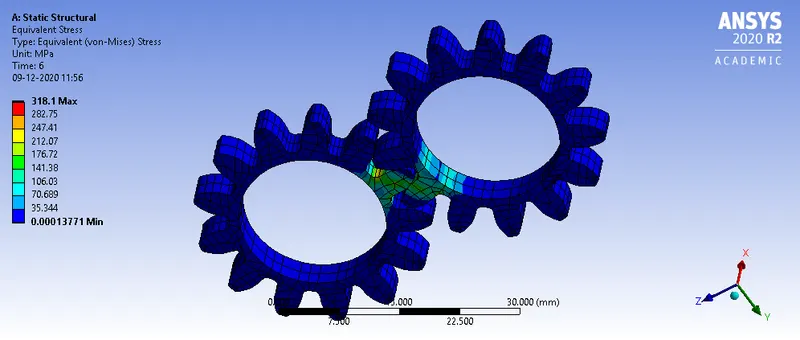
fig shows the max and min stress for the cast iron .
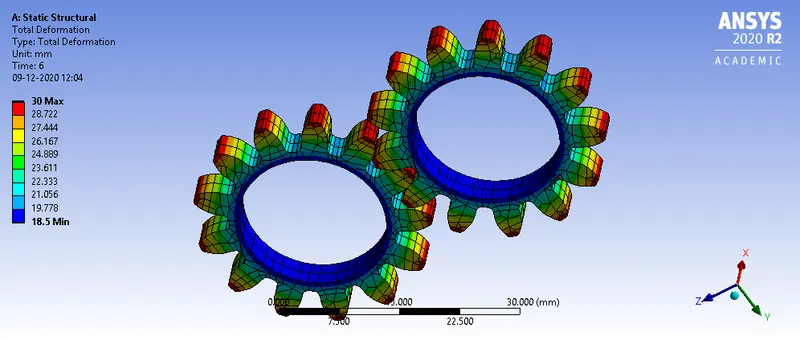
fig shows the max and min of total deformation of the cast iron
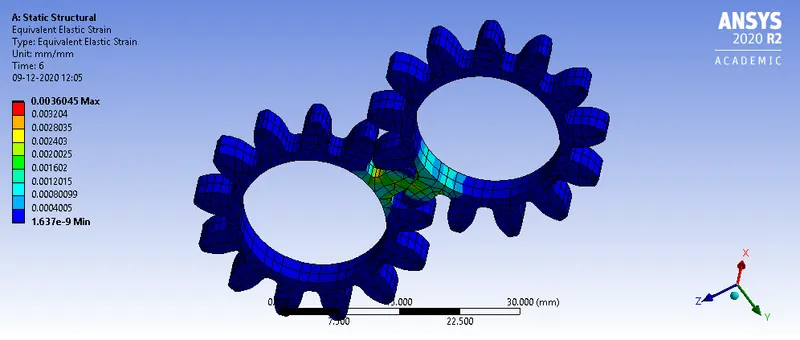
fig shows the max and min elastic strain for the cast iron
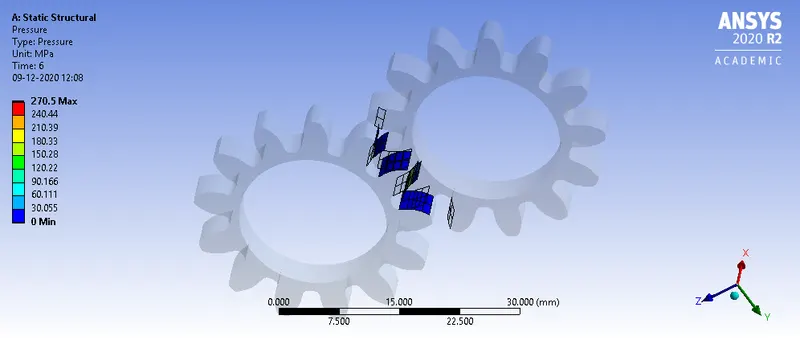
fig shows the max and min pressure of the cast iron
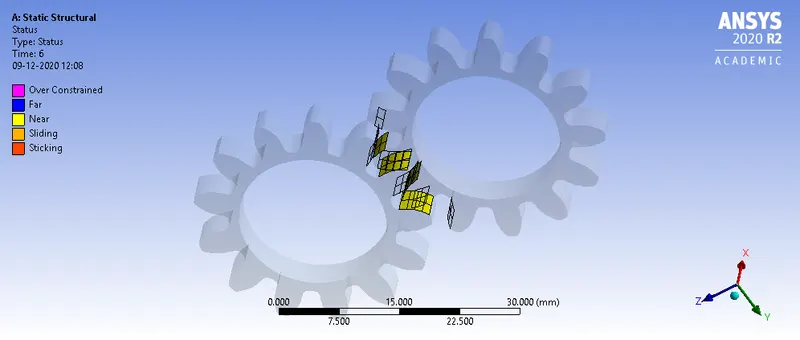
fig shows the status of the contacts of spur gear (cast iron)
case2
Using Cast Steel as material, perform the same analysis for the results as in Case 1.
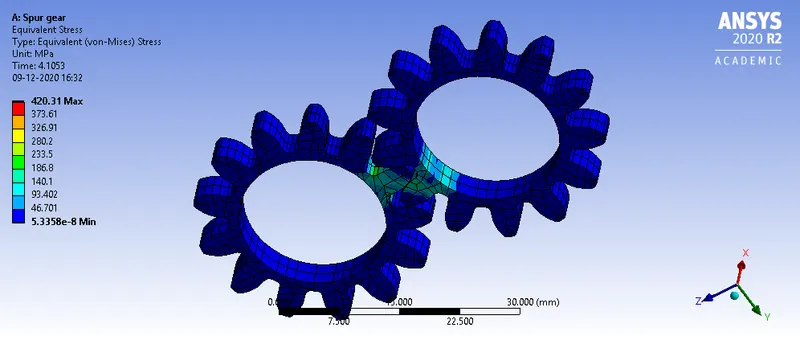
fig shows the max and min stress of the material cast steel
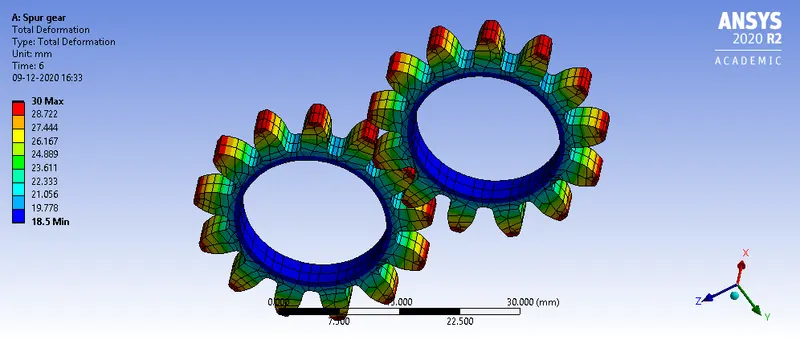
fig shows the total deformation of the material cast steel
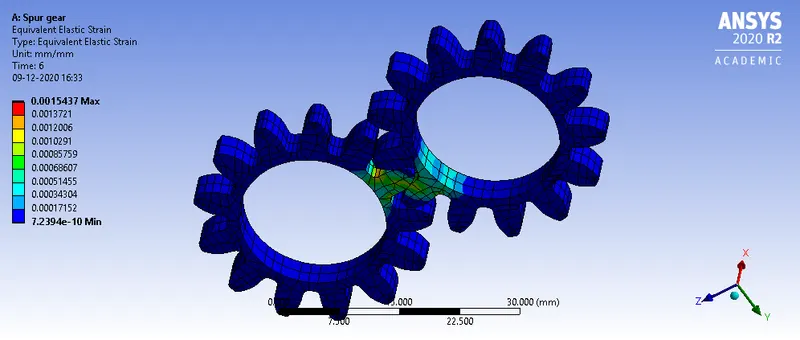
fig shows the elastic strain of the material for cast steel.
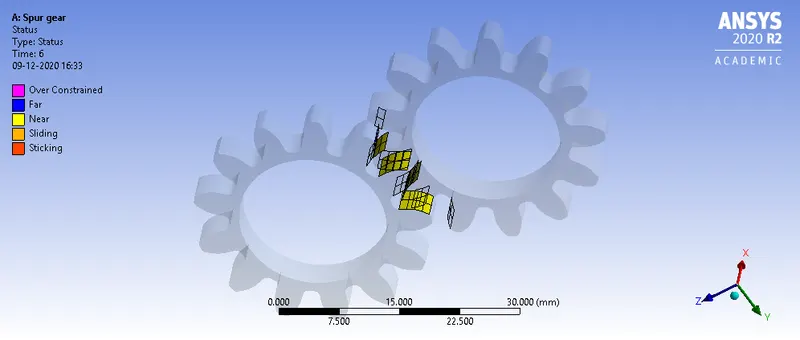
fig shows the status of the contacts of material cast steel
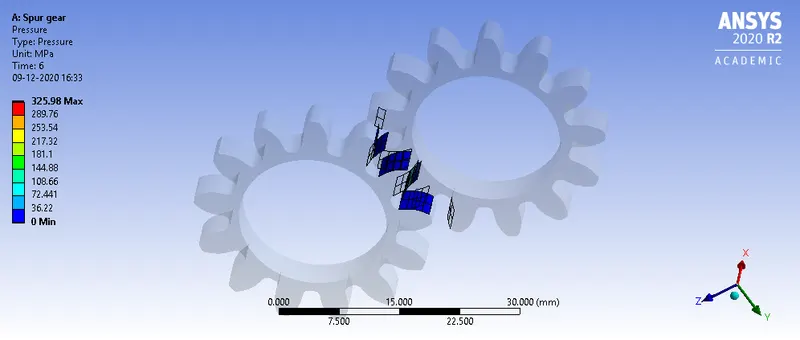
fig shows the max and min pressure of the material cast steel.
case3
Using Cast Bronze as material, perform the same analysis for the results as in Case 1.
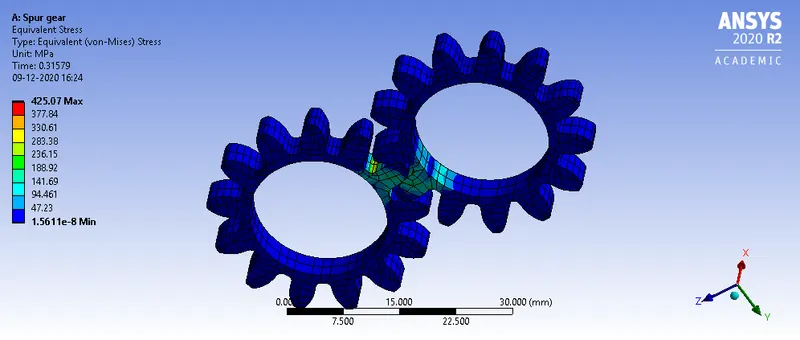
fig shows the max and min stress of the cast bronze.
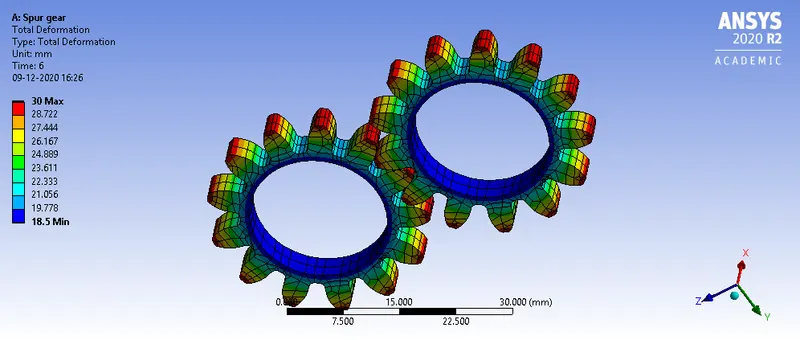
fig shows the min and max total deformation of the material cast bronze
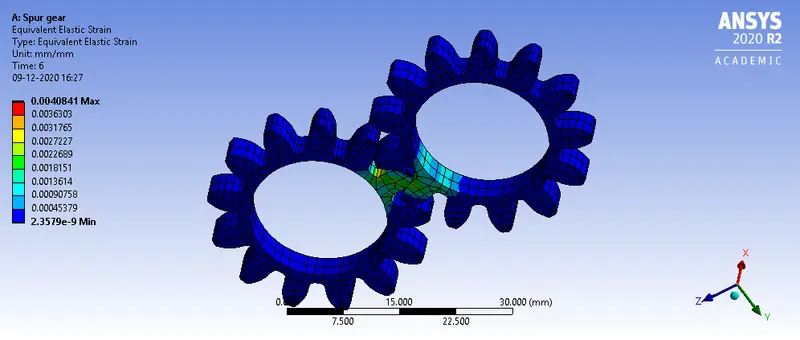
fig shows the max and min elastic strain for the material cast bronze.
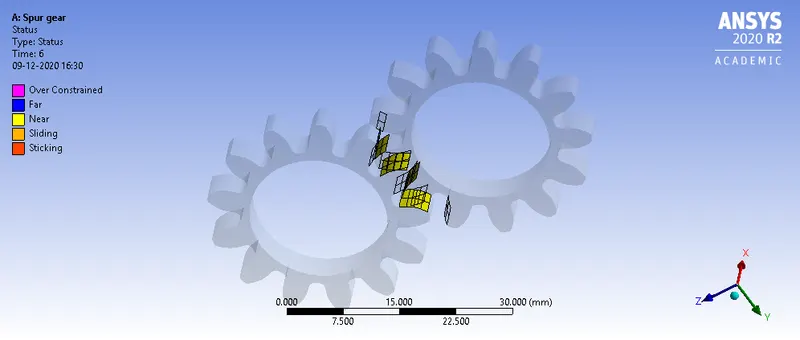
fig shows the status of the contacts for the material cast bronze.
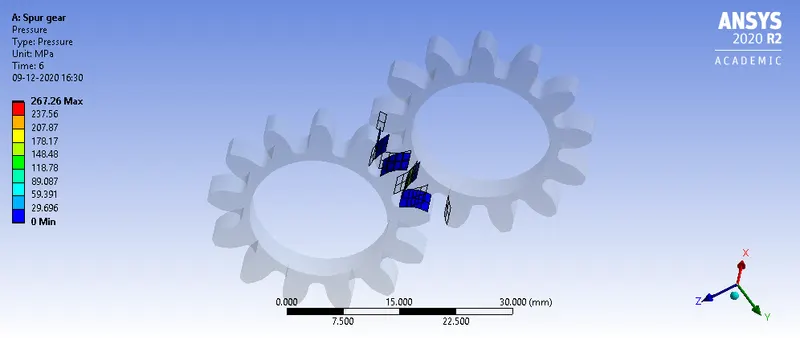
fig shows the max and min pressure of the material cast bronze.
Results and comparision
-
cases Materials Equivalent stress(Mpa) Total deformation(mm) Equivalent elastic strain(mm/mm) pressure(Mpa) case1 cast iron Max:318.1
Min:0.00013771
Max:30
min:18.5
Max:0.0036045
min:1.637e-09
Max:270.5
min:0
case2 cast steel Max:420.31
min:5.3358e-08
Max:30
min:18.5
Max:0.0015437
min:7.2394e-10
Max:325.98
min:0
case3 cast bronze Max:425.07
Min:1.5611e-08
Max:30
min:18.5
Max:0.0040841
min:2.3579e-09
Max:267.26
min:0
- The table shows the results as per the above results the maximum stress is in material cast bronze is observed and the minimum stress is in the cast iron of about the 318.1 mpa so that more stress leads to the highest force or the force is increasing along with the stress .
- cast iron is brittle material with less stress concentation so the cast iron is used as compared to the cast steel and bronze.
- The maximum pressure obtained in the cast steel as compared to cast bronze and cast iron .
- cast iron contains more than 2% carbo as cast steel contains 0.1 to 0.5 % carbon.
conclusion:
From this project learnt about the various materials and the properties involved in that materials and to run the simulation for the various cases with change of materials and then compare the results of the simulation.