Week 8 - Universal Joint
objective:For this challenge, you will have to perform a transient structural analysis on a double universal joint with a spring using three different materials: Structural Steel, Stainless Steel and Titanium alloy and need to obtain the Equivalent stress and total deformation for all the three cases and compare them.
procedure
case1:use the structural steel for the full components.
1.Add the structural steel material to the engineering data library and then import the geometry into the space claim and then check for any geometry errors .
2.Edit the geometry into the mechanical and then assign the material structural steel to all the components.
3.Delete the contacts and then define the fixed joint to the face of the spring,Define the two Revolute joint to the 2 faces and then define the revolute joint of body to body to the joints.
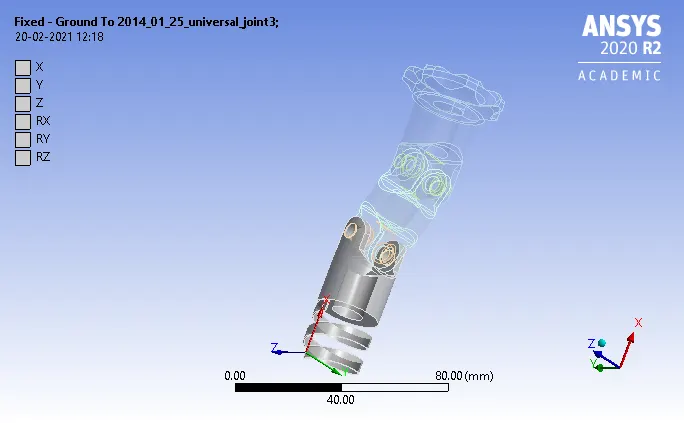
Fig shows the fixed of the face of the spring .
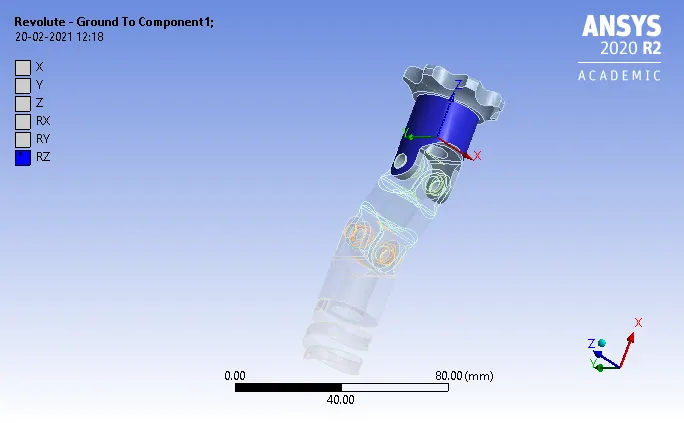
Fig shows the revolute joint 1 in the direction of z axis.
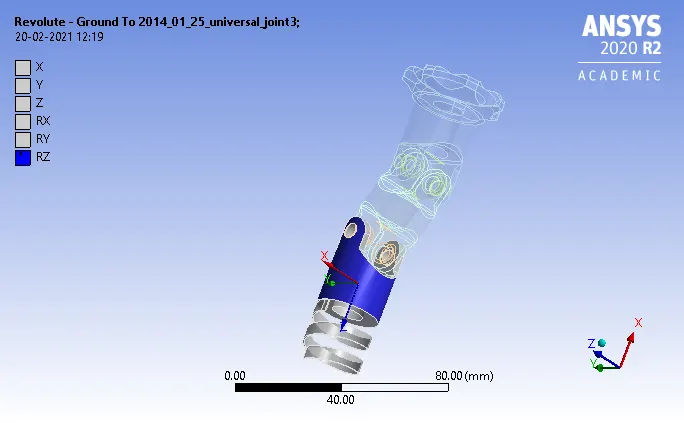
Fig shows the revolute joint 2 of the gear in the z axis.
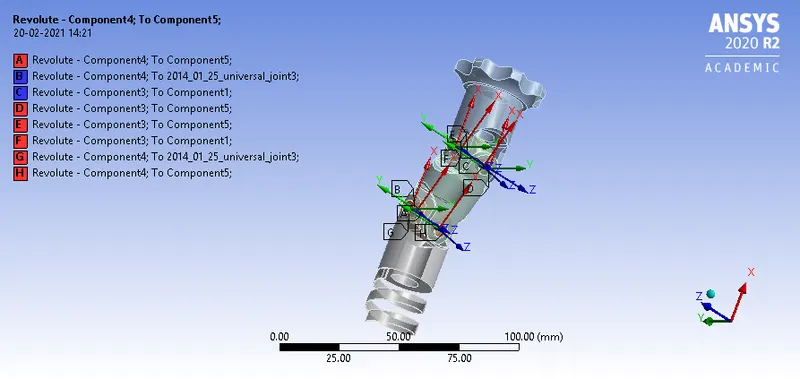
Fig shows the revolute joint of body to body
4.Define the mesh of size 4mm with adaptive sizing off .
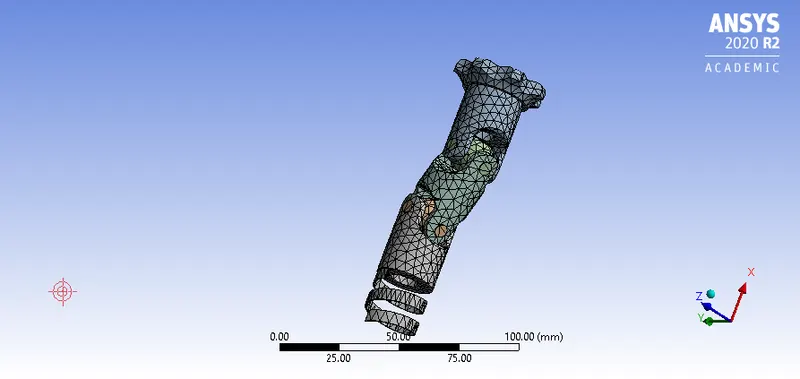
Fig shows the meshing of the component with 4mm mesh size.
5.In the analysis settings set the no of steps is 5 and auto time step is off and give the time step value as 0.1sec and then define the joint rotation of about from 30 degree to 150degree.
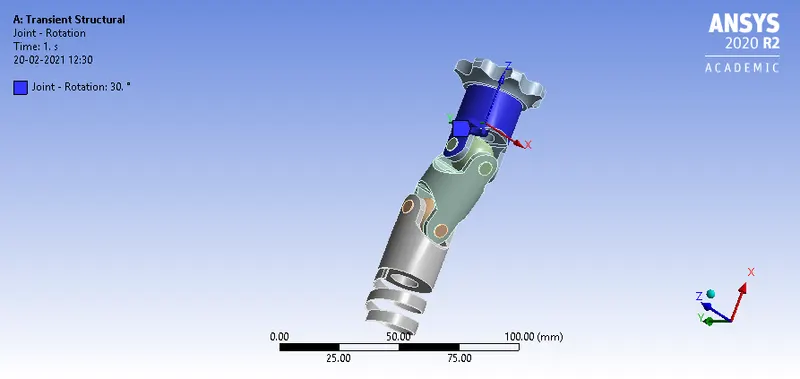
Fig shows the joint rotation from 30 to 150 degree in the z direction.
6.Add the equivalent stress,elastic strain,total deformation,and equivalent stress of the centre joint and joint probe for both the joints with the calculate of total force,moment,angular velocity.
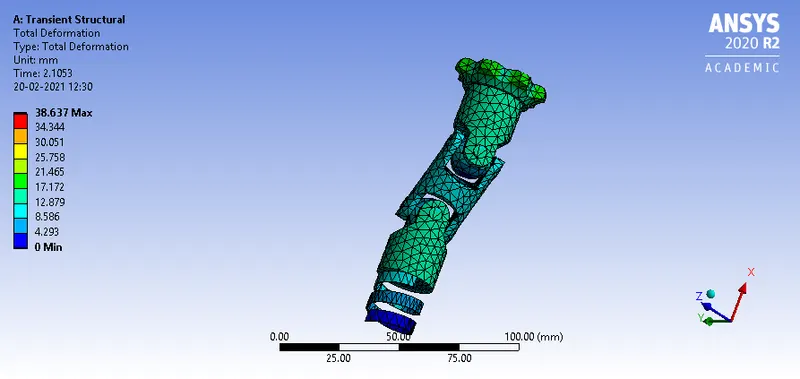
Fig shows the total deformation of min of 0mm and max of 38.637mm
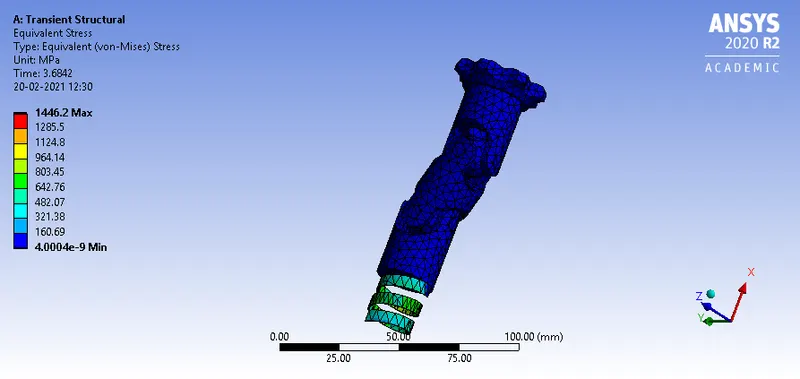
Fig shows the equivalent stress of min of 4.004e-09mpa and max of 1446.2mpa.
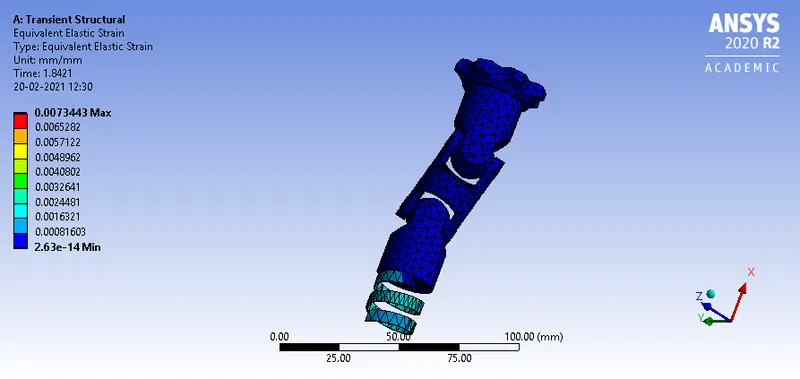
Fig shows the equivalent elastic strain of min of 2.63e-14mm/mm and max of 0.0073443mm/mm.
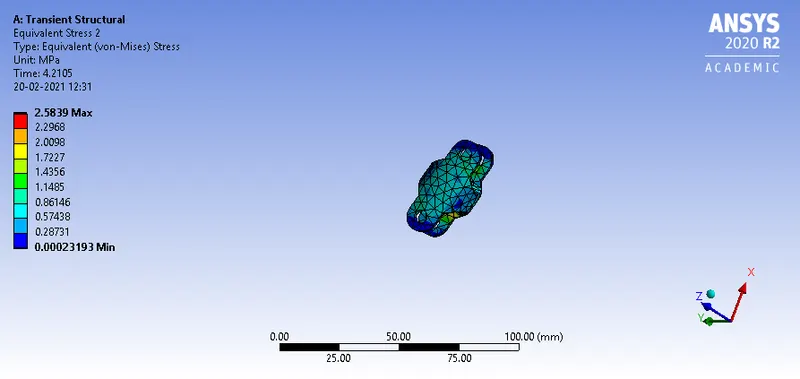
Fig shows the equivalent stress of the central joint of min of 0.00023193mpa and max of 2.5839mpa.
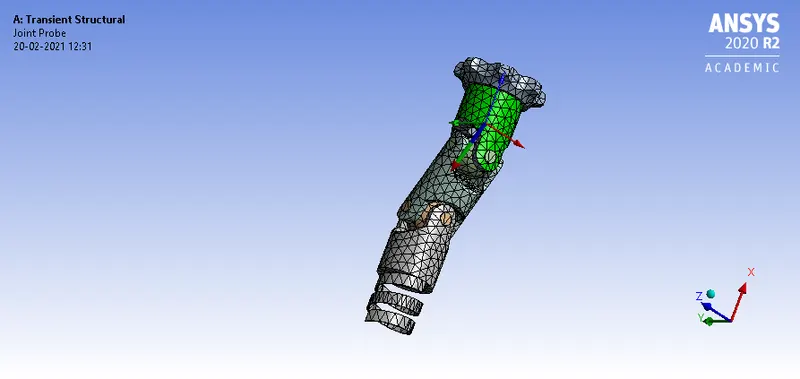
Fig shows the probe of for total force of 86.705N for the revolute joint 1.
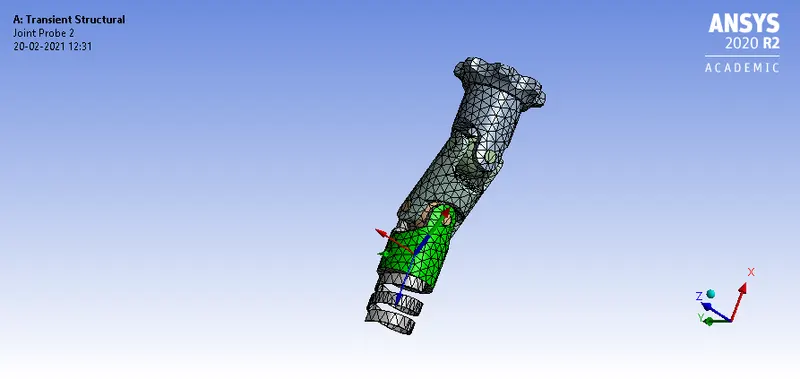
Fig shows the probe for the total force for the revolute joint 2 will be 90.453N.
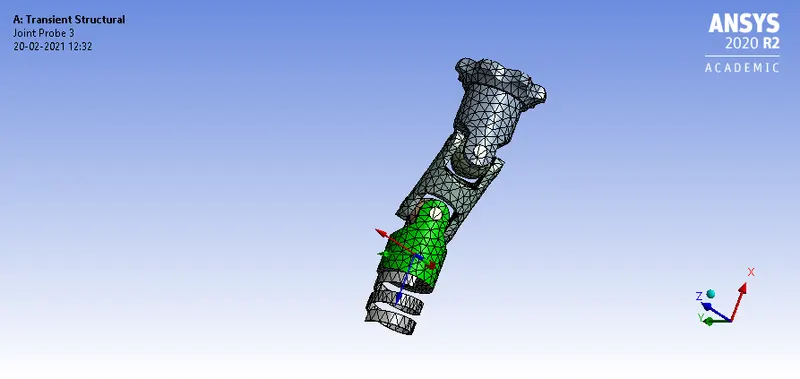
Fig shows the total moment of the revolute joint 2 will be 582.37n-mm.
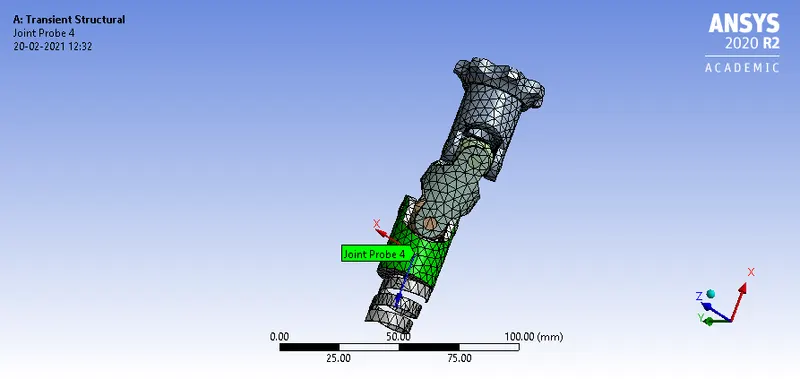
Fig shows the probe of relative angular velocity in z direction of -0.52332rad/sec.
case2
using the material as the stainless steel for the all joints and spring.
- The procedure is repeated as the same for the case1 but just add the material stainless steel to the engineering library and also assign these stainless steel to the all the joints and spring.
- obtain the result of equivalent stress and total deformation .
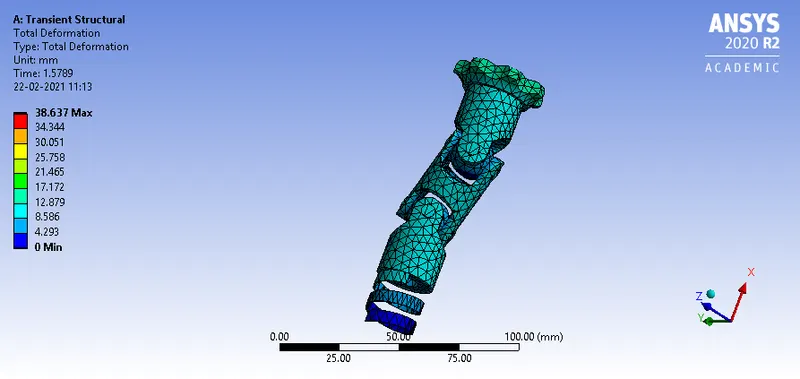
Fig shows the total deformation of min of 0mm and max of 38.637mm.
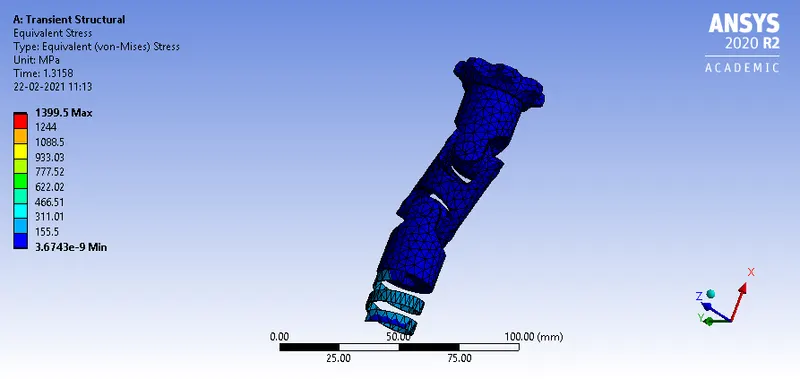
Fig shows the equivalent stress of min of 3.6743e-09mpa and max of 1399.5mpa.
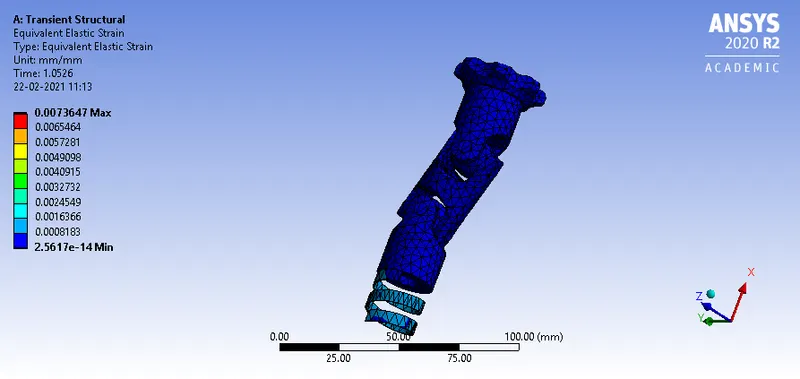
Fig shows the equivalent elastic strain of min of 2.5617e-14mm/mm and max of 0.0073647mm/mm.
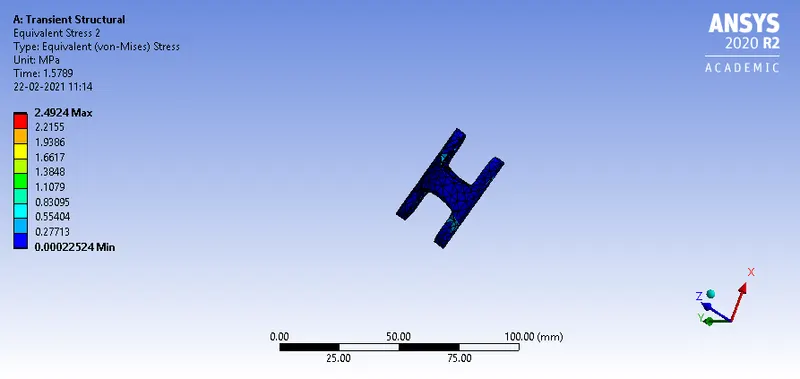
Fig shows the equivalent stress of min of 0.00022524mpa and max of 2.4924mpa.
case3
- The procedure is repeated as the same for the case1 but just add the material titanium alloy to the engineering library and also assign these titanium alloy to the all the joints and spring.
- obtain the result of equivalent stress and total deformation .
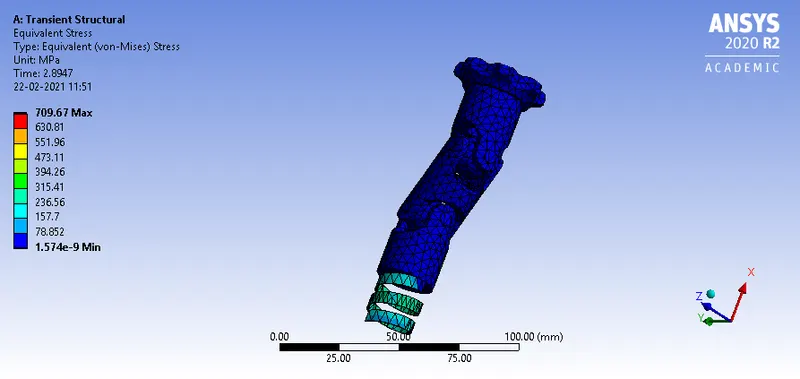
Fig shows the equivalent stress of min of 1.574e-09mpa and max of 709.67mpa.
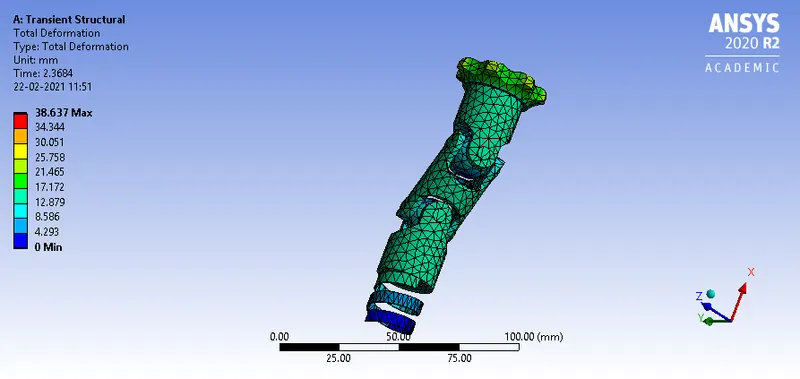
Fig shows the total deformation of min of 0 mm and max of 38.637mm.
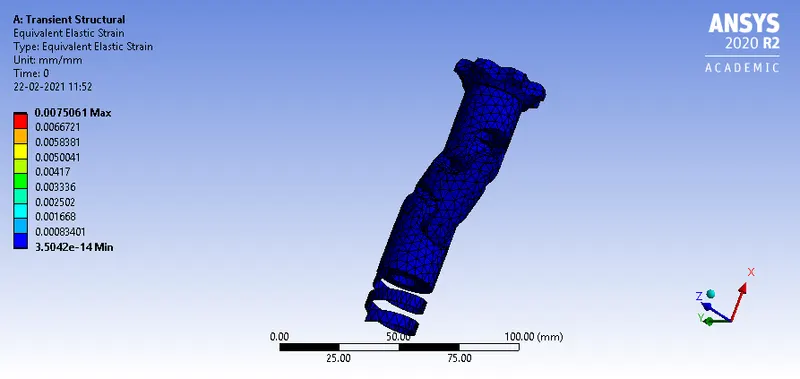
Fig shows the equivalent elastic stain of min of 3.5042e-14mm/mm and max of 0.0075061mm/mm.
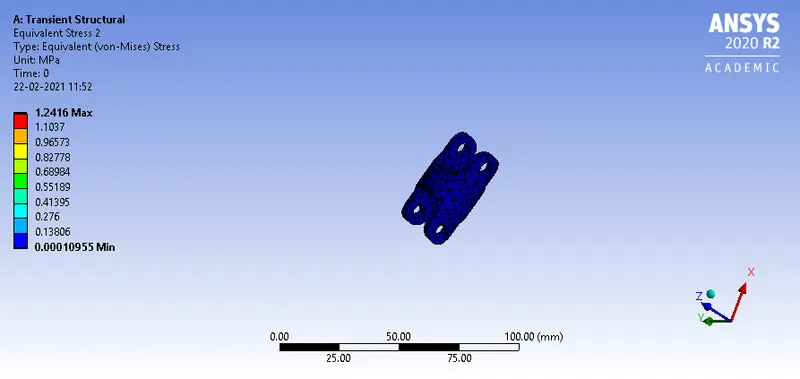
Fig shows the equivalent stress of min of 0.00010955mpa and max of 1.2416mpa.
Results and comparision.
| cases | Materials used | Equivalent stress(mpa) | Total deformation(mm) |
| case1 | structural steel |
Min:4.004e-09 Max:1446.2 |
Min:0 Max:38.637 |
| case2 | stainless steel |
Min:3.6743e-09 Max:1399.5 |
Min:0 Max:38.637 |
| case3 | Titanium alloy |
Min:1.574e-09 Max:709.67 |
Min:0 Max:38.637 |
- In the above results the max stress will be at the material of structural steel is about the 1446.2mpa.
- The minimum stress for the material is about the titanium alloy of min of 709.67mpa.
- The total deformation is constant of about the max of 38.637mm.
CONCLUSION
In this challenge learnt about the equivalent stress will be changing by change of the materials to the joints and the spring in the geometry and then compare these results.
Note:
In this challenge there is clear of the data generated in the results and solution due to large file size.