Project 2
Aim:For the given assembly, check for the geometrical errors and mesh with the given element Quality criteria. After meshing the component the thickness has to be assigned for mid surfaces. Use tetra elements to model non-uniform thickness components.
procedure: 1.Import the given model and then check for the geometry errors and then fix it by auto fix or by manually.
2.The quality criteria as given as fallows.
Quality Criteria for Tria Elements (Tyre and Rim):
|
S.No |
Quality Criteria |
Value |
|
1 |
Target/Average length |
6.5 |
|
2 |
Minimum Length |
5 |
|
3 |
Maximum Length |
10 |
|
4 |
Skewness |
45 |
Quality criteria for mixed elements (For mid surface only)
|
S.No |
Quality Criteria |
Value |
|
1 |
Target/Average length |
4 |
|
2 |
Minimum Length |
2 |
|
3 |
Maximum Length |
6 |
|
4 |
Aspect |
3 |
|
5 |
Warpage |
15 |
|
6 |
Skewness |
45 |
|
7 |
Jacobian |
0.7 |
|
8 |
Minimum Quad Angle |
45 |
|
9 |
Maximum Quad Angle |
135 |
|
10 |
Minimum Tria Angle |
30 |
|
11 |
Maximum Tria Angle |
120 |
Quality criteria for tria ( for other components)
|
S.No |
Quality Criteria |
Value |
|
1 |
Target/Average length |
4 |
|
2 |
Minimum Length |
2 |
|
3 |
Maximum Length |
6 |
|
4 |
Skewness |
45 |
common quality criteria value
|
S.No |
Quality Criteria |
Value |
|
1 |
Tet-collapse |
0.2 |
3.first take the rim and tyre and mesh that components with a shell mesh and then convert into volume mesh .
4.steps to convert shell mesh to volume mesh
- first go to the volume mesh tab in that define the volume by selecting the component and also create the solid property and then make the rapid tetra mesh to the component.
- After the making of the volume mesh check for the tetcollapse that fails if fails fix that by manually by using the move free nodes in the grid option.
5.If the sell mesh the minimum and max size fails fix it by using reconstruction or by moving the move free node option in the grid option .
6.In the suspension aseembly non uniform thickness that mesh with the tetra mesh of a given quality criteria and the thickness of the features which is less than 5 mm and uniform that component will be mesh with the shell mesh .
7.for the tyre and the rim define the quality values as per given in the table above with the volume mesh .
8.After done clear of all the quality then give thickness for the shell meshed features .
9.After giving the thickness then do the necessary connections whereever required.
10.procedure to do overlap shell connections.
- first select the bolt regions that are connected with the rbe2 elements and select the surfaces that are parallel are connected with the overlap shell mesh,and surfaces that are parallel and closed are done with the spot weld.
- In these components more rbe2 elements are connected and for the spring can be done with rbe2 elas elements.
- procedure to do overlap shell
first take the free edge line and then convert that line into the seam line and then go to the connection manager in that select that seam line and then define the property p1 and p2 and then give the search distance and then give apply and realize.
- procedure to do bolt connections
first take the 3d point and then convert that point to bolt and do the nodes by selecting the nodes by circle and then select the master node as the bolt defined at the centre.
- procedure to do the spot weld
first take the 3d point by selecting the cons of the surface and then same on the parallel surface then go to the connection manager then define the proprty p1 and p2 and then give the search distance and thendo apply and realize.
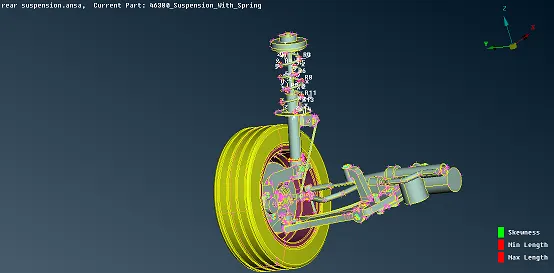
fig shows the rear suspension with rim and tyre
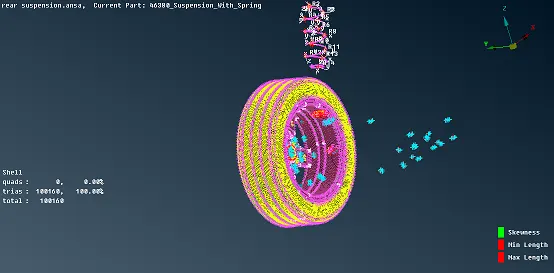
Tetra mesh of the tyre and rim component and showing connections
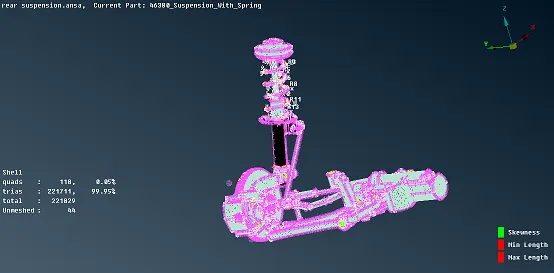
fig shows the meshing of the suspension assembly and shell mesh of the components
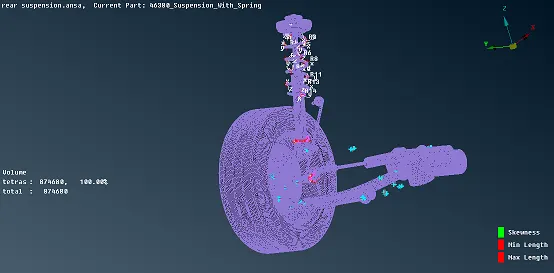
fig shows the volume mesh of the component
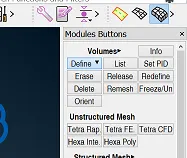
fig shows the define of the volume mesh
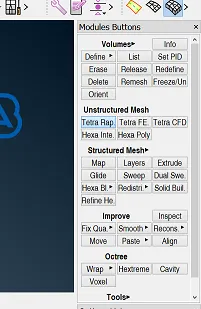
fig shows the define of the tetra mesh
Details about the rear suspension system
Suspension is the system of tires, tire air, springs, shock absorbers and linkages that connects a vehicle to its wheels and allows relative motion between the two. Suspension systems must support both road holding/handling and ride quality, which are at odds with each other. The tuning of suspensions involves finding the right compromise. It is important for the suspension to keep the road wheel in contact with the road surface as much as possible, because all the road or ground forces acting on the vehicle do so through the contact patches of the tires. The suspension also protects the vehicle itself and any cargo or luggage from damage and wear. The design of front and rear suspension of a car may be different.
The first workable spring-suspension required advanced metallurgical knowledge and skill, and only became possible with the advent of industrialization. Obadiah Elliott registered the first patent for a spring-suspension vehicle; each wheel had two durable steel leaf springs on each side and the body of the carriage was fixed directly to the springs which were attached to the axles. Within a decade, most British horse carriages were equipped with springs; wooden springs in the case of light one-horse vehicles to avoid taxation, and steel springs in larger vehicles. These were often made of low carbon steel and usually took the form of multiple layer leaf springs.
The spring rate (or suspension rate) is a component in setting the vehicle's ride height or its location in the suspension stroke. When a spring is compressed or stretched, the force it exerts is proportional to its change in length. The spring rate or spring constant of a spring is the change in the force it exerts, divided by the change in deflection of the spring. Vehicles which carry heavy loads will often have heavier springs to compensate for the additional weight that would otherwise collapse a vehicle to the bottom of its travel (stroke). Heavier springs are also used in performance applications where the loading conditions experienced are more extreme.
Spring rate is a ratio used to measure how resistant a spring is to being compressed or expanded during the spring's deflection. The magnitude of the spring force increases as deflection increases according to hook's law . Briefly, this can be stated as

where
- F is the force the spring exerts
- k is the spring rate of the spring
- x is the deflection of the spring from its equilibrium position (i.e., when no force is applied on the spring).
Damping is the control of motion or oscillation, as seen with the use of hydraulic gates and valves in a vehicle's shock absorber. This may also vary, intentionally or unintentionally. Like spring rate, the optimal damping for comfort may be less than for control.
Damping controls the travel speed and resistance of the vehicle's suspension. An undamped car will oscillate up and down. With proper damping levels, the car will settle back to a normal state in a minimal amount of time. Most damping in modern vehicles can be controlled by increasing or decreasing the resistance to fluid flow in the shock absorber.
The rear suspension of a vehicle performs the same general function as front suspension, but the specific construction is typically quite different. ... The most basic purposes of a suspension system are to prevent the body of a vehicle from hitting the ground and to keep the tires in contact with the road.
There are three basic types of suspension components: linkages, springs, and shock absorbers. The linkages are the bars and brackets that support the wheels, springs and shock absorbers.
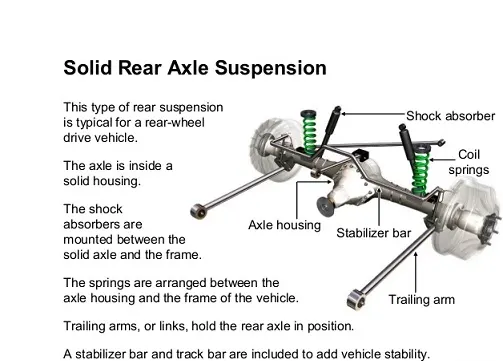
fig shows the diagram of rear suspension system
conclusion:In this project learnt about the rear suspension system with a spring and also the meshing of the components with volume mesh and do the connections of the component and learnt about the few of the formulas that used in the calculation of the force on the spring.