Wiring harness design in CATIA V5 - 3D modeling Week 2 Challenge
OBJECTIVE: Define the given connectors & Connector clip cad data as Electrical Connector using Electrical Part design Workbench. Define all the necessary properties of Connectors & Clip.
Introduction:
A connector is a device(or more precisely, a mating pair of devices, often a plug and a socket) for connecting together two or more wires, cables, or hoses, allowing electricity or fluid to flow but also allowing easy disconnection and reconnection when necessary.
Different Types of Connectors:
Board to Board Connector:
Stackable printed circuit boards (PCBs) can be accurately interconnected with the help of board-to-board (BTB) connectors. Their adaptability gives design freedom to different PCB configurations, relative distances, and space limitations.
To further accommodate electrical and mechanical requirements, a wide variety of materials, plating treatments, and pitches are on hand.
Wire to Board Connector:
Aside from the automotive sector, wire-to-board connectors find widespread application in many other sectors. These connectors are typically used to connect numerous computer equipment to the board.
TME offers a variety of Wire to Board Connector and cable assembly options with various pitch sizes. With over 900+ connectors to choose from, Transfer Multisort Elektronik has been offering high-quality electronic components online since 2013.
Wire to Wire Connector:
Electrical connections called wire-to-wire connectors are used to join two wire-terminated cables together.
Multi-Pin Sealed Connectors:
Multi-pin sealed connectors are used to block the entry of debris and moisture from the outside.
Terminal Connectors:
Automotive connector terminals are built to withstand repeated inserts and removal of cables while allowing maximum efficiency. Built to withstand extreme temperatures and vibrations, these are a must-have.
Standardized terminals are commonly used in automotive connectors because they allow for a reliable and speedy connection between wires and headers.
Ⅰ Automotive Connectors
There are nearly 100 types of connectors used in general automobiles, and there are hundreds of connectors used in a single model. As people have higher and higher requirements for safety, environmental protection, comfort, and intelligence in automobiles, the application of automotive electronic products is increasing, which make the number of automotive connector applications increase.
Figure 1. Automotive Connector Type
Ⅱ Basic Structure
The four basic structural components of automotive connectors, it is these four basic structural components that enable automotive connectors to act as a bridge to make cars run stably.
First, the contact piece is the core part of the automobile connector to complete the electrical connection function. Generally, a contact pair is composed of a male contact piece and a female contact piece, because the electrical connection is completed by the insertion of two parts.
The male contact is a rigid part, and its shape is cylindrical (round pin), square column (square pin) or flat (insert). The male contacts are generally made of brass and phosphor bronze. The female contact piece is the jack, which is the key part of the contact pair. It relies on the elastic structure to elastically deform when it is inserted into the pin to generate elastic force to form close contact with the male contact piece to complete the connection. There are many types of jack structures, including cylindrical type (split slot, necking), tuning fork type, cantilever beam type (longitudinal slotting), folding type (longitudinal slotting), box type (square jack) and hyperboloid wire spring jacks, etc.
Second, the shell, is the outer cover of the automotive connector. It provides mechanical protection for the built-in insulating mounting plate and pins, and provides alignment when the plug and socket are inserted, thereby fixing the connector to the device.
Third, insulators, are also often referred to as automobile connector bases or inserts. Its function is to arrange the contacts according to the required position and spacing, and to ensure the insulation performance with the shell. Good insulation resistance, withstand voltage performance and ease of processing are the basic requirements for selecting insulating materials to be processed into insulators.
Fourth, accessories, are divided into the structural part and the installation part. Structural accessories such as retaining rings, positioning keys, positioning pins, guide pins, coupling rings, cable clamps, sealing rings, gaskets, etc. Mounting accessories such as screws, nuts, spring rings, etc. Most of the accessories have standard parts and general parts.
Ⅲ Design Criteria
With the rapid development of the automobile industry, various functional parts and various components on the automobile are constantly developing in the direction of intelligence, refinement and reliability. The structural design, appearance design and material of automobile connectors are also proposed. higher requirement. Automotive connectors must meet the USCAR-20 standard, which is the performance standard of automotive electrical connector systems. It is necessary to stipulate that the electrical connector contact surface of automotive connectors should always be reliable throughout the service cycle, including the following factors:
1) The material of the connector contacts is stable and reliable.
2) Positive force stability.
3) The voltage and current of the circuit are stable.
4) The temperature requirements are within the specified range, including the surrounding temperature and its own temperature rise.
5) Better robustness.
6) It must be the same as the connector used for high-speed and long-distance communication computers, and the automotive connector must be able to work reliably under harsh conditions.
7) Connector insertion force: below 20.5kg
8) Connector retention force: 2.5kg or more
9) Heat resistance: -40~120℃
Figure 2. Automotive Connectors
Ⅳ Automotive Connector Development Trends
The "Miniaturization", "High Speed" and "Intelligence" of connector products are the trends of future development. The future technological innovation of the industry is mainly concentrated in the following directions:
1) Miniaturization Development
This technology is mainly developed for the miniaturization trend of connectors, and can be applied to micro-miniature connectors below 0.3mm, which belongs to the new varieties of MINI USB series products. It can be used for multi-contact expansion card slot connectors, which can meet and exceed the strict requirements of multi-contact surface mount technology butt joint coplanarity, with high accuracy and low cost.
2) Wireless Transmission
The high-frequency and high-speed wireless transmission of connector technology is mainly aimed at a variety of wireless device communication applications and has a wide range of applications.
3) Simulation Application Technology
It is based on a variety of disciplines and theories, using computer and its corresponding software such as AutoCAD, Pro/E program stress analysis software as tools, through the establishment of product models and corresponding boundary conditions, to its mechanical, electrical, high-frequency simulation analysis and confirmation of other performances, thereby reducing the cost of product development failure caused by factors such as material selection and unreasonable structure, improving the development success rate, and helping to provide support for the realization of complex system applications for products.
4) Connector Intelligence Technology
This technology is currently mainly used in DC series power connector products. Intelligent signal detection can be performed before power transmission to ensure that the positive and negative poles are turned on and the power is turned on after the plug is inserted in place. In the future, enterprises will need to develop similar intelligent technologies for other products because of the adverse consequences of arc damage and burn-in caused by conductive contact.
5) Precision connector technology
Precision connectors involve many aspects such as product design, process technology and quality control technology. The main technologies include the following aspects:
a. Precision mold processing technology: Adopt CAD, CAM and other technologies, introduce high-precision processing equipment in the industry, and use personnel production experience and advanced equipment and technical means to achieve high-precision high-quality mold products.
b. Precision stamping and injection molding technology: realize precise, efficient and stable all-round control and perfect surface quality of various stamping parts and injection molding parts to ensure product quality.
c. Automated assembly technology: Through the application of precision control technology, semi-automatic testing machine technology, etc., the problem of manual operation of precision products is overcome and the core competitiveness is improved.
6) Manufacturing Process Research
The competitiveness of products depends to a certain extent on the level of manufacturing technology. Continuously developing new manufacturing processes and improving existing production and processing technologies can greatly improve the manufacturing efficiency and quality assurance capabilities of products.
a. Fine manufacturing process: This process is mainly aimed at technologies such as small spacing and thin thickness. Some companies have carried out research on the process of connectors with a spacing of less than 0.4mm. This type of technology can ensure that the company reaches the advanced level of the international industry in the field of ultra-fine manufacturing.
b. Integrate development technology of light source signal and electromechanical structure. It can be applied to audio connectors placed in electronic components. By adding IC, LED and other electronic components to the audio connectors, which can also transmit analog signals and the function of digital signal. It breaks through the current design of audio connector conduction transmission in the form of mechanical contact.
c. Low temperature and low pressure molding process technology. The sealing and physical and chemical properties of the hot-melt material are used to achieve the functions of insulation and temperature resistance. After packaging, the wire protects the welding point from being pulled by external forces, and the packaging of the DC connector body and the wire has a insulation, temperature resistance, impact resistance and other functions ensure product quality and reliability, and will continue to be developed and applied in different products in the future.
Figure 3. Automotive Connectors
Ⅴ Connector Selection
1) Electrical Factor
Current requirements: high current, low current, signal level;
Steady state, cyclic, transient.
They determine the type of terminal/size of contact segment/plating (0.64mm to 8.0mm pin and male terminal).
Wire diameter/insulation requirements: voltage drop and/or corrosion resistance, which determine the center distance of the connector.
2) Location/Environment
Temperature: Engine compartment – sealed, ambient temperature >105℃; vibration, fluid compatibility, passenger compartment – unsealed, ambient temperature <85>
Sealing: Potential for high pressure jet/splash, potential for immersion, humidity; fluid type, sealed or not for device connectors.
3) Standard
Standards: Customer Standards
Institutional Standards
Domestic Standards
International Standards
Connector performance test requirements are included in system-level specifications. For GM, Ford and Chrysler are usually USCAR specifications, that is, engine-related applications have relatively high vibration requirements. Other OEMs generally have their own standards (similar to USCAR). What’s more, equipment-side suppliers are responsible for the performance of mating-side connectors.
4) Customer Preference
Preferred product strategy: Reduce cost of connector systems with different methods:
Ford: Design competition for door connectors.
Ford: Prefer terminal design/supplier (focus on contact interface).
General: Prefer the terminal design (focus on the hole position of the connector).
Chrysler: Strategies for favoring terminal/plastic Part suppliers.
5) Regional preference
North America: USCAR Drawing/Performance/Design Criteria —Tangless Terminals, TPA, CPA regulations. In many instances the harness supplier has a significant influence.
Europe: Design influence of contact contacts/development with major OEMs; preference for two-piece contacts, even if cost pressures and North American porting operations force OEMs to consider U.S technology, that is, accepting Tangled contacts. Long-term relationships between OEMs and suppliers.
Asia: Traditionally influenced by Toyota. Focus on assembly ability (ergonomics) that affects quality assurance; North America influences China to change the status, like low-cost solutions.
6) Physical factors
Size, number of circuits, mating position, wire harness docking or equipment connection, mechanical main features: levers, bolts; manual docking capability; multiple types of connectors for high input/output applications.
7) Assembly
Wire Harness: Insertion force of connector
Visual, audible and tactile operational feedback for users.
Figure 4. Terminals & Connectors
Ⅵ Performance Standard for Automotive Electrical Connectors
For a connector, the specification parameters such as the ambient temperature, current carrying capacity, protection level, anti-vibration level, etc. will be defined in its specifications at the beginning of research and development, because when the connector is selected according to different requirements. The following are three most widely used standards USCAR-2-6, QC/T1067-2017 and GMW3191-2012.
🔺QC/T-1067 Temperature Classification
|
Class |
Ambient Operating Temperature |
Typical Installation Position |
|
A |
-40~85℃ |
Passenger compartment (Not recommended) |
|
B |
-40~100℃ |
Passenger compartment |
|
C |
-40~125℃ |
On engine |
|
D |
-40~150℃ |
On engine (hot locations) |
|
E |
-40~175℃ and above |
Negotiate |
🔺QC/T-1067 Vibration Classification
|
Class |
Typical Installation Position |
|
V1 |
On elastic parts of the body but not to the engine |
|
V2 |
On engine but not to heavily vibrating parts |
|
V3 |
Components subject to serve vibration |
|
V4 |
Components subject to extreme vibration |
|
V5 |
On Wheel |
🔺QC/T-1067 Sealing Classification
|
Class |
Description |
Typical Installation Position |
|
S1 |
Unsealed |
Passenger compartment or trunk |
|
S2 |
Sealed |
Exposed areas |
|
S3 |
Sealed (with high pressure spray) |
Exposed areas (with high pressure spray) |
🔶GMW-3191 Temperature Class
|
Class |
Ambient Operating Temperature |
Typical Installation Position |
|
1 |
-40~85℃ |
Passenger compartment or trunk |
|
2 |
-40~100℃ |
Underhood, chassis |
|
3 |
-40~125℃ |
On engine, transmission |
|
4 |
-40~150℃ |
On engine (hot locations) |
|
5 |
Per connector CTS |
Per CTS |
|
GTS=Component Technical Specification |
||
🔶GMW-3191 Vibration Class
|
Class |
Typical Installation Position |
|
1 |
On body or chassis |
|
2 |
On engine |
|
3 |
On wheel, Unsprung Mass |
|
4 |
Severe applications (e.g., ECU, Throttle Body, EGR) |
|
5 |
Transmission (internal and external) |
|
ECU=Engine Control Unit, EGR=Exhaust Gas Recirculation |
|
🔶GMW-3191 Sealing Class
|
Class |
Description |
Typical Installation Position |
|
1 |
Unsealed |
Unsealed Passenger Compartment or trunk |
|
2 |
Submersion Sealed |
Underhood or exposed areas, including door |
|
3 |
High Pressure Spray Protected |
Exposed areas where high pressure spray is expected |
🔻USCAR-2 Temperature Classification
|
Class |
Ambient Operating Temperature |
Typical Application |
|
T1 |
-40~85℃ |
T1 is not recommended for new applications |
|
T2 |
-40~100℃ |
Typical suitable for use in passenger component |
|
T3 |
-40~125℃ |
Typical suitable for use in engine component |
|
T4 |
-40~150℃ |
Needed for some on-engine applications near hot components |
|
T5 |
-40~175℃ |
For use as needed |
🔻USCAR-2 Vibration Classification
|
Class |
Common Name |
Typical Application |
Other Requirements Met |
|
V1 |
Chassis Profile |
Components on sprung portions of vehiele not coupled to Engine |
None |
|
V2 |
Engine Profile |
Components coupled to Engine with no severe vibration possible |
Pass on V2 - pass also for V1 |
|
V3 |
Severe On-Engine |
Components subject to serve vibration |
Pass on V3 - pass also for V1 and V2 |
|
V4 |
Extreme Vibration |
Used as needed to correlate to extreme vibration areas |
Pass on V4 - pass also for V1 and V2 and V3 |
|
V5 |
Unsprung |
Component Wheel-mounted components |
None |
🔻USCAR-2 Sealing Classification
|
Seal Class |
Common Name |
Typical Application |
|
S1 |
Unsealed |
S1 is suitable for use in passenger components or other dry areas on a vehicle such as the trunk |
|
S2 |
Sealed |
S2 (meets requirements of 5.9.7) is for exposed locations |
|
S3 |
Sealed (with high pressure spray) |
S3 is for exposed locations. It meets Sections 5.9.7 plus 5.6.7; S3 is applications when robustness to direct splash is needed |
Regarding the vibration test, the main purpose is to check whether the performance of the connector system under the simulated actual vehicle vibration conditions meets the requirements. In the case of vibration or in shock, it will cause the coating wear of the terminal contact surface, the positive pressure attenuation, the failure of the mechanical system performance of the supporting plastic material, etc. Therefore, it is necessary to continuously monitor the contact resistance in the vibration experiment and ensure that it does not exceed 7Ω (or 1Ω) in the line for more than 1 microsecond. According to the definition and analysis of the connector using environment through the above different standards, it is necessary to understand that the use position, the temperature level, vibration level, and protection level should be considered to make the best choice.
Mounting clips:
Mounting Clips are used for supporting conduits. These clips are made of High-Quality Impact Resistant Polyamide. The mounting clips are stackable and are fixed with the help of screws onto the panel or equipment surface.
Automatic Harness Clips offer a simple and secure method of attaching cables to panels and other surfaces. When the cable is pushed inside, it automatically activates the locking features which causes it to close. These are also connectable which allows for multiple cables to be positioned next to each other.
Different suppliers for connectors and its Accessories:
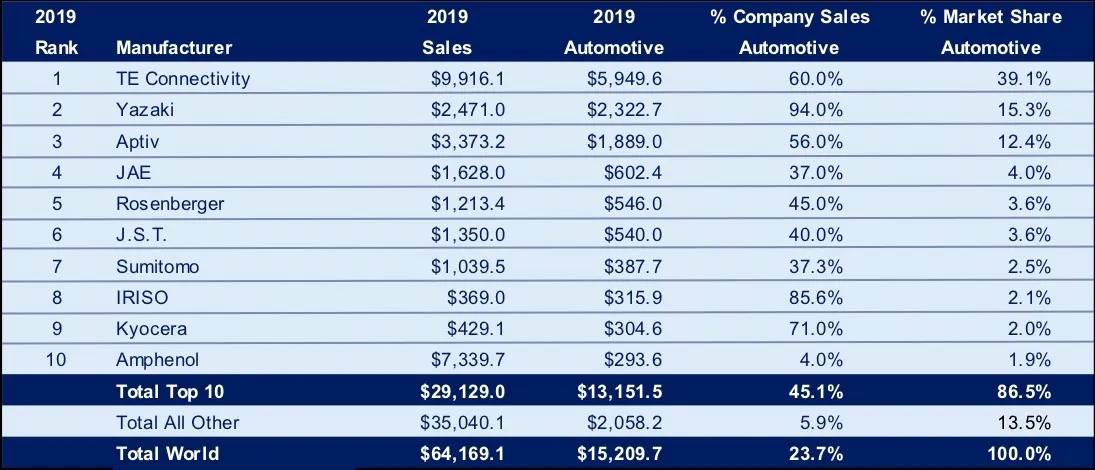
Aim:To download following connectors & Connector clip cad data from given link & define it as Electrical Connector using Electrical Part design Workbench.
- Deutsch DT06 – 08SA ( https://www.te.com/usa-en/product-DT06-08SA.html)
- Tyco 174357-2 (https://www.te.com/usa-en/product-2-174357-2.html?source=header-match)
- Tyco 85229-1 – (https://www.te.com/usa-en/product-85229-1.html?q=85229&source=header)
The following parameters are required to define any connector:
Geometry Parameters: Points & Co-ordinate system (Axis).
Connector connection points: This point is used for the connection of one connector to another connector.
Harness bundle entry point: This point defines where the harness bundle segment point will end when routed to the electrical connector.
Cavity connection point (Optional): This point is used to define the connection of a connector to a connector clip. This only applies to connectors that have the mounting feature for a connector clip
- CONNECTOR DEFINITIONS IN CATIA V5:
Connectors 1. Deutsch DT06 – 08SA
1. Import the downloaded step or igs file into the CATIA mechanical part workbench.
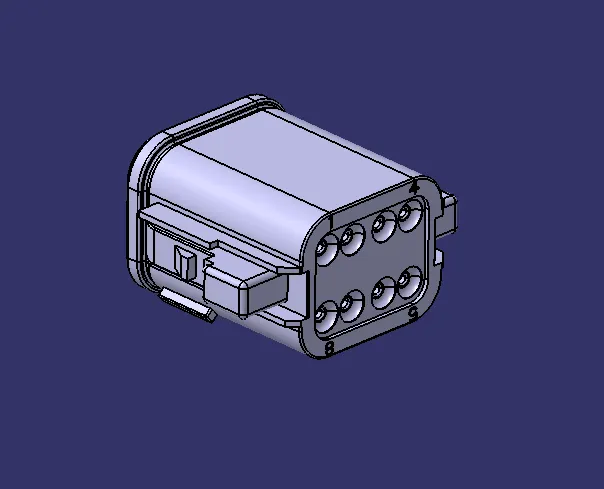
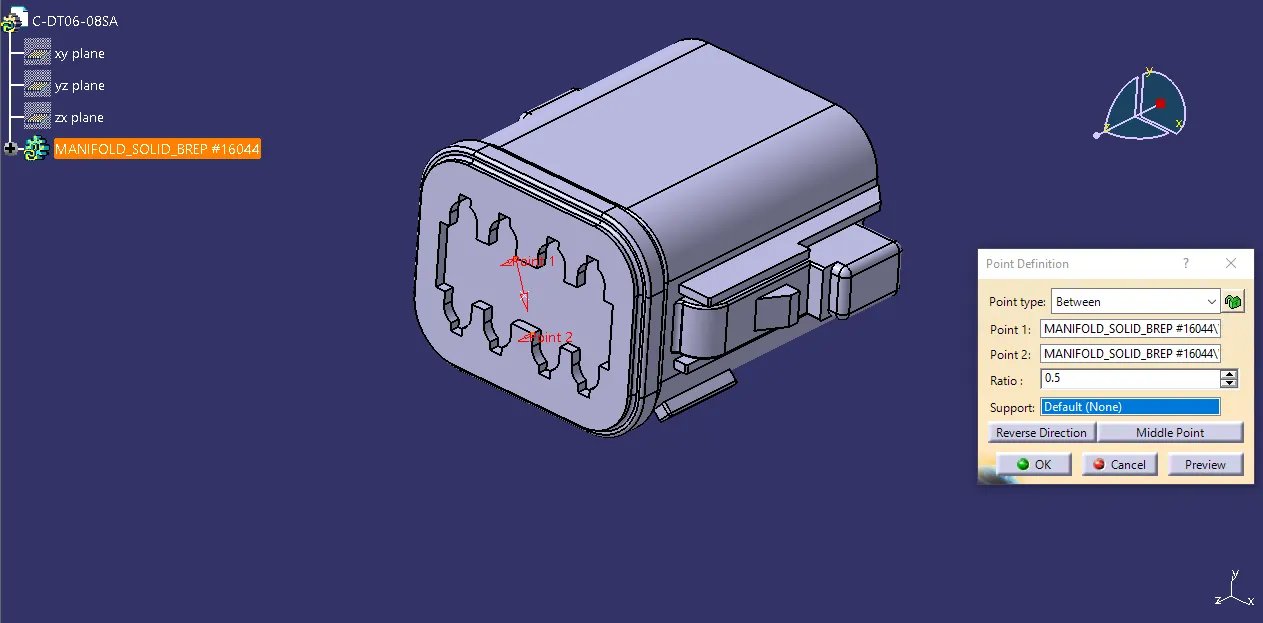
2. Define Connector connection point
Create midpoint on the contact face which will be normal to wire bunddle insertion.
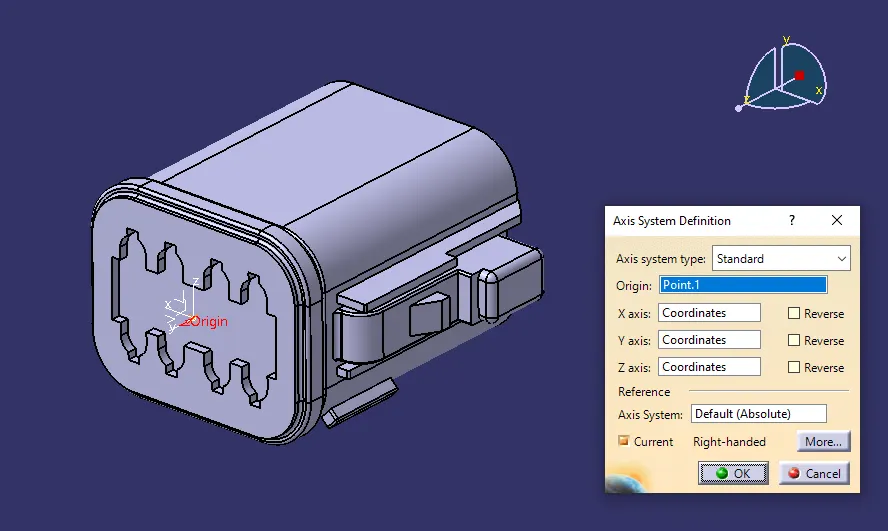
- Create Axis System with respect to the point which we have created and defining the axis direction as shown below.
- Y-AXIS-In direction of mating Face.
- X-AXIS-Towards locking position.
3) Bundle connection point:
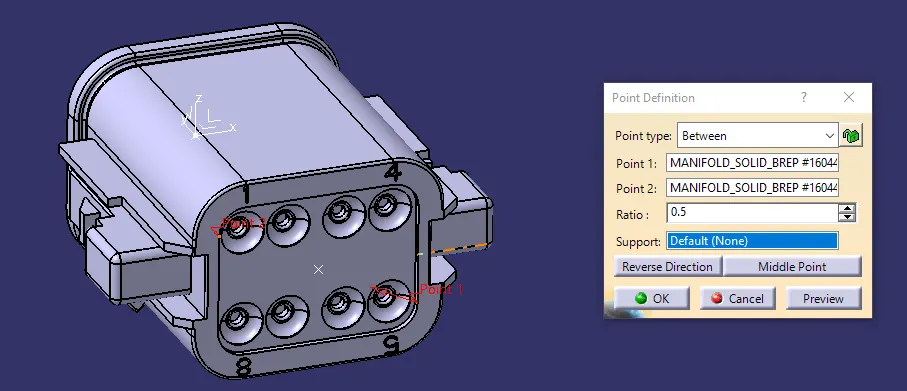
4) Switch to 'Electric Part Design'
- Define the part as connector in catia, give no. of termination as 8 because we have 8 entry points for wire.
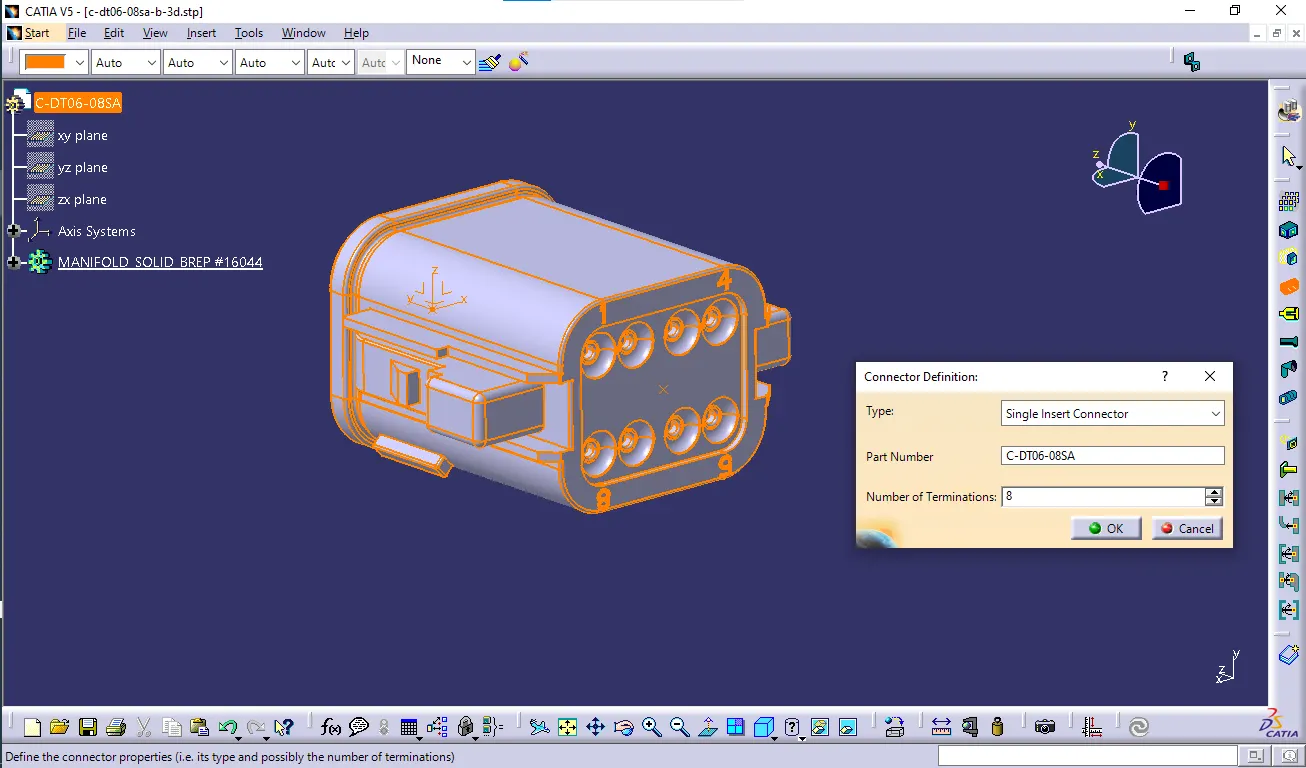
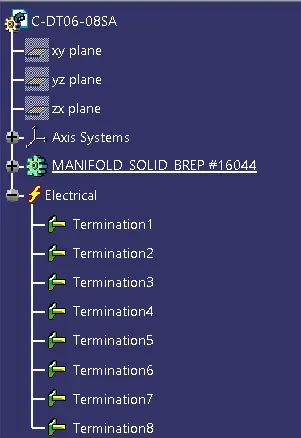

- Now connector is Electrically defined with electrical properties and references are published in publication.
- Define Bundle connection point
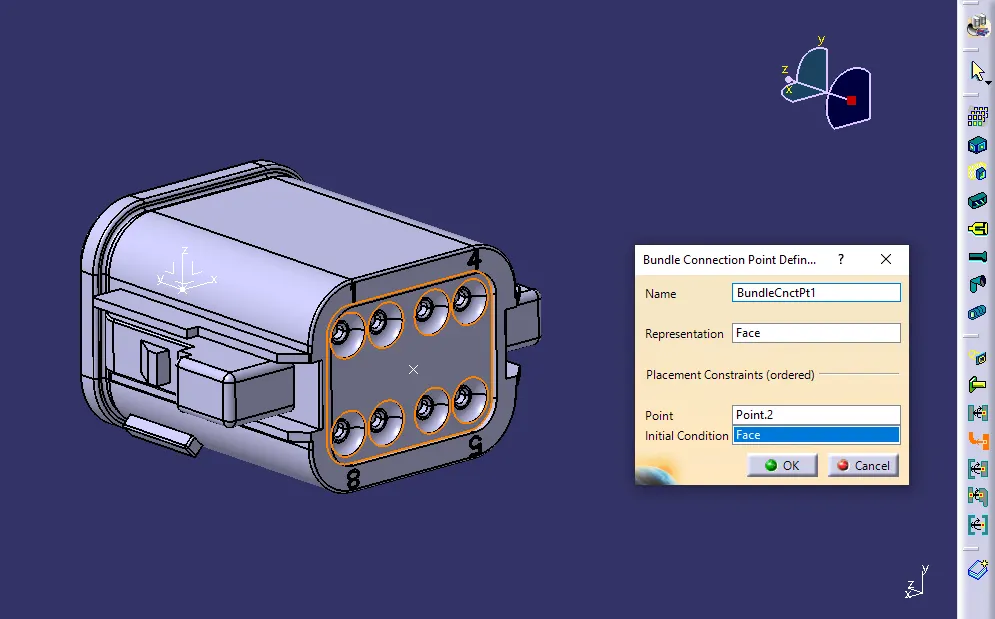
 Bundle entry properties are added and points,face use are added.
- Define Connector Connection point
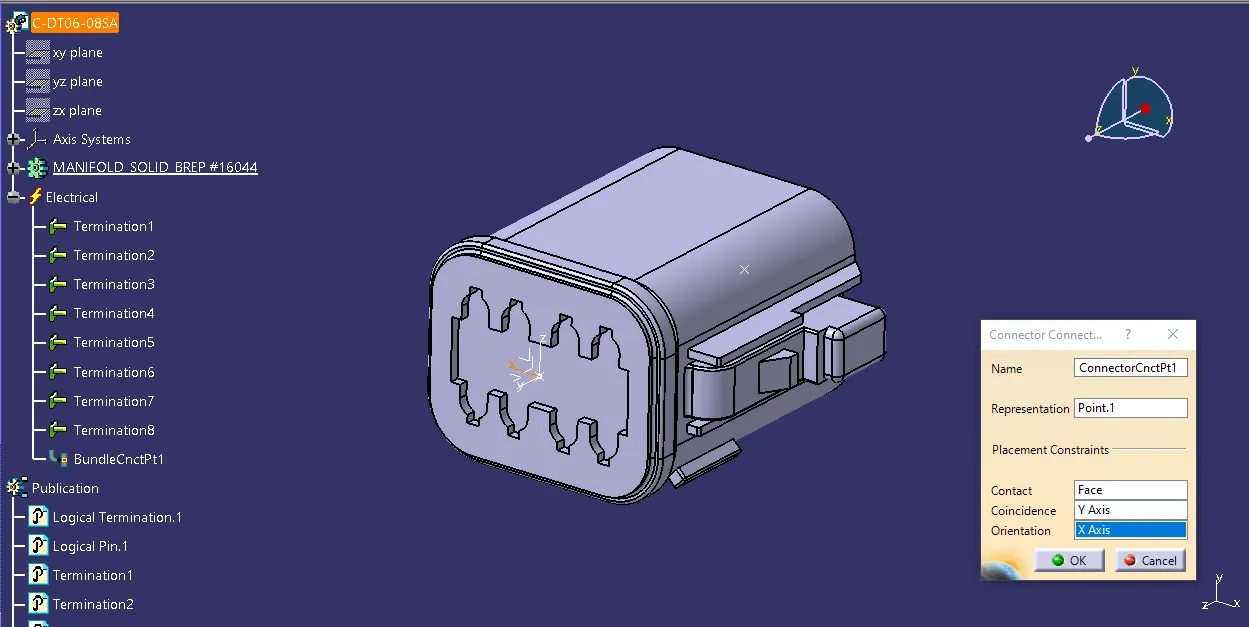
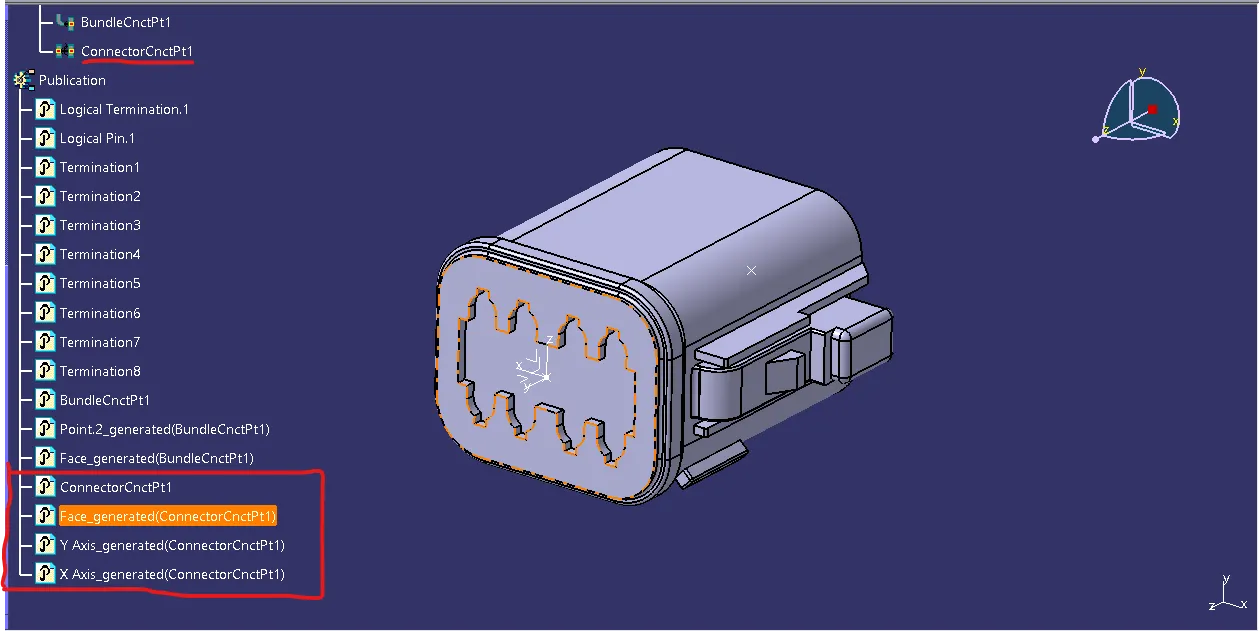
Now Connector connection point is added to electrical properties and it also records the references used to define this properties.
Connector 2. Tyco 174357-2
1) Create midpoint
2) create Connector connection point
3) create Connector connection axis system
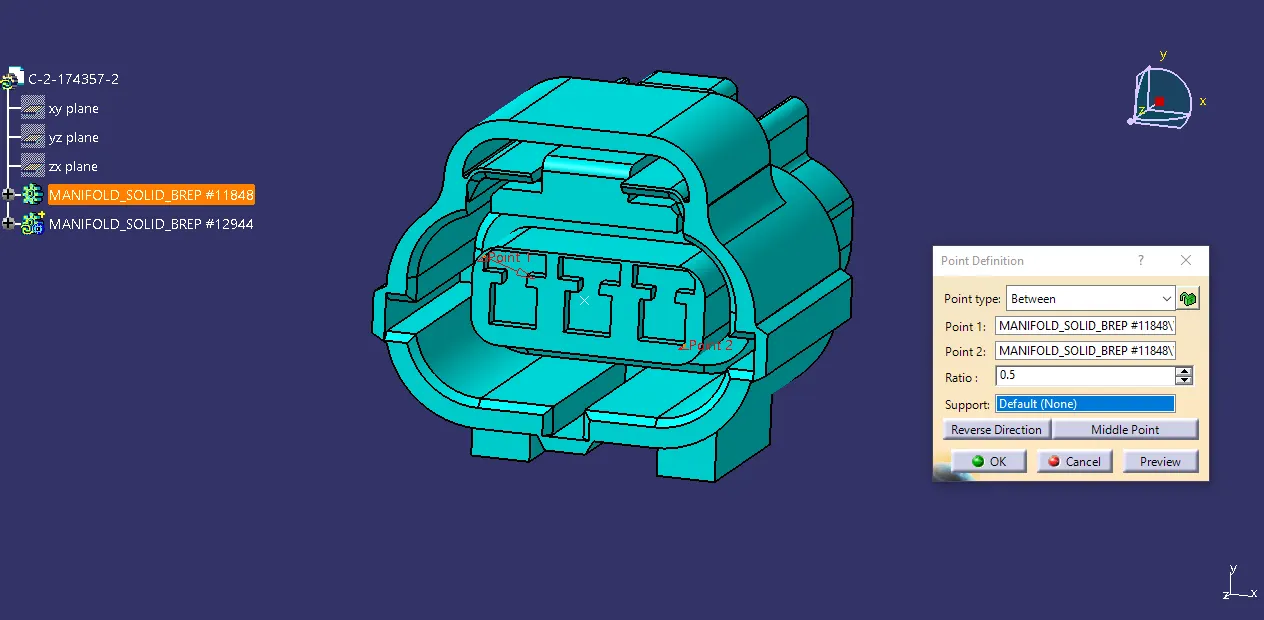
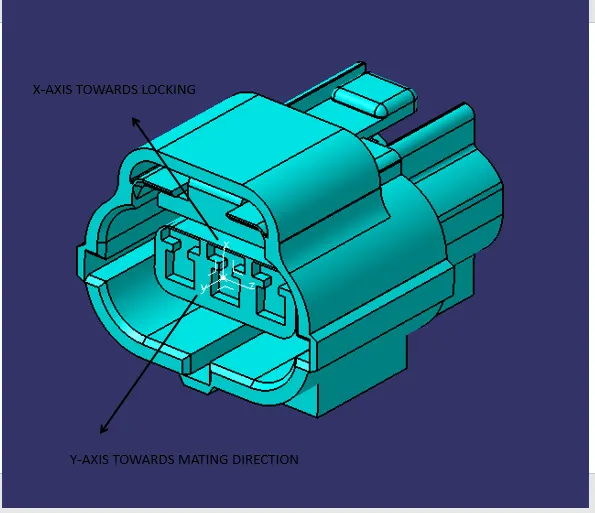
4) create bundle connection point
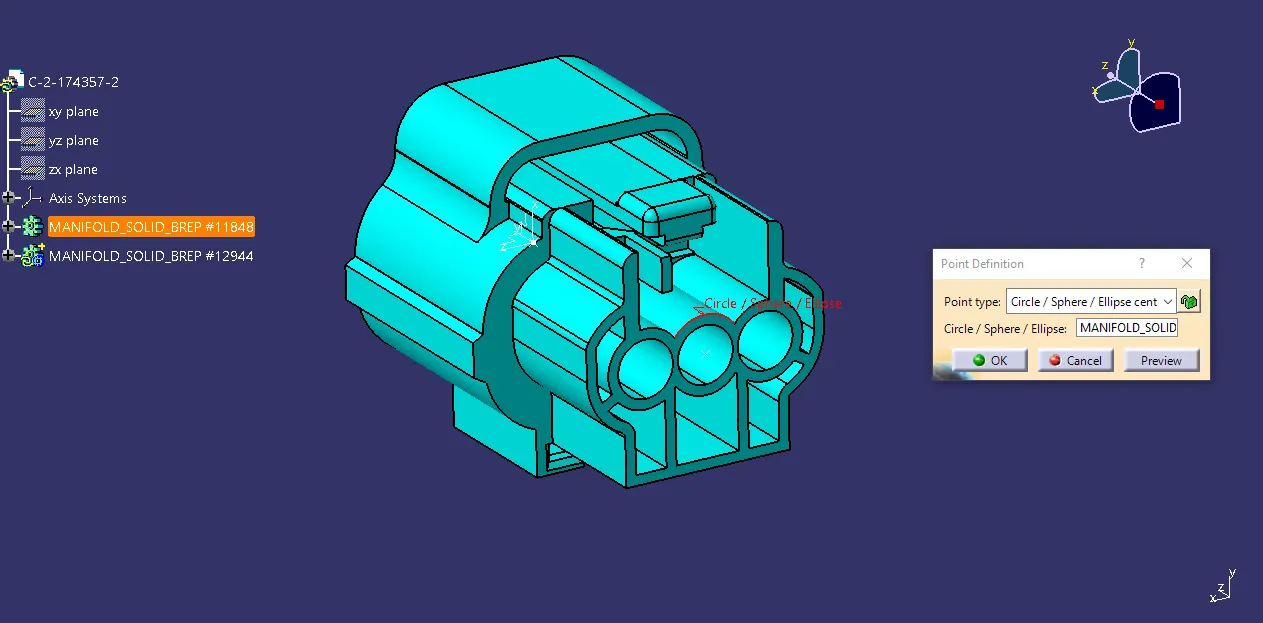
5) create cavity connection point.
6) create cavity connection axis system.
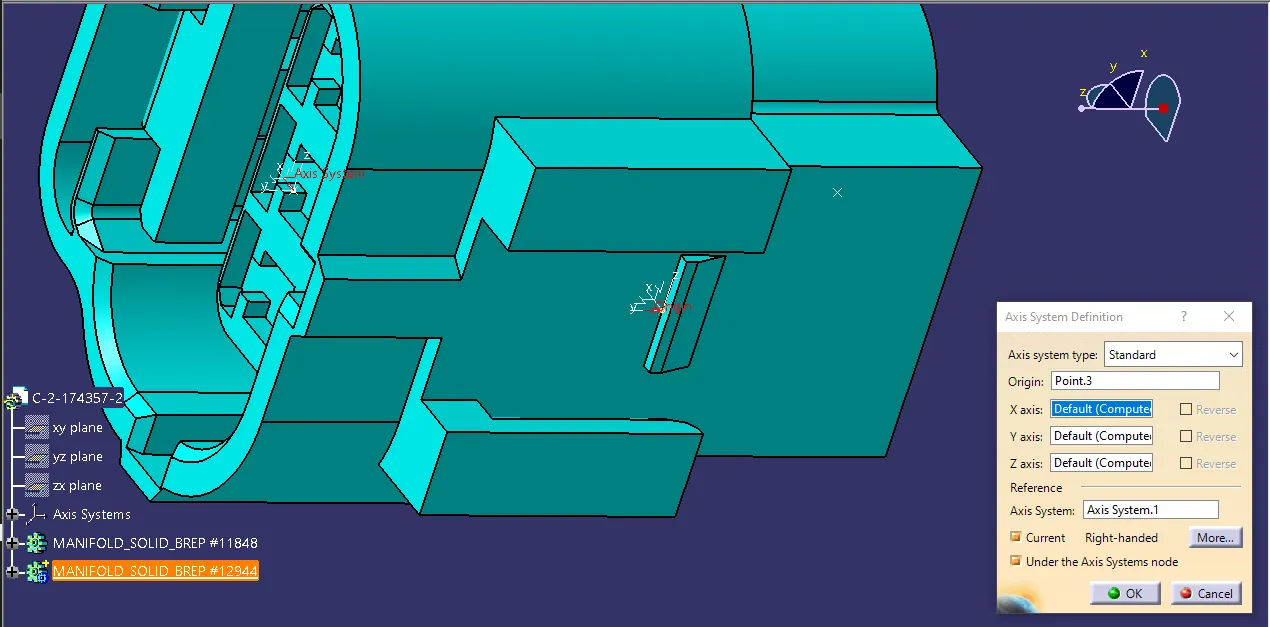
here also same axis ,y-towards mating , x-towards locking and z-towards left or right but ensure that same orientation is given to clip axis system which enables mating of clip and connector correctly.
7) Switch to Electric part design and define part as connector
8) Define Connector connection point and cavity connection point.
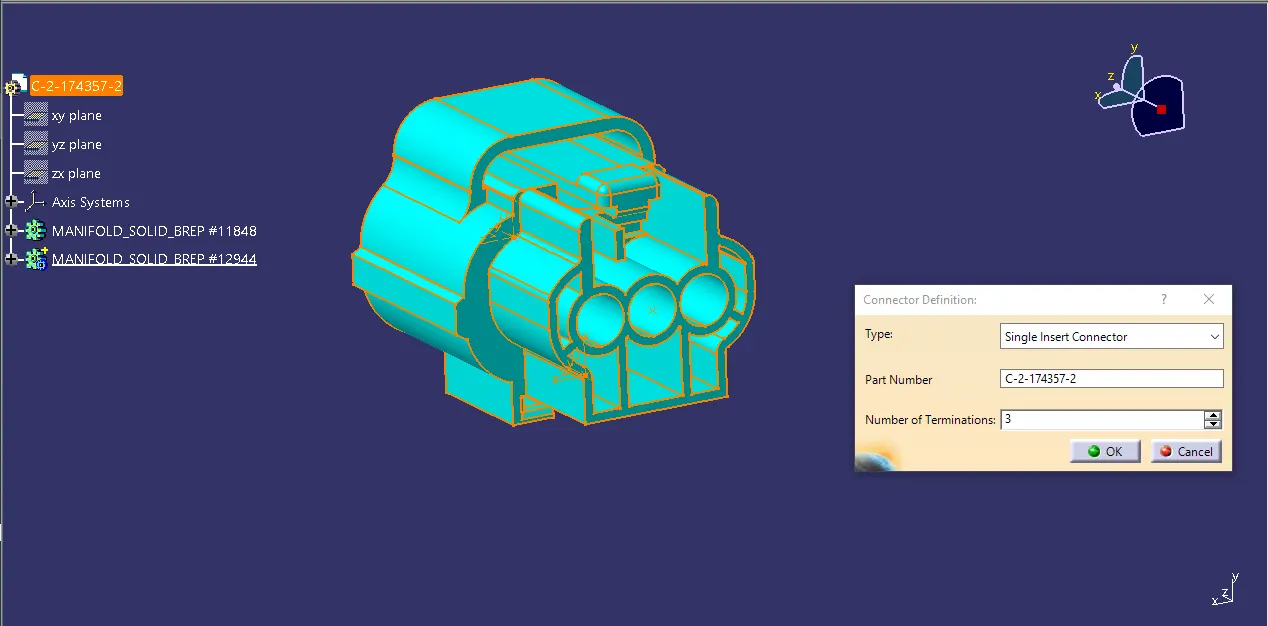
Define as a connector, it is 3 pole connector.
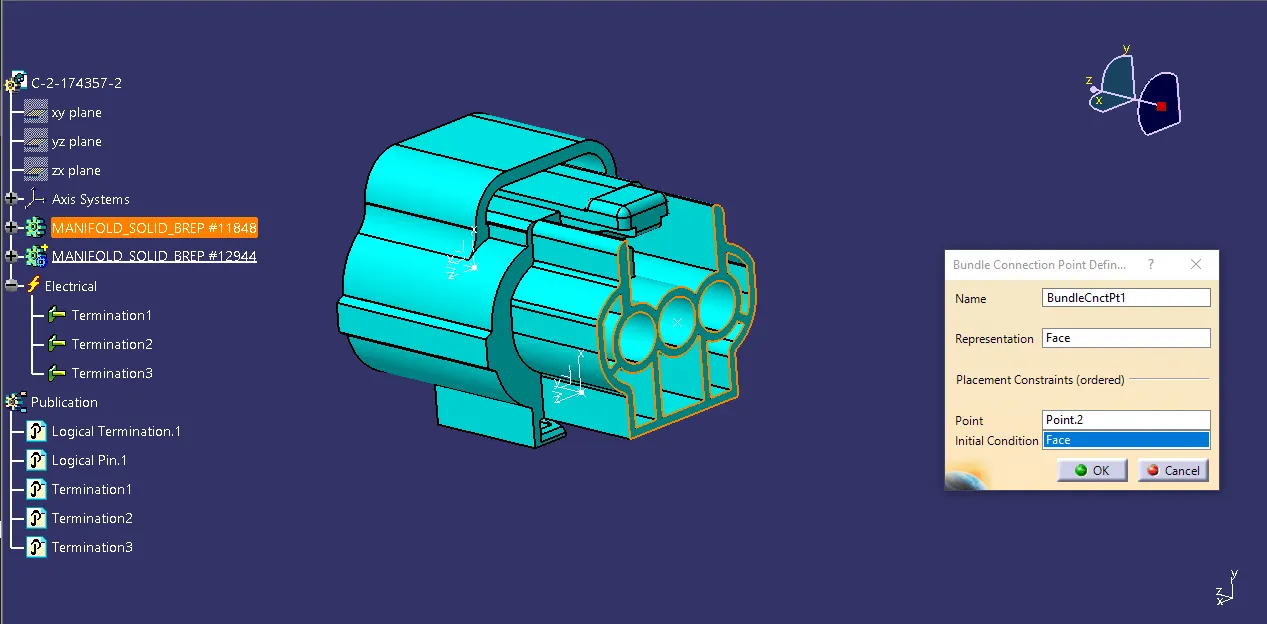
Representation and initial condition is normal face of bundle entry.
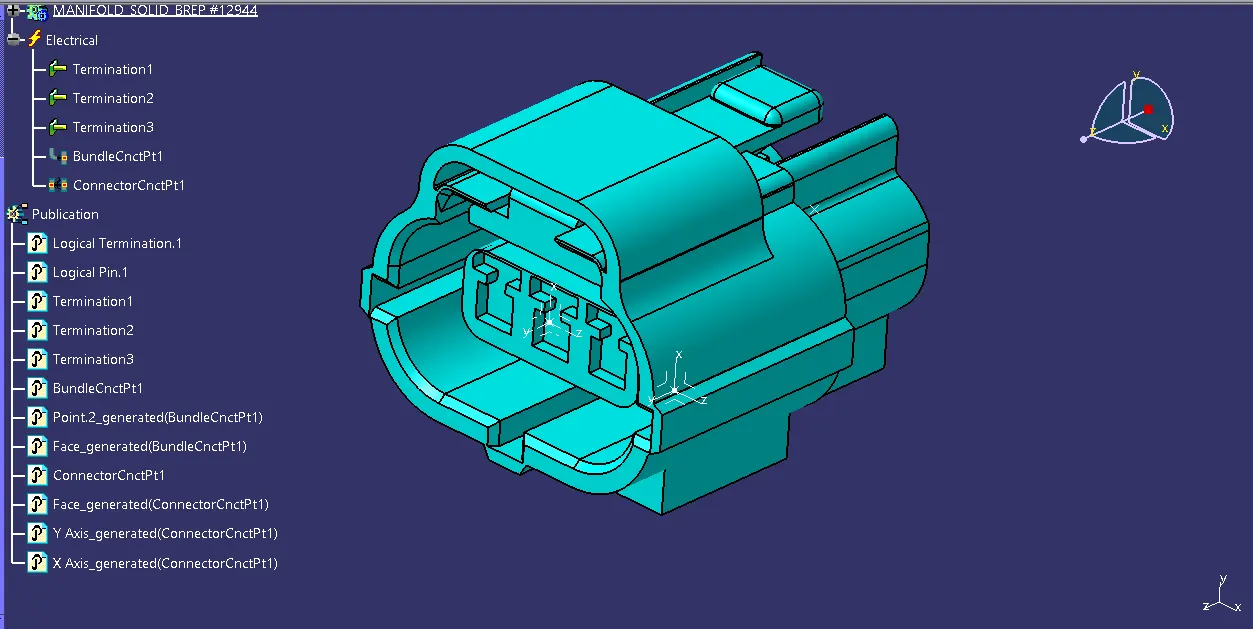
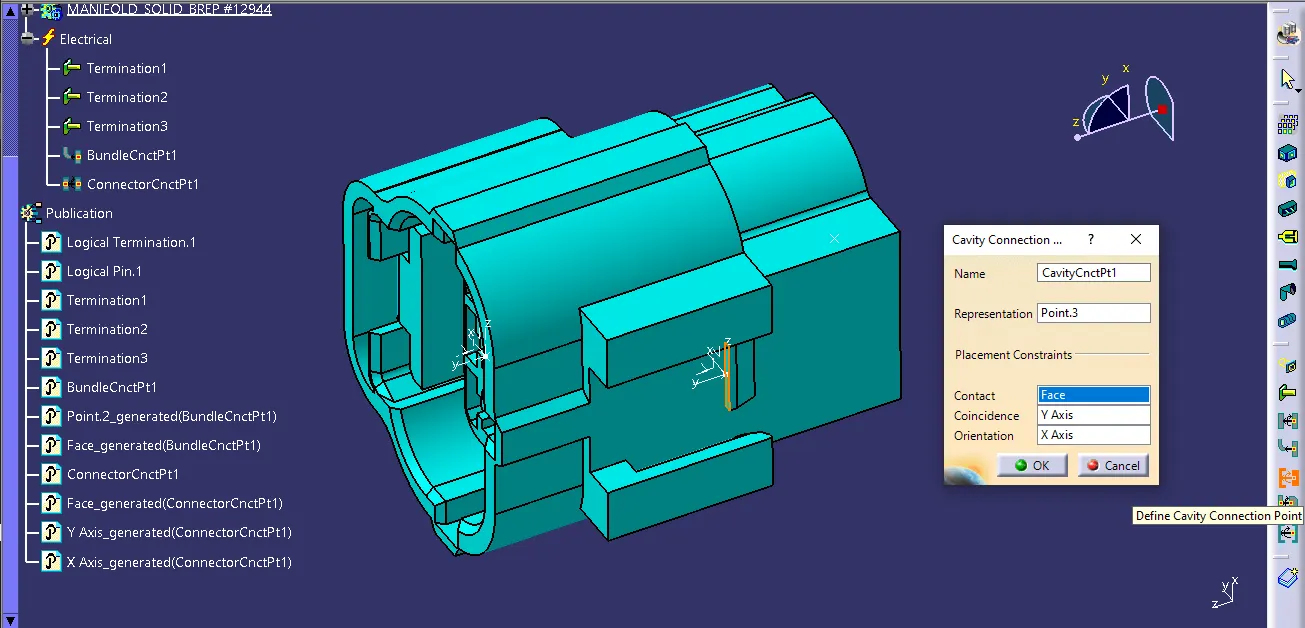
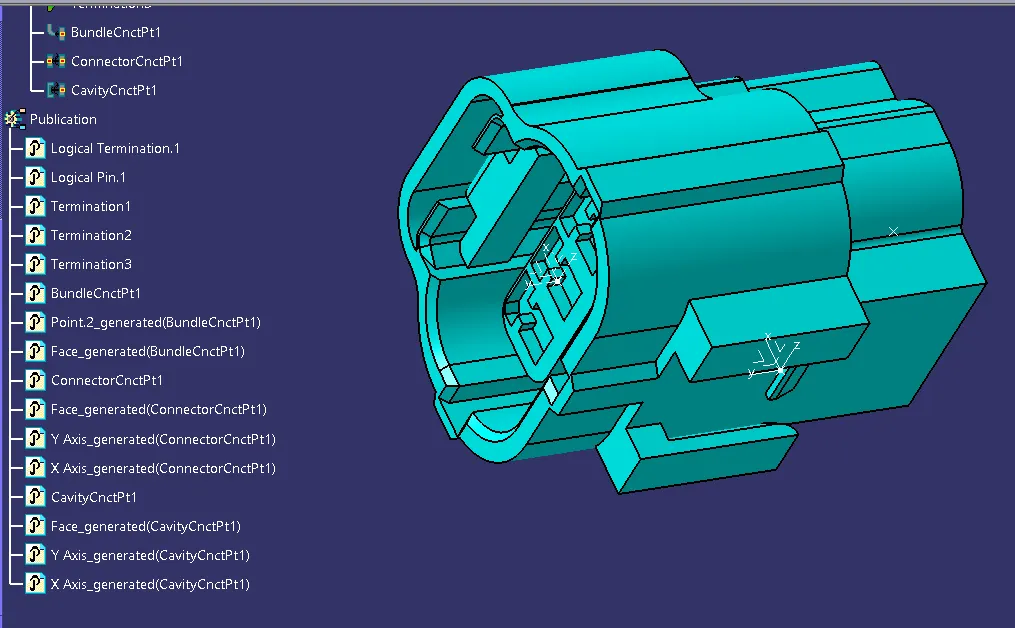
Connector Mounting CLIPS or Connector cavity : Tyco 85229-1
1) Create midpoint - create cavity connection point.
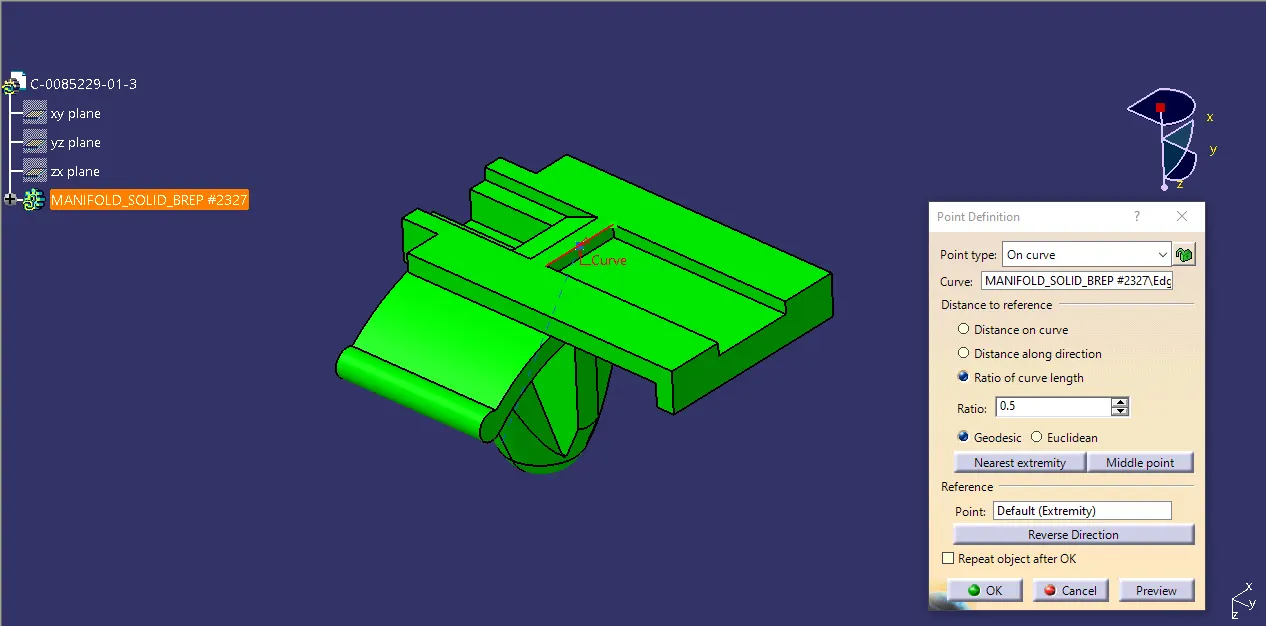
2) create cavity connection axis system and orientation should be same as in connector.
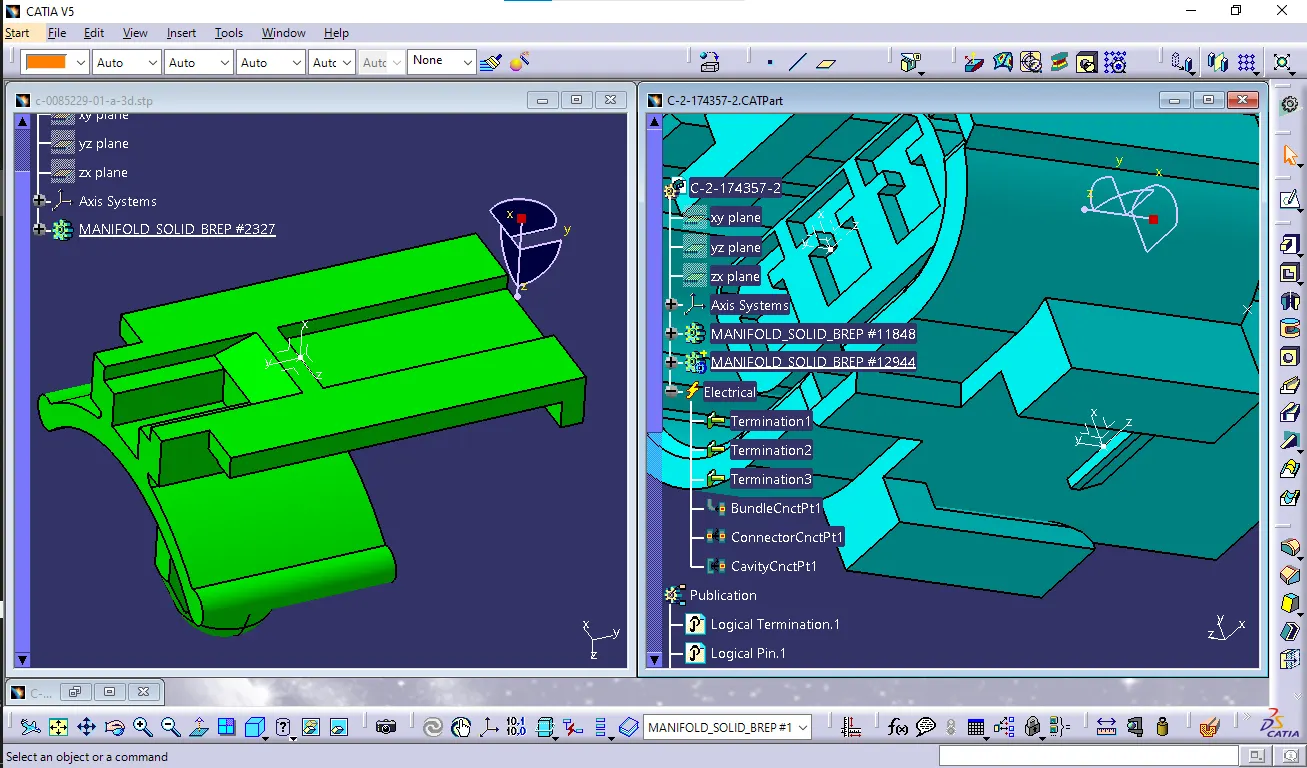
here Y-AXIS - Towards insertion direction ; X-AXIS - Towards locking direction ; Z-AXIS Towards left or right.
3) Switch to Electric part design and define part as Mounting Equipment.
4) Define as a cavity. ( do not define as cavity connection point as it is defined in connector whereas this is clip i.e, entire cavity ) so that software can read this as mating part of cavity connection point.
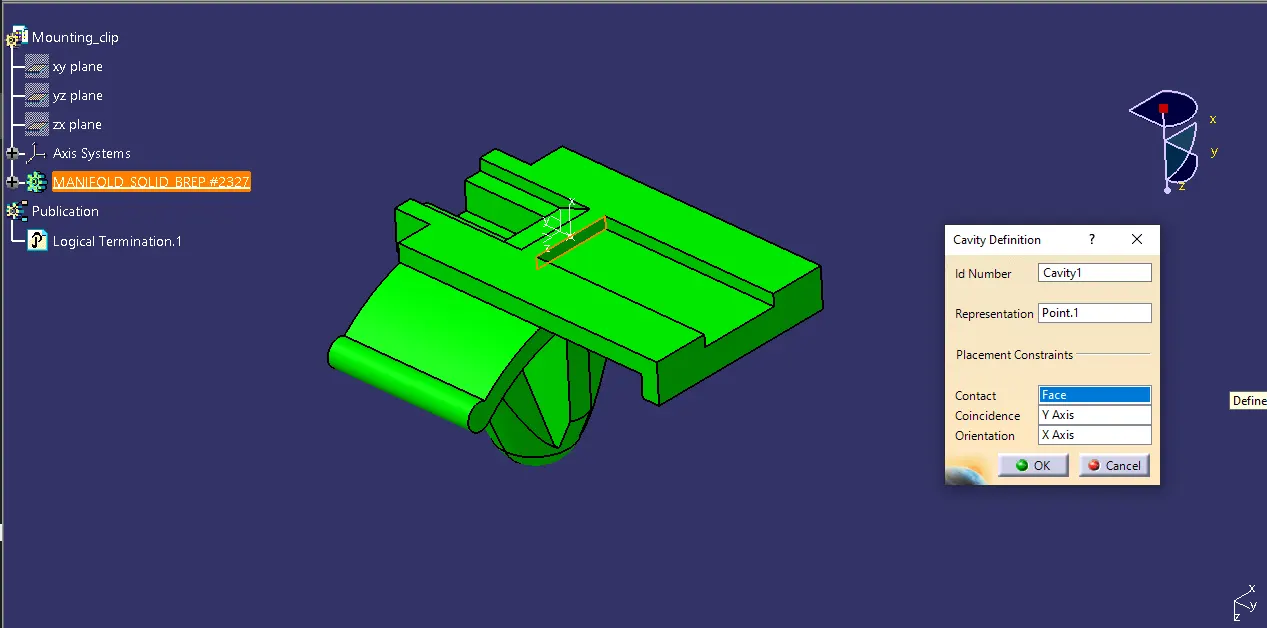
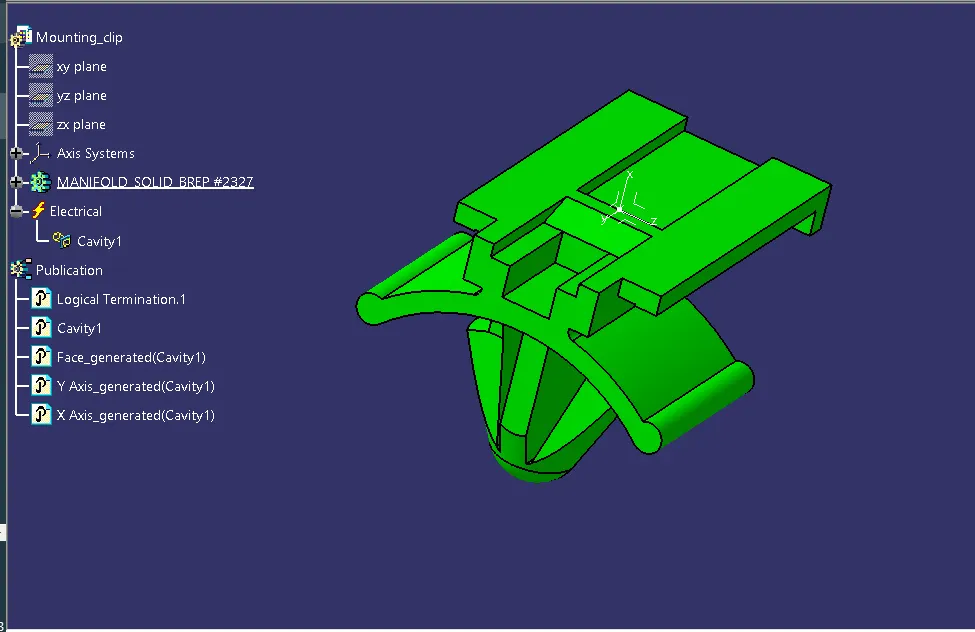
Electric Assembly Design Workbench:
1) Import Connectors and cavity / mounting clip.
2) Select connect Electrical devices  .
.
3) select cavity and then connector.
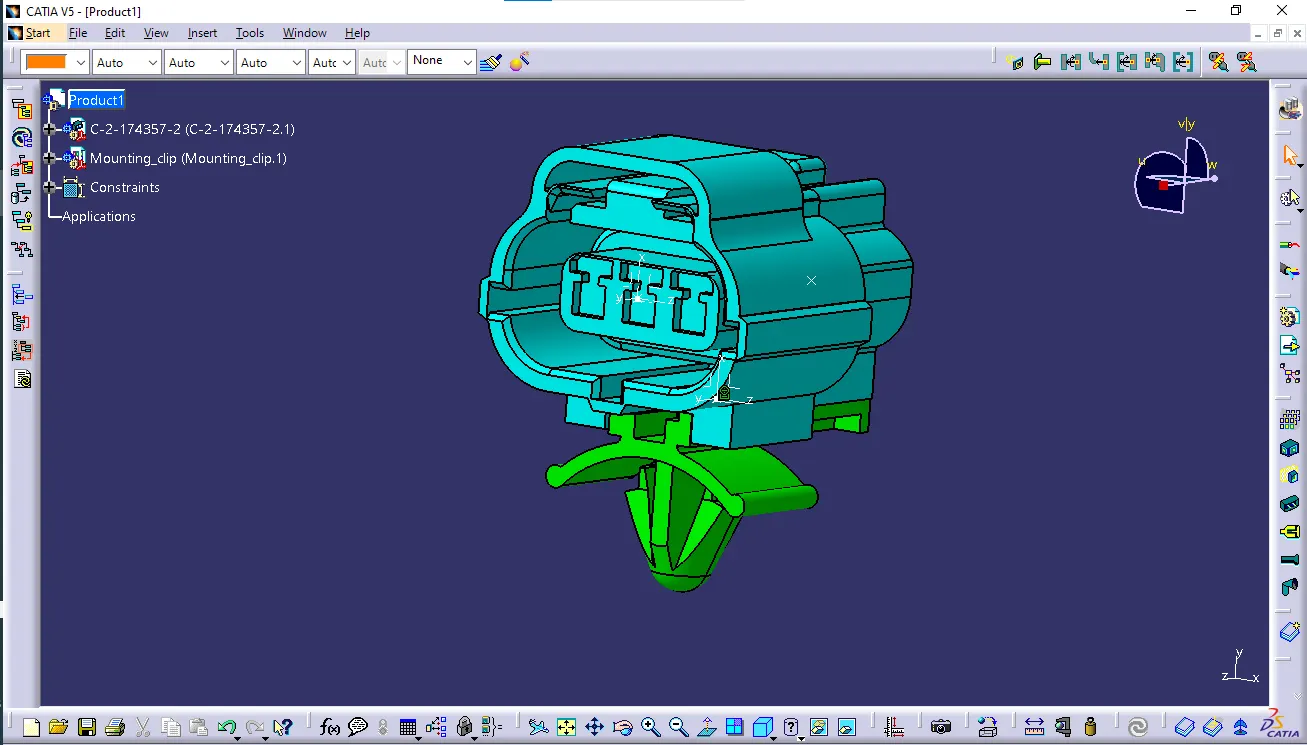
4) I have also downloaded male connector of above connector and electrically defined and assembled that is
C-174359-2-CONNECTOR MALE:
CATALOGUE:
A Cataloge is a CATIA V5 document that keeps a list of references to another catia parts and features. In a wiring harness it means that we can store a set of electrically defined cat parts in a document and insert it into a product assembly when ever required.In other words a catalog is a CATIA V5 document that keeps a list of references to other CATIA parts and features. A typical CATIA document is a generic family table with specific instances within a library context, with a //file structure. In practice, catalogs behave like large assemblies.This enables engineer to reuse the same electrically defined parts which exist in the catalogue.
A cataloge is created and below parts are added.
C-DT06-08SA
C-2-174357-2
C-174359-2-CONNECTOR MALE
85229-1-Mounting_clip
create new catalogue document.
Add Famiy with name and type.
once the catalogue is created save it and add parts in catalogue using store command.
Add your favorite catalogue here.this favorite will be shown when u browse catalogue in assembly workbench.
Here we add catalogue created for different components and mapping is done on type of components as shown below.