Week 8- Moving zones approach in Fluent
1. Moving zones can be modelled using 2 methods generally referred as Moving Reference Frame approach and Moving Mesh approach (Dynamic mesh).
- MRF is strictly performed for steady state analysis. In MRF, the entire moving frame moves as a whole where no remeshing is required and the mesh topology remains the same, only the rotation occurs at the interface between moving frame and the stationary frame.
- MMA is prefered for transient simulations but steady state simulations can also be performed using MMA. In MMA the meshing is moving as the rotation motion occurs and re-meshing is taking place, in MMA only the part which is rotating is being remeshed and not the domain so the entire mesh topology near the rotating part undergoes remshing. This is best suited to understand the physics at the rotating part boundary layers and analyse the pressure differences.
2. Moving mesh approach is best suited to model unsteady phenomena, as it helps in capturing the transient features and important for requirement.
3. Simulation:
- Fluent setup:
- Steady state simulation
- Cell zones:
- Rotating motion: frame motion
- Rotatry velocity: 250 RPM
- Boundaries:
- Airfoil: Moving wall : rotational motion
- Solution method:
- Second order upwind
- Uncheck psuedo transient
- Solution control:
- Courant number: 10
- Pressure and momentum: 0.5
- Hybrid initialisation
- Geometry:
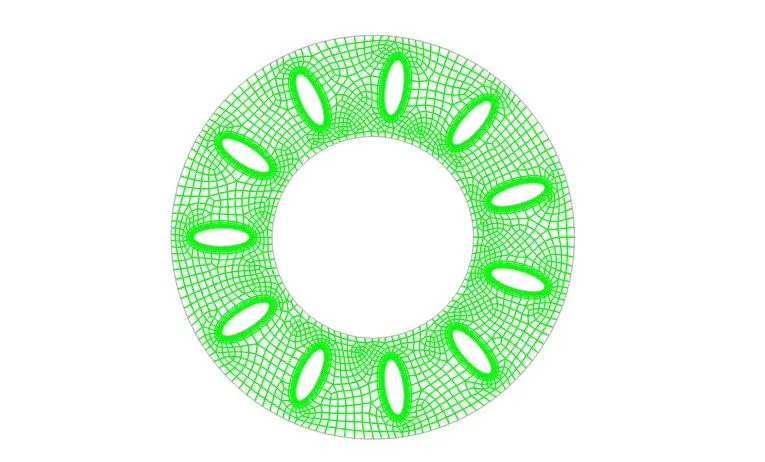
- Simulations results:
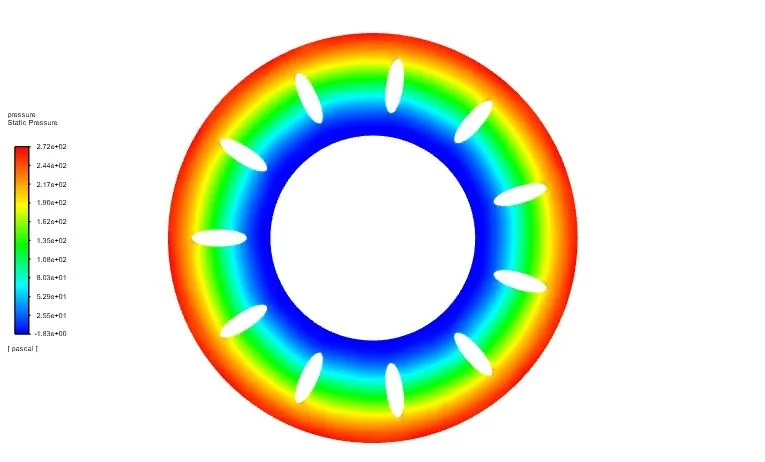
1. Pressure:
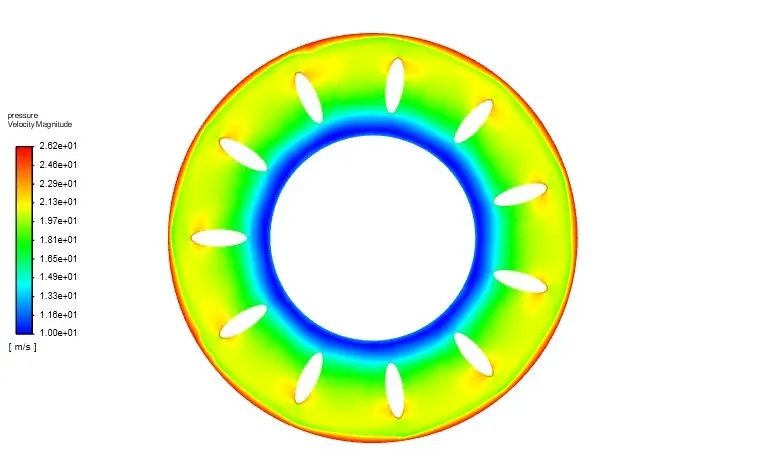
2. Velocity: