Week 2 - Converging diverging nozzle
- Aim:
To perform flow simulation through a convergent-divergent nozzle (de Laval nozzle) and post process the results. Compare the simulation results with experimental and analytical data to validate the simulation results.
- Theory:
- de Laval Nozzle:
A de Laval nozzle (or convergent-divergent nozzle, CD nozzle or con-di nozzle) is a tube that is pinched in the middle, making a carefully balanced, asymmetric hourglass shape. It is used to accelerate a hot, pressurized gas passing through it to a higher supersonic speed in the axial (thrust) direction, by converting the heat energy of the flow into kinetic energy. Because of this, the nozzle is widely used in some types of steam turbines and rocket engine nozzles. It also sees use in supersonic jet engines.
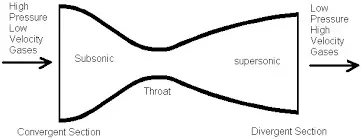
Similar flow properties have been applied to jet streams within astrophysics.
A de Laval nozzle will only choke at the throat if the pressure and mass flow through the nozzle is sufficient to reach sonic speeds, otherwise no supersonic flow is achieved, and it will act as a Venturi tube; this requires the entry pressure to the nozzle to be significantly above ambient at all times (equivalently, the stagnation pressure of the jet must be above ambient).
In addition, the pressure of the gas at the exit of the expansion portion of the exhaust of a nozzle must not be too low. Because pressure cannot travel upstream through the supersonic flow, the exit pressure can be significantly below the ambient pressure into which it exhausts, but if it is too far below ambient, then the flow will cease to be supersonic, or the flow will separate within the expansion portion of the nozzle, forming an unstable jet that may "flop" around within the nozzle, producing a lateral thrust and possibly damaging it.
In practice, ambient pressure must be no higher than roughly 2–3 times the pressure in the supersonic gas at the exit for supersonic flow to leave the nozzle.
- Simulation:
The stages of the simulation are as follows
- Geometry
- Mesh
- Setup
- Solution
- Results
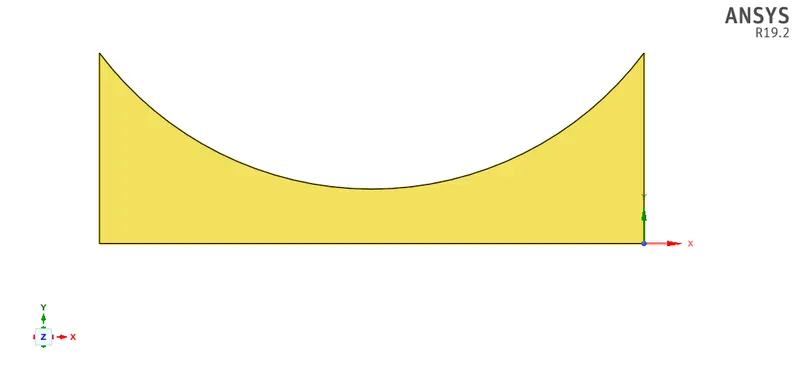
- Geometry:
- Mesh:
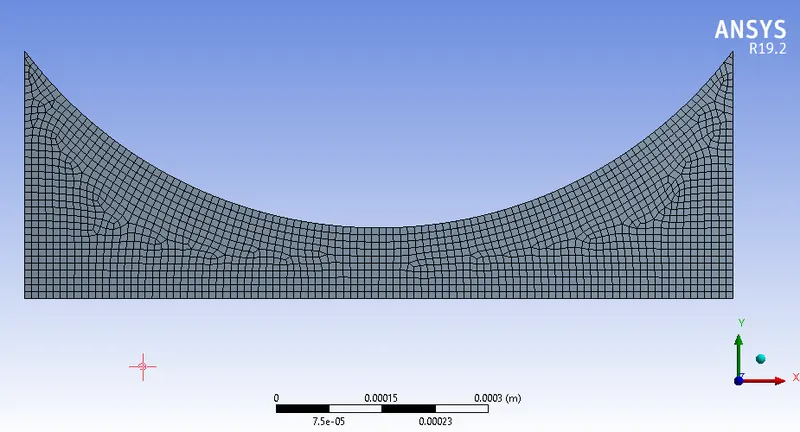
The mesh was selected to be triangle dominated mesh type with an element size of 0.5mm.
Setup
The setup included
- Solver - Density-Based
- Solver State - Steady State
- Flow Model - Invicid
- Boundary Condition
Inlet
- Inlet - Pressure Inlet
- Pressure = 101325 Pa
- Temperature = 300 K
Outlet
- Inlet - Pressure Outlet
- Pressure = 101325 Pa
- Temperature = 300 K
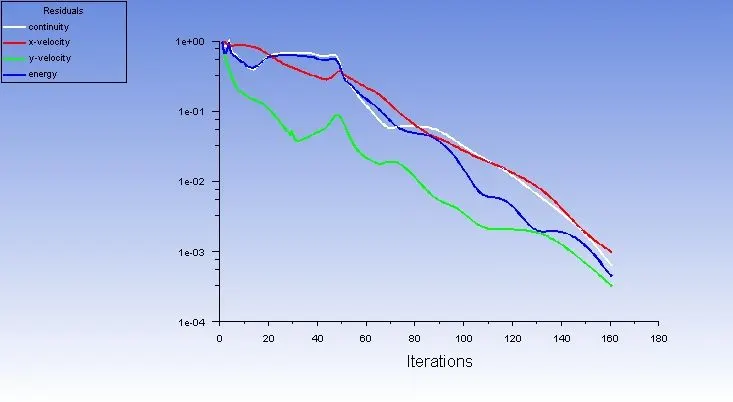
- Resdiuals plot:
- Results:
1. Plots:
a. Velocity:
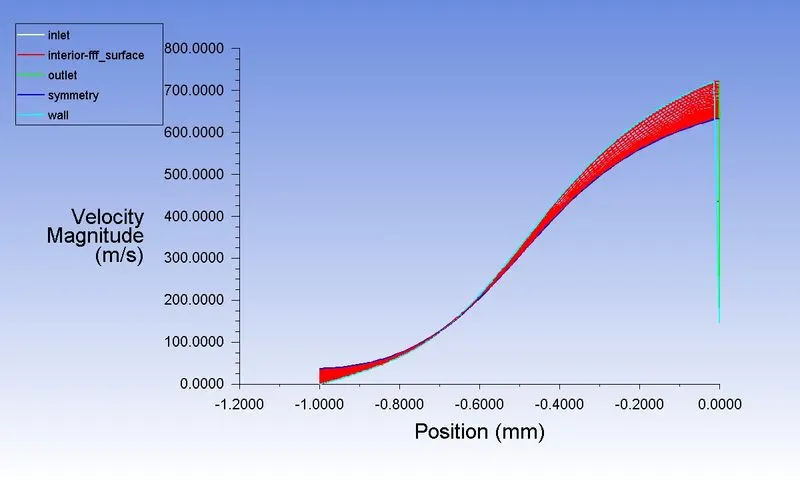
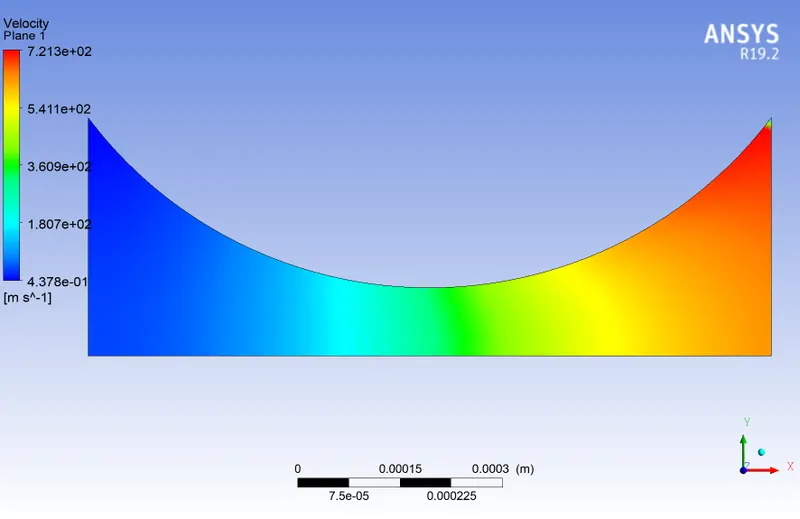
b. Pressure:
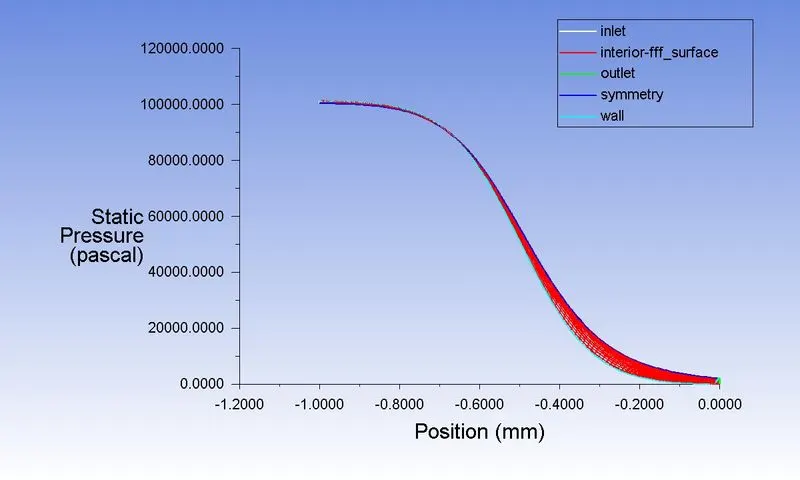
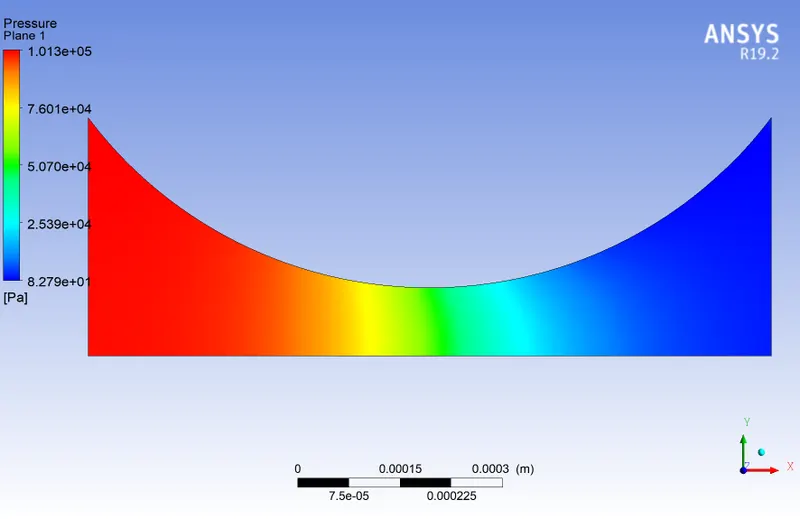
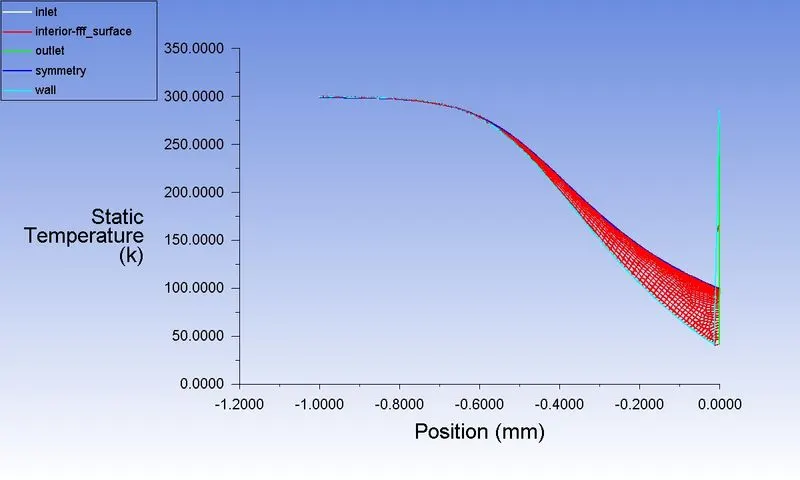
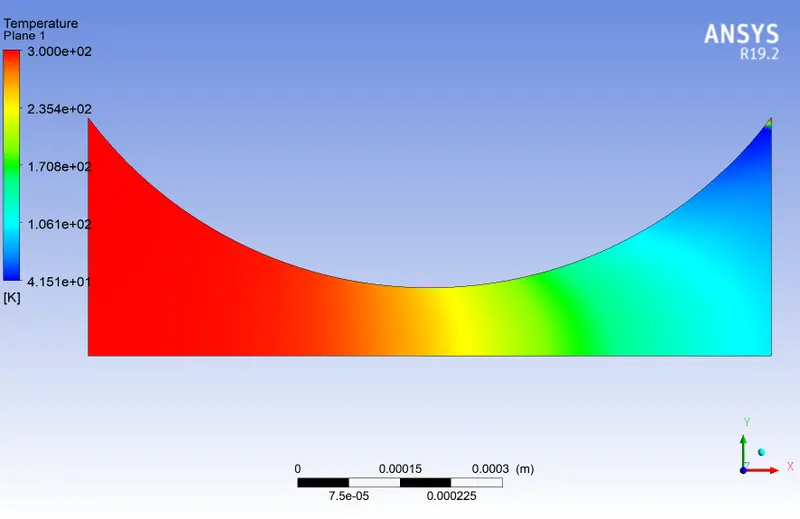
c. Temperature:
d. Mach number:
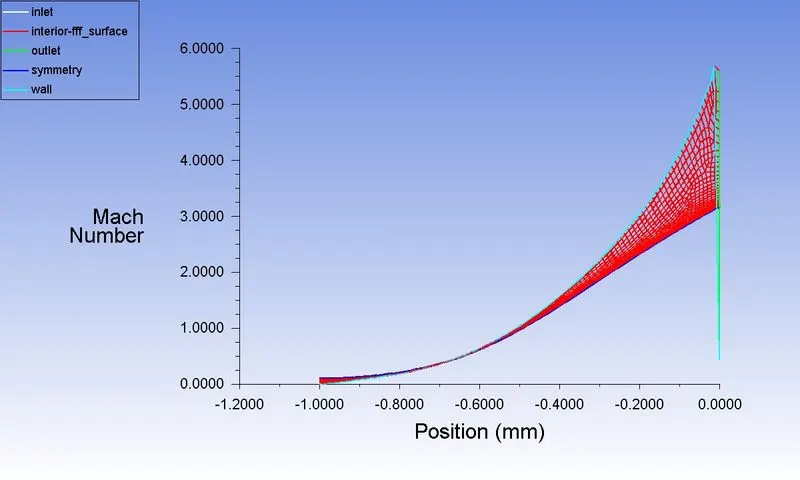
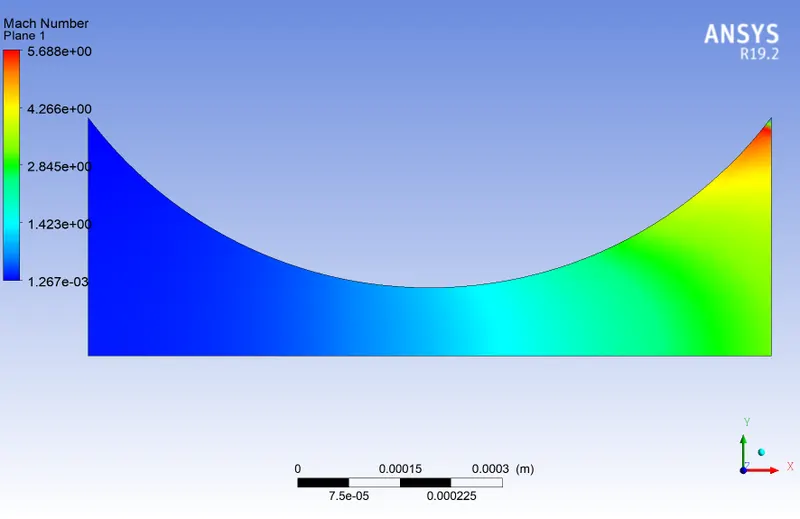
The Mach velocity of the fluid reaches Super sonic mach speed (i.e, 1.2>M>5) at 0.52mm from the Inlet of the nozzle. (at the Throat section section)
- CFD V/S EXPERIMENTAL COMPARISION
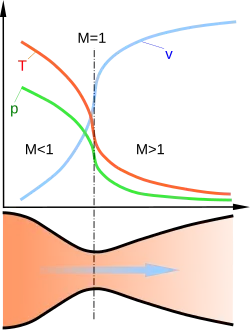
From the above image, the experimental data shows a decreasing trend of temperature and pressure which were obtained in the simulation results as well. When we see the plots in the results section we can compare pressure, temperature, and Mach number plots.
- CFD V/S ANALYTICAL COMPARISON
The equation for the De-Laval Nozzle which has a variation of converging and diverging area, the fluid flow behavior is
`(dA)/A=(dc)/c(M^2-1)`
Now let's take the inlet as section 1, and the outlet as section 2. We can now substitute the values in the above equation to give us the flow condition according to the Mach number
- Convergent section
`(dA)/(dC)= (A1-A2)/(C1-C2)`
It is clear from the diagram that A1>A2 and C1<C2
If these conditions are substituted in the equation we get
`(dA)/(dc)<0andM<1`
From the above condition we say the flow is sub-sonic.
- for Divergent section,
`(dA)/(dc)=(A2−A1)/(V2−V1)`
It is clear from the diagram that `A3>A2 and V3>V2`
If these conditions are substituted in the equation we get
`(dA)/(dc)>0andM>1`
From the above condition, we say the flow is super-sonic.
- For Throat section,
Since there is no change in Area and velocity at that point,
`(dA)/(dc) =0 => M=1`
Therefore, flow is at transonic speeds at the throat
- CONCLUSION
- Thus the simulation results are in quite in good agreement with the analytical and experimental data
- Validation shows that the CFD simulation results are correct.
- Thus CFD helps to simulate fluid flow with good results with analytical and experimental data.