Week 9:Super Charger Simulation Project
Super Charger Simulation
- Aim:
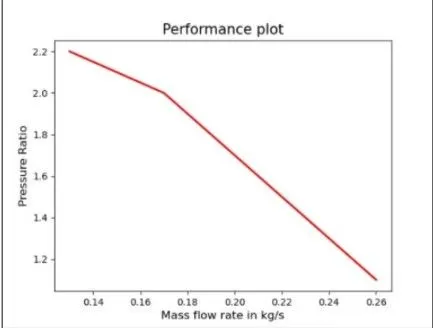
- Get Supercharger performance data (i.e total pressure ratio vs mass flow rate)
- Array of Pressure Ratio = [ 1.1 1.5 2.0 2.2]
- i.e for these 4 values of Pressure ratio get the mass flow rate and plot the graph between the total pressure ratio and mass flow rate for these 4 values.
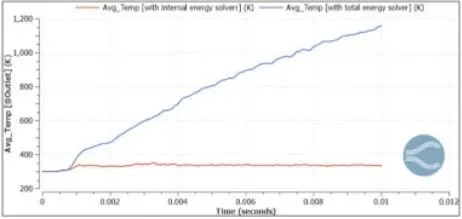
- Compare results with and without total_energy_solver
- Check if mass is conserved.
- Make use of MS EXCEL to check whether mass is conserved or not.
- Import the data of mass flow rate at Inlet and Outlet and add them up.
- After adding, ideally it should be zero for mass to be conserved but it will not be exactly zero.
- The difference should not be more than 2e-4 kg/s.
- Theory:
1. Super Charger:
A supercharger is an air compressor that increases the pressure or densty of air supplied to an internal combustion engine. This gives each intake cycle of the engine more oxygen, letting it burn more fuel and do more work, thus increasing the power output. Power for the supercharger can be provided mechanically by means of a belt, shaft, or chain connected to the engine's crankshaft.
Common usage restricts the term supercharger to mechanically driven units; when power is instead provided by a turbine powered by exhaust gas, a supercharger is known as a turbocharger or just a turbo—or in the past a turbosupercharger
- Types:
1. Positive displacement:
Positive-displacement pumps deliver a nearly fixed volume of air per revolution at all speeds (minus leakage, which is almost constant at all speeds for a given pressure, thus its importance decreases at higher speeds).
Major types of positive-displacement pumps include:
- Roots
- Lysholm twin-screw
- Sliding vane, e.g. Powerplus, Shorrock, Zoller, Cozette
- scroll-type supercharger, also known as the G-Lader
2. Dynamic compressor:
Dynamic compressors rely on accelerating the air to high speed and then exchanging that velocity for pressure by diffusing or slowing it down.
Major types of a dynamic compressor are:
- Centrifugal
- Multi-stage axial-flow
- Procedure:
1. Geometry:
Super Charger Simulation
- Aim:
- Get Supercharger performance data (i.e total pressure ratio vs mass flow rate)
- Array of Pressure Ratio = [ 1.1 1.5 2.0 2.2]
- i.e for these 4 values of Pressure ratio get the mass flow rate and plot the graph between the total pressure ratio and mass flow rate for these 4 values.
- Compare results with and without total_energy_solver
- Check if mass is conserved.
- Make use of MS EXCEL to check whether mass is conserved or not.
- Import the data of mass flow rate at Inlet and Outlet and add them up.
- After adding, ideally it should be zero for mass to be conserved but it will not be exactly zero.
- The difference should not be more than 2e-4 kg/s.
- Theory:
1. Super Charger:
A supercharger is an air compressor that increases the pressure or densty of air supplied to an internal combustion engine. This gives each intake cycle of the engine more oxygen, letting it burn more fuel and do more work, thus increasing the power output. Power for the supercharger can be provided mechanically by means of a belt, shaft, or chain connected to the engine's crankshaft.
Common usage restricts the term supercharger to mechanically driven units; when power is instead provided by a turbine powered by exhaust gas, a supercharger is known as a turbocharger or just a turbo—or in the past a turbosupercharger
- Types:
1. Positive displacement:
Positive-displacement pumps deliver a nearly fixed volume of air per revolution at all speeds (minus leakage, which is almost constant at all speeds for a given pressure, thus its importance decreases at higher speeds).
Major types of positive-displacement pumps include:
- Roots
- Lysholm twin-screw
- Sliding vane, e.g. Powerplus, Shorrock, Zoller, Cozette
- scroll-type supercharger, also known as the G-Lader
2. Dynamic compressor:
Dynamic compressors rely on accelerating the air to high speed and then exchanging that velocity for pressure by diffusing or slowing it down.
Major types of a dynamic compressor are:
- Centrifugal
- Multi-stage axial-flow
- Procedure:
1. Geometry:
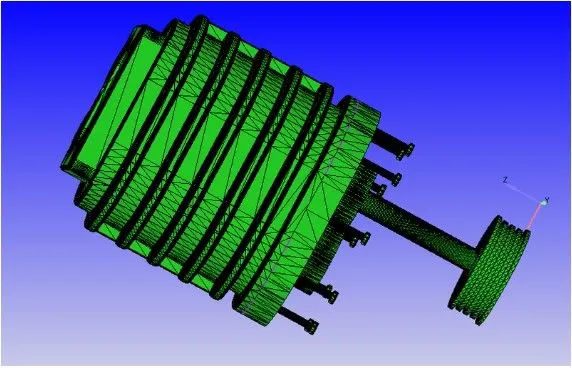
The above given geometry was cleaned and boundary flagged appropriately.
- Grid size:
x= 0.004m, y= 0.004m, z=0.004m
- Case setup:
1. Application: General flow
2. Solver: Transient solver
3. Simulation type: Gas
4. Material: Air
5. Species: O2 and N2
6. Simulation model: Full Hydrodynamic
7. Simulation time Parameters:
Start time: 0sec
End Time: 0.01sec
8. Regions and Initialisation: Default
9. Boundary conditions:
- Inlet: Inflow- Pressure- 1bar at 300K
- Outlet: Outflow- Pressure- 1.1, 1.5, 2 and 2.2bar at 300K
- Right lobe: Wall-rotating- 216000deg/sec-center at origin in z-axis
- Left lobe: Wall-rotating- 216000deg/sec- center at center of left lobe in z-axis
- Casing: Wall-law of the wall at 300K
10. Turbulence model: RNG k-e
11. Time interval for 3D output files: 6e-5sec
12. Time interval for writing text otuput files: 1e-6sec
13. Time interval for restart files: 6e-5sec
- Results:
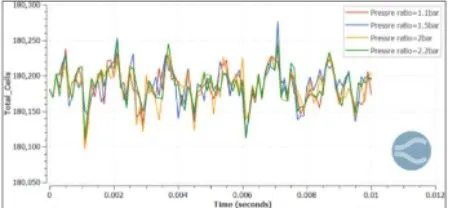
- Total cell count:
- Temperature:
- Mass convergence:
| Pressure ratio | Mass flow rate at inlet | Mass flow rate at outlet | Error |
| 1.1 | -0.29 | 0.26 | -0.03 |
| 1.5 | -0.22 | 0.24 | 0.02 |
| 2 | -0.12 | 0.15 | 0.03 |
| 2.2 | -0.1 | 0.136 | 0.036 |
- Performance plot:
- Conclusions:
Supercharger Simulation was done successfully.