Week 8:Centrifugal pump simulation
Centrifugal Pump Simulation
- Aim:
To Perform a transient simulation on a Centrifugal pump to calculate the pressure drop while providing mass flow outlet boundary conditions. Post-process the results and obtain the graph total pressure v/s mass flow rate to calculate pump efficiency. Carry the simulation for 3 different outflow mass flow rates: 130Kg/s, 156Kg/s, 180Kg/s.
- Theory:
1. Centrifugal pump:
Centrifugal pumps are used to transport fluids by the conversion of rotational kinetic energy to the hydrodynamic energy of the fluid flow. The rotational energy typically comes from an engine or electric motor. They are a sub-class of dynamic axisymmetric work-absorbing turbomachinery.
- Working: Like most pumps, a centrifugal pump converts rotational energy, often from a motor, to energy in a moving fluid. A portion of the energy goes into kinetic energy of the fluid. Fluid enters axially through eye of the casing, is caught up in the impeller blades, and is whirled tangentially and radially outward until it leaves through all circumferential parts of the impeller into the diffuser part of the casing. The fluid gains both velocity and pressure while passing through the impeller. The doughnut-shaped diffuser, or scroll, section of the casing decelerates the flow and further increases the pressure.
- Pump efficiency:

where:
- P_m is the mechanics input power required (W)
- `rho` is the fluid density (kg/m3)
- g is the standard acceleration of gravity (9.80665 m/s2)
- H is the energy Head added to the flow (m)
- Q is the flow rate (m3/s)
- `eta` is the efficiency of the pump plant as a decimal
- Procedure:
- Geometry:
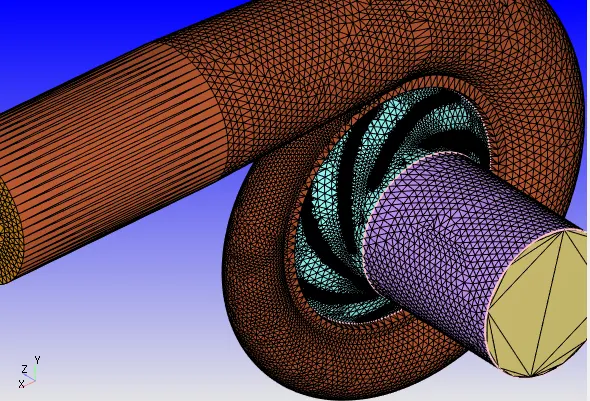
1. CAD model was uploaded onto converge studio v3.0
2. Clean up was performed and boundary flagging was performed.
- Case Setup:
1. Application type:
General flow, liquid flow
2. Materials:
- Liquid simulation: H2O
- Global transport properties: Default
- Species: H2O
3. Simulation Parameters:
- Run parameters: Transient, incompressible
- Simulation time parameters:
Start time: 0, End time: 0.2sec.
Time step size: min:1e-9, max=1
- Solver Parameters: Default
4. Boundary:
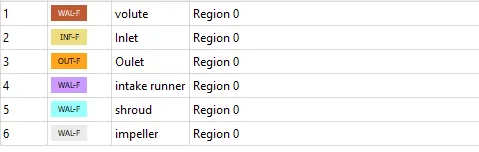
- Inflow: Pressure inlet: 101325Pa
- Outflow: Mass Flow: 130, 156, 180 kg/s
- Impeller: Rotating wall about z-axis
- Rest: Wall
5. Regions and initialization:
- H20
6. Physical Model:
- RNG K-epsilon
7. Grid control:
- Grid size: x= 1e-12, y=1e-12, z=1e-12
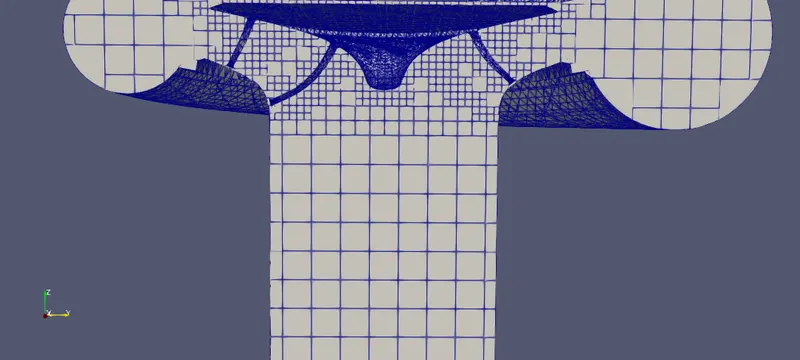
- Fixed embedding: Permanent embedding on impeller having scale of 2
8. Output post-processing:
- Post variable files: default
- Output files: write interval: 0.002
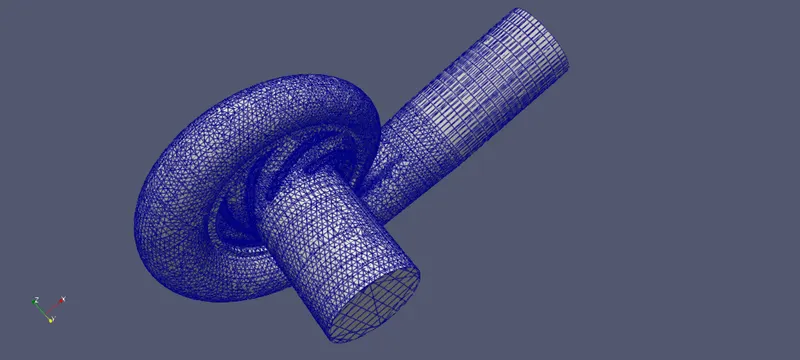
- Mesh:

- Results:
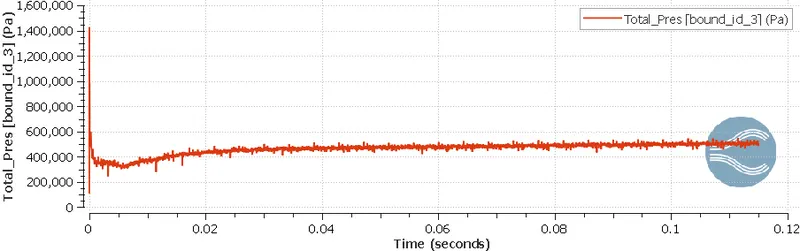
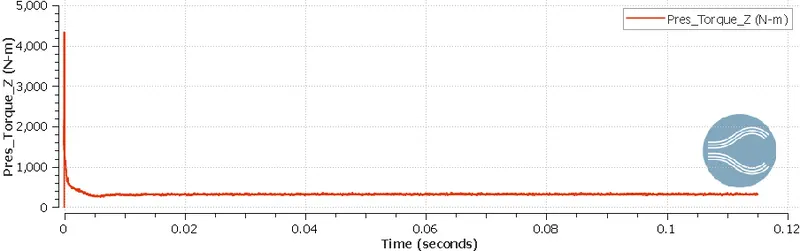
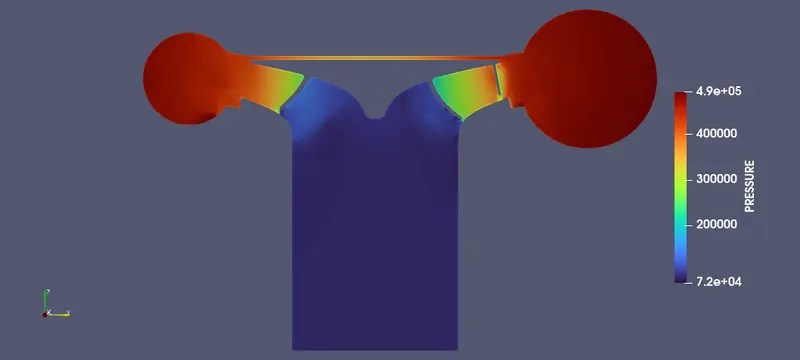
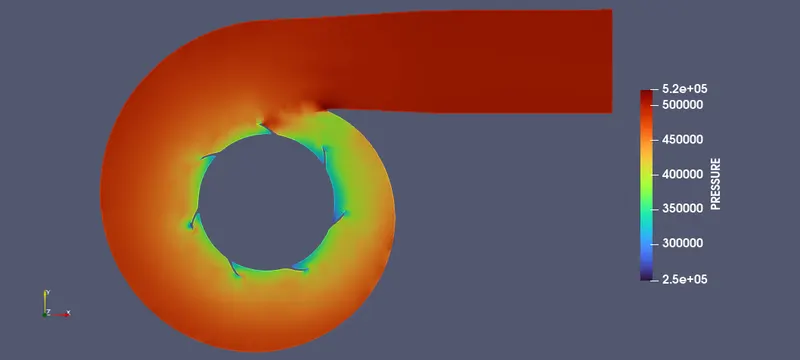
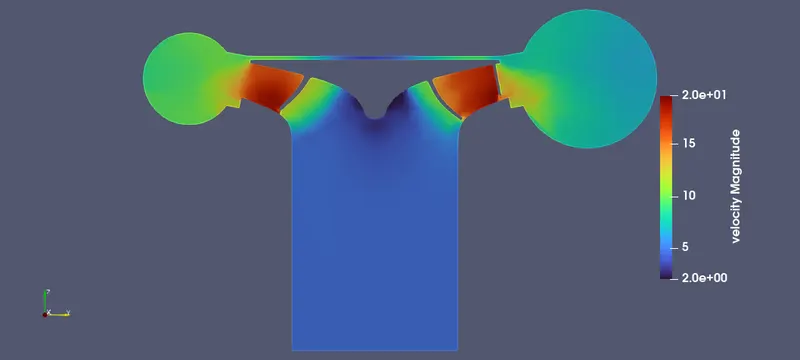
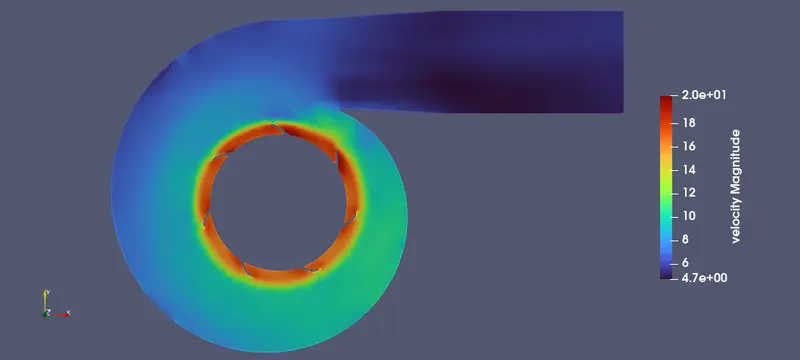
1. Mass flow: 130Kg/s
- Graphs:
- Total Pressure:
- Torque:
- Contours:
1. Total Pressure:
- Velocity Contours:
2. Mass flow: 156Kg/s:
- Graphs:
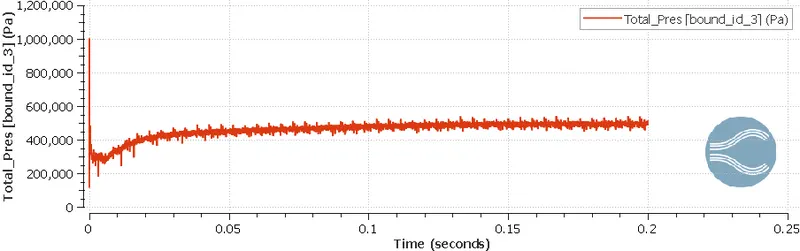
- Total Pressure:
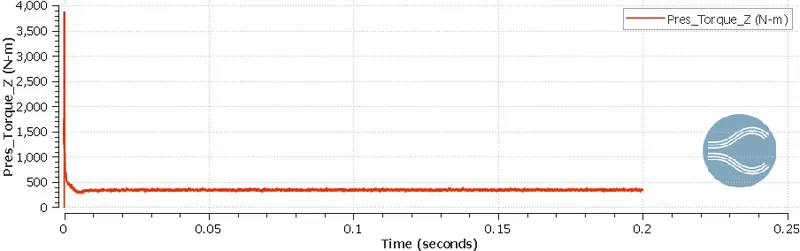
- Torque:
- Contours:
- Pressure contours:
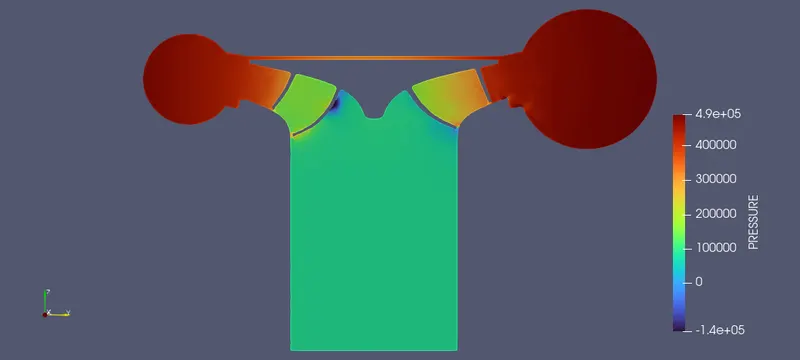
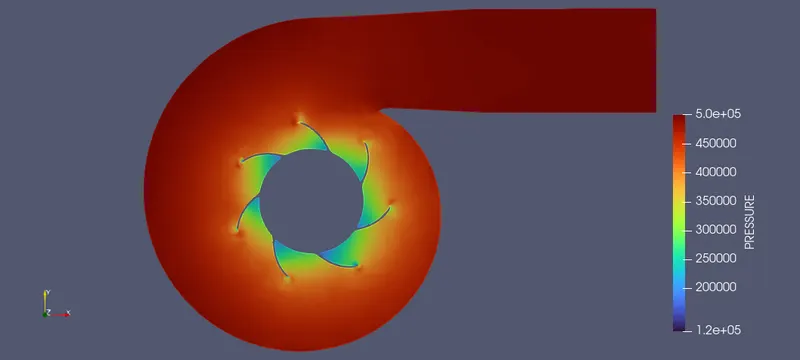
- Velocity contour:
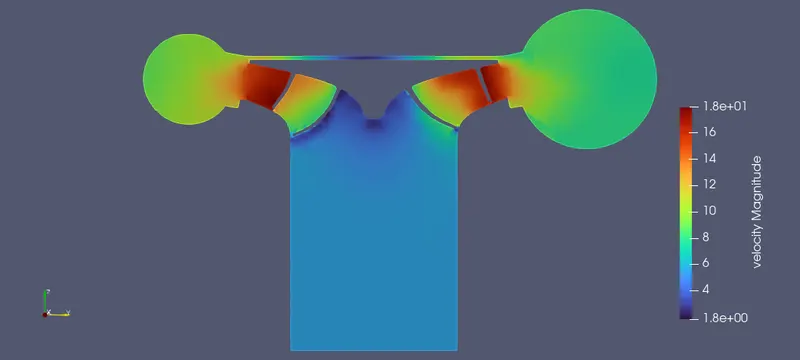
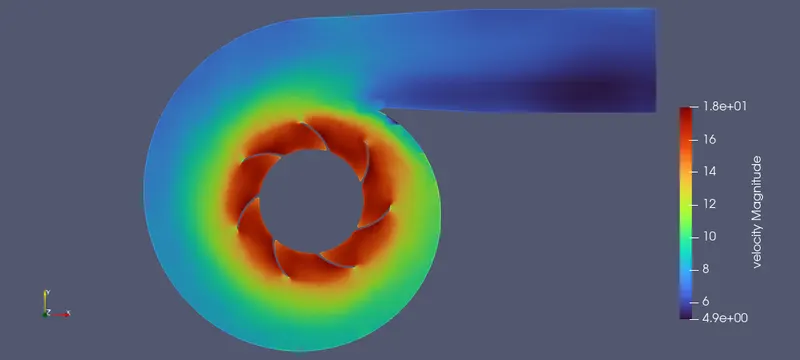
3. Mass flow: 180Kg/s
- Graphs:
- Total Pressure:
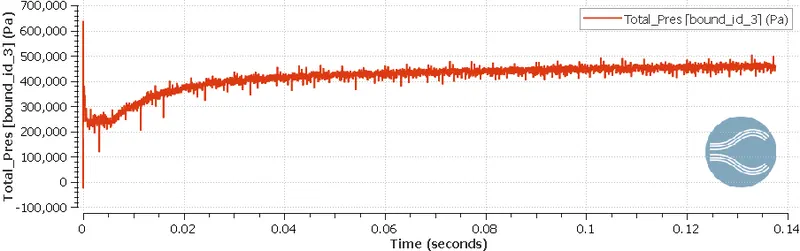
- Torque:
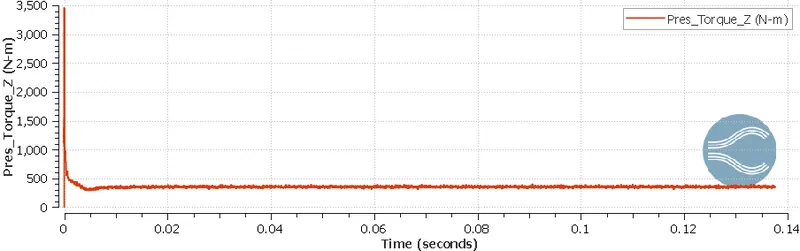
- Contours:
- Pressure Contours:
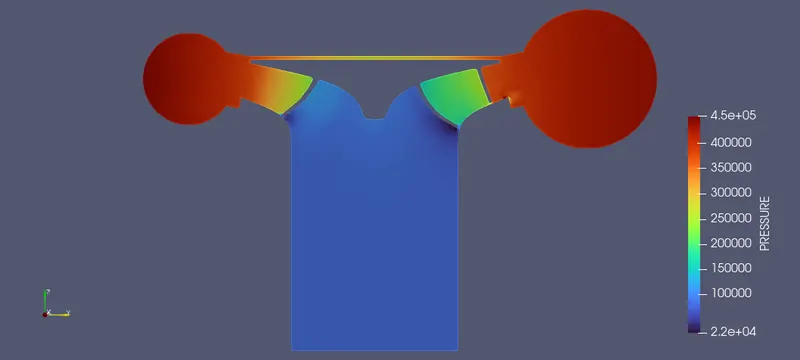
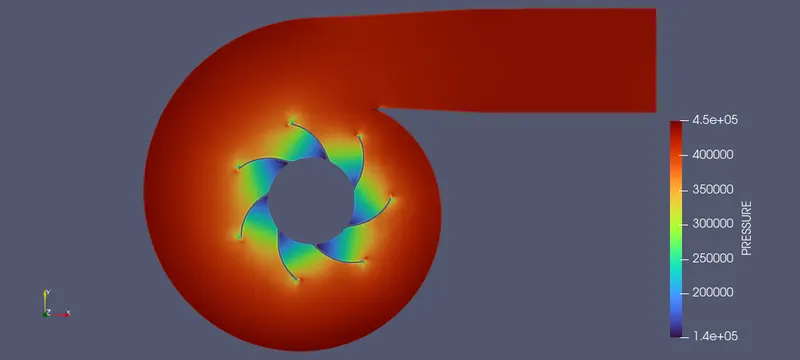
- Velocity contours:
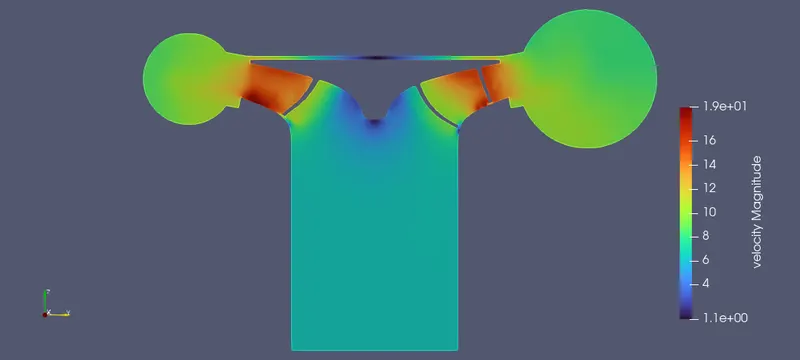
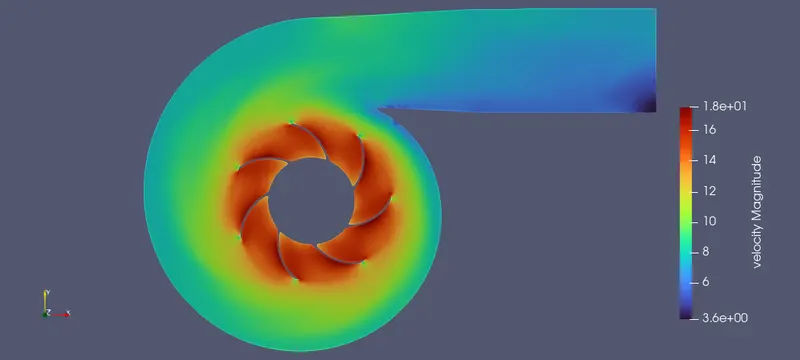
- Calculations:
- Pressure ratio:
| Mass flow rate(Kg/s) | Total pressure at inlet | Total pressure at outlet | Pressure ratio |
| 130 | 101325 | 546337 | 5.39 |
| 156 | 101325 | 501658 | 4.95 |
| 180 | 101325 | 451714 | 4.45 |
- Efficiency: It is defined as the ratio of the power output of the pump to the power input of the pump
P_m = 2`pi`NT/60
| Mass flow rate (Kg/s) | Torque | Impeller speed | Shaft power |
| 130 | 312 | 2000 | 65.94 |
| 156 | 346 | 2000 | 72.42 |
| 180 | 360 | 2000 | 75.38 |
| Mass Flow rate(Kg/s) | Volume flow rate (m3/s) | Pressure head(m) | Hydraulic power (kW) | Shaft power(kW) | pump efficiency |
| 130 | 0.130 | 45.49 | 57.85 | 65.94 | 87.73 |
| 156 | 0.156 | 40.93 | 62.45 | 72.42 | 86.23 |
| 180 | 0.180 | 35.82 | 63.07 | 75.38 | 83.66 |
- Conclusion:
Centrifugal pump simulation was performed.