Week 11- Broadband Noise modelling over Ahmed body
- Aim:
To perform a steady-state external flow simulation over an Ahmed body model. Use of Broadband model to capture the acoustic effects produced due to pressure difference at the surface of the body. Post process the results and justify the solution derived.
- Theory:
1. Ahmed body:
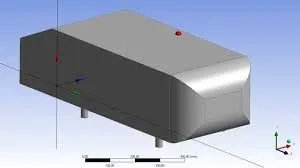
Ahmed body is a generic car body (a simplified car model) i.e the flow of air around the Ahmed body captures the essential flow features around an automobile. The particular goal of this benchmark is to compare the Drag Coefficient, Velocity Profiles, Velocity field, and the time-averaged Wake structure of the simulation results with the real experimental measurement in the wind tunnel.
The airflow around the Ahmed body captures the essential flow features around an automobile and was first defined and characterized in the experimental work of Ahmed [1]. Although it has a very simple shape, Ahmed body allows us to capture characteristic features that are relevant to bodies in the automobile industry.
This model is also used to describe the turbulent flow field around a car-like geometry. Once the numerical model in validated, it is used to design new models of the car.
2. Aeroacoustics:
Aeroacoustics is a branch of acoustics that studies noise generation via either turbulent fluid motion or aerodynamic forces interacting with surfaces. Noise generation can also be associated with periodically varying flows. A notable example of this phenomenon is the Aeolian tones produced by wind blowing over fixed objects.
Although no complete scientific theory of the generation of noise by aerodynamic flows has been established, most practical aeroacoustic analysis relies upon the so-called aeroacoustic analogy, proposed by Sir James Lighthill in the 1950s while at the University of Manchester. whereby the governing equations of motion of the fluid are coerced into a form reminiscent of the wave equation of "classical" (i.e. linear) acoustics in the left-hand side with the remaining terms as sources in the right-hand side.
3. Wave equation:
The wave equation is a second-order linear partial differential equation for the description of waves—as they occur in classical physics—such as mechanical waves (e.g. water waves, sound waves and seismic waves) or light waves. It arises in fields like acoustics, electromagnetics, and fluid dynamics.
Historically, the problem of a vibrating string such as that of a musical instrument was studied by Jean le Rond d'Alembert, Leonhard Euler, Daniel Bernoulli, and Joseph-Louis Lagrange. In 1746, d'Alembert discovered the one-dimensional wave equation, and within ten years Euler discovered the three-dimensional wave equation.

- Simulation setup:
1. Geometry:
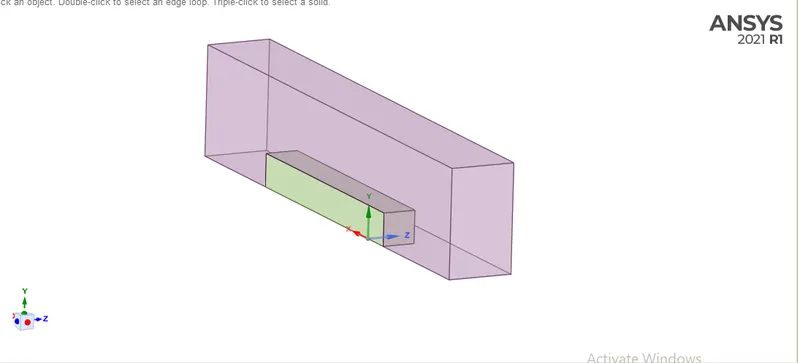
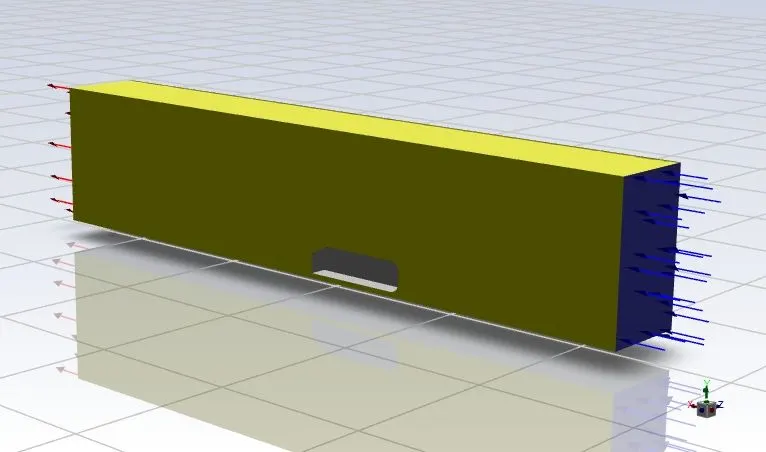
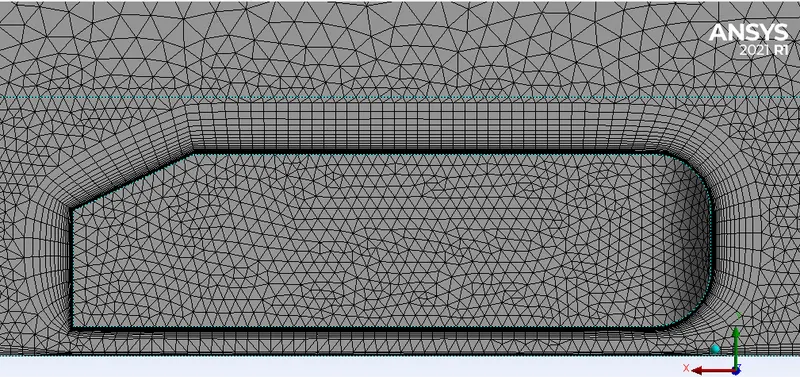
2. Ansys Mesher:
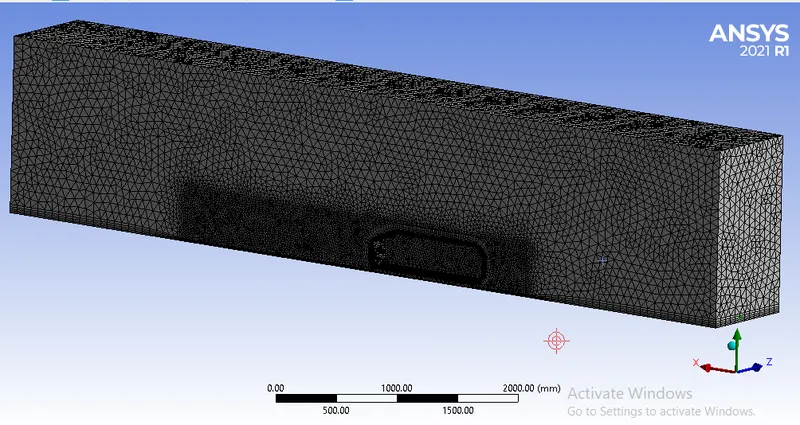
1. Global element size: 70mm
2. Body sizing: 20mm
- Body of influence => choose density body
3. Inflation: Road to upper surface
- Layers: 5, growth rate: 1.2
4. Inflation: Ahmed body to symmetry planes
- First layer height: 0.48mm (calculated for Y+=40 since we are using k-epsilon model)
3. Fluent setup:
- Steady state simulation
- Pressure based
- Material used: fluid: air, Solid: aluminum
- Cell zone: fluid
- Boundary conditons:
1. Inlet: Velocity inlet
Components wise formulation
Velocity in x-direction= 31m/s
2. Road: Wall (moving wall)
Translational motion, speed= 31m/s
3. Outlet: Pressure outlet
0 gauge pressure
- Refernce values:
Aera= front view, rectangle of Ahmed body
i.e, Length X Breadth
=> (1.8x0.297)X(0.297)= 0.10408m^2
Compute from: Inlet
- Report definitions:
Drag co-efficient
Lift co-efficient
- Solution methods and controls:
Coupled solver scheme with second order derivative schemes
Courant no=10
- Calculation time:
1000 iterations
- Results:
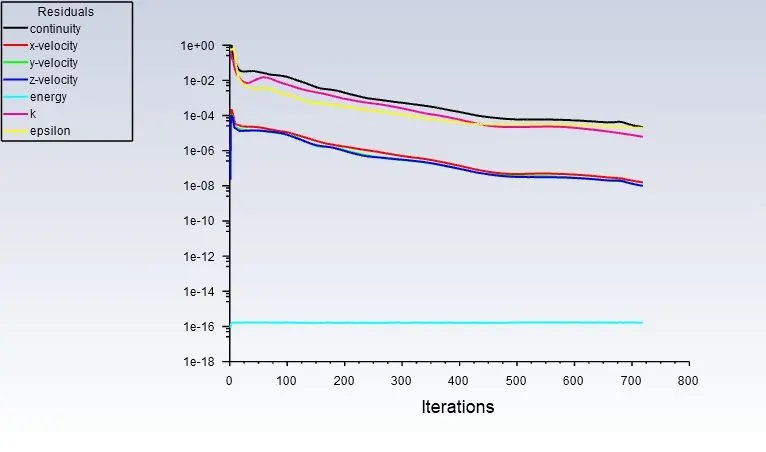
1. Residuals:
2. Drag-coefficient:
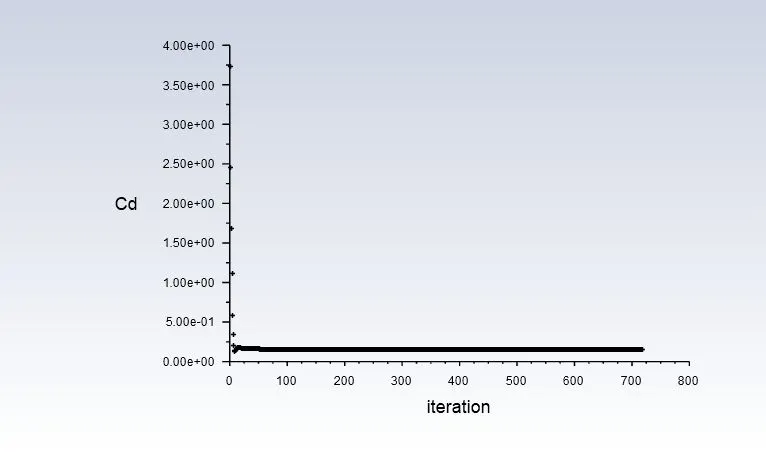
Cd value: 0.15335
3. Lift co-efficient:
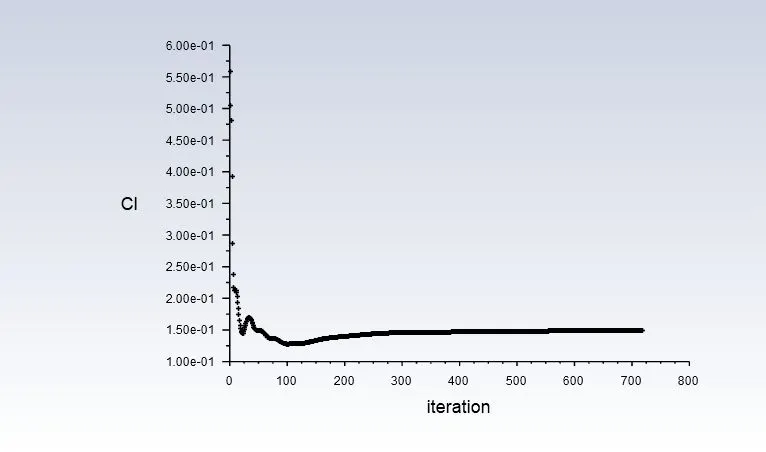
Cl value: 0.148728
4. Velocity contours:
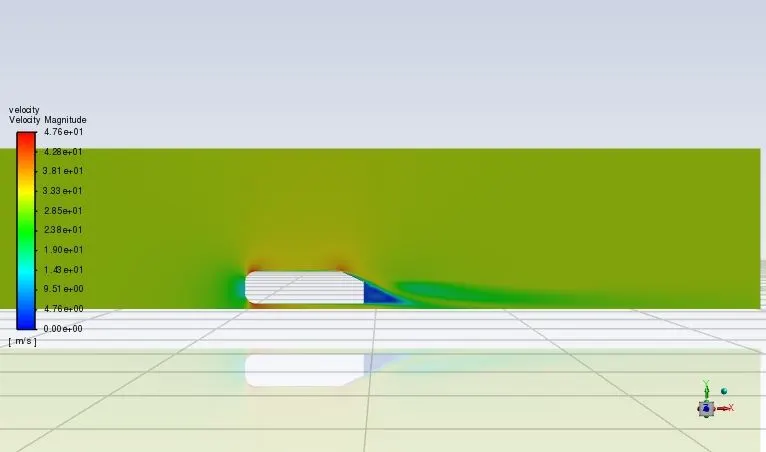
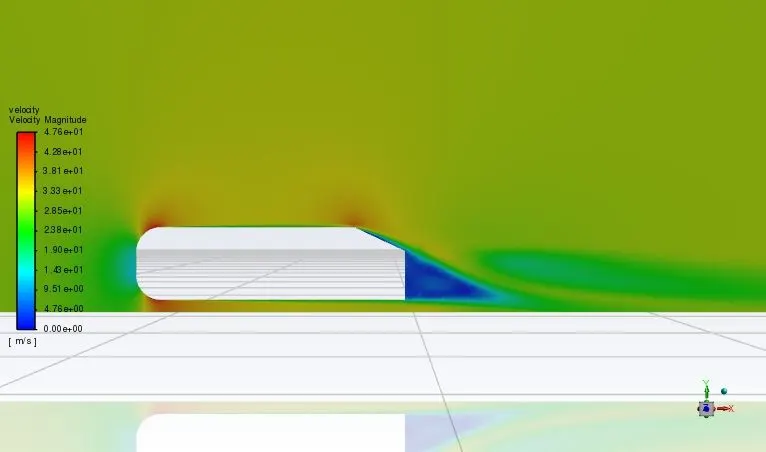
5. Pressure contours:
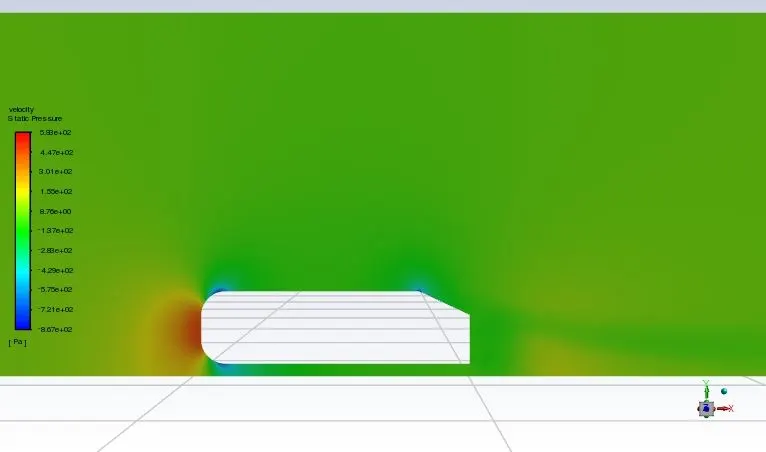
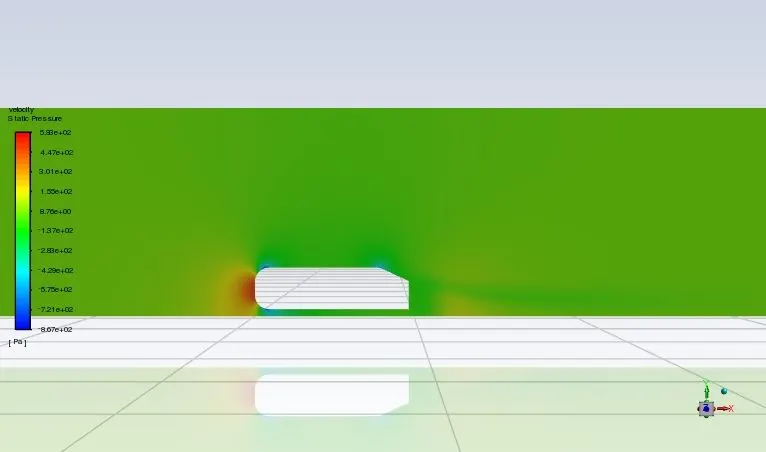
6. Acoustics contours:
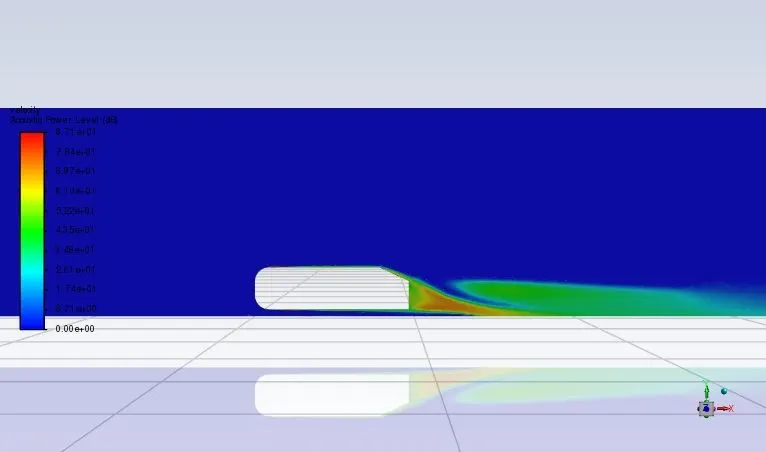
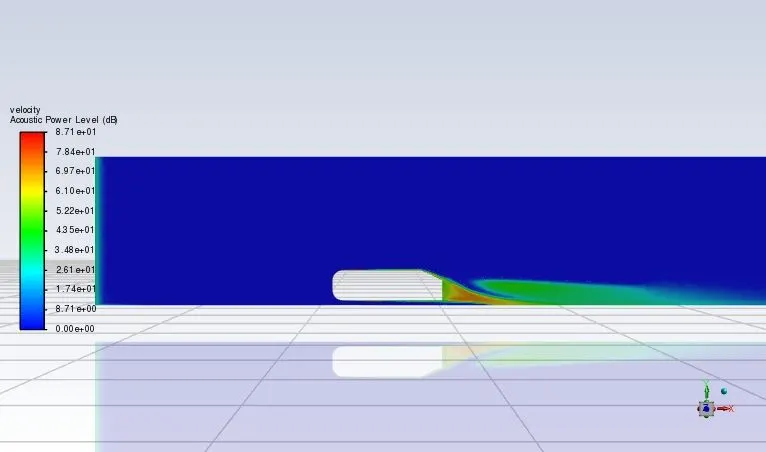
- Acoustic power level:
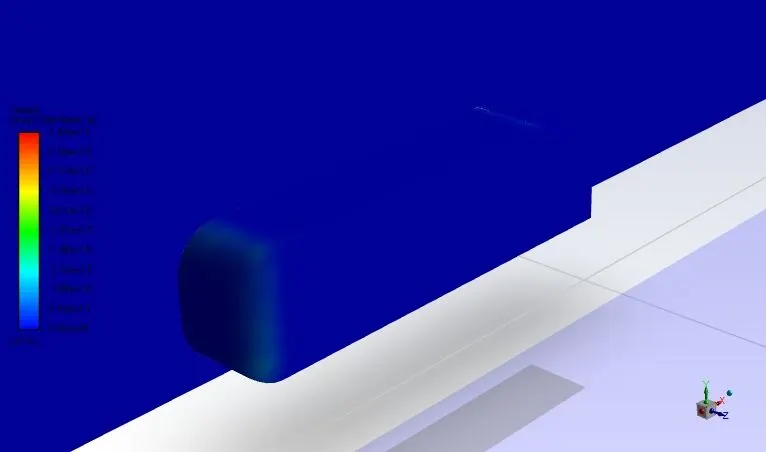
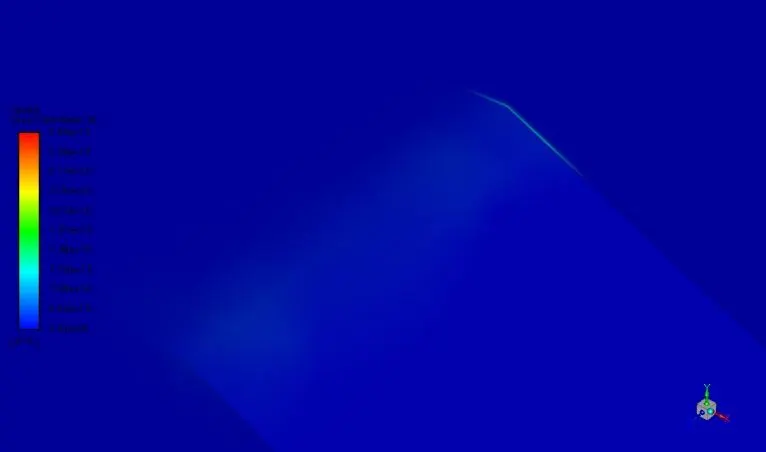
- Lilley's Self Noise source:
- Conclusion:
- Performed external flow simulation over an Ahmed body, using k-epsilon turbulence model. Used Broadband noise model to capture the acoustics effect over the surface of the car.
- A drag co-efficient of 0.15 was achieved for 25 degree slant angle, while lift coefficient of 0.148 was achieved.
- The acoustic power level contour clearly shows that the major acoustic disturbance/generation is found at the wake regions where high vortices are formed and causing large pressure difference developing sound waves.
- 87.1 dB is the max acoustic power level achieved at the wake region.